
Skip to Content
  • Bureaux

    Bureaux

    Amérique du Nord et Amérique du Sud
    • Atlanta
    • Austin
    • Bogota
    • Boston
    • Buenos Aires
    • Chicago
    • Dallas
    • Denver
    • Houston
    • Los Angeles
    • Mexico City
    • Minneapolis
    • Monterrey
    • Montreal
    • New York
    • Rio de Janeiro
    • San Francisco
    • Santiago
    • São Paulo
    • Seattle
    • Silicon Valley
    • Toronto
    • Washington, DC
    Europe, Moyen-Orient et Afrique
    • Amsterdam
    • Athens
    • Berlin
    • Brussels
    • Copenhagen
    • Doha
    • Dubai
    • Dusseldorf
    • Frankfurt
    • Helsinki
    • Istanbul
    • Johannesburg
    • Kyiv
    • Lisbon
    • London
    • Madrid
    • Milan
    • Munich
    • Oslo
    • Paris
    • Riyadh
    • Rome
    • Stockholm
    • Vienna
    • Warsaw
    • Zurich
    Asie et Australie
    • Bangkok
    • Beijing
    • Bengaluru
    • Brisbane
    • Ho Chi Minh City
    • Hong Kong
    • Jakarta
    • Kuala Lumpur
    • Manila
    • Melbourne
    • Mumbai
    • New Delhi
    • Perth
    • Seoul
    • Shanghai
    • Singapore
    • Sydney
    • Tokyo
    Voir tous les bureaux
  • Alumni
  • Presse
  • S’abonner
  • Contacter
  • France | Français

    Sélectionnez votre région et votre langue

    Global
    • Global (English)
    Amérique du Nord et Amérique du Sud
    • Brazil (Português)
    • Argentina (Español)
    • Canada (Français)
    • Chile (Español)
    • Colombia (Español)
    Europe, Moyen-Orient et Afrique
    • France (Français)
    • DACH Region (Deutsch)
    • Italy (Italiano)
    • Spain (Español)
    • Greece (Elliniká)
    Asie et Australie
    • China (中文版)
    • Korea (한국어)
    • Japan (日本語)
  • Saved items (0)
    Saved items (0)

    You have no saved items.

    Bookmark content that interests you and it will be saved here for you to read or share later.

    Explore Bain Insights
  • Expertises Sectorielles
    Menu principal

    Expertises Sectorielles

    • Aerospace et Défense
    • Agroalimentaire
    • Chimie
    • Infrastructures, BTP et Matériaux de Construction
    • Grande Consommation
    • Services Financiers
    • Santé
    • Engins & Equipements Industriels
    • Media et Divertissement
    • Metals
    • Mining
    • Pétrole & Gaz
    • Papier et Emballage
    • Private Equity
    • Secteur Public
    • Distribution
    • Technologie
    • Télécommunications
    • Transportation
    • Travel & Leisure
    • Utilities & Energies Renouvelables
  • Expertises Fonctionnelles
    Menu principal

    Expertises Fonctionnelles

    • Expérience Client
    • ESG
    • Innovation
    • Fusions et Acquisitions
    • Opérations
    • People & Organization
    • Private Equity
    • Sales & Marketing
    • Stratégie
    • IA, Perspectives et Solutions
    • Technology
    • Transformation
  • Digital
  • Points de Vue
  • À propos
    Menu principal

    À propos

    • Notre Activité
    • Nos Valeurs
    • Nos Collaborateurs et Notre Équipe Dirigeante
    • Notre Impact
    • Prix & Récompenses
    • Partenariats Internationaux
    • Evénements
    Further: Our global responsibility
    • Diversité et Inclusion
    • Impact Social
    • Sustainability
    • World Economic Forum
    Learn more about Further
  • Carrières
    Menu principal

    Carrières

    • Rejoignez-nous
      Carrières
      Rejoignez-nous
      • Find Your Place
      • Nos domaines d’expertise
      • Equipes multidisciplinaires
      • Étudiants
      • Stages et programmes
      • Événements de recrutement
    • La vie chez Bain
      Carrières
      La vie chez Bain
      • Blog: Inside Bain
      • Récits de carrière
      • Nos collaborateurs
      • Nos bureaux
      • Soutenir votre évolution professionnelle
      • Groupes d’affinités
      • Avantages chez Bain
    • Histoires d’impact
    • Notre processus de recrutement
      Carrières
      Notre processus de recrutement
      • Ce que vous pouvez attendre
      • Entretiens
    Trouver un poste
  • Bureaux
    Menu principal

    Bureaux

    • Amérique du Nord et Amérique du Sud
      Bureaux
      Amérique du Nord et Amérique du Sud
      • Atlanta
      • Austin
      • Bogota
      • Boston
      • Buenos Aires
      • Chicago
      • Dallas
      • Denver
      • Houston
      • Los Angeles
      • Mexico City
      • Minneapolis
      • Monterrey
      • Montreal
      • New York
      • Rio de Janeiro
      • San Francisco
      • Santiago
      • São Paulo
      • Seattle
      • Silicon Valley
      • Toronto
      • Washington, DC
    • Europe, Moyen-Orient et Afrique
      Bureaux
      Europe, Moyen-Orient et Afrique
      • Amsterdam
      • Athens
      • Berlin
      • Brussels
      • Copenhagen
      • Doha
      • Dubai
      • Dusseldorf
      • Frankfurt
      • Helsinki
      • Istanbul
      • Johannesburg
      • Kyiv
      • Lisbon
      • London
      • Madrid
      • Milan
      • Munich
      • Oslo
      • Paris
      • Riyadh
      • Rome
      • Stockholm
      • Vienna
      • Warsaw
      • Zurich
    • Asie et Australie
      Bureaux
      Asie et Australie
      • Bangkok
      • Beijing
      • Bengaluru
      • Brisbane
      • Ho Chi Minh City
      • Hong Kong
      • Jakarta
      • Kuala Lumpur
      • Manila
      • Melbourne
      • Mumbai
      • New Delhi
      • Perth
      • Seoul
      • Shanghai
      • Singapore
      • Sydney
      • Tokyo
    Voir tous les bureaux
  • Alumni
  • Presse
  • S’abonner
  • Contacter
  • France | Français
    Menu principal

    Sélectionnez votre région et votre langue

    • Global
      Sélectionnez votre région et votre langue
      Global
      • Global (English)
    • Amérique du Nord et Amérique du Sud
      Sélectionnez votre région et votre langue
      Amérique du Nord et Amérique du Sud
      • Brazil (Português)
      • Argentina (Español)
      • Canada (Français)
      • Chile (Español)
      • Colombia (Español)
    • Europe, Moyen-Orient et Afrique
      Sélectionnez votre région et votre langue
      Europe, Moyen-Orient et Afrique
      • France (Français)
      • DACH Region (Deutsch)
      • Italy (Italiano)
      • Spain (Español)
      • Greece (Elliniká)
    • Asie et Australie
      Sélectionnez votre région et votre langue
      Asie et Australie
      • China (中文版)
      • Korea (한국어)
      • Japan (日本語)
  • Saved items  (0)
    Menu principal
    Saved items (0)

    You have no saved items.

    Bookmark content that interests you and it will be saved here for you to read or share later.

    Explore Bain Insights
  • Expertises Sectorielles
    • Expertises Sectorielles

      • Aerospace et Défense
      • Agroalimentaire
      • Chimie
      • Infrastructures, BTP et Matériaux de Construction
      • Grande Consommation
      • Services Financiers
      • Santé
      • Engins & Equipements Industriels
      • Media et Divertissement
      • Metals
      • Mining
      • Pétrole & Gaz
      • Papier et Emballage
      • Private Equity
      • Secteur Public
      • Distribution
      • Technologie
      • Télécommunications
      • Transportation
      • Travel & Leisure
      • Utilities & Energies Renouvelables
  • Expertises Fonctionnelles
    • Expertises Fonctionnelles

      • Expérience Client
      • ESG
      • Innovation
      • Fusions et Acquisitions
      • Opérations
      • People & Organization
      • Private Equity
      • Sales & Marketing
      • Stratégie
      • IA, Perspectives et Solutions
      • Technology
      • Transformation
  • Digital
  • Points de Vue
  • À propos
    • À propos

      • Notre Activité
      • Nos Valeurs
      • Nos Collaborateurs et Notre Équipe Dirigeante
      • Notre Impact
      • Prix & Récompenses
      • Partenariats Internationaux
      • Evénements
      Further: Our global responsibility
      • Diversité et Inclusion
      • Impact Social
      • Sustainability
      • World Economic Forum
      Learn more about Further
  • Carrières
    Recherches les plus fréquentes
    • Agile
    • Digital
    • Stratégie
    Vos recherches précédentes
      Pages récemment visitées

      Content added to saved items

      Saved items (0)

      Removed from saved items

      Saved items (0)

      Etude

      IT in M&A: Increasing the Odds of a Successful Integration

      IT in M&A: Increasing the Odds of a Successful Integration

      Leaders focus on making new opportunities happen, while planning for long-term savings.

      Par Sachin Shah, Marc Lino and Vishy Padmanabhan

      • min

      Etude

      IT in M&A: Increasing the Odds of a Successful Integration
      en

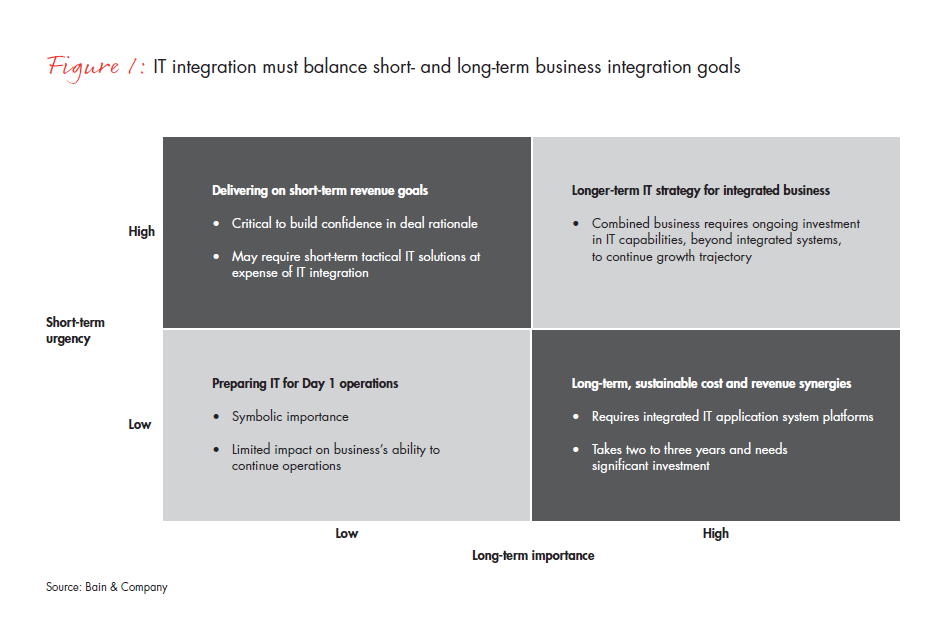
      In every merger or acquisition, companies integrating their IT systems face two conflicting needs. The business wants to start cross-selling the products and services of the newly combined organization as quickly as possible to increase revenues. IT, taking a longer-term view, wants to invest the time and effort to integrate the combined organization’s systems effectively. Both goals are critical to merger success—and the sooner they happen, the quicker IT can begin generating incremental value for the new business (see Figure 1).

      it-in-m-andd-a-increasing-the-odds-fig-01_embed

      But too often, executives lose valuable time in the early weeks and months after a deal completes by taking too long to decide on critical issues, such as which platforms the new organization will run on and the best approach to IT integration. Often they focus on the wrong issues, including lower-priority projects like merging email, intranets or other systems that could continue to run independently or with patched connections without slowing down the new business. 

      In successful IT integrations, executives work quickly to determine which decisions are most important, and how to make those decisions quickly. This reduces uncertainty about how the company will integrate its platforms and what the end state will look like. 

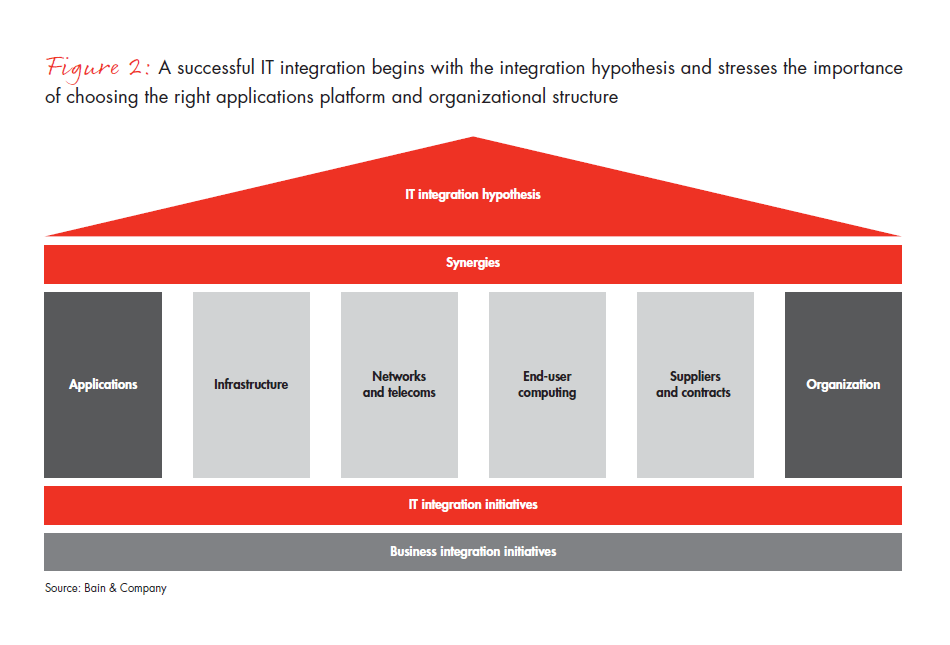
      • By the end of the first month, they should have a clear idea of the company’s IT integration goals and hypothesis (see Figure 2).
      • At the end of three months, they should know the shape and makeup of the future integrated application systems platforms, as well as how much they will need to invest and where they will get the resources. By this time, they should also know where integration is most important, which systems can continue to run independently and where interface connections are good enough for a while. They should also have defined the benefits they expect and how to manage the implementation risks.
      • After the first year, the integrated systems should be delivering at least half the value in cost and revenue synergies, as envisioned by the merger deal thesis. Full integration should be completed within two or three years.

      Getting this right is more important than ever, as low interest rates and abundant capital spur more M&A activity. The rewards are worth the effort: Bain’s research finds that companies that take part in M&A deliver higher total shareholder returns (4.8%) than those that stay on the sidelines (3.3%). (For more details, see the Bain Brief “The renaissance in mergers and acquisitions: The surprising lessons of the 2000s.”) Given IT’s critical role in determining whether mergers deliver their expected value, the key strategic decisions belong not only to IT executives but also to CEOs and other senior executives. Ideally, senior IT executives should make the recommendations and then work with the CEO and other senior managers to make decisions. The governance model of the post-merger organization will also help determine who makes those decisions. When one dominant partner is acquiring another, decision making tends to be easier (and quicker) than in a merger of equals.

      it-in-m-andd-a-increasing-the-odds-fig-02_embed

      Defining the goals of integration

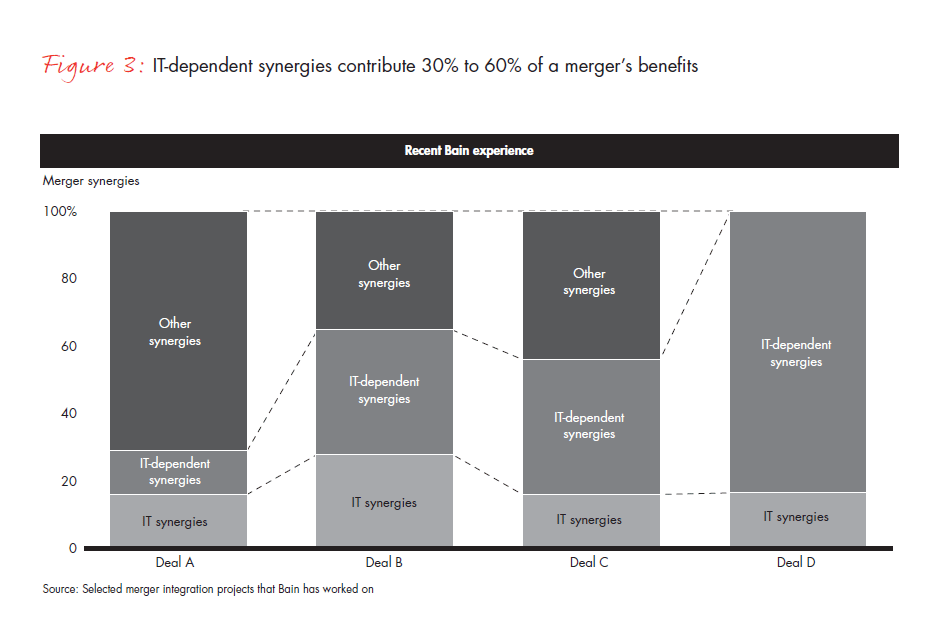
      The first step in a successful merger of IT organizations— one that is often overlooked—is to determine IT’s role in supporting the deal thesis. This important first decision clarifies the business value that IT will contribute to the merger (see Figure 3). Once the business integration principles are clear, they create a solid foundation on which to make other decisions.

      it-in-m-andd-a-increasing-the-odds-fig-03_embed

      With the business integration goals clear, the team can decide on the platform that best equips the company for future success—whether that’s using one company’s systems, employing a hybrid mix from both or continuing to run each company’s systems independently. With that decision made, others about infrastructure, organization, suppliers and outsourcing become easier to make.

      The merger of Kraft Foods and Cadbury in 2010 shows how answering the right questions promptly can help ensure a successful integration. One of the most compelling opportunities of the merger was the potential to cross-sell each company’s products through the other’s distribution channels. Kraft Foods was strong in food and snacks in North America and Europe, while Cadbury had a solid customer base for its confectionary products in Europe, India, Australia and other Commonwealth countries. To cross-sell, the company needed one platform. Kraft Foods had spent several years consolidating its systems and was heading toward a position of having three regional platforms—in North America, Europe and Asia-Pacific. Cadbury had a more distributed application platform footprint with 15 key platforms and a goal of consolidating down to nine. Executives decided to move all of Cadbury’s business to Kraft Food’s platforms because they were more modern and supported multiple operating models, and Kraft Foods was twice the size of Cadbury. Kraft Foods also had a good track record of consolidating and implementing its systems. Within a year, the combined company had achieved half of its intended integration synergies, and the entire IT integration was completed within three years.

      Sachin Shah, a partner in Bain's Information Technology practice, outlines four things an organization needs to get right for a successful IT integration project.

      Traits of successful integration

      In addition to starting with the right questions and adopting a clear understanding of the goals, successful mergers share several other pragmatic principles that help ensure a successful IT integration in the days and months after companies merge.

      • Focus on revenues. Many companies focus on cost savings right after a merger, but their first obligation should be to pursue new revenues, even if that means running two IT systems independently for a while. The upside of cross-selling combined products and services across both companies’ customer bases often far outstrips cost savings. In most airline mergers, for example, revenue synergies are a bigger target than cost savings. So it makes sense to quickly choose the reservation system that best suits customers’ needs and create value from selling each airline’s routes to both customer bases.
      • Act fast to support business goals. IT executives often want to pick and choose the best of breed from each organization’s application systems. But the costs of selecting and reconnecting these systems may outweigh the benefits to be gained. A more pragmatic strategy is to pick the best anchor system—reservations, for example, with an airline—and then consider living with the auxiliary systems that are tied to it. As integration continues, executives will want to weigh the value of changing those systems against the costs.
      • Prioritize ruthlessly. Align decisions with the business goals, and execute quickly and decisively. Leaders don’t shy away from cutting large projects that are no longer essential, even when it’s painful to project owners. When one beer company acquired another, it stopped a multimillion-dollar CRM project that was well under way, because it wasn’t needed in the combined company.
      • Hold on to talent. People experience a lot of uncertainty and anxiety during a merger, so it’s more important than ever for senior managers to actively communicate with top talent. Good people may leave during the integration if they think the deal could limit their futures. In one merger, IT executives in the company being acquired were actively looking for new job opportunities, since they thought they would be redundant in the new company. They didn’t realize that the acquirer was actually glad to have the chance to replace some of its own staff with new talent from the company being acquired. When the acquiring company learned what was happening, managers gave incentives to top talent so they would stay in the newly merged organization.

      Beyond the merger

      One of the risks inherent in mergers is that, with everyone focused on integration, the IT department can get derailed from its longer-term journey, which depends on developing technologies that support the company’s growth ambitions. It may be helpful to assign a team to look specifically at opportunities beyond the merger and to continue developing applications in line with the new company’s IT strategy, as well as to experiment with new technologies that may contribute to future growth, such as advanced data analytics or cloud computing.

      It is also important to set boundaries that signal an explicit transition from merger integration back to business. Change will no doubt continue, but at some point, the emphasis switches from integration to transformation, allowing the newly merged company to move forward as a single, integrated venture.

      Sachin Shah is a partner with Bain & Company in London. Marc Lino is a Bain partner in Amsterdam, and Vishy Padmanabhan is a partner in Bain’s Dallas office. All three partners work with Bain’s Global Information Technology practice.


      Auteurs
      • Headshot of Sachin Shah
        Sachin Shah
        Associé, London
      • Headshot of Marc Lino
        Marc Lino
        Associé, Dubai
      • Vishy Padmanabhan
        Former Partner, New York
      Contactez-nous
      Expertises fonctionnelles transverses
      • Fusions et Acquisitions
      • Post-Merger Integration
      • Technologies de l'information
      Fusions et Acquisitions
      Integrating cultures after a merger

      Practical tools for measuring cultural differences—and for managing the challenge of combining two organizations.

      Voir plus
      Fusions et Acquisitions
      The renaissance in mergers and acquisitions: What to do with all that cash?

      Several macro trends will combine to make M&A essential for profitable growth this decade.

      Voir plus
      Technologie
      How to Keep Control of an IT System That's Outsourced to Multiple Suppliers

      To master increasingly complex IT, companies are turning to multiple suppliers. But that strategy creates another risk: loss of control over mission-critical functions.

      Voir plus
      Technologies de l'information
      In M&A, Successful Acquirers Master Process and Systems Integration

      Bain Partner Laurent Hermoye outlines five core elements that can make or break deal value.

      Voir plus
      Fusions et Acquisitions
      Media M&A

      AI and other tech tools can boost bidding confidence in this highly competitive environment.

      Voir plus
      First published in février 2014
      Mots clés
      • Fusions et Acquisitions
      • Post-Merger Integration
      • Technologies de l'information

      Comment nous avons aidé nos clients

      Amélioration de la Performance Aggressively growing an IT service provider with a high-performance culture

      Lire l’étude de cas

      Fusions et Acquisitions An OFS captures post-merger growth synergies

      Lire l’étude de cas

      Stratégie Client et Marketing Salesforce integration generates M&A success in healthcare

      Lire l’étude de cas

      Vous souhaitez continuer cette conversation ?

      Nous aidons des dirigeants du monde entier à matérialiser des impacts et des résultats pérennes et créateurs de valeur dans leurs organisations.

      Les points de vue de Bain : notre perspective sur des problématiques auxquelles sont confrontées les entreprises à travers le monde, envoyés chaque mois dans votre boîte de réception. 

      *J’ai lu la politique de confidentialité et j’accepte les conditions.

      Merci de lire notre politique de confidentialité.
      Bain & Company
      Contactez-nous Sustainability Accessibility Conditions d’utilisation Politique de Confidentialité Cookie Policy Mentions Légales Sitemap Log In

      © 1996-2026 Bain & Company, Inc.

      Contacter Bain

      Comment pouvons-nous vous aider ?

      • Business inquiry
      • Career information
      • Press relations
      • Partnership request
      • Speaker request
      Voir tous les bureaux