

Etude

En Bref
- Companies that develop a repeatable model for frequent and material M&A consistently deliver higher shareholder returns than competitors that are less adept at acquisitions.
- One of the most critical ingredients for successful M&A is a differentiated ability to integrate business processes and related systems effectively. Based on our research, 70% of process and systems integrations fail in the beginning, not in the end.
- Working with the highest-performing acquirers, we have identified the six key areas in which these companies excel. For example, proper IT integration requires investments that many companies fail to make, leading to complexity and spiraling costs down the line. That’s why the best companies carefully reevaluate preclose systems integration cost estimates—and appropriately allocate the necessary resources and budgets.
Our extensive research over the past two decades of M&A has uncovered one enduring truth: A repeatable M&A capability, developed through consistent M&A activity over various economic cycles, contributes to higher shareholder returns. This finding holds up year after year, across industries.
We tracked more than 1,700 companies over a 10-year period and found that the average company gained an annual total shareholder return (TSR) of 6.9%. However, companies that acquired frequently and developed the capabilities to do larger deals did substantially better, achieving a 9.2% TSR. Without doubt, deal success and failure are more a matter of cumulative experience and capability in doing deals, and less a function of standalone deal circumstances.
Studying serial acquirers has shown us how a repeatable M&A capability usually results from a differentiated ability to integrate business processes and related systems effectively—it’s a key ingredient in AB InBev’s winning deal recipe, for example. Indeed, IT integration done right, with the appropriate investments of resources and budget, builds a better platform for future growth through repeatable acquisitions. Companies can integrate those acquisitions, prepare for digital transformation, enable synergies and maintain lower ongoing costs. As deals become more complex, IT integration only gains in importance.
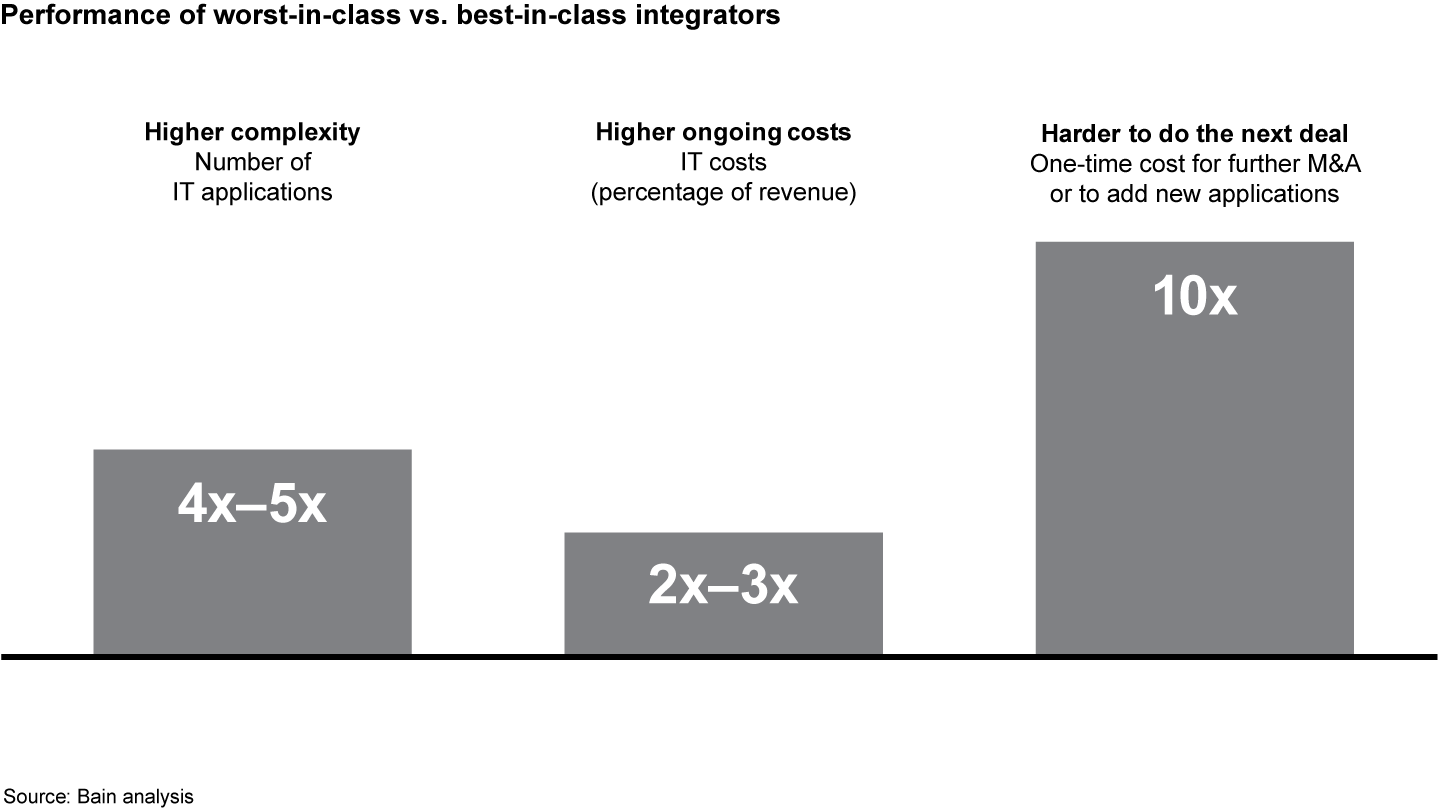
Unfortunately, it’s also an area of integration that we see is often under-resourced and in which costs can spiral quickly, making or breaking the deal value—and making it harder to do the next deal. The worst performers in our research are burdened with four to five times the number of applications as the best performers, and two to three times higher IT costs (as a percentage of revenues). They also found it 10 times more costly to do the next deal or add new applications (see Figure 1). Those higher costs can offset synergy gains.
Figure 1

In addition, executives often lose valuable time in the early weeks and months after a deal completes by taking too long to decide on critical issues, such as which platforms the new organization will run on and the best approach to IT integration. Often they focus on the wrong issues, including lower-priority projects like merging email, intranets or other systems that could continue to run independently or with patched connections without slowing down the new business.
Some companies manage to develop repeatable IT integration capabilities that become a competitive advantage, year after year. Working with the highest-performing acquirers, we have identified the six key areas in which these companies excel.

Mastering Process and Systems Integration After a Merger
The best-performing acquirers have a repeatable integration capability that gives them a competitive advantage.
1. Align IT integration thesis to guide the integration effort
Based on our research, 70% of process and systems integrations fail in the beginning, not in the end. Inadequate IT integration hypothesis and execution are the top reasons for that failure. A hypothesis needs to help a company determine whether to choose one set of systems, a mix of both systems or completely separate systems. A typical answer: a systems spine consisting of the core transaction processing system (e.g., ERP, Core Banking System, etc.), finance processes and master data is selected from either the acquirer or target based on future fit, enabling one company to migrate to the other company’s systems. Beyond that, the acquirer chooses the best systems from either company. This usually is the cheapest and fastest approach to integration. For instance, in a recent insurance merger, the IT integration thesis called for adopting the systems spine of one company to enable easier migration of the core systems. For digital and other differentiating capabilities (for instance, data analytics and robotic process automation), however, a best-of-breed approach was adopted from either company.
2. Integrate processes and systems with speed
We see the best acquirers move quickly when integrating to a single set of systems. They reduce the talent loss and distraction from extended integration periods and they capture synergies earlier. Speed matters a lot. In fact, according to our estimates, more than half of business synergies are often contingent on systems integration. Faster systems integration enables faster realization of those revenue and cost synergies and earlier introduction of new technological capabilities, as well as the ability to present a single face to the customer earlier. We see the most successful acquirers complete about half of the systems integration within the first year of closing and the remaining half within two to three years of closing. It takes much longer for those that lack a disciplined, systematic and repeatable approach.
3. Appropriately allocate resources and budget
Proper IT integration requires investments that many companies fail to make, leading to complexity and spiraling costs down the line. Faster integrations may demand higher initial investments—but companies also need to ensure that their investment is appropriate and affordable.
We’ve seen that even when companies make the necessary investment, the huge estimates for systems integration costs are further overrun by 20% to 50%. Indeed, companies need to reevaluate preclose systems integration cost estimates. For example, in two large-scale acquisitions in the consumer products industry, we found that there were opportunities for 40% to 50% cost reductions on systems integration cost estimates without any impact on value delivery.
4. Protect digital agenda while advancing integration
Digital transformation is front and center on the IT agenda for most companies. Companies need to forget the old “integrate first/then optimize” mantra. Digital transformation needs to be part of the integration—it spells the difference between winning and losing the digital race. The objective is to find a way to advance the transformation without compromising the IT integration. In our experience, the best acquirers make it a priority to protect resources for both.
5. Adopt best of both IT talent, with consideration for transition needs
Quality IT talent is among the most in-demand and hardest to find. Regardless of the integration approach adopted, talent selection should be the best of both and not depend on the systems selected. Companies also need to choose based on the short- and medium-term requirements for the integration itself, retaining the must-have talent for specific systems to ensure smooth migration. It’s also important to “front-load” resources. Assuming deployment will be big is a way to accelerate delivery. Meanwhile, dedicated firefighter teams enable companies to solve unexpected “fix-now” issues. Also, colocation of the integration team is critical for success.
6. Reassess IT approach and costs at the time of integration
IT integration costs and, more broadly, IT operating costs are constantly rising, as companies need to invest in new capabilities and deal with mounting technical debt. Many companies use traditional approaches in due diligence when setting IT cost targets by basing them on historical benchmarks. At times, the need for regulator-mandated remedies (e.g., divesting businesses to address competition concerns) often complicates and drives up one-time IT integration costs. These are typically not accounted for at the due diligence stage. Those one-time costs can be so high that they can affect the P&L for years.
We believe historic benchmarks do not reflect the current reality of the structurally rising IT costs resulting from digital transformation efforts and other transactional complexities. As such, integration and transformation initiatives cannot be viewed separately and require a combined roadmap and business case to avoid cost surprises down the line. Getting the full roadmap and cost targets right means greater scrutiny at the time of diligence. Fact is, once the deal is done, it is too late.
Bain Partner Laurent Hermoye discusses the benefits of mastering best-in-class practices for integrating acquired companies.
Putting it all together
To see these principles in action, consider the merger of First Gulf Bank and National Bank of Abu Dhabi to form the United Arab Emirates’ largest bank and one of the top five in the Middle East, with a market capitalization of around $30 billion at the time of the merger announcement. While the banks were erstwhile competitors operating with similar product portfolios and complementary market positions, there were significant differences in how each bank operated. This was also an integration involving two large, full-service universal banks, adding tremendous complexity to the overall integration, particularly process and systems integration. Neither bank had done a merger of this scale nor a systems integration of this nature.
First Abu Dhabi Bank, or FAB as it is now known, adopted the best-in-class principles, ultimately delivering full IT integration within 20 months compared with an initial timeline of 24 months (and the minimum 36 months it takes for most acquirers in banking). This gave the bank significant advantages. It moved to business as usual much earlier than would otherwise be possible. In one of the business units, systems integration was complete in nine months, allowing for an even faster return to regular business operations.
Let’s look at some of the ways that this was made possible.
A clearly defined integrated business footprint and as-is IT fact base for both organizations informed the options and potential choices for the IT integration thesis for the combined entity. This included evaluating options to adopt systems from either company, take best of both or adopt new solutions for key IT components. The decision was made to migrate to the systems of one of the banks and add in systems from the other bank only where there were gaps. Instead of a time-consuming bottom-up approach, the integration leaders invested the time up front to align top management on the IT integration thesis and guiding principles. The move was critical to get a head start and avoid roadblocks later.
The up-front guiding principles spelled out the need for a speedy integration to enable a single face to the customer and operations as one bank, with full integration within 24 months. A number of other decisions supported this goal—the decision to migrate first, add capabilities later; fix go-live dates early; minimize additional in-flight projects and requests for additional capabilities; and adequately allocate resources toward the integration effort.
Senior management aligned on the IT integration thesis within six weeks of integration kickoff, with broad buy-in. Within three months, they confirmed the thesis and highlighted any gaps in understanding before moving on to the detailed planning. Detailed integration planning before day one enabled integration teams to be ready to start implementation soon after close and to complete the full integration effort in record time.
Recent trends in M&A are likely to increase the complexity and choices for acquirers
Our study of the top 250 deals of 2018 worldwide found that for the first time ever, the number of scope deals now outnumber scale deals. Instead of pursuing scale synergies of the sort sought by First Abu Dhabi Bank, more companies are turning to M&A to find new markets, new geographies and new digital capabilities to help them grow amid mounting industry disruption.
At first blush, scope deals may require less process and systems integration, with fewer synergies impacted and fewer overlapping processes. Given the required link to the operating model, however, these deals actually bring far more options to the table. Determining the right process and systems solution means answering many questions. For example, Will the acquired business be kept separate or fully integrated? What functions will be shared across both businesses? What distinguishing systems or technology in one business can be applied to the other?
To help answer these questions, companies need to make a distinction between the approach for integrating business-specific and customer-facing systems. Some business support systems can be shared. Even if you don’t integrate any of the systems, you might be able to use the capability from one company in the other, accelerating the deployment of those capabilities in both companies. You could move to shared infrastructure, network and end-user capabilities.
More companies are using M&A to gain such digital capabilities— everything from advanced analytics to cloud computing to security to agile development. In fact, the share of capability-driven M&A in strategic deals has mushroomed from 2% in 2015 to 15% in 2018. For these companies, the big question becomes, how quickly can you adopt the capability from one company to the other? The most successful acquirers will be those that realize you can get more value when you integrate faster.
Sachin Shah is a Bain & Company partner based in London, and Laurent Hermoye is a partner based in Brussels. Both are members of Bain’s Mergers & Acquisitions practice.
First published in juin 2019