
Skip to Content
  • Offices

    Offices

    North & Latin America
    • Atlanta
    • Austin
    • Bogota
    • Boston
    • Buenos Aires
    • Chicago
    • Dallas
    • Denver
    • Houston
    • Los Angeles
    • Mexico City
    • Minneapolis
    • Monterrey
    • Montreal
    • New York
    • Rio de Janeiro
    • San Francisco
    • Santiago
    • São Paulo
    • Seattle
    • Silicon Valley
    • Toronto
    • Washington, DC
    Europe & Africa
    • Amsterdam
    • Athens
    • Berlin
    • Brussels
    • Copenhagen
    • Dusseldorf
    • Frankfurt
    • Helsinki
    • Istanbul
    • Johannesburg
    • Kyiv
    • Lisbon
    • London
    • Madrid
    • Milan
    • Munich
    • Oslo
    • Paris
    • Rome
    • Stockholm
    • Vienna
    • Warsaw
    • Zurich
    Middle East
    • Doha
    • Dubai
    • Riyadh
    Asia & Australia
    • Bangkok
    • Beijing
    • Bengaluru
    • Brisbane
    • Ho Chi Minh City
    • Hong Kong
    • Jakarta
    • Kuala Lumpur
    • Manila
    • Melbourne
    • Mumbai
    • New Delhi
    • Perth
    • Seoul
    • Shanghai
    • Singapore
    • Sydney
    • Tokyo
    See all offices
  • Alumni
  • Media Center
  • Subscribe
  • Contact
  • Global | English

    Select your region and language

    Global
    • Global (English)
    North & Latin America
    • Brazil (Português)
    • Argentina (Español)
    • Canada (Français)
    • Chile (Español)
    • Colombia (Español)
    Europe, Middle East, & Africa
    • France (Français)
    • DACH Region (Deutsch)
    • Italy (Italiano)
    • Spain (Español)
    • Greece (Elliniká)
    Asia & Australia
    • China (中文版)
    • Korea (한국어)
    • Japan (日本語)
  • Saved items (0)
    Saved items (0)

    You have no saved items.

    Bookmark content that interests you and it will be saved here for you to read or share later.

    Explore Bain Insights
  • Industries
    Main menu

    Industries

    • Aerospace & Defense
    • Agribusiness
    • Chemicals
    • Construction & Infrastructure
    • Consumer Products
    • Financial Services
    • Healthcare & Life Sciences
    • Industrial Machinery & Equipment
    • Media & Entertainment
      Industries
      Media & Entertainment
      • Media Lab
    • Metals
    • Mining
    • Oil & Gas
    • Paper & Packaging
    • Private Equity
      Industries
      Private Equity
      • Due Diligence
      • Exit Planning
      • Firm Strategy & Operations
      • Portfolio Value Creation
    • Social Impact
    • Retail
    • Technology
    • Telecommunications
      Industries
      Telecommunications
      • Capital Expenditure
      • Telco Digital Transformation
    • Transportation
    • Travel & Leisure
    • Utilities & Renewables
  • Consulting Services
    Main menu

    Consulting Services

    • Customer Experience
    • Sustainability
    • Innovation
    • M&A
    • Operations
    • People & Organization
    • Private Equity
    • Sales & Marketing
    • Strategy
    • AI, Insights, and Solutions
    • Technology
    • Transformation
  • Digital
  • Insights
    Main menu

    Insights

    • Industry Insights
    • Services Insights
    • Bain Books
    • Webinars
    • Bain Futures
    View all Insights
    Featured topics
    • Tariff Response
    • Artificial Intelligence
    • Thriving in Uncertainty
    • Executive Conversations
    • Macro Trends
    • M&A Report
    • Healthcare Private Equity Report
    • Paper & Packaging Report
    • Technology Report
    • CEO's Guide to Sustainability
    • CEO Insights
    • CFO Insights
    • COO Insights
    • CIO Insights
    • CMO Insights
    View all featured topics
  • About
    Main menu

    About

    • What We Do
    • What We Believe
    • Our People & Leadership
    • Client Results
    • Awards & Recognition
    • Global Affiliations
    Further: Our global responsibility
    • Sustainability
    • Social Impact
    • World Economic Forum
    Learn more about Further
  • Careers
    Main menu

    Careers

    • Work with Us
      Careers
      Work with Us
      • Find Your Place
      • Our Work Areas
      • Integrated Teams
      • Students
      • Internships & Programs
      • Recruiting Events
    • Life at Bain
      Careers
      Life at Bain
      • Blog: Inside Bain
      • Career Stories
      • Our People
      • Where We Work
      • Supporting Your Growth
      • Affinity Groups
      • Benefits
    • Impact Stories
    • Hiring Process
      Careers
      Hiring Process
      • What to Expect
      • Interviewing
    FIND JOBS
  • Offices
    Main menu

    Offices

    • North & Latin America
      Offices
      North & Latin America
      • Atlanta
      • Austin
      • Bogota
      • Boston
      • Buenos Aires
      • Chicago
      • Dallas
      • Denver
      • Houston
      • Los Angeles
      • Mexico City
      • Minneapolis
      • Monterrey
      • Montreal
      • New York
      • Rio de Janeiro
      • San Francisco
      • Santiago
      • São Paulo
      • Seattle
      • Silicon Valley
      • Toronto
      • Washington, DC
    • Europe & Africa
      Offices
      Europe & Africa
      • Amsterdam
      • Athens
      • Berlin
      • Brussels
      • Copenhagen
      • Dusseldorf
      • Frankfurt
      • Helsinki
      • Istanbul
      • Johannesburg
      • Kyiv
      • Lisbon
      • London
      • Madrid
      • Milan
      • Munich
      • Oslo
      • Paris
      • Rome
      • Stockholm
      • Vienna
      • Warsaw
      • Zurich
    • Middle East
      Offices
      Middle East
      • Doha
      • Dubai
      • Riyadh
    • Asia & Australia
      Offices
      Asia & Australia
      • Bangkok
      • Beijing
      • Bengaluru
      • Brisbane
      • Ho Chi Minh City
      • Hong Kong
      • Jakarta
      • Kuala Lumpur
      • Manila
      • Melbourne
      • Mumbai
      • New Delhi
      • Perth
      • Seoul
      • Shanghai
      • Singapore
      • Sydney
      • Tokyo
    See all offices
  • Alumni
  • Media Center
  • Subscribe
  • Contact
  • Global | English
    Main menu

    Select your region and language

    • Global
      Select your region and language
      Global
      • Global (English)
    • North & Latin America
      Select your region and language
      North & Latin America
      • Brazil (Português)
      • Argentina (Español)
      • Canada (Français)
      • Chile (Español)
      • Colombia (Español)
    • Europe, Middle East, & Africa
      Select your region and language
      Europe, Middle East, & Africa
      • France (Français)
      • DACH Region (Deutsch)
      • Italy (Italiano)
      • Spain (Español)
      • Greece (Elliniká)
    • Asia & Australia
      Select your region and language
      Asia & Australia
      • China (中文版)
      • Korea (한국어)
      • Japan (日本語)
  • Saved items  (0)
    Main menu
    Saved items (0)

    You have no saved items.

    Bookmark content that interests you and it will be saved here for you to read or share later.

    Explore Bain Insights
  • Industries
    • Industries

      • Aerospace & Defense
      • Agribusiness
      • Chemicals
      • Construction & Infrastructure
      • Consumer Products
      • Financial Services
      • Healthcare & Life Sciences
      • Industrial Machinery & Equipment
      • Media & Entertainment
      • Metals
      • Mining
      • Oil & Gas
      • Paper & Packaging
      • Private Equity
      • Social Impact
      • Retail
      • Technology
      • Telecommunications
      • Transportation
      • Travel & Leisure
      • Utilities & Renewables
  • Consulting Services
    • Consulting Services

      • Customer Experience
      • Sustainability
      • Innovation
      • M&A
      • Operations
      • People & Organization
      • Private Equity
      • Sales & Marketing
      • Strategy
      • AI, Insights, and Solutions
      • Technology
      • Transformation
  • Digital
  • Insights
    • Insights

      • Industry Insights
      • Services Insights
      • Bain Books
      • Webinars
      • Bain Futures
      View all Insights
      Featured topics
      • Tariff Response
      • Artificial Intelligence
      • Thriving in Uncertainty
      • Executive Conversations
      • Macro Trends
      • M&A Report
      • Healthcare Private Equity Report
      • Paper & Packaging Report
      • Technology Report
      • CEO's Guide to Sustainability
      • CEO Insights
      • CFO Insights
      • COO Insights
      • CIO Insights
      • CMO Insights
      View all featured topics
  • About
    • About

      • What We Do
      • What We Believe
      • Our People & Leadership
      • Client Results
      • Awards & Recognition
      • Global Affiliations
      Further: Our global responsibility
      • Sustainability
      • Social Impact
      • World Economic Forum
      Learn more about Further
  • Careers
    Popular Searches
    • Agile
    • Digital
    • Strategy
    Your Previous Searches
      Recently Visited Pages

      Content added to saved items

      Saved items (0)

      Removed from saved items

      Saved items (0)

      Brief

      Field service: Reenergizing a hidden asset

      Field service: Reenergizing a hidden asset

      Improving field service operations is a difficult task, but it can save utilities a lot of money, increase productivity and even make customers happier.

      By Tina Radabaugh and Joseph Scalise

      • min read

      Brief

      Field service: Reenergizing a hidden asset
      en

      When faced with angry customers, rocketing fuel prices and IT meltdowns, utility executives don’t often think of the guys in hard hats as their top priority. It’s easy to say that field service operations could run more smoothly, but it’s harder to say how—and even harder to make it happen. But achieving full potential in field service can save utilities a lot of time and money. Productivity and efficiency reviews targeted at field service operations, done correctly, can reinforce other areas of the business by increasing customer satisfaction and improving safety and quality. For many utilities, it’s worth another look.

      Historically, field service units—the crews that install, maintain, repair and replace various components of the core utility infrastructure—have been highly decentralized. Often run as mini and distinct geographic businesses with little oversight from the corporate headquarters, many field service units haven’t kept up with industry best practices. Additionally, it has also often been difficult to fully assess the field service opportunity due to inconsistent, and often poor, data quality. But with an increase in big IT automation projects and the accompanying emphasis on functional expertise, companies can ill afford to let their field service units flounder in isolation.

      Why is field service so often a company’s weakest link? First, in major markets around the world we have seen a rapid increase in both the workload and the costs associated with field service activities due to increasing capacity utilization and aging networks, the introduction of complex new technologies, and growing demand from customers (and regulators) for a wider range and greater reliability of services. Second, many field service units operate with low expectations for employee efficiency or engagement. The legacy of public-sector ownership includes corps of unionized field service workers who are sometimes inflexible and resistant to change. They are often skeptical of process simplification and look warily (if at all) at recommendations from corporate headquarters. And yet the increasing complexity of new technology has created real skill gaps for many field service workforces. Finally, with the difficulty in accurately measuring productivity, it’s hard to know when things are working well and when they aren’t.

      Getting to “full potential” first requires a definition of the opportunity for improvement, but even this can be difficult. Benchmarking usually falls short, in part because most companies lack reliable, comparable productivity metrics. The variation in work types (e.g., new business vs. maintenance vs. breakdown), a mix of different resource levels and types across units, and geographic differences further complicate the process. Instead, a more effective approach is a holistic diagnostic, which breaks down the various components of field service operations to see how efficient they really are.

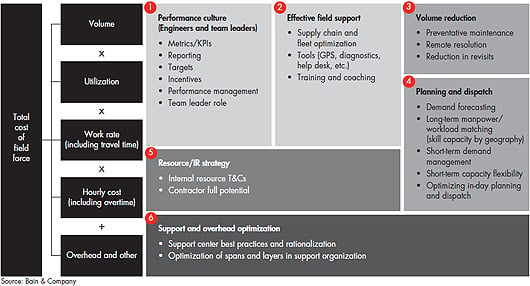
      This includes a broad look at the entire workflow process—not just field service personnel themselves. To be most useful, the diagnostic should provide efficiency ratings for the key areas of activity:

      • Volume of jobs, which can be classified as good (e.g., good plans or job designs), potentially avoidable (e.g., modified by field or scheduling) or bad (e.g., rejected by field or scheduling);

      • Utilization, which measures a crew’s productive hours as a percentage of the total (i.e., actual time spent working contrasted with nonscheduled time, idle time, sick time and holidays);

      • Work rate, which measures the rate at which employees can complete jobs due to optimization of jobs designs and scheduling;

      • Hourly cost, which analyzes the total cost of labor, including overtime (for in-house work vs. contractors);

      • “Overhead and other,” which addresses the costs of supporting nonfield activities (e.g., resource planning, dispatch) and nonlabor costs (e.g., fleet).

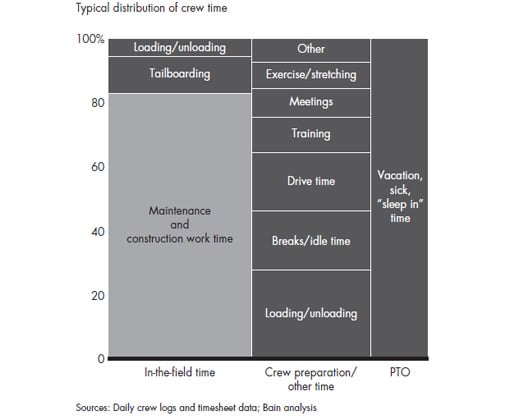
      Recognizing that unique units and divisions do—and often should—operate differently, an effective diagnostic looks closely at day-to-day operations in multiple areas. Once completed, the diagnostic quickly brings inefficient processes to light. It also provides a robust data baseline from which to measure and prioritize opportunities for improvement. In a diagnostic conducted by one US utility, for example, an analysis of how crews spent their time revealed that less than 50 percent was spent on actual maintenance or construction work. The upshot: in order to make crews more effective, executives would have to address key challenges in the areas of work order quality, scheduling, work support and performance management.
      field-service-reenergizing-figure_01

      Typically the output of a diagnostic focuses on six categories of high-value initiatives. These include performance culture, effective field support, volume reduction, planning and dispatch, resource strategy, and support and overhead optimization. Most companies find that the greatest need and the largest payoff come from focusing on performance culture and planning and dispatch.

      Performance culture. In getting field service units to full potential, developing—and applying—a succinct set of key performance measures is critical. This is especially true in planning, scheduling and working in the field. In planning, good metrics include comparing estimated with actual job times and measuring the percentage of “good” job designs. In scheduling, they measure the percentage of jobs cancelled and output per hour (as a proxy for resource utilization). And in the field, they focus on output per hour (by work location, team lead and individual) and cost per unit of output (based on overtime percentage). Good metrics are easy to measure and hard to argue with. They aren’t just statistics for quarterly reports, but rather useful tools for improving your business day to day and driving a healthy sense of competition.

      Good managers use the right metrics to hold people accountable and reward strong performance. The next step in improving performance culture involves using incentives to bring out the best in employees. Some industry leaders have produced positive results with creative designs. One UK utility, for example, took an unorthodox approach: letting their engineers “opt-in” to incentive plans of their own choosing—including one that offered more vacation days as an alternative perk to bonus pay. Both morale and performance jumped significantly.
      field-service-reenergizing-figure_02

      Planning and dispatch. For utility field service units across the spectrum—large, small, those focused on one-hour jobs and those working on multi-year major construction projects—scheduling plays a critical role. High performance is all about getting the crews to the right place at the right time with the right tools and information and the right amount of work. As all utilities know, it’s harder than it appears. One US utility struggled with a seesaw of inefficiency in their scheduling. At first they scheduled their work crews too tightly and ended up missing customer visits and compliance dates. Then to ensure they met commitment dates, they scheduled their crews too loosely and ended up with idle crews 50 percent to 60 percent of the time. To find the right balance, the best companies blend “schedule stability” (avoiding cancelled or last-minute scheduled jobs) with the amount of work that gets done (output per hour).

      A bottoms-up, integrated solution. Many ideas for improving field service aren’t new. Many have been tried and tested—often with lackluster results. So what is it that so often goes wrong in field service redesigns? The most common mistake: developing the solution at corporate headquarters and then rolling it out to the business with little input from the field. Not only can this lead to resentment and resistance, but it genuinely fails to account for real operating differences across divisions. For example, rural and urban units might serve very different types of customers and crews working in wet climates might face very different conditions from those working in arid ones. By ignoring these differences, companies handicap their workforces with bad metrics and planning. Instead, the most successful companies get buy-in from the center, but develop their solutions bottoms-up using real input from those on the ground. They also strike a balance between implementing standard rules and frameworks across units and allowing for flexibility and contingency plans.
      field-service-reenergizing-figure_03

      The second biggest pitfall companies encounter is trying to redesign field service operations in piecemeal fashion when what’s needed is an integrated solution. One US utility revamped its processes and found that while each individual function operated better, much of the benefit was lost because of the lack of coordination. The units didn’t know how to talk to one another, and because each unit measured productivity differently, they operated on different timescales and with different objectives. After a full process redesign, common metrics were applied across different functions, and each group was held partly accountable for success in the next phase. This accountability made everyone eager to talk more and drop the ball less. Different functions were suddenly “in it together,” so they proactively addressed issues before they could become real problems.

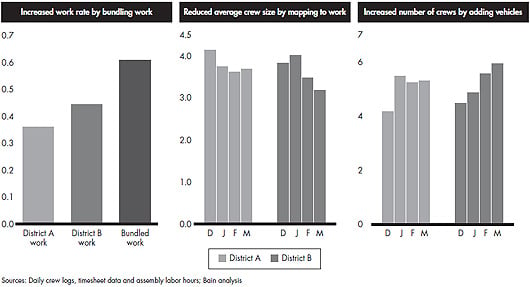
      One US electricity transmission and distribution utility used a field service diagnostic to identify solutions in work scheduling, work rate management, work support and performance management. They developed an integrated field service solution and set 20 percent to 30 percent productivity improvement targets. The new initiatives have started to pay off: bundling work across districts has led to a more than 30 percent improvement in wrench time; mapping crews to work type has resulted in a reduction of crew size by up to 20 percent; and increasing the number of vehicles available has bought about an increase of 10 percent to 20 percent in the number of crews per district.

      Full potential. Getting your field service operations to reach its full potential is challenging, and it takes time. Effective implementation counts as much as good ideas. But when you make it work, you can reduce costs and increase productivity significantly. This translates into better service—and happier customers, employees and shareholders.

      Authors
      • Headshot of Tina Radabaugh
        Tina Radabaugh
        Partner, Los Angeles
      Contact us
      Related Industries
      • Energy & Natural Resources
      • Telecommunications
      • Utilities & Renewables
      Related Consulting Services
      • Service Operations
      Top Digital Use Cases by Industry

      Bain’s research identifies the most useful digital applications, including those that offer the best opportunities for competitive advantage.

      Read More
      Service Operations
      Transforming Maintenance with Artificial Intelligence

      With little to no capex, companies can turn maintenance into an engine of cash flow.

      Read More
      Utilities & Renewables
      Measuring and Modeling Customer Love

      Bain’s Fred Reichheld and Jason Barro share NPS® success stories and what customer experience leaders are doing to benchmark company performance.

      Read More
      Service Operations
      The $100 Billion Opportunity for Generative AI in P&C Claims Handling

      To improve productivity and the claims experience, insurers will need to scale up the most promising initiatives.

      Read More
      Digital Transformation: What Matters Most in Your Sector?

      Bain Digital GPS Benchmark 2021 reveals the most relevant digital applications for business leaders across 10 sectors.

      Read More
      Published in September 2011
      Tags
      • Energy & Natural Resources
      • Service Operations
      • Telecommunications
      • Utilities & Renewables

      How We've Helped Clients

      An Environmental Services Company Captures Massive Savings from a Merger

      Read case study

      Performance Improvement Boosting a utility's workforce productivity

      Read case study

      Sales and Marketing Revitalizing a utility's market position with customer loyalty

      Read case study

      Ready to talk?

      We work with ambitious leaders who want to define the future, not hide from it. Together, we achieve extraordinary outcomes.

      Stay ahead in a rapidly changing world. Subscribe to Bain Insights, our monthly look at the critical issues facing global businesses.

      *I have read and understand Bain’s Privacy Notice.

      Please read and agree to the Privacy Policy.
      Bain & Company
      Contact us Sustainability Accessibility Terms of use Privacy Modern Slavery Act Statement Cookie Policy Sitemap Log In

      © 1996-2026 Bain & Company, Inc.

      Contact Bain

      How can we help you?

      • Business inquiry
      • Career information
      • Press relations
      • Partnership request
      • Speaker request
      See all offices