

Brief

At a Glance
- Regenerative agriculture and other food-industry changes can significantly reduce greenhouse gas emissions and offer environmental, health, and economic benefits.
- We need to move more quickly: There are fewer than nine annual planting cycles left in which to make the necessary progress.
- Moving faster requires a better understanding of three paradoxes in play today with consumers, farmers, and the market and taking specific actions to address them.
The global food system is a marvel of human achievement. It feeds 7.9 billion people, employs 40% of the world’s population, and generates a third of global GDP. But at the same time, agriculture places a hefty burden on the environment, creating more than a quarter of all greenhouse gas emissions and acting as the biggest contributor to tropical deforestation and the pending extinction of 1 million species.
Social issues are also in focus. We suffer epidemics of both hunger and obesity. More than 800 million people go to bed hungry each night while over 1 billion are considered obese. And although the overall economic contribution of the food and agriculture sector is huge, its benefits are uneven: 65% of working adults who live in poverty make their living through agriculture.
These sustainability issues must be addressed, and quickly. We have fewer than nine annual planting cycles to build a sustainable, inclusive, and healthy food system in time to meet key milestones of the Paris Agreement and the United Nations Sustainable Development Goals. And we face this challenge against the backdrop of a volatile world. Today, Russia’s war in Ukraine has set off a humanitarian tragedy and possible global food crisis, natural disasters are becoming more frequent and increasingly severe, and the pain of the Covid-19 pandemic continues.
It’s urgent that we create a more resilient food system. To have a chance at doing so, we must first understand why, despite significant effort by corporations, governments, and NGOs, we haven’t made more progress so far. The answer lies in three paradoxes (see Figure 1).
Figure 1
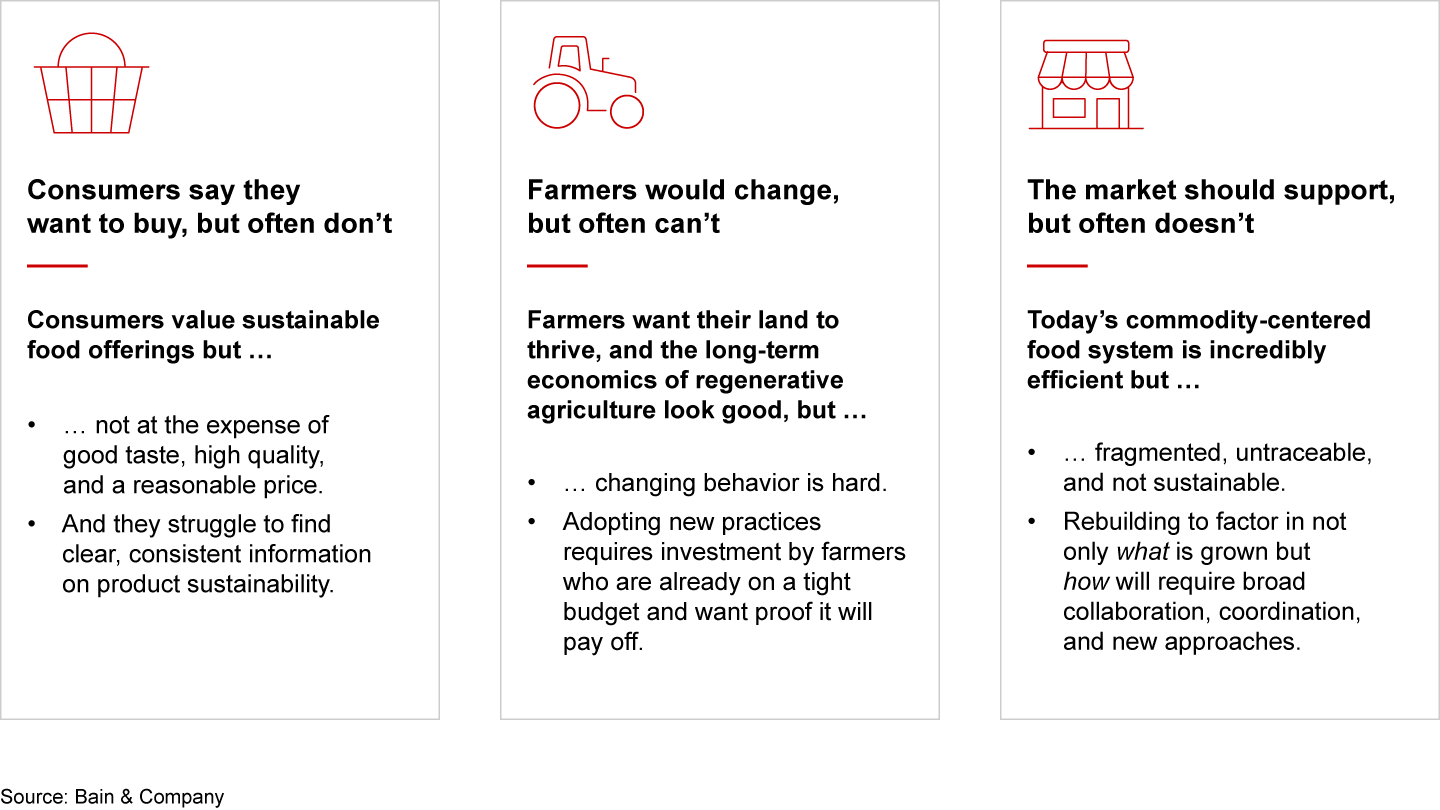

1. Consumers say they want to buy, but often don’t
Consumers around the world say they value sustainable food offerings. In a recent Bain & Company survey, 87% of European consumers say they are willing to pay more for products made in an environmentally and socially responsible way. The figures are similar in Asia and the US.
In a recent Bain & Company survey, 80% of European consumers report caring about sustainability, and 14% say ESG considerations are their main purchase criteria.
Unfortunately, shoppers’ high level of interest is not consistently reflected in what lands in their carts.
It’s possible to pinpoint several reasons for this. First, while sustainability is important, it’s just one of several factors that strongly influence purchase decisions. Taste is critical, and in surveys about what sways purchases, quality, healthiness, and price often outrank sustainability.
Pricing is a particularly critical issue. Global food prices are climbing due to a number of inflationary factors, but the long-term trend in the developed world has been one of abundant food choice at historically low prices. US consumers spend approximately 9% of their discretionary income on food, down from 17% 60 years ago. Those prices omit hidden costs like food waste, pollution, and greenhouse gas emissions. Bain research shows that while customers are willing to pay some premium for healthier and sustainable options, there is a limit on how much more they’ll spend. Many sustainable alternatives seem to be priced well above that limit, making it no surprise they aren’t selected at scale.
US consumers spend approximately 9% of their discretionary income on food, down from 17% 60 years ago.
Consumers also find it challenging to get the information and guidance they need to evaluate a product’s sustainability. They are looking to brands to provide clear, simple information, something snack company Kind has tapped into with the slogan “Ingredients you can see and pronounce.” Successful insurgent brands, while pursuing sustainability on many fronts, often reduce complexity for consumers by focusing their communications on one critical issue. For example, Beyond Meat, maker of protein alternatives, highlights its lower environmental impact, particularly greenhouse gas emissions.
Consumer product companies often complain that there’s no clear consumer call for sustainable products, but there is an opportunity for brands to communicate the benefits, provide the transparency, and fine-tune the pricing that will stoke demand.
2. Farmers would change, but often can’t
Individual farmers are critical to creating a more sustainable food system. They make the decisions that can lead to more—or less—sustainable outcomes. As stewards of the land, often over multiple generations, farmers want to see it thrive. But farming is also their livelihood, and profit margins are thin. For them, the risk of a bad year is very high.
Shifting to regenerative farming and grazing practices helps fight climate change by rebuilding soil’s organic matter, pulling carbon from the atmosphere and sequestering it in the ground. But adopting these practices costs money and involves significant change, and farmers need some guarantee that it’s worth the effort. Early studies of the economics of regenerative agriculture show that farmers using these techniques can increase their profit margins by the fifth or sixth season, but they may first go through a period of higher expenses and lower yields. Changing behavior is always hard, and since farming is local, any farmer will want to test new techniques on their own land over at least one full growing season. Given the education and financing required and the risks new practices introduce, scaling regenerative experimentation can be daunting.
Stronger farmer-focused ecosystems are beginning to develop to help build the economic and environmental case for regenerative agriculture, but so far they have struggled to reach the scale needed fast enough.
3. The market should support, but often doesn’t
Our current food system is optimized for scale and efficiency. At its center are commodities that meet common standards. Farmers work to produce those commodities, and food companies rely on them to create consistent products.
Consider US No. 2 yellow corn. Corn of this grade must meet certain specifications: yellow kerneled with not more than 5% in other colors, of a minimum weight and a maximum percentage of damaged kernels and foreign material per bushel. Buyers, knowing exactly what they are getting, standardize their own production to cheaply turn large quantities of these uniform inputs into processed commodities like cornmeal and corn syrup, which food companies then purchase.
It’s incredibly efficient, but not very sustainable. Sustainability and health criteria are rarely part of the definition of a commodity like No. 2 yellow corn. It doesn’t matter where the corn was grown or how, the amount of water and fertilizer used, or how much carbon was emitted.
Even when we begin to implement systems that start to address where and how corn was grown, supply chain dynamics make it impossible or prohibitively expensive to bring more sustainable corn to market in a way that’s sufficiently appreciated by commodity buyers or procurement teams working to meet tough cost targets. Three challenges make it particularly difficult. The first is the fact that there are often six to eight (and sometimes more) steps in the value chain between growing and consuming food.
There are often six to eight (and sometimes more) steps in the value chain between growing and consuming food.
The second challenge is that many of these steps have production systems that operate best (that is, most cost effectively) at very high volumes, so experimentation can be expensive. Finally, many agricultural products are “disassembly” businesses, meaning they break up raw material into multiple components that each have different uses. Finding a good use for sustainable soy oil is only part of the battle, because a soybean also comes with soy meal.
Rebuilding these fragmented food value chains in a way that rewards not only efficiency but also how food is grown will require fresh thinking, collaboration, and coordination among key market participants.
Five actions to address these paradoxes
This is where things stand today, but we don’t have to accept our lack of progress. We can speed this transition by tackling the consumer, farmer, and market paradoxes with five actions.
Shifting consumption. Some companies successfully help consumers switch to healthier and more sustainable options that they either acquire, develop, or reformulate. Unilever’s Knorr-brand Plizza, for example, features plant-based, nutrient-rich ingredients: a whole-grain spelt flour crust; a sauce made from sustainably sourced ingredients including flaxseed oil and soil-enriching, high-fiber beans; and vegetable toppings like fast-growing spinach, shiitake mushrooms, and self-sowing watercress.
Companies like Upfield, a maker of plant-based spreads, butter, creams, and cheese, are optimizing their entire product portfolios to reduce the use of plastics, emission of carbon, and generation of waste. Scale insurgents such as Beyond Meat are looking to disrupt whole categories and shift consumers to tasty yet sustainable offerings.
At the same time, retailers like Sainsbury’s and Walmart are actively sourcing significantly more sustainable options to stock their shelves.
There are attractive rewards for any brand that figures out how to break the paradox and help consumers shift their behavior. Brands that are seen as sustainable grow two times faster than rivals, and sustainability-driven insurgents grow up to five times faster. The 10% of brands for which sustainability is a core element of value grow fastest of all, according to Bain research.
Brands that are seen as sustainable grow two times faster than rivals, and sustainability-driven insurgents grow up to five times faster.
Embracing regenerative agriculture. Food and beverage companies are supporting the shift to regenerative agriculture by, among other things, hardwiring sustainability into procurement practices, guaranteeing purchase contracts, and providing financing and training. General Mills is one of a number of large companies that have committed to supporting farmers’ transitions. Through training and technical assistance for farmers, the company is on track to help transform 1 million acres of farmland by the end of the decade.
Farmers can also tap into carbon credit systems that provide revenue for practices that sequester carbon—compensation for the cost farmers bear while adopting regenerative agriculture. Yara’s Agoro Carbon Alliance works with farmers to implement practices and processes that ensure they can earn high-quality carbon credits in demand from businesses working to meet their own carbon emission goals.
Meanwhile, governments around the world have a huge opportunity to redirect some of the more than $500 billion in subsidies spent on agriculture each year. The US Department of Agriculture recently announced a $1 billion investment in the Partnerships for Climate-Smart Commodities, for pilot projects that create market opportunities for commodities produced using climate-friendly practices. Similarly, the European Union is updating its common agricultural policy and funding to strengthen sustainability considerations.
Globally, governments have an opportunity to redirect some of the more than $500 billion spent each year on agriculture subsidies.
Reinventing the value chain. For some commodities, the existing value chain carries such high environmental costs, inequity, and labor abuses that the only way to transform the system is to reinvent it. This often means creating value chains that are shorter, more transparent, and capable of capturing more of the product’s economic value where it is grown. These new chains depend on key market participants—from corporate buyers to governments and NGOs—working together in innovative ways.
Reimagining a better future requires being open to new ways of working. Canned tuna is a product that traditionally has been rife with sustainability issues. Among them: illegal and overfishing, bycatch of marine life, bad working conditions on vessels, and an economic structure in which only a very small portion of profits goes to the developing countries that legally control the fisheries.
Tuna also happens to be one of the cheapest sources of protein widely available. Seeing an opportunity to effect important change, The Nature Conservancy and the Republic of the Marshall Islands cofounded Pacific Island Tuna (PIT) to build a fairer system and produce a sustainable can of tuna, fairly caught and processed, with full transparency.
In every way, PIT upended tradition. The company doesn’t negotiate for tuna after it has been caught on a transloading vessel out at sea, as is the norm. Instead, before the fishing vessel even goes out, PIT makes clear what price it will pay for sustainably caught tuna. Fishers who want that premium price must keep their electronic video monitoring on at all times, ensuring they follow humane work rules and do not fish in restricted waters. Once the fish is caught, the vessel must come back to dock in Majuro. This gives workers a regular opportunity to leave the vessel if needed.
As a co-owner of the joint venture, and through its initial processing facilities at the dock, the Marshall Islands enjoys a much greater portion of profits. And a partnership with Walmart, which is buying PIT’s tuna for sale in its stores, provides a reliable source of demand, making possible ongoing investment that helps PIT scale much more efficiently.
Building resilient local food systems in developing markets. In many developing markets where food systems are nascent yet hold significant potential, the urgency for transformation has never been greater.
Africa is a case in point. Malnutrition and food insecurity were already a major issue before Covid-19 pushed 130 million additional people into hunger. Those numbers are expected to increase as the war in Ukraine causes shortages and drives up prices of crops, including wheat, corn, and sunflower oil, as well as fertilizers. Net food imports have risen 400% since the early 2000s and are expected to increase further. At the same time, many of Africa’s smallholder farmers live on less than $5.50 a day, and the higher temperatures, longer dry seasons, and unpredictable rainfalls brought about by climate change are predicted to reduce already low yields by another 10% by 2050.
In Africa, net food imports have risen 400% since the early 2000s and are expected to increase further.
The urgent need to tackle these interrelated issues is now well recognized. The 2021 UN Food Systems Summit highlighted the challenges of feeding a growing African population amid calls for greater sustainability, climate resilience, inclusivity, and nutrition. By the summit’s conclusion, 25 African countries had presented national strategies for transforming their food systems.
A critical group in these efforts are the farmer-allied intermediaries (FAIs)—aggregators, processors, and vertically integrated brands—that anchor Africa’s local food systems. These enterprises play a linchpin role, ensuring that commercially oriented smallholder farmers can access markets and are paid fair prices for what they produce, providing critical inputs such as seeds and fertilizer on credit, and training farmers to adopt tools and practices that increase production in a sustainable way. As they grow their businesses, FAIs help to capture more of the economic value created beyond the farm gate. In the process, they create jobs and help consumers gain access to more safe, nutritious, and affordable food. This intentional, farmer-allied sourcing approach does carry additional costs, however, which can make it hard for these enterprises to scale, particularly in already challenging operating environments.
Recently, a number of initiatives focused on FAIs have begun to see good results. One example is Dairy Nourishes Africa (DNA), a 15- to 20-year public-private partnership that aims to accelerate the transformation of African dairy industries, optimizing outcomes from farms to consumers and across the operating environment, with farmer-allied dairy processors at the center. For the processors working with DNA in Tanzania during the first year of the pilot, cow’s milk production rose more than 50%, as did farmer incomes, and on-farm greenhouse gas emissions dropped 33%.
For food and beverage companies seeking to grow their businesses in developing markets and localize their supply sources, there is a huge opportunity to play a catalytic role in supporting the growth of these critical enterprises by pursuing similar partnerships and providing a large, predictable demand for sustainably produced foods.
Business TopicAfrica’s Critical Agricultural Intermediaries
Enterprises that ally with smallholder farmers are key to unlocking Africa’s food production and economic potential. Learn how farmer-allied intermediaries can act as the linchpin firms for building more resilient food systems in Africa.
Accelerating innovation. A transition from a food system built on standardized commodities with a goal of maximizing yield and efficiency to one in which sustainability considerations are embedded and valued has important implications for every participant. Many companies will have to reconsider what their consumers need from them. Business boundaries will shift, and the basis of competition will change.
A growing tidal wave of food and agriculture-focused technologies will enable and accelerate that transition. In developed markets, entirely new forms of technology-enabled agriculture are taking root, from controlled environment agriculture to advanced aquaculture, self-driving tractors, and widespread seed gene editing using advanced technologies like CRISPR. Other technologies like precision fermentation and cell-based meat production are creating healthier versions of existing foods and, in some cases, entirely new foods. Satellite imagery and new data platforms track the food supply chain and make it transparent and traceable, pulling into one place the wealth of information available.
Much of this innovation comes from start-ups. Large food companies spend just 1.4% of revenue on R&D, on average, and much of that goes toward incremental improvements, not new breakthroughs.
Large food companies spend just 1.4% of revenue on R&D, on average.
But large food companies must consider what these developments mean for their innovation and technology strategy: what partnerships they might need to launch with innovative start-ups or other technology leaders, the areas in which they should acquire or invest in their own technology, and the proper level of R&D spending. Critical questions include how they see technology helping them evolve into their new future and how high the risk is that tech-centric innovators could outcompete them and eat into their business.
What the future could be
Our goal must be to build a healthy, resilient food system. What will that future look like?
- It will be more diverse. Today, just 12 species of plants provide three-quarters of the world’s crops. More diversity means fewer countries will be dependent on a limited number of suppliers, lower chances of a devastating crop wipeout, and more nutritious diets.
- We will treat natural resources—soils, trees, mangroves, peatlands, and the biological ecosystems these support—as allies to help protect us against the worst consequences of weather and climate shocks.
- The people and communities who grow our food will capture a greater share of its value, and they will be able to use that profit to adopt new practices and technologies to better withstand climate and economic shocks.
- Supply chains that are more transparent, traceable, and, when possible, shorter, will decrease exposure to weather events, reduce energy-intensive shipping, and strengthen parts of the world like Africa that spend tens of billions of dollars importing much of their food.
- Consumers, armed with the information they need, will have—and choose—ample sustainable and healthier options at reasonable prices.
- Financial incentives and capital will flow toward innovators committed to new approaches to growing and consuming food that improve nutrition, inclusivity, and sustainability.
This kind of food system—one strong enough to withstand cycles of global turbulence, that gives us a real shot at mitigating carbon emissions and supporting a thriving planet, healthy populations, and a prosperous society—is within reach. Acting quickly to overcome the paradoxes of consumers, farmers, and the market is the right place to start.
Published in April 2022