
Skip to Content
  • Offices

    Offices

    North & Latin America
    • Atlanta
    • Austin
    • Bogota
    • Boston
    • Buenos Aires
    • Chicago
    • Dallas
    • Denver
    • Houston
    • Los Angeles
    • Mexico City
    • Minneapolis
    • Monterrey
    • Montreal
    • New York
    • Rio de Janeiro
    • San Francisco
    • Santiago
    • São Paulo
    • Seattle
    • Silicon Valley
    • Toronto
    • Washington, DC
    Europe & Africa
    • Amsterdam
    • Athens
    • Berlin
    • Brussels
    • Copenhagen
    • Dusseldorf
    • Frankfurt
    • Helsinki
    • Istanbul
    • Johannesburg
    • Kyiv
    • Lisbon
    • London
    • Madrid
    • Milan
    • Munich
    • Oslo
    • Paris
    • Rome
    • Stockholm
    • Vienna
    • Warsaw
    • Zurich
    Middle East
    • Doha
    • Dubai
    • Riyadh
    Asia & Australia
    • Bangkok
    • Beijing
    • Bengaluru
    • Brisbane
    • Ho Chi Minh City
    • Hong Kong
    • Jakarta
    • Kuala Lumpur
    • Manila
    • Melbourne
    • Mumbai
    • New Delhi
    • Perth
    • Seoul
    • Shanghai
    • Singapore
    • Sydney
    • Tokyo
    See all offices
  • Alumni
  • Media Center
  • Subscribe
  • Contact
  • Global | English

    Select your region and language

    Global
    • Global (English)
    North & Latin America
    • Brazil (Português)
    • Argentina (Español)
    • Canada (Français)
    • Chile (Español)
    • Colombia (Español)
    Europe, Middle East, & Africa
    • France (Français)
    • DACH Region (Deutsch)
    • Italy (Italiano)
    • Spain (Español)
    • Greece (Elliniká)
    Asia & Australia
    • China (中文版)
    • Korea (한국어)
    • Japan (日本語)
  • Saved items (0)
    Saved items (0)

    You have no saved items.

    Bookmark content that interests you and it will be saved here for you to read or share later.

    Explore Bain Insights
  • Industries
    Main menu

    Industries

    • Aerospace & Defense
    • Agribusiness
    • Chemicals
    • Construction & Infrastructure
    • Consumer Products
    • Financial Services
    • Healthcare & Life Sciences
    • Industrial Machinery & Equipment
    • Media & Entertainment
      Industries
      Media & Entertainment
      • Media Lab
    • Metals
    • Mining
    • Oil & Gas
    • Paper & Packaging
    • Private Equity
      Industries
      Private Equity
      • Due Diligence
      • Exit Planning
      • Firm Strategy & Operations
      • Portfolio Value Creation
    • Social Impact
    • Retail
    • Technology
    • Telecommunications
      Industries
      Telecommunications
      • Capital Expenditure
      • Telco Digital Transformation
    • Transportation
    • Travel & Leisure
    • Utilities & Renewables
  • Consulting Services
    Main menu

    Consulting Services

    • Customer Experience
    • Sustainability
    • Innovation
    • M&A
    • Operations
    • People & Organization
    • Private Equity
    • Sales & Marketing
    • Strategy
    • AI, Insights, and Solutions
    • Technology
    • Transformation
  • Digital
  • Insights
    Main menu

    Insights

    • Industry Insights
    • Services Insights
    • Bain Books
    • Webinars
    • Bain Futures
    View all Insights
    Featured topics
    • Tariff Response
    • Artificial Intelligence
    • Thriving in Uncertainty
    • Executive Conversations
    • Macro Trends
    • M&A Report
    • Healthcare Private Equity Report
    • Paper & Packaging Report
    • Technology Report
    • CEO's Guide to Sustainability
    • CEO Insights
    • CFO Insights
    • COO Insights
    • CIO Insights
    • CMO Insights
    View all featured topics
  • About
    Main menu

    About

    • What We Do
    • What We Believe
    • Our People & Leadership
    • Client Results
    • Awards & Recognition
    • Global Affiliations
    Further: Our global responsibility
    • Sustainability
    • Social Impact
    • World Economic Forum
    Learn more about Further
  • Careers
    Main menu

    Careers

    • Work with Us
      Careers
      Work with Us
      • Find Your Place
      • Our Work Areas
      • Integrated Teams
      • Students
      • Internships & Programs
      • Recruiting Events
    • Life at Bain
      Careers
      Life at Bain
      • Blog: Inside Bain
      • Career Stories
      • Our People
      • Where We Work
      • Supporting Your Growth
      • Affinity Groups
      • Benefits
    • Impact Stories
    • Hiring Process
      Careers
      Hiring Process
      • What to Expect
      • Interviewing
    FIND JOBS
  • Offices
    Main menu

    Offices

    • North & Latin America
      Offices
      North & Latin America
      • Atlanta
      • Austin
      • Bogota
      • Boston
      • Buenos Aires
      • Chicago
      • Dallas
      • Denver
      • Houston
      • Los Angeles
      • Mexico City
      • Minneapolis
      • Monterrey
      • Montreal
      • New York
      • Rio de Janeiro
      • San Francisco
      • Santiago
      • São Paulo
      • Seattle
      • Silicon Valley
      • Toronto
      • Washington, DC
    • Europe & Africa
      Offices
      Europe & Africa
      • Amsterdam
      • Athens
      • Berlin
      • Brussels
      • Copenhagen
      • Dusseldorf
      • Frankfurt
      • Helsinki
      • Istanbul
      • Johannesburg
      • Kyiv
      • Lisbon
      • London
      • Madrid
      • Milan
      • Munich
      • Oslo
      • Paris
      • Rome
      • Stockholm
      • Vienna
      • Warsaw
      • Zurich
    • Middle East
      Offices
      Middle East
      • Doha
      • Dubai
      • Riyadh
    • Asia & Australia
      Offices
      Asia & Australia
      • Bangkok
      • Beijing
      • Bengaluru
      • Brisbane
      • Ho Chi Minh City
      • Hong Kong
      • Jakarta
      • Kuala Lumpur
      • Manila
      • Melbourne
      • Mumbai
      • New Delhi
      • Perth
      • Seoul
      • Shanghai
      • Singapore
      • Sydney
      • Tokyo
    See all offices
  • Alumni
  • Media Center
  • Subscribe
  • Contact
  • Global | English
    Main menu

    Select your region and language

    • Global
      Select your region and language
      Global
      • Global (English)
    • North & Latin America
      Select your region and language
      North & Latin America
      • Brazil (Português)
      • Argentina (Español)
      • Canada (Français)
      • Chile (Español)
      • Colombia (Español)
    • Europe, Middle East, & Africa
      Select your region and language
      Europe, Middle East, & Africa
      • France (Français)
      • DACH Region (Deutsch)
      • Italy (Italiano)
      • Spain (Español)
      • Greece (Elliniká)
    • Asia & Australia
      Select your region and language
      Asia & Australia
      • China (中文版)
      • Korea (한국어)
      • Japan (日本語)
  • Saved items  (0)
    Main menu
    Saved items (0)

    You have no saved items.

    Bookmark content that interests you and it will be saved here for you to read or share later.

    Explore Bain Insights
  • Industries
    • Industries

      • Aerospace & Defense
      • Agribusiness
      • Chemicals
      • Construction & Infrastructure
      • Consumer Products
      • Financial Services
      • Healthcare & Life Sciences
      • Industrial Machinery & Equipment
      • Media & Entertainment
      • Metals
      • Mining
      • Oil & Gas
      • Paper & Packaging
      • Private Equity
      • Social Impact
      • Retail
      • Technology
      • Telecommunications
      • Transportation
      • Travel & Leisure
      • Utilities & Renewables
  • Consulting Services
    • Consulting Services

      • Customer Experience
      • Sustainability
      • Innovation
      • M&A
      • Operations
      • People & Organization
      • Private Equity
      • Sales & Marketing
      • Strategy
      • AI, Insights, and Solutions
      • Technology
      • Transformation
  • Digital
  • Insights
    • Insights

      • Industry Insights
      • Services Insights
      • Bain Books
      • Webinars
      • Bain Futures
      View all Insights
      Featured topics
      • Tariff Response
      • Artificial Intelligence
      • Thriving in Uncertainty
      • Executive Conversations
      • Macro Trends
      • M&A Report
      • Healthcare Private Equity Report
      • Paper & Packaging Report
      • Technology Report
      • CEO's Guide to Sustainability
      • CEO Insights
      • CFO Insights
      • COO Insights
      • CIO Insights
      • CMO Insights
      View all featured topics
  • About
    • About

      • What We Do
      • What We Believe
      • Our People & Leadership
      • Client Results
      • Awards & Recognition
      • Global Affiliations
      Further: Our global responsibility
      • Sustainability
      • Social Impact
      • World Economic Forum
      Learn more about Further
  • Careers
    Popular Searches
    • Agile
    • Digital
    • Strategy
    Your Previous Searches
      Recently Visited Pages

      Content added to saved items

      Saved items (0)

      Removed from saved items

      Saved items (0)

      Brief

      Hacking Software’s Rule of 40

      Hacking Software’s Rule of 40

      Software companies need to balance growth and profitability to create lasting value.

      By Thierry Depeyrot and Simon Heap

      • min read
      }

      Brief

      Hacking Software’s Rule of 40
      en
      At a Glance
      • Large software companies are, increasingly, measured against the Rule of 40: the idea that growth rate plus profit margin should exceed 40%.
      • Young companies often beat that mark with their rapid growth. But older companies, whose growth has tapered off, need to improve performance and profit margins to hit that metric.
      • Beating the Rule of 40 in a single year is admirable, but the greater challenge is balancing growth and performance year after year.

      The Rule of 40—the principle that a software company’s combined growth rate and profit margin should exceed 40%—has gained momentum as a high-level gauge of performance for software businesses in recent years, especially in the realms of venture capital and growth equity. Increasingly, software industry executives are embracing the Rule of 40 as an important metric to help measure the trade-offs of balancing growth and profitability.

      • Click to expand: About the Rule of 40

        Venture capitalists began to popularize the Rule of 40 in 2015 as a high-level health check for SaaS companies, but it’s broadly applicable to most software companies. The metric neatly captures the fundamental trade-off between investing in growth (including new products and customer acquisition) and short-term profitability. Analysts have differed on which measure of profitability to use—most use EBITDA, but some have proposed free cash flow, EBIT or net income as alternatives. We use EBITDA, a publicly available profitability metric that excludes the effect of taxes and accounting policies.

      Venture capital investors initially came up with the Rule of 40 as a way to quickly assess the performance of small, fast-growing companies. For larger companies, beating the Rule of 40 in a single year is not exceptional. In fact, over such a short period, the top quintile of software businesses approaches a gross profit ratio of 50% (see Figure 1).

      Figure 1
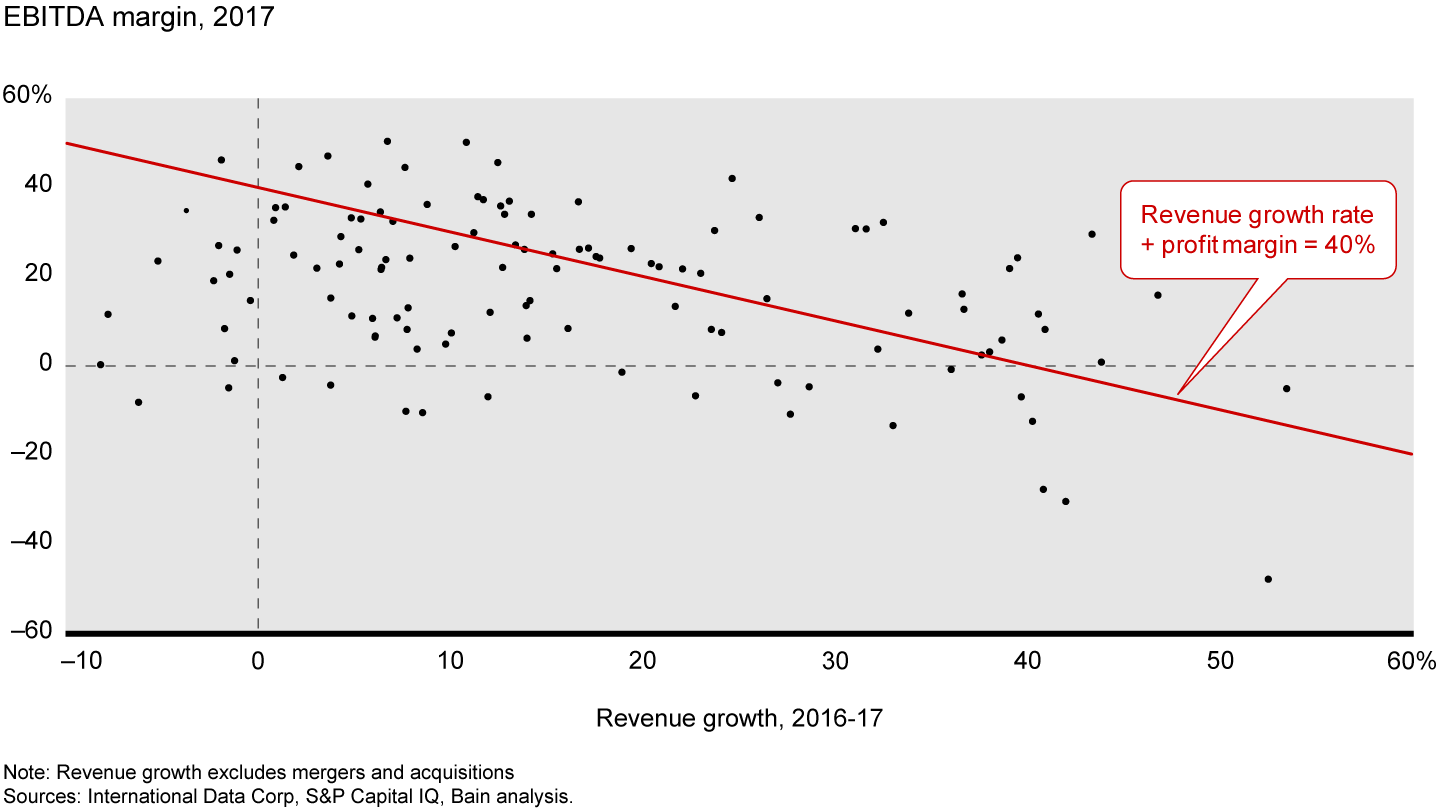
      In 2017, 40% of software companies outperformed the Rule of 40
      In 2017, 40% of software companies outperformed the Rule of 40
      In 2017, 40% of software companies outperformed the Rule of 40

      Consistently strong performance against the Rule of 40, however, is difficult to maintain. Bain & Company researched the performance of 124 publicly traded software companies to identify those that outperformed the Rule of 40 over three years and five years. We found that 40% of them outperformed the Rule of 40 in a single year (2017). But of 86 companies researched from 2013 to 2017, just 25% outperformed the Rule of 40 for three or more years, and only 16% outperformed for all five years, adjusted for mergers and acquisitions (see Figure 2).

      Figure 2
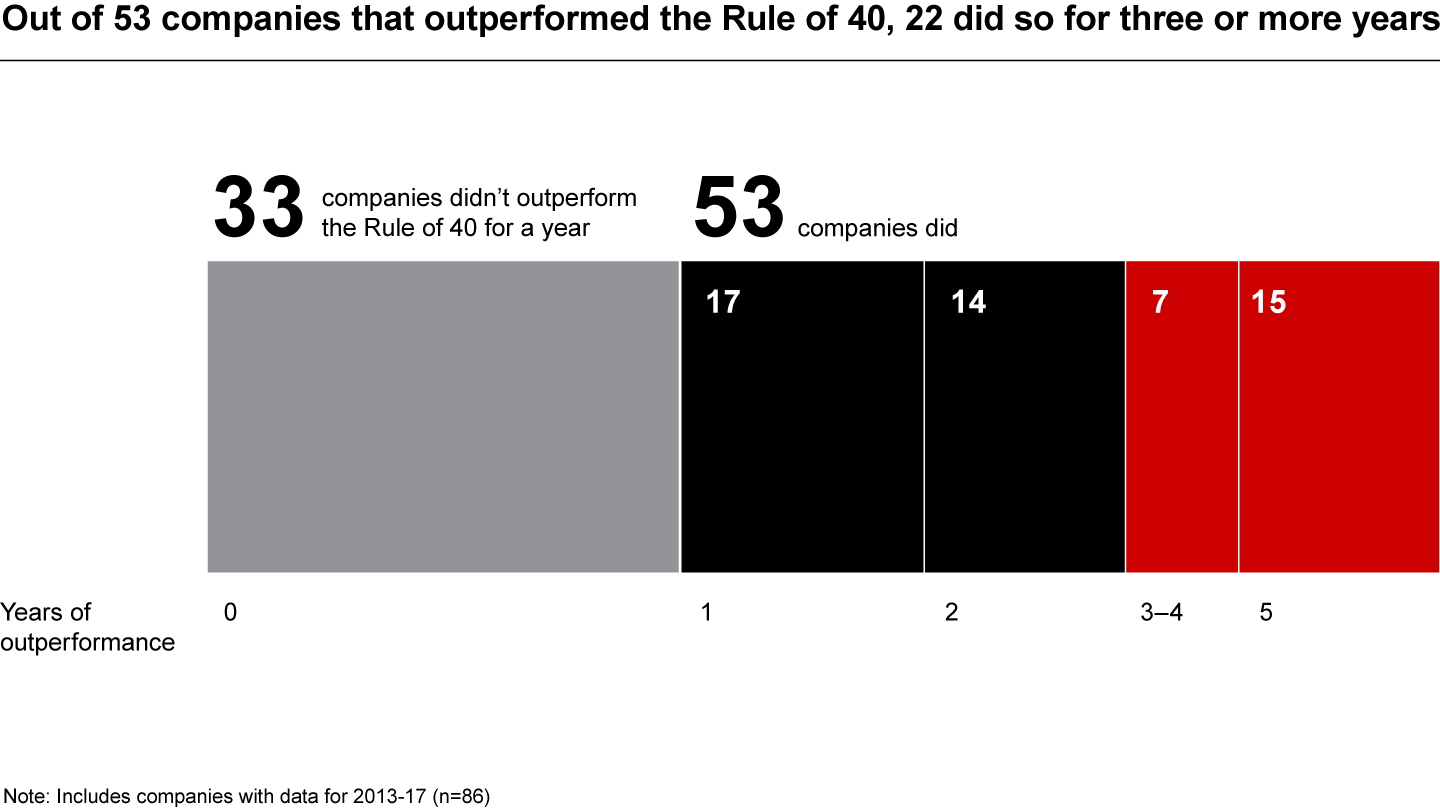
      Consistently outperforming the Rule of 40 is difficult
      Consistently outperforming the Rule of 40 is difficult
      Consistently outperforming the Rule of 40 is difficult

      What’s more, once a business has matured and its growth has slowed, it’s difficult to regain that growth. Among companies with growth rates higher than 10% in 2004–05, average revenue growth sank below 10% over time and has not bounced back (see Figure 3). Continuing growth at scale is also hard; only five software companies have grown to $5 billion from $1 billion in the past 20 years.

      Figure 3
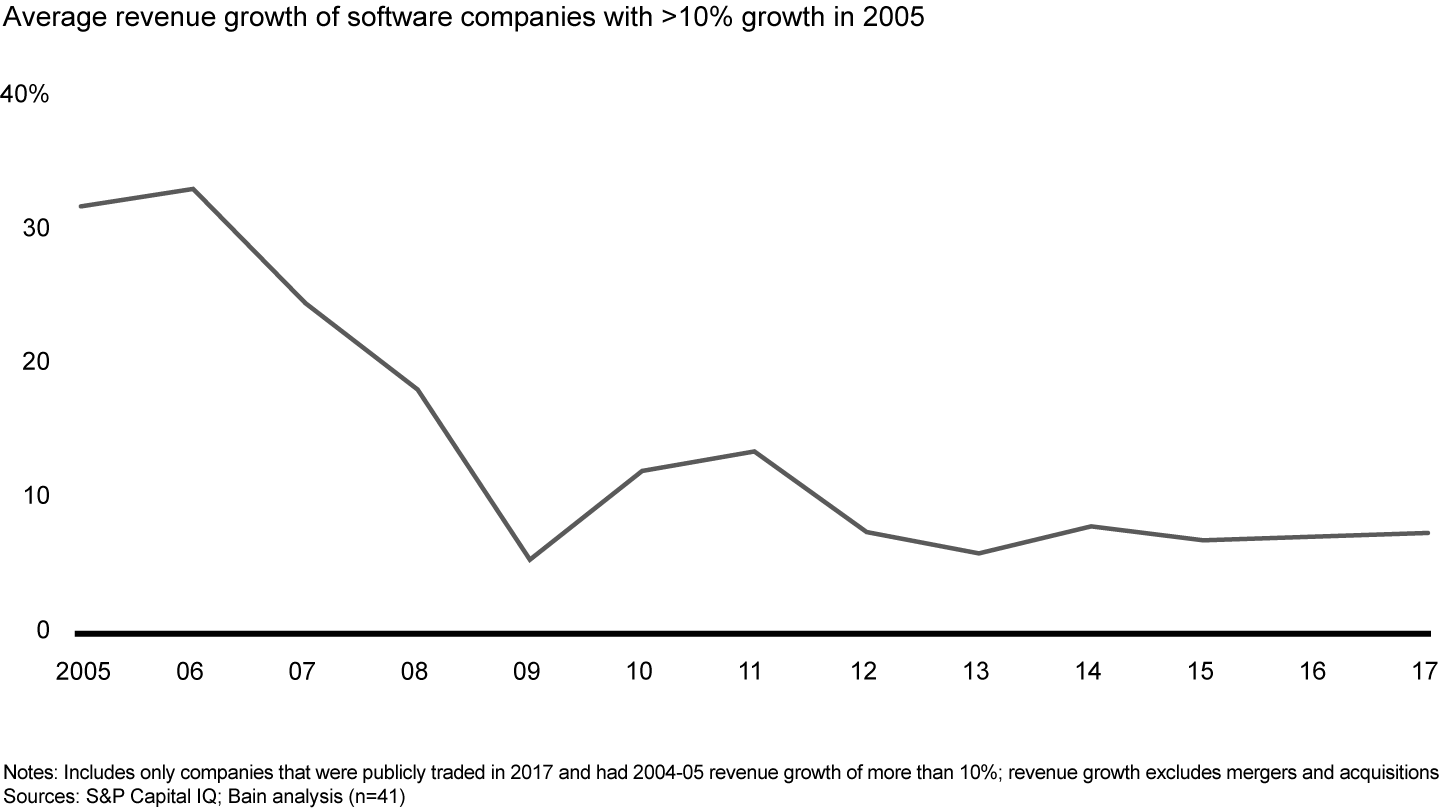
      Growth falls off over time – and is difficult to revive
      Growth falls off over time – and is difficult to revive
      Growth falls off over time – and is difficult to revive

      Software companies that can balance growth and profitability to outperform the Rule of 40 have valuations (measured by the ratio of enterprise value to revenue) double that of companies that fall “below the line,” and they achieve returns as much as 15% higher than the S&P 500. Companies whose growth slows and that fail to improve profitability often find themselves the target of activist investors and private equity acquirers.

      Bain Partner Thierry Depeyrot explains how software companies can achieve sustained, profitable growth.

      Three ways to beat the Rule of 40

      Companies can beat the Rule of 40 at all stages of their life cycle.

      • Strong growth. Of the companies that outperform the Rule of 40 over five years, one-third achieve it with revenue growth above 30%. These companies—such as Splunk, Wix and Workday—are modestly profitable while investing in hypergrowth to build a large installed base, displace legacy vendors and attain the holy grail of becoming a platform. Beyond $1 billion in revenue, software businesses must evolve their operating model and process maturity to handle the complexities of serving multiple customer segments, with multiple products, across many countries. As growth slows, mature software companies look for ways to generate more revenue from existing customers, while becoming more efficient to increase profit margins and maintain performance that beats the Rule of 40.
      • Balanced, profitable growth. Half of the companies consistently exceeding the Rule of 40 do so with revenue growth between 10% and 30%. Such large, established companies as VMWare, Adobe and Salesforce have successfully developed new products for markets adjacent to their core, and navigated technology or business model transitions (for example, to SaaS and subscription models) to keep growing. Having climbed the S-curve, they must reorient their approach to reach the next level. Some companies accustomed to rapid growth struggle to adapt. For example, R&D spending needs to reflect the fact that subsequent waves of innovation might not be as valuable as the earlier breakthroughs, relative to the business size, and that the mix of investment may need to shift to renewing the original architecture. Disciplined and data-driven portfolio management and investment choices become increasingly important.
      • Profitability. We also found that 18% of companies beat the Rule of 40 with annual organic revenue growth below 10%. Established players like Oracle, SAP and Trend Micro have large, profitable flagship businesses. With growth stabilizing below 10%, companies turn to becoming more efficient and profitable—exacting pricing power, leveraging the scale and scope of large salesforces, cross-selling and expanding installed base customers, exploring new business models, increasing renewals, moderating R&D investment.
      Infographic

      How Software Firms Can Outpace the Rule of 40

      Consistently beating this magic number remains elusive for large, established firms. But it’s possible with the right moves.

      Increasing efficiency and effectiveness in a maturing business

      It’s difficult to consistently and sustainably outperform. Each company faces its own unique profitability challenges across products and offerings, engineering efficiency and effectiveness, go-to-market productivity and customer life cycle management. But most successful companies display a few common patterns.

      • Focus on installed base. Customers are the biggest asset of a mature software business. Retaining that base, and expanding the value delivered to it, becomes the top priority. Ensuring customer success, investing in customer-centric innovation, developing broader and deeper solutions strategies, and implementing pricing strategies and discipline are all essential. Customer data can help provide insights on the best ways to deliver, as marketing investments shift to “farming” over “hunting.” They need to establish more efficient ways of selling to established customers, for example, by deploying inside sales rather than expensive field forces, and paying channel partners based on the value they add.
      • Engineering productivity. Engineering groups face new challenges as a business matures. In addition to being directed by smart portfolio investment choices, engineering groups need to balance the demands of delivering new features with those of product maintenance—all while dealing with the technical debt that often slows them down. Getting clarity on priorities and visibility into how sprawling engineering groups are spending time to align with those priorities is paramount. Streamlining roles, supporting critical developers and clarifying site strategy can refocus the best resources on building what is important in the most cost-effective way.
      • Operational efficiency. For mature companies, the enemy of efficiency is often complexity. Processes and systems reflect historical choices as new products, customer and countries are added to the business mix, along with new acquisitions. Continuous streamlining and process automation can help raise efficiency. This can include reducing the number of SKUs and price meters, streamlining the number of legal entities and channel types, clarifying the roles of operational teams and removing duplication, and eliminating layers of management.

      Some of the most successful software businesses gauge their performance against the Rule of 40, and many others increasingly aspire to achieve it across the various stages of their life cycles. What’s more, the rule is helpful not only at the companywide level, but as a way to assess the performance of business units or product families within an organization. Indeed, for some companies, focusing on and achieving the Rule of 40 at the unit level is an ideal way to get started, allowing them to build the goal into their business planning and performance assessments.

      Thierry Depeyrot and Simon Heap are partners with Bain & Company’s Global Technology practice, and both work in the firm’s Silicon Valley office.

      Authors
      • Headshot of Thierry Depeyrot
        Thierry Depeyrot
        Executive Vice President, Coro, Silicon Valley
      • Headshot of Simon Heap
        Simon Heap
        Advisory Partner, Silicon Valley
      Contact us
      Related Industries
      • Technology
      How We Can Help
      • Software Value Creation
      Technology
      In Enterprise Software, Renewals and Retention Have Never Been More Important

      Covid-19 has changed every customer’s finances. Vendors should respond with new segmentations and offers.

      Read More
      Technology
      Software M&A

      The good news: Most deal best practices still apply to AI acquisitions.

      Read More
      Software Value Creation
      India SaaS Report 2022

      Remaining steady through turbulence

      Read More
      Technology
      Exploring AI for Packaging Circularity

      AI is already creating value across the packaging lifecycle, from optimising design and reducing material use to improving sorting and traceability.

      Read More
      Technology
      How Businesses Can Prepare for Post-Quantum Cybersecurity Threats

      Your company will soon face attackers armed with quantum technology. Will you be ready?

      Read More
      Published in December 2018
      Tags
      • Software Value Creation
      • Technology

      How We've Helped Clients

      Helping a Midsize ERP Player Compete against the Giants

      Read case study

      Performance Improvement Aggressively growing an IT service provider with a high-performance culture

      Read case study

      Sales and Marketing Electronics manufacturer increases value of CRM investment

      Read case study

      Ready to talk?

      We work with ambitious leaders who want to define the future, not hide from it. Together, we achieve extraordinary outcomes.

      Stay ahead in a rapidly changing world. Subscribe to Bain Insights, our monthly look at the critical issues facing global businesses.

      *I have read and understand Bain’s Privacy Notice.

      Please read and agree to the Privacy Policy.
      Bain & Company
      Contact us Sustainability Accessibility Terms of use Privacy Modern Slavery Act Statement Cookie Policy Sitemap Log In

      © 1996-2026 Bain & Company, Inc.

      Contact Bain

      How can we help you?

      • Business inquiry
      • Career information
      • Press relations
      • Partnership request
      • Speaker request
      See all offices