

Report

This article is Chapter 6 of Bain’s global Technology Report 2020. Explore the contents of the report here or download the PDF to read the full report.
If you talk to a CIO, you're likely to come away thinking that the hybrid cloud is one of the most critical areas of investment that will define their IT strategy over the next decade. But what does hybrid cloud actually mean?
A lot of the current focus and energy in the market revolves around three related but distinct hybrid cloud value propositions: the ability to seamlessly integrate cloud infrastructure from multiple vendors, to move workloads and data between on-premise systems and a public cloud, and to extend cloud capabilities to edge computing environments.
If you listen to cloud providers, you’ll hear a lot about multicloud and edge. The truth is that today’s hybrid cloud deployments focus mainly on the simpler and more practical need: applying public cloud resources to legacy data and applications.
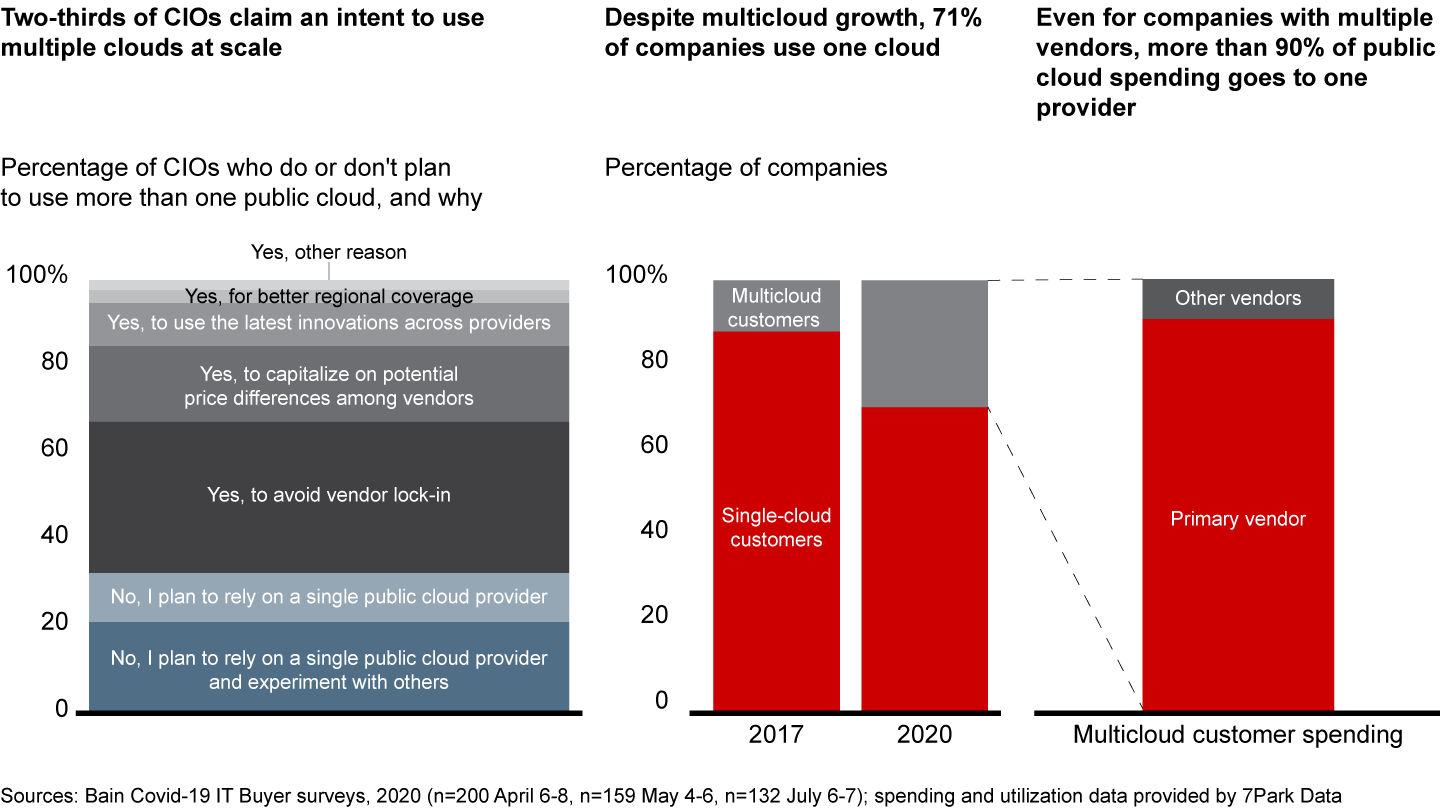
The multicloud value proposition is more a dream than a reality at this point. Two out of three CIOs indicate they plan to use multiple public cloud infrastructure providers to avoid vendor lock-in and control costs, according to Bain & Company’s Covid-19 IT Buyer Survey. However, when we look at actual spending, very few companies have succeeded in doing so. Companies use many clouds when it comes to their software-as-a-service applications. But looking just at their computing infrastructure—which is most relevant to hybrid cloud purchase decisions—more than 70% of companies are using only one provider. Those who do use multiple public clouds spend more than 90% of their public cloud budget with a single vendor (see Figure 1).
Figure 1

Why the discrepancy between desire and reality?
First, the average company uses 53 cloud platform services that go beyond basic computing and storage. These services support products in artificial intelligence (AI), mobility services, augmented reality (AR), virtual reality (VR) and more. This makes it nearly impossible to seamlessly migrate an application from one infrastructure provider to another, as the application will call on a platform service that isn’t there. Second, the complexity of operating across multiple public clouds creates security and downtime risks. Third, companies are struggling to develop, hire and retain the talent to operate one cloud infrastructure environment at scale, let alone several. Lastly, the differentiation across the current public clouds is just not significant enough to offset all of these challenges.
The other two hybrid cloud value propositions are more real.
The link between on-premise infrastructure and the public cloud is crucial to many companies’ IT operations today. Many CIOs currently rely on this link to modernize legacy systems with advanced cloud services, to provide backup and disaster recovery capabilities, or to gain extra computing capacity during periods of peak usage. It’s challenging enough for CIOs to capture value from these kinds of hybrid cloud use cases. The loftier goal of deploying and running multiple public cloud infrastructure environments at scale, and then connecting and securing them—that’s well beyond the reach of mainstream IT organizations.
For the third proposition, edge computing, the question is “when?” not “if?” In a recent Bain survey, only 35% of CIOs said they’re looking for end-to-end hybrid solutions that encompass the edge, the computing that occurs at or near the source of the data. Nevertheless, enterprise investments in the edge are growing. As video, the Internet of Things, autonomous driving, AR/VR and other emerging technologies continue to advance, more workloads will take advantage of edge resources. The connection between edge environments and the cloud is going to be a critical issue as edge deployments scale up. Having a seamless and interoperable development, security and operations environment; common analytic tools; and one-touch provisioning will be major sources of value when enormous volumes of data are generated at the edge and need to be efficiently processed.
What does that mean? The two competitive battlegrounds that will determine the direction of the hybrid cloud market are edge computing and the link between on-premise and public cloud systems. Investments in these areas have a stronger likelihood of paying off. Bets on enabling multicloud interoperability are riskier and face some structural barriers that may not be overcome, at least in the near term.
Cloud service providers (CSPs) are behaving accordingly, especially the leaders, Amazon and Microsoft. It’s no surprise these CSPs are more focused on helping customers take full advantage of their proprietary cloud services than they are on enabling multicloud integration.
Leading CSPs are setting the hybrid cloud agenda from a position of strength. Their advanced AI capabilities, strong balance sheets, best-in-class developer talent and CIO relationships rate highly in this kind of platform battle.
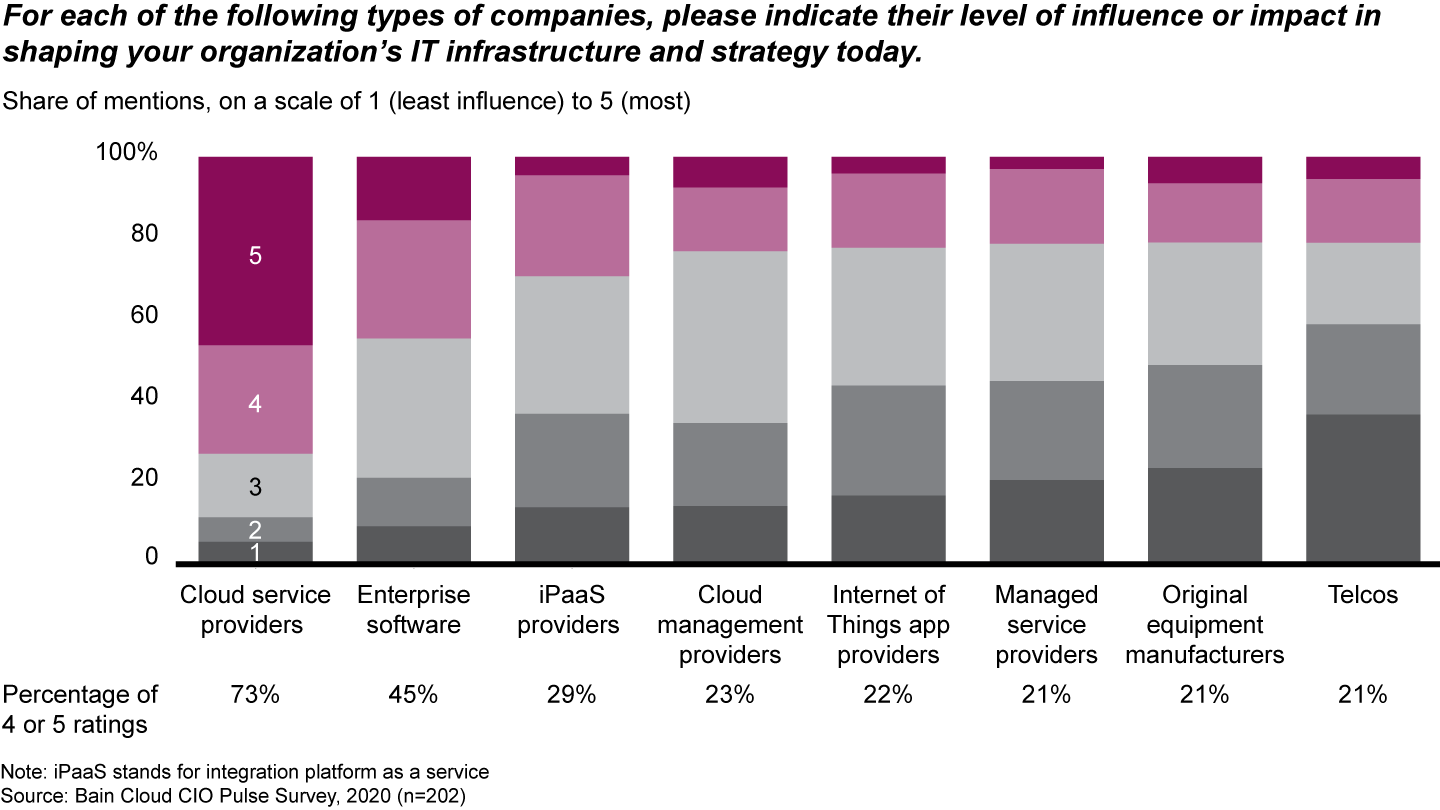
And CSPs are cementing their leadership position. A recent Bain survey of CIOs found that 73% view CSPs as critical, strategic IT partners today. About 80% said they expect CSPs to be strategic partners in three to five years. Most competitors’ products and services are perceived as commodities (see Figure 2).
Figure 2

For CSPs, the hybrid cloud market opens the door to managing additional computing workloads, expanding into new markets and pushing the rest of the field to fight, ally or exit.
“Cloud-to-prem” hybrid
The fiercest battle in the hybrid cloud will be over the last on-premise target: legacy mission-critical workloads. Migrating these workloads to the cloud will take years because of their cost, complexity, longevity and sensitivity—think core banking software, medical imaging databases and supply chain systems.
CSPs are making a bid to accelerate the transition by connecting legacy systems to advanced cloud services and creating a common development platform that will ease eventual migration. The offerings from Amazon, Microsoft and Google are all nascent and not widely adopted today. But these products—Amazon’s AWS Outposts, Microsoft’s Azure Stack Hub and Azure Arc, and Google Cloud Platform—give CSPs a point of entry into the on-premise environment. If CSPs demonstrate their cloud platforms can handle these critical workloads, they’ll build even more trust with CIOs and capture a greater share of the market.
CSPs are threatening original equipment manufacturers’ (OEMs) on-premise infrastructure stronghold. But OEMs have a significant advantage: their systems currently run these legacy workloads. Contrary to some headlines, investment in the on-premise hardware behind these “value” workloads has been quite sticky.
The question is whether companies will trust OEMs to help them take full advantage of cloud services or whether they’ll see their cloud strategies as thinly veiled attempts to keep as much infrastructure on premise as possible. OEMs have started to collaborate with CSPs to provide hardware—Dell EMC is serving as the hardware and channel partner for Azure Stack Hub—and have introduced their own on-premise, software-enabled hybrid products.
Another relevant priority for CIOs is the desire to simplify on-premise infrastructure through hyperconverged infrastructure (HCI) products. These systems bundle three products—a server, a storage system and a fiber channel switch that connects the two—in a single box with preinstalled hypervisor software to run it all. HCI can be an efficient way to deploy private cloud infrastructure. In response to demand from CIOs, Dell EMC launched an HCI product coengineered by and deeply integrated with VMware’s VCF, sold via subscription. Hewlett Packard Enterprise offers Ezmeral, software delivered through the company’s end-to-end hybrid offering, HPE GreenLake. Nutanix, the originator of the HCI category, remains a leader and over time has migrated from an appliance model to a subscription-based software model.
All of these efforts are allowing OEMs to stay relevant. Sales of branded servers are still forecast to grow by a modest 1% compound annual growth rate from 2019 through 2024, according to Bain analysis of IDC data. By comparison, public and private cloud revenues are each expected to grow around 20% per year from 2019 to 2023, according to Bain analysis of IDC and Gartner data.
If you believe virtualization isn’t going anywhere anytime soon, VMware likely has a role in the hybrid cloud’s future, given its entrenchment in the sector. Between 60% and 75% of virtual machines are run on VMware software, according to Morningstar. The Pivotal acquisition and organic investments in a new suite of apps, Tanzu, have strengthened VMware’s offering by embedding Kubernetes, the open-source container orchestration system, into the control pane. Recognizing VMware’s position, Amazon has formed a partnership to sell a version of its new on-premises product, AWS Outposts, that runs VMware’s cloud.
Then there’s IBM and its $34 billion acquisition of Red Hat. IBM is playing from behind in the public cloud battle, but with Red Hat, it now has some industry-leading assets that are directly relevant to the hybrid cloud. Red Hat Enterprise Linux is the leading paid Linux vendor and is particularly strong in the cloud, and Red Hat’s OpenShift container orchestration platform is the leading product in that critical control point. IBM has proactively reconfigured its infrastructure and middleware solutions to run on OpenShift. Considering the fact that IBM’s solutions and services continue to run many of the world’s most mission-critical systems, there is a path to hybrid cloud leadership.
Lastly, managed service providers (MSPs) face significant challenges in this evolving hybrid cloud landscape. OEMs’ future challenges will hit MSPs sooner, as customers increasingly shift commodity workloads from a hosted data center to the public cloud. What remains in MSP data centers are the legacy, complex workloads. Unfortunately for MSPs, managing these custom workloads is more expensive and less profitable. As the volume of new deployments declines, this will put pressure on their utilization-driven business model.
What will MSPs do in response? One possible route is helping to solve CSPs’ “people problem” by supplying the scarce talent required to manage these hybrid cloud environments and helping with the migration on the front end. But MSPs face the same talent shortage as the rest of the industry. They’ll need focus and strong execution in order to pivot from acquiring and developing skills needed to manage legacy environments to those required for the hybrid cloud. Rackspace is already pursuing this opportunity. In a partnership with Amazon, Rackspace provides AWS-specific technical resources and advisory services for data migration and related projects. Whichever route MSPs take, they’ll have no choice but to fundamentally change their current business model of high-volume workload hosting.
It’s too early to definitively pick winners in the hybrid battle for the future of on-premise infrastructure. There are clear leaders and likely to be roles for many, even if it means forming partnerships with competitors.
“Cloud-to-edge” hybrid
Although edge computing is a lower priority for CIOs, enterprise spending in this area is surging. It’s projected to grow around 35% from 2019 to 2024, compared with roughly 2.5% growth of nonpublic cloud spending, according to Bain analysis of IDC data.
CSPs are following suit and investing heavily in edge infrastructure, especially Internet of Things applications. Amazon, Microsoft and Google have each introduced cloud-to-edge products in recent years, and collectively they’ve spent or announced planned investments into the IoT totaling around $10 billion to date. Their efforts are advancing technologies such as mobile-edge computing—see Amazon’s deal to run AWS Wavelength on Verizon’s 5G network.
Although CSPs’ edge products are still maturing, the leading companies are delivering value to customers by bringing their AI and analytics capabilities to edge environments. Microsoft’s Azure Stack Edge, for example, intakes raw data inputs and intelligently routes instructions across devices.
The challenge for CSPs is they have little industrial and operational technology experience. Many will look to industrial OEMs for partnerships, in which CSPs provide machine learning models and other advanced software. The OEM would then handle the aspects where it has deeper expertise: hardware, knowledge of industrial IoT applications, strong customer and channel relationships, and experience navigating the four walls of the factory.
Nevertheless, industrial OEMs don’t want to cede software and other high-margin, value-added territory to CSPs. They don’t want to be relegated just to equipment manufacturing. As a result, some are deploying their own cloud solutions, though they’re still early. For example, Schneider Electric offers EcoStruxure, which provides edge control; connected products that link server, mechanical and power rooms; and capabilities such as predictive analytics, smart alarms and communicating real-time sensor data. Meanwhile, Siemens’s MindSphere has expanded its integrations with AWS and Azure.
Like industrial OEMs, telecommunications firms don’t want to cede the most valuable parts of the edge computing market to CSPs. But telcos aren’t in as strong a starting position as industrial OEMs. In a 2019 Bain survey, large enterprise IT customers ranked telcos sixth out of seven groups best positioned to provide edge computing services. CSPs ranked No. 1.
That said, whenever telcos are unable to secure direct customer relationships for their multiaccess edge computing offerings, they still can play important roles as partners providing edge computing via their networks of cell towers and central offices. In the near term, we don’t expect many edge use cases requiring significant computing resources between the far edge (meaning devices) and the public cloud. In the future, telcos could enable edge applications such as mobile AR or communication between vehicles and everything else, where data-latency requirements surpass the capabilities of distributed data centers. For these cases, telcos could provide connectivity and/or hosting services to CSPs through their existing infrastructure, via partnership agreements or on the open market. These deals are already happening; the Verizon and Amazon partnership is a prime example.
Aside from raw connectivity and access to distributed networks, the question remains as to what higher-value solutions telcos can provide. Two options could be aiding enterprises in network orchestration or providing private LTE or 5G networks.
What’s the end game?
CSPs have put themselves in pole position, but the hybrid cloud race has a long way to go. Vendors across the competitive landscape still have an opportunity to build a successful business before the dust settles. Executives trying to hone their company’s strategy in this evolving market should start by asking themselves the following questions:
- What cloud solutions are our current and prospective customers investing money in now, vs. what’s on their long-term wish list in a perfect world? Does that warrant adjusting our product roadmap?
- How many cloud infrastructure platforms—not including any software-as-a-service applications they might have—are our clients using at scale today?
- How are our customers thinking about containerization? Are they refactoring legacy workloads and viewing container orchestration as a control point in their hybrid cloud, or are they using containers on new, cloud-native applications? What does this mean for our product roadmaps and our partnership strategy?
- Are we well-positioned to respond to customers’ needs in these areas? What investments can we feasibly make now that would deliver the most value?
Published in October 2020