

Brief

At a Glance
- New and more powerful forms of automation are emerging rapidly. To date, adoption has largely occurred through automation centers of excellence.
- For automation to achieve full potential, companies must also build demand and usage of these tools among employees.
- A recent Bain-UiPath study found that as automation becomes increasingly entrenched in company strategies, a paradox has emerged: 86% of employees want to use automation, but only 30% of business leaders give them access to it, and only 5% allow them to create their own automations.
- Companies can take four steps to overcome the hurdles and democratize access.
The imperative to sharply improve business processes, and even reinvent the business, using automation technologies is gaining steam. Healthcare insurer Anthem, for instance, aims to automate half of its work by 2024.
One way to automate is through teams: Set up a project team, or an automation center of excellence (CoE), identify the right activities or tasks, reimagine a business process, and then automate the activities.
Written in collaboration with
Written in collaboration with

Another way is to get automation technologies into the hands of a broad swath of employees who can, in turn, automate work on their own. In 1993, Microsoft’s introduction of Excel 5.0 for Windows, which included Visual Basic for Applications and the ability to create macros, put the power to automate repetitive tasks in the hands of people with basic technical skills.
While involving a wide range of employees in automation isn’t new, increasingly powerful types of automation are rapidly emerging. These include robotic process automation (RPA) and cognitive automation tools deploying machine learning, natural language processing, and other forms of artificial intelligence. Unlike earlier tools, these new technologies hold tremendous promise for automating an even greater amount of manual work and simultaneously giving organizations resources to support effective collaboration and governance.
To harness the potential of these new technologies, companies need to grow automation in both ways—through project teams and CoEs and through employees interacting with the tools and automating their own work. Until now, the former approach has been more prevalent.
This presents a challenge: How can companies empower employees to more enthusiastically embrace automation, with flexible and easy-to-use tools that have strong governance, without creating more complexity for IT teams to manage?
Democratizing automation
Sustained success in automation requires enlisting the organization more broadly to set the right goals and generate new opportunities. Most business users may not have specialized technical backgrounds, yet they’re capable of using automation software and tools. They can automate work through self-service tools or even participate in more sophisticated initiatives, including developing automations and submitting them for approval. This won’t happen in a vacuum, and it goes beyond giving employees access to tools. The organization must make people aware of automation possibilities, evangelize adoption, create clear guidelines, build training programs, and offer incentives.
Today’s movement to democratize automation stems from a few recent trends.
- Slowing growth in labor productivity. Annual growth in labor productivity dropped from an average of 2.6% from 2000 to 2007 to 1.7% between 2011 and 2019 and 0.9% in 2020, according to the Conference Board. This slowdown led to a cumulative loss in output in the US nonfarm business sector of $10.9 trillion since 2005, or $95,000 in output per worker. To accelerate growth in productivity, automation will be imperative, especially in knowledge-based work.
- Scarcity of technical talent. Korn Ferry estimates that, by 2030, more than 85 million jobs globally will go unfilled, representing $8.5 trillion in economic output. The technology sector is particularly hard hit by the shortage. There are not enough technically skilled people to automate all the work that needs to be automated.
- Digitally savvy employees. Technology has become pervasive in today’s society, and people are more comfortable using technology at home and at work.
- User-friendly technology. Automation tools are becoming easier for nontechnical people to use. The emergence and ongoing maturation of low-code and no-code development software environments makes it easier for anyone to pick up these tools and use them. Many such tools can be deployed out of the box, featuring intuitive interfaces and even prebuilt automations for specific industries and functions.
While plenty of organizations have automation CoEs, they have struggled to expand beyond a few processes. Democratized automation can attain greater scale by targeting use cases that a CoE otherwise wouldn’t have capacity to build or would miss due to limited familiarity with business processes. It also fosters a more productive and skilled workforce.
The California State Association of Counties’ Excess Insurance Authority, for instance, has automated administrative processes, enabling employees to be more strategic with their time and focus on more technically complex work. Automation has cut in half the time spent processing high-volume tasks, increased process accuracy, and reduced human error, lowering employee stress levels.
Companies that have successfully democratized automation realize other substantial benefits as well. Dentsu, a global media and digital marketing communications firm, launched its Citizen Automation Program with a mission to integrate automation into every business process across the company. Although its automation CoE had successfully delivered projects such as building 60 robots in under 30 days to complete a large-scale data migration project, saving over 125,000 hours, the CoE realized it would quickly become a bottleneck to identifying and implementing the long tail of opportunities.
Now employees can identify opportunities and automate their daily challenges independently, submitting automation ideas and tracking their progress via a dedicated platform to ensure centralized oversight and transparency. Dentsu estimates that employee-initiated automations completed during its first group of two-day hackathons have already saved over 3,000 hours of manual effort. These automations help employees keep their marketing campaign process on track, improve quality assurance, and free them up to focus on more valuable, strategic, and creative aspects of their work.
“Upskilling and empowering employees to tackle the long tail of automation opportunities, in aggregate, can far exceed the benefits of complex, top-down, COE or IT-driven initiatives,” said Max Cheprasov, Dentsu’s former chief automation officer.
What’s impeding democratization
Despite the clear need, few organizations have made meaningful progress toward democratizing automation at scale—primarily due to four perceptions.
- Fear of job loss. Many managers perceive that employees are reluctant to automate their work because they fear losing their jobs.
- Increased data and IT security risks. Some companies don’t want to place automation in the hands of business users, perceiving an increased risk to data and IT security. This is particularly the case in highly regulated industries, such as financial services and healthcare.
- Lack of confidence in employees. Not all managers believe that employees can learn to develop and use automations effectively, because they perceive the tools as complex and requiring deep technical knowledge.
- Disruption and higher costs. Current processes would need to change, and managers think employees might not have the time to learn to use new tools. Organizations worry that new tools may also add expense and require additional IT resources to manage and maintain.
Many of these perceptions haven’t been formed through actual experience, however. Few companies have mature, democratized automation programs operating at a large scale. As a result, many senior leaders may not fully understand how employees feel about automation.
Returning to robotic process automation, a joint Bain & Company and UiPath survey of over 500 IT and business users of RPA found that 86% of employees are willing to use these tools, yet only 14% were provided the opportunity. Just 30% of organizations had some form of attended RPA deployment (bots that reside at an employee’s workstation and are triggered by specific events, actions, or commands from employees). And only about 5% of companies have any RPA development led by business users (see Figure 1). Of this 5%, only about one-third said they have a mature, democratized automation program—or less than 2% of all surveyed companies.
Figure 1


The first gap is lack of awareness. Despite RPA’s rapid growth, 66% of employee respondents have not even heard of RPA (see Figure 2). Making them aware is an obvious first step.
Figure 2
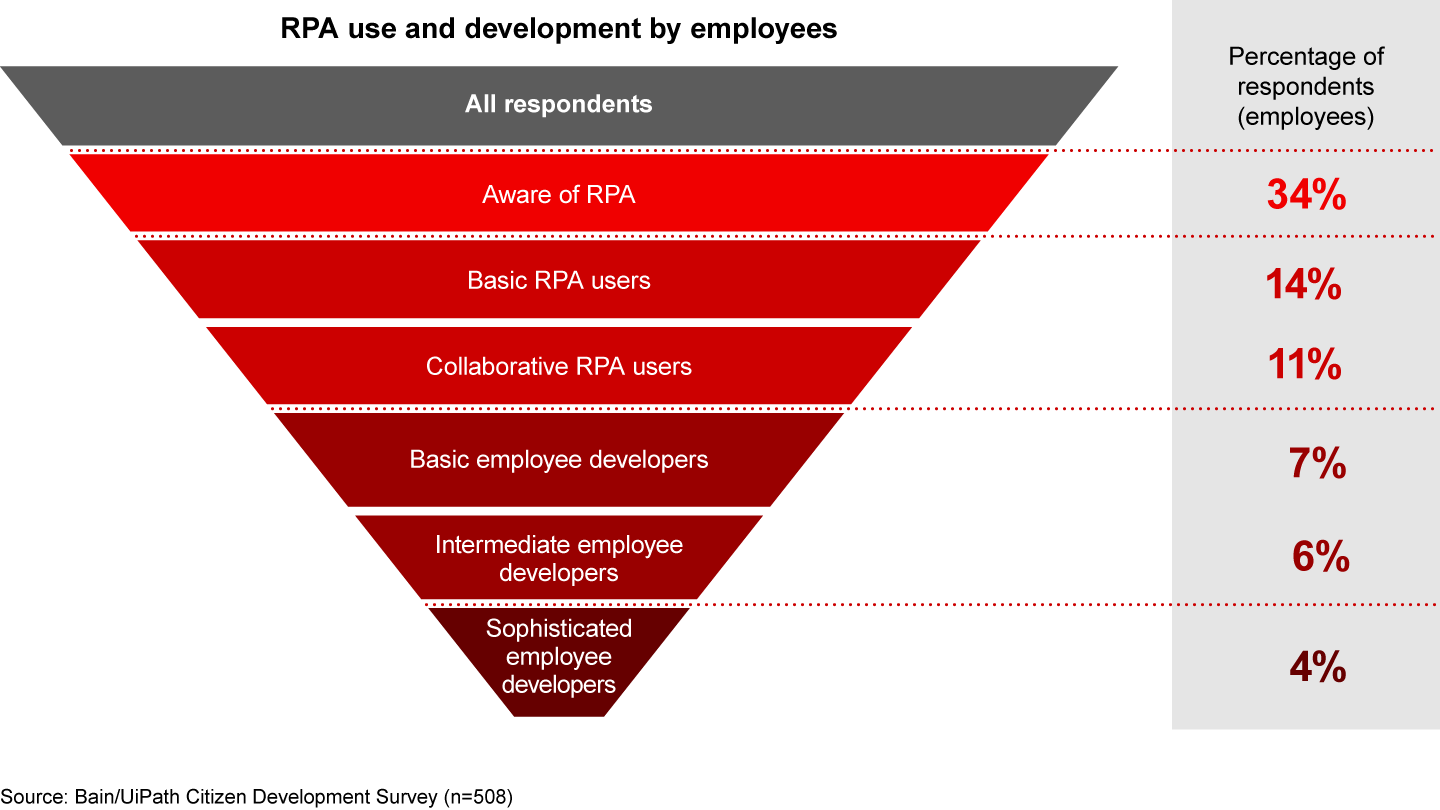

Once employees know about it, the great majority want to use RPA. Of employees who have heard of RPA, 60% have never used bots to perform tasks. Despite that, 86% cite high willingness to do so.
Among employees who already use RPA, half have never created a bot themselves. Still, some 80% are very willing to develop automations.
Hurdles to employee adoption
Three categories of impediments contribute to slow adoption among employees, despite high interest (see Figure 3).
- Cognitive. As the data shows, trust in automation is not an issue for employees. However, they struggle to identify use cases for automation in their daily work, and many are not certain about how automation adds value to their workdays.
- Organizational. Employees shy away from using automation if their company has not formally sanctioned it or does not offer a formal training program.
- Product and training. Employees frequently perceive products as difficult to use, and companies lack effective, consistent training to familiarize employees.
Figure 3
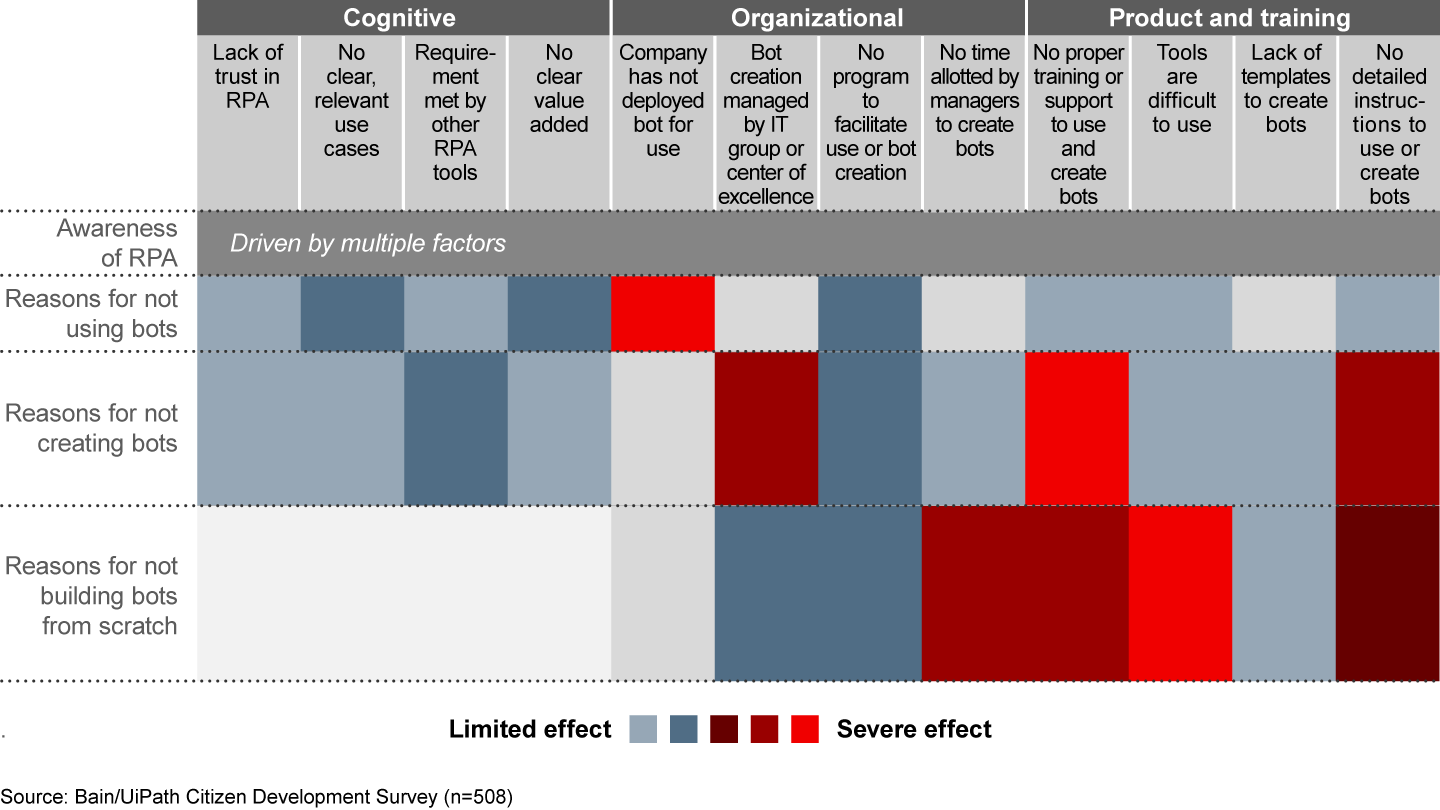

These findings underscore the importance of reconciling the automation paradox. Despite the widespread interest, many leaders mistakenly believe employees are not willing or able to use these tools.
While our survey focused on RPA, these trends also apply to other forms of automation. Building awareness of low-code and no-code automation tools, along with providing organizational support, should help increase adoption.
Four guidelines to achieve scale
Stepping back, it’s clear that different perspectives come into play as companies develop automation initiatives.
Business users want to free up time to do more valuable work and improve their skills. But they often feel hamstrung by IT and CoEs. Those who are eager to use and even develop automations may struggle to get the necessary support.
For their part, IT and CoE teams don’t want to cede control over identifying, building, and managing automations to business users. They have concerns about quality, security, governance, training, tool proliferation, scalability of automated solutions, and cost.
Senior executives, meanwhile, care most about enabling growth, increasing productivity, improving service quality, and enhancing customer satisfaction. They are only interested in automation if it will deliver significant business value.
With those perspectives in mind, the experiences of leading companies that have overcome the automation paradox suggest four themes for success.
Break through the noise. Most companies have numerous, often competing, business priorities. Why pay attention to automation over other priorities? CEOs need to convince their executives that automation is central to reinventing the business. And reinvention requires not only that business and functional leaders, supported by an automation CoE, identify and execute on automation ideas, but also that every employee contributes to achieving the automation goals. Business leaders will need to adjust the traditional view of automation as an initiative imposed on employees to an initiative alongside, or in collaboration with, employees.
Inspire employees. As mentioned, awareness is low. Just as a CEO must rally the senior management team to the cause, automation leaders need to inspire employees to take an interest in automation for their everyday work.
Hackathons, big prizes for great ideas, and bonuses for people who come up with winning proposals are among the ways to inspire. Companies will also have to think through what they do with the savings derived from an automation project, and how to reward the employees who enable it.
As automation takes hold, quarterly performance goals may include digital adoption scores tied to automation tool certifications. Organizations could establish digital personnel records that allow them to update and track milestones throughout a person’s career. Just as companies get consumers excited about buying a product, they can use similar marketing techniques in service of selling automation internally.
Singtel launched “a robot for every person” with the goal of saving at least 30 minutes weekly for each employee. This program is not an investment in bots but in people. Since the way work is done will change as Singtel introduces automation, the company invested time and resources to help employees upgrade their skills.
Formalize the democratization. Success with automation entails coaching employees on how to spot use cases and how to navigate the transition to digital processes. Digital transformation requires not only new tools but also new ways for people to collaborate.
Employees should be able to share automation projects with other employees through power users. Having one enterprise-wide platform—a low- or no-code development environment—makes it easy for anyone to develop an automation without going through the IT group. And the IT group or automation CoE can provide the right governance to avoid tool proliferation, assist business users in building their automations, and provide the right frameworks to scale up these automations.
World Fuel Services conducts workshops to showcase the potential of automation, with real-life examples to make it interesting and relatable. With the CoE team as an advocate, World Fuel Services introduced an employee-initiated automation program that allows anyone in the organization, regardless of technical skills, to create software robots for everyday clerical tasks. Continuous communication makes people aware of the value of automation, including opportunities that might lie within their departments and what it can do for them personally.
Invest in culture change. Smart leaders recognize, and act quickly to address, employees’ fear of losing their jobs to automation. They communicate early and often on the impacts that automation will have in their companies. Democratizing automation ultimately requires employees to adopt a digital or automation-first mindset. And to do so, employees need clarity on what is in it for them as individuals. It’s important to highlight how automation empowers employees with better skills, allows them to focus on higher-value activities, and ultimately leads to greater advancement and rewards over their careers. And companies should celebrate the successes of employees who innovate the use of automation to add business value.
As automation of all kinds spreads throughout the business, many companies unwittingly limit its potential. That leaves a huge amount of value untapped. Properly scoped and sequenced, an automation democratization program helps companies harness employee knowledge and creativity to surface new opportunities for automation and ultimately reinvent their businesses.

About UiPath
UiPath has a vision to deliver the Fully Automated Enterprise™, one where companies use automation to unlock their greatest potential. UiPath offers an end-to-end platform for automation, combining the leading robotic process automation (RPA) solution with a full suite of capabilities that enable every organization to rapidly scale digital business operations. Learn more at www.uipath.com.
Published in September 2021