

Retail Holiday Newsletter

At a Glance
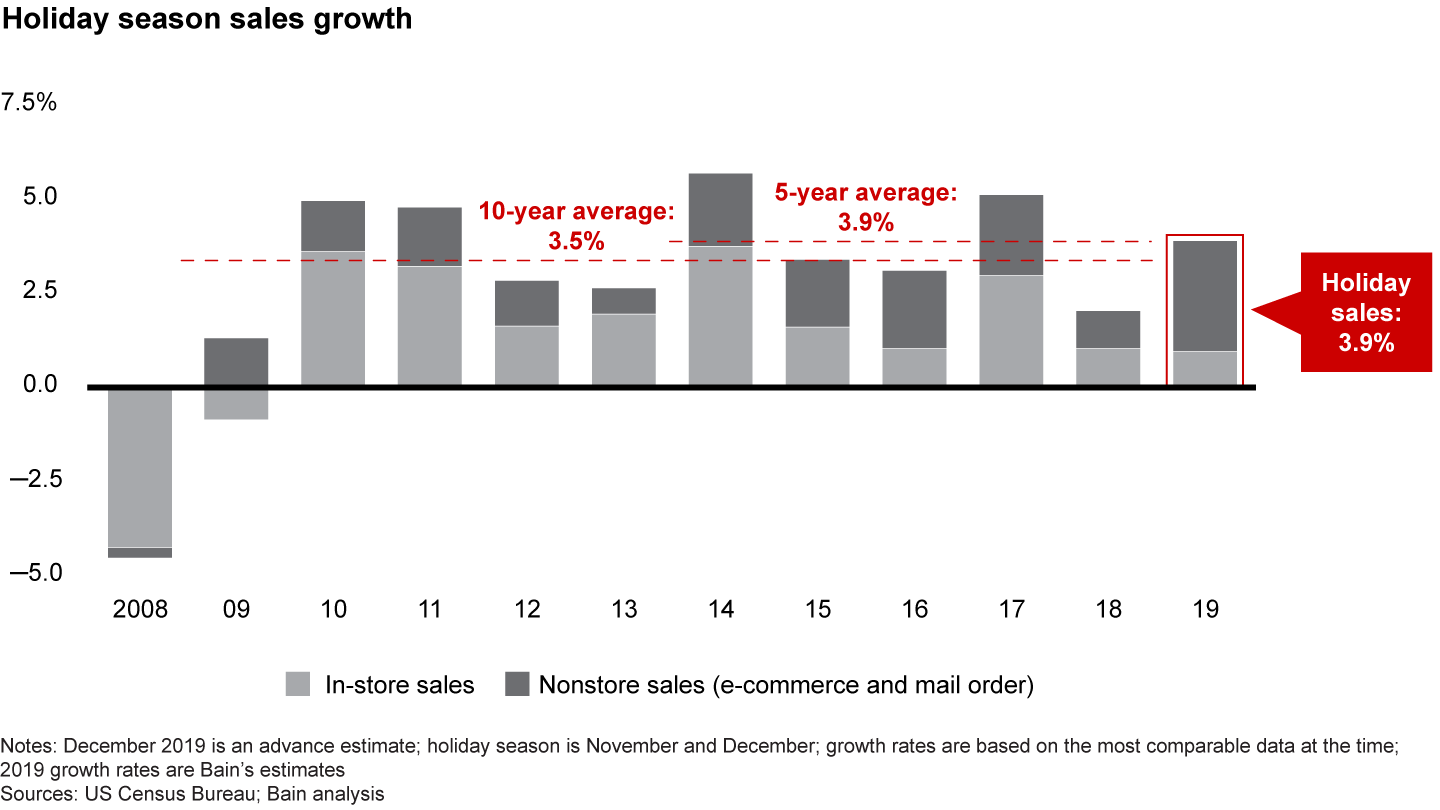
- Overall retail sales increased a robust 3.9% this holiday season, approximately in line with our 3.8% forecast and more than the 10-year average of 3.5%.
- Nonstore sales rose 14.7%, bolstered by the steady climb in mobile shopping. In-store sales increased a mere 1.3%.
- To carry their holiday success into the 2020s, retailers will need to navigate 10 transformational trends.
- Winners over the next decade will do more than ride trends; they will gain market share by adopting an insurgent mindset and outmaneuvering competitors.
Tying a bow on 2019
US holiday sales returned to strong growth this year, bouncing back from a disappointing 2018 season. Preliminary estimates suggest that overall Bain-defined retail sales grew an impressive 3.9%, almost perfectly in line with our forecasted growth of 3.8% (see Figure 1). Strong nonstore sales, which notched 14.7% growth year over year, propelled the gains. In-store sales were muted, growing only 1.3% over last year. Results were mixed for individual retailers.
Figure 1

E-commerce excelled as mobile continued its march toward dominance. For the first time, nonstore sales—predominantly e-commerce channels—made up more than 20% of total holiday sales, clocking in at 21.5%. Mobile sales bolstered this growth: Adobe Analytics estimates that 58% of online retail traffic originated from smartphone apps and mobile website visits vs. 51% last year. Although these mobile consumers are still less likely than desktop shoppers to convert visits into purchases, an increasing number are hitting the checkout button. Smartphone purchases accounted for 36% of this season’s online purchases vs. 31% last year. This growth was partially supported by the integration of commerce into social media platforms. This holiday season, TikTok began testing shoppable links in its videos, and Instagram integrated in-app checkout for select retailers.
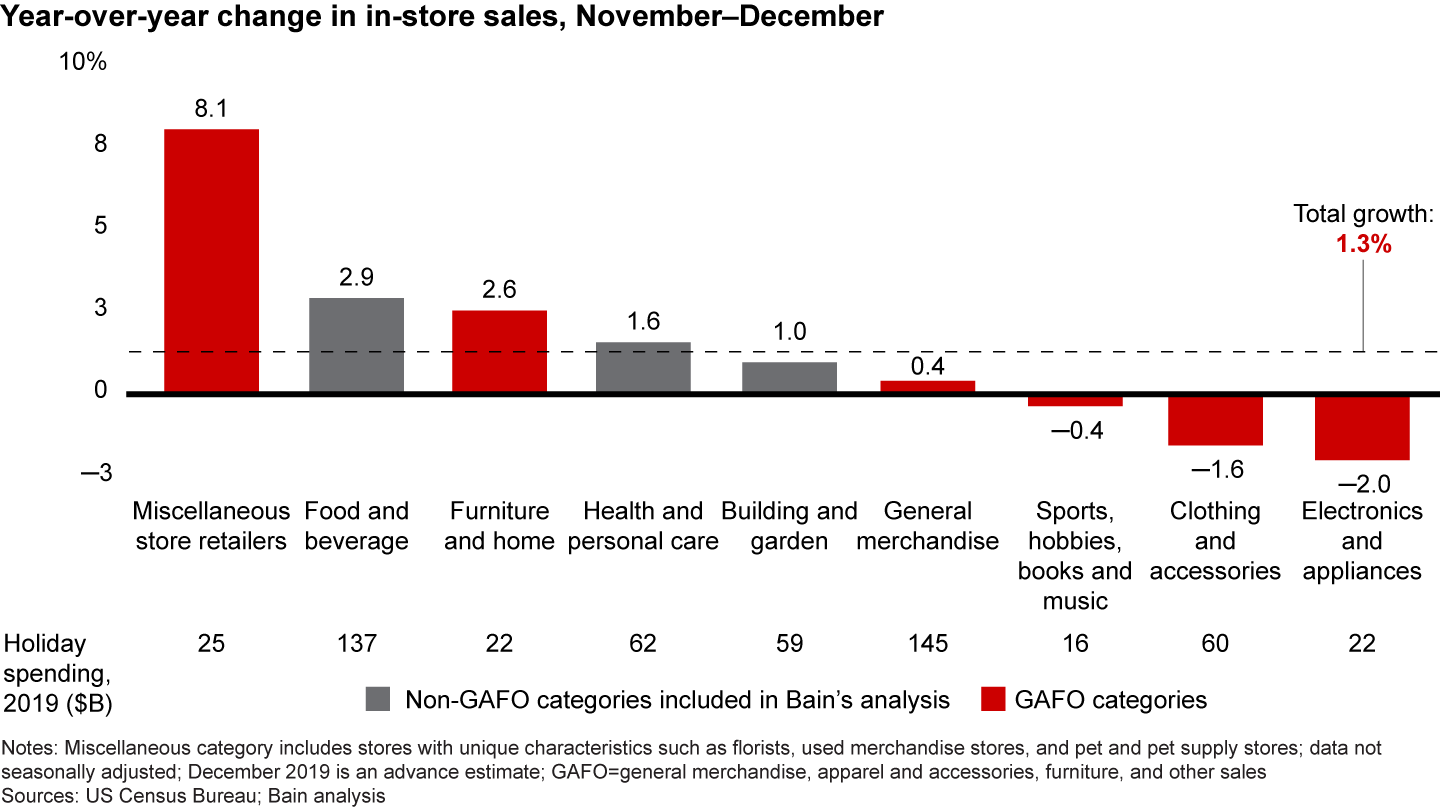
For many retailers, in-store sales were disappointing. Shoppers continue to move away from brick-and-mortar stores. In-store holiday sales maintained last year’s lackluster 1.3% growth rate, disproportionately affecting some retailers in major shopping categories, including general merchandise, clothing and electronics (see Figure 2). There were some bright spots: Costco saw a 9% increase in December same-store sales, and Lululemon raised its fourth-quarter guidance after a strong holiday performance.
Figure 2

Retailers are anticipating record gift returns. Total holiday gift returns are expected to reach $95 billion. Return volume was forecasted to peak on January 2, with UPS alone expecting to process 1.9 million returns, a 26% increase over the peak day last year. With this season’s strong e-commerce sales, the growth in returns is no surprise: According to estimates from Shopify, online purchases are roughly three times more likely than brick-and-mortar purchases to be returned over the holidays (vs. twice as likely during other times of the year).
The increase in returns presents an opportunity (and potential pitfall) for retailers. According to a recent UPS survey, 73% of online shoppers stated that their experience with returns influenced their likelihood of making future purchases at a retailer, and these consumers rank free return shipping as the most important factor in a positive return experience. But returns can take a bite out of retailers’ margins. As e-commerce grows, they will look to alternative options, such as hassle-free in-store returns or new personalization and apparel fit tools that improve customers’ satisfaction with initial purchases, to limit the economic impact.
Trends to navigate over the next decade
While the turbulent 2010s ended on a relatively high note, retailers are bracing themselves for more disruption in the 2020s. And change will come in all shapes and forms: consumer behaviors and expectations, tools, capabilities, leaderboards, and more. This constant change is nothing new—of the top 10 net profit leaders in 1970, only one remains on the list today, and there have been meaningful shifts even in the past decade alone, including Amazon’s meteoric rise.
In an industry with nonstop turnover, predicting the future seems impossible. Forecasts are often incorrect in determining the direction, magnitude or timing of change. But attempting to peer into the future often helps leaders recognize change faster and respond to it more quickly and effectively. So, what trends will retailers face over the coming decade? We predict that some familiar themes will escalate in speed and impact.
- Unique products become increasingly critical. As algorithmic price comparison bots get smarter and faster, competition will intensify. But customers can’t price compare products that don’t exist elsewhere. To win over customers, most retailers will increase the exclusive and private label portions of their assortments by 10 to 20 percentage points over the next decade.
- Consumers place even more value on their time. From researching products to purchasing and accessing services, the opportunity cost of shopping is continuously increasing. With more (and better) choices for how to spend their time, consumers will need to weigh trade-offs—for instance, “Should I hunt through a store for an hour, or should I make money by driving for Uber?”—and convenience will become even more important. Winners will benefit from providing time-saving solutions, such as fast and easy curbside pickup, scheduled autonomous delivery and real-time mobile support, among others.
- Personalization gets more practical. We’ve seen major strides in targeted marketing and assortment localization, but these capabilities often come with technology and process challenges. Leaders will unlock the power of boundless data to gain a next-level understanding of their customers and to cater to individuals in real time at scale.
- Technology expands innovation opportunities. As unit costs of technology exponentially decline while IT budgets grow, retailers will broaden their use of radio-frequency identification (RFID), warehouse and store automation, dynamic signage, and more. These innovations will speed up supply chains, improve experiences and reduce costs.
- Measuring effectiveness and causality gets harder. As the lines between digital and physical blur and retail systems become more complex, it will be trickier to determine which individual factors influence customer behavior. Retailers will shift their focus from channel- and store-specific views to comprehensive views of each customer and catchment area.
In addition, we anticipate fundamental shifts, which will require fresh thinking.
- Digital isn’t always better. Digital can revolutionize the shopping experience, but at times, physical interactions and innovations with a human touch can better enable retailers to connect with shoppers. Winners will blend technology with more personal and tactile solutions, creating outstanding (and often previously unimaginable) customer experiences.
- New tools fight costly product returns. Reducing the cost of product returns is good, but reducing the number of returns is even better. Innovative technologies, such as 3-D body scans, computer vision and augmented reality, among others, will reduce returns and boost customer satisfaction across product categories.
- Sustainability considerations fundamentally change. More customers will shift from saying they care to shopping with care. As a result, winners will invent new business models to deliver reused, resold and recycled goods; to reorient supply chains to lessen their environmental and social impact; and more.
- Talent equations tumble. Demographic cycles and regulatory policies will force retailers to manage rising wages and rethink historical approaches to employee sourcing, scheduling, engagement, training and retention. Talent strategy and effective talent systems will become a source of competitive advantage.
- Being big doesn’t mean being slow. Winners will embrace more nimble operating models, adaptive supply chains and analytically oriented talent to react quickly to changing customer preferences and market trends. They will break away from hierarchical, functional silos and create nimble teams that are empowered to make decisions and take action.

Doing Agile Right: Transformation Without Chaos
Agile has the power to transform work—but only if it's implemented the right way.
How to prepare for the future
Knowing what may lie ahead is only the first step. It’s equally important to understand the timing and implications of future trends. Making the wrong assumptions on those fronts can be costly. Remember Webvan? Founded in 1996, the dotcom company correctly predicted a major trend: grocery e-commerce. But its multibillion-dollar valuation imploded because of two miscalculations. The first was the speed of adoption—Webvan was too early. The second was its capital-intensive model for delivery and separate inventory—it would have had a better shot at success as a low-cost disrupter. Unable to change course quickly, Webvan didn’t survive long enough to see online grocery shopping go mainstream.
Such tales of caution can be paralyzing for many retailers. They struggle with questions on how to proceed: Should we offer faster free shipping to grow now, or should we keep the profit from expedited delivery fees? Do we invest in RFID, new point-of-sale systems and employee training programs now, or do we wait for the technology to improve and costs to decrease? How realistically and rapidly can we embed artificial intelligence and adapt processes?
Industry leaders, on the other hand, have the keys to success: They understand the futility of trying to make perfect predictions and the value of flexibility to pivot as conditions change. Here are four practical steps to consider when evaluating future trends.
Build off the known future
While nobody knows specifically how or when autonomous vehicles, 3-D design, the growth of exurbs and other trends will impact the mainstream, there are directional truths. We do know that costs will decline as technology continues to improve, consumers will continue to demand added convenience and the lines between channels will continue to blur, among myriad other certainties.
To prepare for the future, retailers can first identify and decide which of these known truths are most likely to affect them: Which fit with their brand, and which add value for their customers? What concrete strategies can their team rally around? From there, determine the implications for the next few years, not just the next few quarters—the known future is often (but not always) further away than we expect.
Take a test-and-learn approach
Success is rarely achieved on the first attempt. Play-Doh was initially developed to remove coal dust from wallpaper, and YouTube was originally intended to be a video dating service. In fact, nearly two-thirds of venture capital successes transform initial plans while 80% of failures stick to the original plan.
Retailers, with their expansive store footprints and constant access to customers, are prime candidates for such a nimble approach: They have a perfect test lab for field trials, limited releases and customer studies. Leading retailers determine what, when and how to adapt to change by testing the assumptions underlying anticipated trends. They let the results dictate whether it’s time to invest behind an idea, change an approach, slow-roll an expansion or reject a new opportunity outright.
For instance, Polo Ralph Lauren partnered with digital upstart MakerSights to test which styles of men’s T-shirts to take to market. They applied predictive intelligence to preseason customer feedback, informing the retailer’s seasonal assortment before placing big buys. These tests boosted sales while markdown rates decreased by double digits.
Adopt a venture capital mindset
For most retailers, requests for multimillion-dollar (or even multibillion-dollar) checks over multiple years are tough pills to swallow, especially when investors want to see profits and success doesn’t feel certain. Leading retailers, however, are taking a page from the venture capitalist playbook to weigh new investments.
First, rather than funding large, long-term commitments, they start with a small Series A investment to nurture proof-of-concept ideas. Further investment is allocated as ideas are successfully refined or, just as importantly, quickly denied as ideas prove irredeemable. Most won’t work, but this approach enables retailers to limit losses quickly and grow gains aggressively. Second, these retailers take a portfolio approach. Several small bets, which often aim to fill the same customer need, increase the odds that one idea will work.
Consider Amazon’s numerous experiments in grocery. The e-commerce giant began offering nonperishable grocery items through Amazon.com in 2006. Since then, it has expanded to a portfolio of offerings, including PrimeNow, Whole Foods, Amazon Go and its own new large-format traditional grocery store that will launch in select cities this year. Not every experiment has worked: Amazon Fresh was subsumed by PrimeNow, and Prime Pantry is rumored to be winding down. Although Amazon has only achieved 3% share of the total US grocery market, these experiments have made progress. The retailer is on track to grow that share by more than 50% by 2025, and it has achieved a 47% share of the US online grocery market.
Embrace more nimble operating models
All the testing strategies and investment models in the world are worthless if innovative ideas languish in traditional retail hierarchies. Yet very few retailers have updated their operating models—their structure, accountabilities, governance, capabilities and ways of working—to foster innovation. To speed up decision making and change company culture, retailers need to rethink outdated ways of working. New operating models can break siloed, bureaucratic bottlenecks. They rely on cross-functional groups, close to the consumer, empowered to make rapid decisions that would normally take weeks to slog up the traditional chain of command.
Those experimenting with nimble operating models and emulating Amazon’s “two-pizza rule,” which states that every team should be small enough to be fed by two pizzas, have found success. These industry leaders have boosted productivity, time to market and quality—all while reducing the barriers to adoption for new ideas.
. . .
Our final prediction: Retailers’ ability to manage through change will become the single biggest factor determining whether they earn a spot on future leaderboards. In the coming months and years, the rapidly evolving landscape will challenge them to adopt the latest technologies, embrace new talent and ways of working, establish deeper relationships with their customers, and more. Those that succeed will adopt an insurgent mindset, proactively think about disruption, and move quickly and intelligently ahead of the competition.
Wrapping up
This is the last issue of this season’s holiday newsletter. Thank you for tracking the holiday season with us. We hope you’ve enjoyed our discussions on Amazon’s influence, innovation in retail supply chains, seasonal marketing and future trends. The full series can be found here.
We look forward to keeping in touch with you over the coming months, and we will be back later this year to share our 2020 holiday outlook. As always, we welcome your thoughts and questions.
Appendix
Exhibit A

Suzanne Tager is a senior director with Bain & Company’s Global Retail practice and is based in the firm’s New York office. Darrell Rigby leads Bain’s Global Innovation practice and is based in the Boston office. Aaron Cheris leads the firm’s Retail practice in the Americas and is based in San Francisco.
The authors would like to acknowledge the contributions of Sara Magenheimer, Muhammad Eltahir, Mark Heneine, Amanda Sload and Daniel Topler-Garcia.
Published in January 2020