

Brief

At a Glance
- US department store retailers have launched a host of incremental initiatives to rejuvenate their businesses, but they’ve yet to achieve the game-changing impact needed to transform shopper behavior.
- Amid continued sales declines and shopper indifference, time is running out for these evolutionary approaches, but a bolder strategy can still succeed.
- Executive teams need to restore their innovation engine first, then create far greater differentiation in assortment, experience, and value.
Once a hotbed of retail innovation, US department stores recently have focused on mere survival. Now, having defied many predictions of their imminent demise, they may be facing a true moment of reckoning. Sales reported by North American department store retail groups declined at a compound annual rate of 6% from 2018 to 2023, an acceleration of the 5% revenue erosion suffered annually in the preceding five years. The financial pressure remains intense, and more department stores are set to close.
The outlook is particularly alarming because many US shoppers are now indifferent or averse to the format—a trend that might not be showing up fully in the Net Promoter ScoreSM surveys carried out by department stores themselves, but which is clear in our double-blind research across the sector, conducted in partnership with ROI Rocket. Just look at women’s clothing, once a department store stronghold. In 2018, when we ranked women’s clothing retailers by NPS®, four department stores were in the top ten. In 2023, there was one, way back in eighth place.
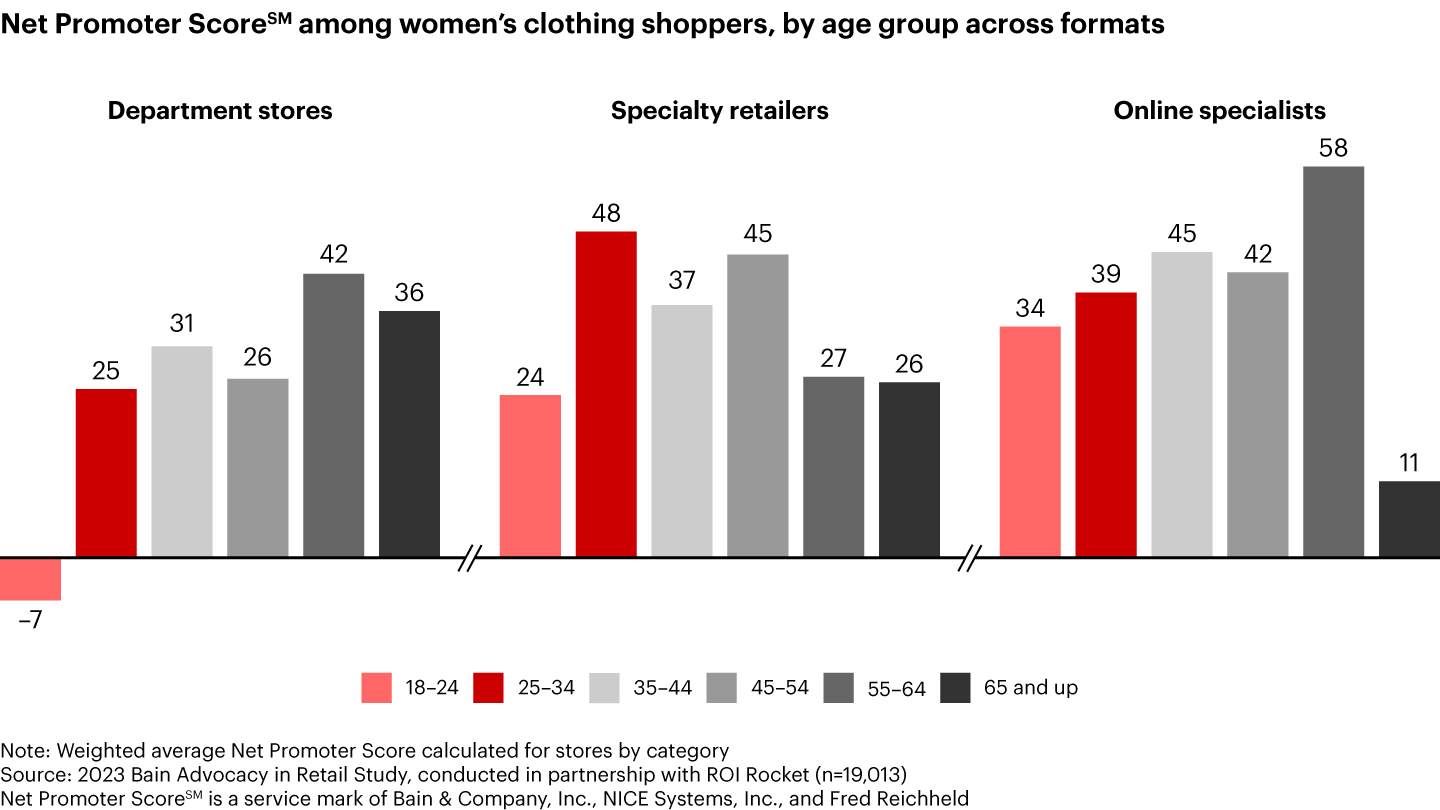
Today, few US department store operators are NPS leaders in any category, be that children’s clothing, women’s apparel, home, beauty, or other competitive battlegrounds. The shoppers who still recommend them tend to be over 45, a stalwart demographic that nonetheless can no longer be taken for granted as digital penetration grows among all age groups. In the key women’s clothing category, US department stores have an NPS of negative 7 among 18–24-year-olds, meaning detractors outnumber promoters (see Figure 1).
Figure 1

It’s all deeply frustrating for US department store executive teams. Striving to rejuvenate their businesses in recent years, they’ve launched initiative after initiative to strengthen the customer value proposition against a backdrop of layoffs, declining mall traffic, store closures, inventory volatility, activist investor scrutiny, and many other complications.
Some current attempts at repositioning, such as the ongoing expansion of Bluemercury beauty specialty stores by Macy’s, show promise but aren’t likely to be sufficient on their own, given their relatively limited size compared with the retailer’s overall business. Other initiatives are unlikely to gain much traction or have faded away already, such as the Cusp freestanding luxury boutique concept tried and shelved by Neiman Marcus. Overall, it’s hard to think of an angle that hasn’t been considered by department stores lately.
However, the long list of experiments doesn’t mean all avenues have been exhausted. Far from it. Some of the attempted changes have borne fruit. The real issue is that none have yet generated a big enough improvement for shoppers to notice and appreciate the enhancement, then alter their behavior accordingly. That’s because those changes have been too incremental and too slow to scale.
Today’s evolutionary approach won’t create the visible and habit-changing impact that’s urgently needed to win back shoppers. But it’s not too late to shift gears. While the competitive outlook remains challenging, a fresh transformational push could capitalize on a few industry trends that offer department stores relief. For instance, some disruptive e-commerce pure plays that once lured shoppers from department stores are now struggling due to the high costs of shipping and returns and to unsustainably low profit margins. Similarly, some brands that went big on selling directly to consumers have realized that this channel brings its own capital and cash flow challenges.
Department stores can build on consumer-level advantages too. The squeeze on spending created by inflation and rising interest rates has tended to affect their core demographic of older and more affluent shoppers less than the young. Furthermore, consumers still really do value the opportunity to shop across brands, which is core to the department store value proposition. And many people emerged from the pandemic with a renewed appreciation for the physical experience of shopping in-store (when executed well).
Years of existential threat have highlighted other cards that department stores still hold, such as the breadth of shopper data in their loyalty programs, cheap rents, knowledgeable store associates, and their strategic importance to vendors, many of whom can’t afford to let the format fail. These are all meaningful assets that can mitigate the broader challenges. However, to keep defying the prophecies of doom, US department stores urgently need to carry out a hard reset of their customer value propositions.
First, restore the innovation engine
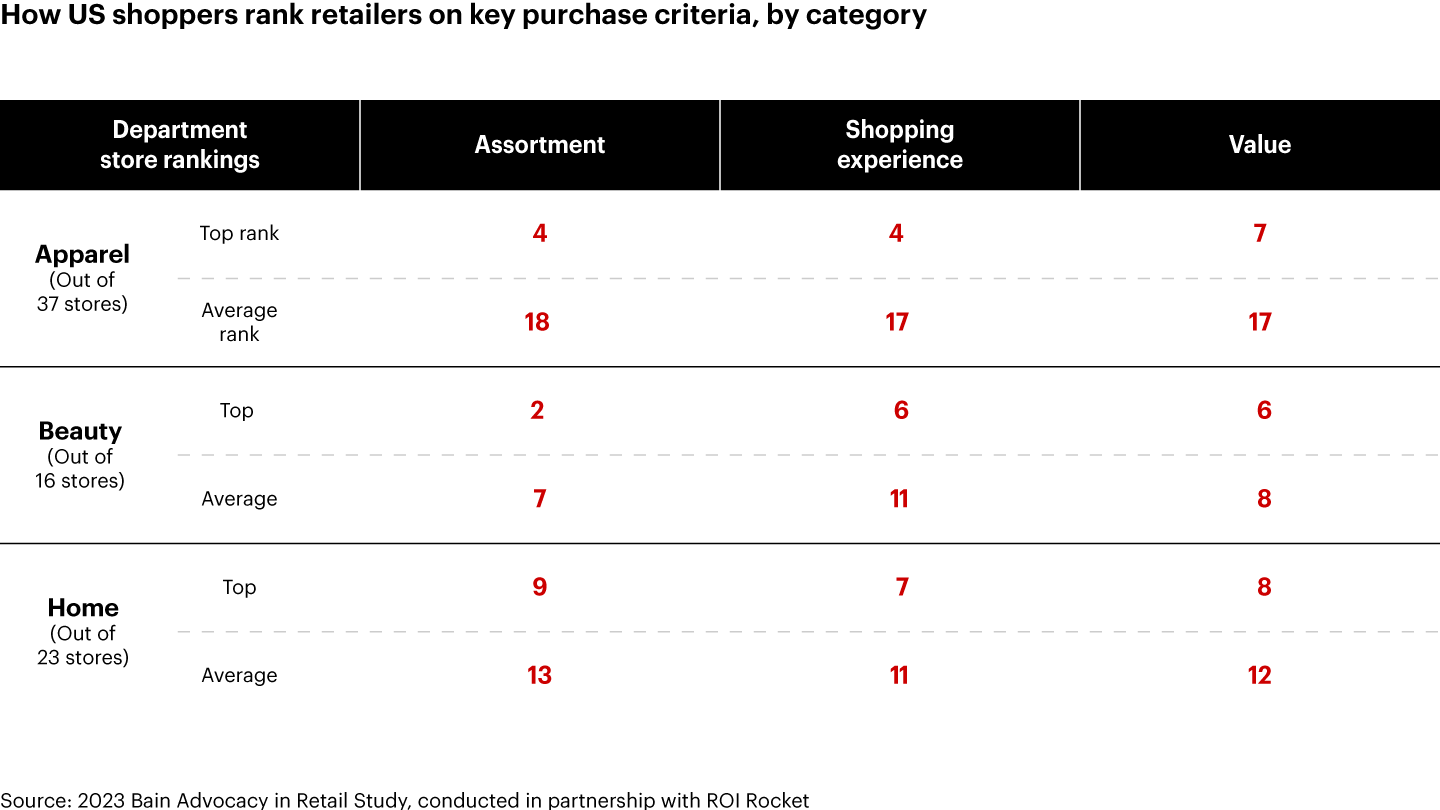
To thrive again, US department stores need a customer value proposition that passes the following simple test: Do we sell things that today’s shoppers want, in a way that makes people return, and at a price that conveys value? Today, the format too often fails to meet one or more of the criteria. When it comes to assortment, shopping experience, and value, our research shows the average US department store is at best in the middle of the pack (see Figure 2).
Figure 2

Before we dive into some specific actions that US department stores can take to revamp their assortment, experience, and value, we first need to talk about innovation, a current weakness that’s hampering progress in all three of these areas.
When we ask US department store executives to tell us how innovation happens at their company, we get stories about incremental improvements in every functional silo. That approach must change for there to be a meaningful reset of the customer value proposition. Department stores need to make fewer, bigger bets while taking a coordinated, cross-functional approach to testing and scaling new ideas. They need continuous steps toward breakthrough innovations, not lots of little things that nobody notices. And they can’t compromise this bold new vision by trying to shoehorn it into existing spaces, organizations, and labor models it just won’t fit.
Of course, the financial constraints that force such compromises on executive teams are brutal. To ease these constraints, US department store operators at the very least need to free up cash. That will involve reinventing the cost base, taking care to avoid spending cuts that damage the shopper experience. Further consolidation of the sector (through moves similar to the recently agreed acquisition of Neiman Marcus by Saks Fifth Avenue’s owner) could also boost innovation efforts if additional scale benefits are skillfully deployed. Unlocking new profit pools through “beyond trade” diversification in areas such as retail media and data monetization can help, too (see the Bain Brief “How Engine 2 Expansion Can Power the Future of Retail”).
Executive teams can also take advantage of new technologies both to ease the financial pressure and to turbocharge their innovation program. Generative AI is particularly promising, with pilot projects offering productivity gains and revenue enhancements that can be as high as 50 times the required investment (see the Bain Brief “Retail and Gen AI: Now Scale Those Terrific Early Returns”).
In addition, it’s worth remembering that great innovations reduce costs in other areas. They make jobs easier and more rewarding for employees, reducing attrition. Their word-of-mouth success amounts to free advertising. Crucially, great innovations persuade investors that reinvestment in the business is a good idea, which would be a welcome change from their current preference for the safety of dividends and stock buybacks.
An innovation engine firing at scale is the only thing that can renew the customer value proposition and propel US department store operators to a profitable future. Some of the ideas generated by the engine will fail. Those that succeed will be too quickly copied by competitors. But the hardest innovation to copy is the innovation process itself—and that can be a solid platform for winning back and retaining shoppers in the long term.
Assortment: Make merchandise the star attraction
In our latest NPS research, 23% of department store detractors cite assortment-related concerns as primary reasons for reporting a low score. These assortment failings include stores offering only a limited selection of the styles and brands that are most relevant to the shopper, outdated selections, and poor quality relative to value.
Assortment is indeed a weak spot for US department stores overall. Inventory often includes too many duplicative items (few shoppers need a rack of near-identical black polo shirts from different brands). Too much shelf space is offered to brands that spark little excitement in shoppers. Too little shelf space is taken up by hot brands that have real consumer pull.
Department stores need to be more ruthless in reducing product overlaps and weeding out products from tired brands that are only stocked because the supplier offers favorable terms. Hot brands need to be reassured that selling through department stores can enhance their growth rather than kill their cachet. Department stores can help emerging brands gain that confidence by offering them the best merchandising space, insights from shopper data usually shared only with big brands, and even accelerator funding.
There’s still a huge opportunity for department stores to sprinkle some stardust on their private-label ranges, turning them into genuine brands with world-class design and exceptional quality. Just look at what Target has been able to achieve with its Cat & Jack children’s clothing brand, which boasts sales of more than 300 million units a year and is now being sold through the Canadian department store chain Hudson’s Bay.
As top brands reevaluate channel strategy in light of direct-to-consumer sales growth, department stores will have to show they can be effective partners to gain access to the latest in-demand products. As with high-growth emerging brands, the answer might include sharing more data-driven insights on consumer behavior. Targeting a specific tier of a brand’s assortment (“good,” “better,” or “best,” for instance) could pay off for stores, too. On the flip side, some vendors might need reminding of how much they need department stores to remain a viable channel.
Experience: Start with remarkable service
To tackle their mediocre ranking for shopping experience, department stores should ensure that customer-facing associates offer exceptional service. These employees must earn the confidence of shoppers in the briefest of interactions. That can only happen if department stores hire people who are service oriented and can offer credible expertise in the products they are selling.
After hiring these customer-friendly talents, department stores will need to retain them not just with competitive pay but also with meaningful career paths and training that can help stars advance beyond entry-level roles. Associates need tech-enabled tools that make them look good in the eyes of the shopper. Their credibility can be further strengthened by attractive employee discounts that enable them to gain hands-on knowledge of the products they sell.
Nothing can sway shoppers quite like personalized service from a store associate at the top of their game. Nonetheless, department store retailers can augment this human connection by using cutting-edge analysis of loyalty program data to hyperpersonalize their automated interactions with shoppers, both online and in-store. That can help them inspire shoppers with new purchase ideas—a traditional strength that hasn’t yet fully translated to the digital age.
As for the physical experience of shopping in a department store, it’s perhaps unreasonable to expect things to be as magical as they were during the format’s 20th-century “cathedrals of commerce” heyday. But it is still possible for brick-and-mortar retail to dazzle shoppers in a way that also boosts profits.
Consider Dick’s Sporting Goods, one big-box retailer that has thrived as department stores declined. It launched its first Dick’s House of Sport experiential store in 2021 and plans to expand the format to as many as 75 to 100 locations by 2027, up from 14 in May 2024. In a move rich in symbolism, it recently opened a new House of Sport on a Boston site previously occupied by a Lord & Taylor department store. The immersive attractions within include a climbing wall, a batting cage, and a putting green. But they aren’t just for play: Dick’s is targeting EBITDA margins of about 20% from the House of Sport format.
Even with the budget constraints they face today, department stores can push the boundaries of the in-store experience to increase traffic through fun bolt-on offerings (fitness classes, fashion shows, etc.) and other innovations. And they should never underestimate the power of a fast and cheap tailoring service to win over customers simply by making their new clothes fit properly.
Value: Break bad pricing habits
In our NPS research, 22% of detractors say expensive prices are a key reason they do not recommend shopping at US department stores. When it comes to competing on value, US department stores are still being held back by excessive complexity across their many layers of markdowns, coupons, loyalty deals, and clearance offers. That’s hurting their ability to compete with off-price retailers such as T.J. Maxx and HomeGoods, while alienating shoppers who don’t want to (or don’t know how to) play the coupon-clipping game. Moving to everyday low pricing won’t be the answer either, but there’s still lots of room for simplification.
This is sensitive territory for department store retailers, of course. Many executives remember JCPenney’s strategic U-turn in 2012, after it overhauled its pricing too hastily and ended up alienating customers who liked hunting for treasure amid the markdowns. As they seek to revive their appeal, department stores still need to take care not to alienate core customers. But they can’t let themselves be paralyzed by the JCPenney episode. Remedial action is much more urgently needed now than it was in 2012. Tweaking the status quo is no longer an option, except for department store operators overtly looking to harvest short-term value.
It’s worth remembering that department stores once disrupted the retail industry by offering one price to all customers, eliminating haggling. Breaking the bad pricing habits of recent decades isn’t the first action we’d recommend. But once US department stores have upgraded their merchandise and their service levels, it will be time to improve pricing policies and regain the trust lost through the constant sales events, the coupons on top of coupons, and all the other maneuvers that succeeded the radical transparency of the format’s youth.
A new day one can be done
It’s understandable if US department store executive teams feel fatigued after so many attempts at correcting course over recent years. There’s no shortage of items already on their strategic to-do lists, either. But renewed momentum doesn’t necessarily require a succession of new transformation initiatives. In some cases, it can be achieved by reprioritizing or redirecting existing efforts.
Innovation by department stores helped to create modern US retail. As well as haggle-free pricing, it popularized features as diverse as one-stop shopping, escalators, money-back guarantees, and the chance to meet Santa Claus at Christmas. These bold moves in the format’s infancy created differentiated value and a platform for decades of growth. It’s not too late for US department stores to usher in a new day one by rediscovering a flair for innovation at scale and resetting their customer value propositions.
Published in July 2024