

Brief

Wake up the average CEO in the middle of the night, and they'll probably start talking immediately about creating shareholder value. But what does value actually mean? How is it created? And how do companies that do create it sustain it over time?
When most executives think about value creation, they think about it through the lens of the P&L: more revenue, less cost, or some combination of the two. This is one very important type of value creation, but it's not the beginning nor end of value creation.
Capital efficiency and an optimized capital structure are just as important, but most executives feel much less comfortable with cash flow statements and balance sheets. To truly understand value creation, you must understand how all three levers work together.
Our purpose here is to demystify the process of developing and executing strategies that lead to superior economic profitability and growth.
What is economic value creation?
Warren Buffett’s mentor Ben Graham taught him that in the short run the stock market is a voting machine, but in the long run it is a weighing machine.
Investors are always trying to figure out how likely it is that a given set of actions by management will create or destroy value over time. The point of Graham’s observation is that their visibility into the drivers of value improves over time, as the company shifts from telling its story to showing its results.
In the near term, the story you tell is critically important—investors need to dream the dream with you in order to buy in. In the long term, the results you deliver will tell the most decisive tale.
Investor perceptions can be detached from reality at any given point in time, but the two will converge eventually; this means that an effective equity story must be grounded in real actions that create tangible long-term value.
To understand what creates value, let’s start by defining our terms.
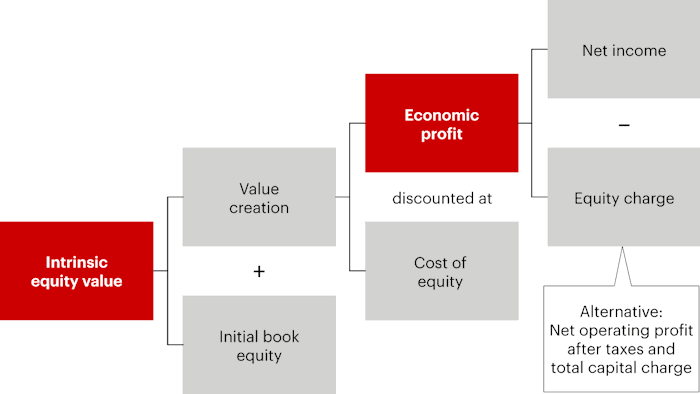
You can see from this diagram that if you increase economic profit, then, all else being equal, you will increase intrinsic value. Over time, since markets are fairly efficient, intrinsic value converges with market value.

Growing economic profit is straightforward—grow revenue, increase profitability, improve capital efficiency—but not easy.
We should note that since economic profits are discounted at the cost of equity, any increase in the cost of equity (e.g., as a result of higher interest rates) will cause markets to value future growth less and current profitability more.
As we transition from a world of capital abundance to one of comparative scarcity, the relative importance of profitability and growth will shift. That is a long run, secular trend. Over the medium term, as political parties, policymakers, and conditions shift, movements in interest rates will cause market gyrations that companies will have to navigate. Strategies must be resilient both to the long run trajectory and the oscillations around it.
This reality implies that companies should focus not just on growth but profitable growth.
History is replete with stories of companies that gorged on junk revenue that led to little or no bottom-line impact, sending their stock prices soaring in the near term, only to come thudding back to earth when the P&L rendered its final verdict (think of Lucent, Global Crossing, Enron, and other notorious flops). Hence our focus on sustainable value creation.
If you take market value growth and add cash distributed to shareholders (via dividends or stock repurchases), you get total shareholder return (TSR), which is what most investors rely on as a measure of value creation.
What is sustained value creation?
Anybody can get lucky, at least for a while. They can launch a product that takes off with consumers, catch a tailwind from secular growth trends, or form a company during a historically anomalous period of low interest rates and stable economic expansion.
Legendary baseball manager Branch Rickey said that luck is the residue of hard work. Profit From the Core, the classic 2001 business book by Bain Partners Chris Zook and James Allen, was, in a sense, their attempt to understand just exactly what kind of hard work might produce the best luck over time.
Rather famously, that study concluded that the most sustainable path to value creation was to focus on driving a well-defined core business toward full potential, capturing and extending the benefits of leadership economics by developing repeatable models for success.
At Bain, we still believe in this, 25 years later.
We recently refreshed our analysis of sustained value creation (SVC) and, in the process, shed new light on the challenges involved.
Here’s what it shows: Sustained value creation is hard.
How hard? Take a look.
Less than half of all companies in our database generate an economic profit in a given year (2024, in this case). Slightly more than a quarter generate revenue growth higher than inflation. Less than 20% of all companies manage to deliver both a positive economic profit and real top-line growth in a single year.
How many companies can sustain this for 10 years in a row?
Basically nobody.
Even if we relax the constraint—from delivering profitable growth 10 years in a row to doing it 8 years out of 10—the picture is still daunting.
This is the challenge that CEOs face.
What does it take to sustain value creation?
So, what do CEOs need to do? Looking across all the work we have done with our clients, we have identified five building blocks of value creation:

- Market and portfolio. Which businesses should be in or out of our portfolio? How should we manage our exposures?
- Distinctive assets. What are the differentiating assets and capabilities we can leverage to create value?
- Leadership positions. Where can we develop or defend leadership positions that provide superior economic returns?
- Repeatable model. What is the repeatable model to extend and reinforce leadership by outgrowing, out-earning, or out-investing, including investment in M&A?
- Financial strategy. What is the right trade-off between reinvestment in the business and the requirements of equity and debtholders?
All of which add up to:
Measurable outcomes. How will the execution of our strategy be visible in the P&L and balance sheet and drive superior returns for investors?
Hereunder, a little commentary on each of these building blocks.
1. Market and portfolio
It is sometimes said that there are no bad markets, just bad strategies. While there is a grain of truth in that, and a healthy dose of accountability, it is also obviously true that there are just some markets in which it is easier to grow profitably than others. High-growth markets often combine penetration curves with demographic tailwinds, or stack penetration curves on top of penetration curves—for example, the reason OpenAI reached 100 million users so quickly was because it stacked the penetration curve of AI on top of smartphones on top of cloud services on top of mobile networks.
2. Distinctive assets
Superior returns are driven by superior capabilities. What are the differentiating assets (or parenting advantages) that our business has or can acquire in order to create a defensible competitive edge? The aspirations here must be bold and are better described in words that end in “-st” than in words that end in “-er”—that is, not lower cost but lowest cost; not faster to scale but the fastest in the industry. Meaningful outperformance over the long term requires investment in meaningfully differentiated capabilities.
3. Leadership positions
Many strategic approaches acknowledge the value of scale, but at Bain, we focus on the importance of leadership. In about 60% of industries, the scale leader also captures the highest share of the economic profits. But in the other 40%, they don’t. In addition to scale, companies can differentiate, premiumize, and seek leadership in defensible market subsegments as alternative pathways to leadership economics. As we have noted before, leadership economics do not simply accrue by default; they are the result of actions taken by leaders to drive superior outcomes.
4. Repeatable model
Zook and Allen’s Profit from the Core was ultimately part of a trilogy that also included Beyond the Core and Repeatability. The lesson of that third book matters. Defining your repeatable model yields strategic advantages (codifying the means by which you exploit economic leverage), organizational advantages (creating ways of working and motions that are well understood by your team), and financial advantages (investors find repeatable models easy to grasp; valuations tend to increase the more repeatably you deliver results). Repeatable models allow you to outgrow, out-earn, and out-invest your competitors, including through investment in M&A. Finally, repeatable models are not merely conceptual; they can be linked to clear milestones and key performance indicators (both leading and lagging) that create a track record of results that can be underwritten over a longer time period.
Our latest SVC analysis illustrates the premium paid for repeatability: The more consistently you deliver, the higher your valuation. (While price-to-book ratio is not a perfect valuation metric for every industry, it is a reasonable way to look across industries.)
5. Financial strategy
Choices around capital structure affect how much economic profit flows back to shareholders as opposed to debt holders and other stakeholders. Choices around resource allocation impact how much economic profit is reinvested in the business vs. distributed to shareholders as dividends or buybacks. Choices around capex and cash conversion impact a company’s capital efficiency. The balance sheet tends to be chiefly the preserve of accountants and investment bankers, but great executives make it their business to understand the full scope of value creation.
Of course, all of this is just talk unless it shows up in the form of measurable outcomes.
Measurable outcomes
The choices described above and the relentless execution of the company’s strategy must show up in the form of superior economics: an advantaged P&L, a balance sheet optimized for value creation, and a sustained track record of outperformance for investors.
Well, there you have it: To accomplish sustained value creation, companies must shape their portfolio, exploit distinctive assets, fight for and leverage leadership positions, develop a repeatable model, and engineer the balance sheet to optimize performance, culminating in an advantaged set of economics and a track record of superior performance.
Mystery? What mystery?
The authors would like to acknowledge and thank the broader team that has contributed to developing and pressure testing this point of view, including Zach First, Thomas Gerber, Michael Mankins, Peter Shively, and Matt Waterbury.
Published in October 2025