
Skip to Content
  • Bureaux

    Bureaux

    Amérique du Nord et Amérique du Sud
    • Atlanta
    • Austin
    • Bogota
    • Boston
    • Buenos Aires
    • Chicago
    • Dallas
    • Denver
    • Houston
    • Los Angeles
    • Mexico City
    • Minneapolis
    • Monterrey
    • Montreal
    • New York
    • Rio de Janeiro
    • San Francisco
    • Santiago
    • São Paulo
    • Seattle
    • Silicon Valley
    • Toronto
    • Washington, DC
    Europe, Moyen-Orient et Afrique
    • Amsterdam
    • Athens
    • Berlin
    • Brussels
    • Copenhagen
    • Doha
    • Dubai
    • Dusseldorf
    • Frankfurt
    • Helsinki
    • Istanbul
    • Johannesburg
    • Kyiv
    • Lisbon
    • London
    • Madrid
    • Milan
    • Munich
    • Oslo
    • Paris
    • Riyadh
    • Rome
    • Stockholm
    • Vienna
    • Warsaw
    • Zurich
    Asie et Australie
    • Bangkok
    • Beijing
    • Bengaluru
    • Brisbane
    • Ho Chi Minh City
    • Hong Kong
    • Jakarta
    • Kuala Lumpur
    • Manila
    • Melbourne
    • Mumbai
    • New Delhi
    • Perth
    • Seoul
    • Shanghai
    • Singapore
    • Sydney
    • Tokyo
    Voir tous les bureaux
  • Alumni
  • Presse
  • S’abonner
  • Contacter
  • France | Français

    Sélectionnez votre région et votre langue

    Global
    • Global (English)
    Amérique du Nord et Amérique du Sud
    • Brazil (Português)
    • Argentina (Español)
    • Canada (Français)
    • Chile (Español)
    • Colombia (Español)
    Europe, Moyen-Orient et Afrique
    • France (Français)
    • DACH Region (Deutsch)
    • Italy (Italiano)
    • Spain (Español)
    • Greece (Elliniká)
    Asie et Australie
    • China (中文版)
    • Korea (한국어)
    • Japan (日本語)
  • Saved items (0)
    Saved items (0)

    You have no saved items.

    Bookmark content that interests you and it will be saved here for you to read or share later.

    Explore Bain Insights
  • Expertises Sectorielles
    Menu principal

    Expertises Sectorielles

    • Aerospace et Défense
    • Agroalimentaire
    • Chimie
    • Infrastructures, BTP et Matériaux de Construction
    • Grande Consommation
    • Services Financiers
    • Santé
    • Engins & Equipements Industriels
    • Media et Divertissement
    • Metals
    • Mining
    • Pétrole & Gaz
    • Papier et Emballage
    • Private Equity
    • Secteur Public
    • Distribution
    • Technologie
    • Télécommunications
    • Transportation
    • Travel & Leisure
    • Utilities & Energies Renouvelables
  • Expertises Fonctionnelles
    Menu principal

    Expertises Fonctionnelles

    • Expérience Client
    • ESG
    • Innovation
    • Fusions et Acquisitions
    • Opérations
    • People & Organization
    • Private Equity
    • Sales & Marketing
    • Stratégie
    • IA, Perspectives et Solutions
    • Technology
    • Transformation
  • Digital
  • Points de Vue
  • À propos
    Menu principal

    À propos

    • Notre Activité
    • Nos Valeurs
    • Nos Collaborateurs et Notre Équipe Dirigeante
    • Notre Impact
    • Prix & Récompenses
    • Partenariats Internationaux
    • Evénements
    Further: Our global responsibility
    • Diversité et Inclusion
    • Impact Social
    • Sustainability
    • World Economic Forum
    Learn more about Further
  • Carrières
    Menu principal

    Carrières

    • Rejoignez-nous
      Carrières
      Rejoignez-nous
      • Find Your Place
      • Nos domaines d’expertise
      • Equipes multidisciplinaires
      • Étudiants
      • Stages et programmes
      • Événements de recrutement
    • La vie chez Bain
      Carrières
      La vie chez Bain
      • Blog: Inside Bain
      • Récits de carrière
      • Nos collaborateurs
      • Nos bureaux
      • Soutenir votre évolution professionnelle
      • Groupes d’affinités
      • Avantages chez Bain
    • Histoires d’impact
    • Notre processus de recrutement
      Carrières
      Notre processus de recrutement
      • Ce que vous pouvez attendre
      • Entretiens
    Trouver un poste
  • Bureaux
    Menu principal

    Bureaux

    • Amérique du Nord et Amérique du Sud
      Bureaux
      Amérique du Nord et Amérique du Sud
      • Atlanta
      • Austin
      • Bogota
      • Boston
      • Buenos Aires
      • Chicago
      • Dallas
      • Denver
      • Houston
      • Los Angeles
      • Mexico City
      • Minneapolis
      • Monterrey
      • Montreal
      • New York
      • Rio de Janeiro
      • San Francisco
      • Santiago
      • São Paulo
      • Seattle
      • Silicon Valley
      • Toronto
      • Washington, DC
    • Europe, Moyen-Orient et Afrique
      Bureaux
      Europe, Moyen-Orient et Afrique
      • Amsterdam
      • Athens
      • Berlin
      • Brussels
      • Copenhagen
      • Doha
      • Dubai
      • Dusseldorf
      • Frankfurt
      • Helsinki
      • Istanbul
      • Johannesburg
      • Kyiv
      • Lisbon
      • London
      • Madrid
      • Milan
      • Munich
      • Oslo
      • Paris
      • Riyadh
      • Rome
      • Stockholm
      • Vienna
      • Warsaw
      • Zurich
    • Asie et Australie
      Bureaux
      Asie et Australie
      • Bangkok
      • Beijing
      • Bengaluru
      • Brisbane
      • Ho Chi Minh City
      • Hong Kong
      • Jakarta
      • Kuala Lumpur
      • Manila
      • Melbourne
      • Mumbai
      • New Delhi
      • Perth
      • Seoul
      • Shanghai
      • Singapore
      • Sydney
      • Tokyo
    Voir tous les bureaux
  • Alumni
  • Presse
  • S’abonner
  • Contacter
  • France | Français
    Menu principal

    Sélectionnez votre région et votre langue

    • Global
      Sélectionnez votre région et votre langue
      Global
      • Global (English)
    • Amérique du Nord et Amérique du Sud
      Sélectionnez votre région et votre langue
      Amérique du Nord et Amérique du Sud
      • Brazil (Português)
      • Argentina (Español)
      • Canada (Français)
      • Chile (Español)
      • Colombia (Español)
    • Europe, Moyen-Orient et Afrique
      Sélectionnez votre région et votre langue
      Europe, Moyen-Orient et Afrique
      • France (Français)
      • DACH Region (Deutsch)
      • Italy (Italiano)
      • Spain (Español)
      • Greece (Elliniká)
    • Asie et Australie
      Sélectionnez votre région et votre langue
      Asie et Australie
      • China (中文版)
      • Korea (한국어)
      • Japan (日本語)
  • Saved items  (0)
    Menu principal
    Saved items (0)

    You have no saved items.

    Bookmark content that interests you and it will be saved here for you to read or share later.

    Explore Bain Insights
  • Expertises Sectorielles
    • Expertises Sectorielles

      • Aerospace et Défense
      • Agroalimentaire
      • Chimie
      • Infrastructures, BTP et Matériaux de Construction
      • Grande Consommation
      • Services Financiers
      • Santé
      • Engins & Equipements Industriels
      • Media et Divertissement
      • Metals
      • Mining
      • Pétrole & Gaz
      • Papier et Emballage
      • Private Equity
      • Secteur Public
      • Distribution
      • Technologie
      • Télécommunications
      • Transportation
      • Travel & Leisure
      • Utilities & Energies Renouvelables
  • Expertises Fonctionnelles
    • Expertises Fonctionnelles

      • Expérience Client
      • ESG
      • Innovation
      • Fusions et Acquisitions
      • Opérations
      • People & Organization
      • Private Equity
      • Sales & Marketing
      • Stratégie
      • IA, Perspectives et Solutions
      • Technology
      • Transformation
  • Digital
  • Points de Vue
  • À propos
    • À propos

      • Notre Activité
      • Nos Valeurs
      • Nos Collaborateurs et Notre Équipe Dirigeante
      • Notre Impact
      • Prix & Récompenses
      • Partenariats Internationaux
      • Evénements
      Further: Our global responsibility
      • Diversité et Inclusion
      • Impact Social
      • Sustainability
      • World Economic Forum
      Learn more about Further
  • Carrières
    Recherches les plus fréquentes
    • Agile
    • Digital
    • Stratégie
    Vos recherches précédentes
      Pages récemment visitées

      Content added to saved items

      Saved items (0)

      Removed from saved items

      Saved items (0)

      Etude

      How Companies Got So Good at M&A

      How Companies Got So Good at M&A

      What 20 years in the trenches have taught us about deal success

      Par David Harding, Dale Stafford, et Suzanne Kumar

      • min
      }

      Etude

      How Companies Got So Good at M&A
      en
      En Bref
      • Companies did M&A deals worth more than $56 trillion over the last 20 years and are getting much better at it.
      • Frequent acquirers have a 130% advantage in shareholder returns over non-acquirers—it was 57% in 2000–2010.
      • Companies have been rewarded by making scope acquisitions in addition to scale deals.
      • Other factors in successful deals include more sophisticated due diligence and integration.

      Let’s hop into the time machine and dial in 2004. The deal of the year was the Sears/Kmart merger. Tech giants like Lucent and Juniper Networks were active, and lest we forget, Cingular bought AT&T Wireless, only to be acquired by the new AT&T two years later. Like so many others, these companies were all struggling to grow at a time when the empirical evidence clearly showed how difficult it was to grow a world-class business organically. Yes, they knew they were taking a big risk with M&A. At the time, most academic studies found that 70% of all mergers failed. Bain’s own surveys of executives found that just about 60% of all deals failed to meet internal expectations.

      If so many deals destroyed value, why did executives keep doing them?

      This was the paradox that led us to conduct a deep dive into the factors contributing to the seemingly rare M&A successes, the findings of which we published in Bain’s 2004 book, Mastering the Merger (HBR Press).

      The last two decades have upended that paradox to the point that now most great companies are the by-product of M&A, and those that have mastered the art of frequently adding new businesses to their portfolio (we call such companies “Mountain Climbers”) unequivocally perform the best.

      It’s not as if M&A isn’t still risky—the landscape is littered with failures. Yet, while some companies made difficult missteps, others learned, deal after deal, how they could substantially boost the odds of success in their favor. To put some data behind this assertion, from 2000 to 2010 companies that were frequent acquirers earned 57% higher shareholder returns vs. those that stayed out of the market. Now that advantage is about 130% (see Figure 1). Sitting on the M&A sideline is generally a losing strategy.

      Figure 1
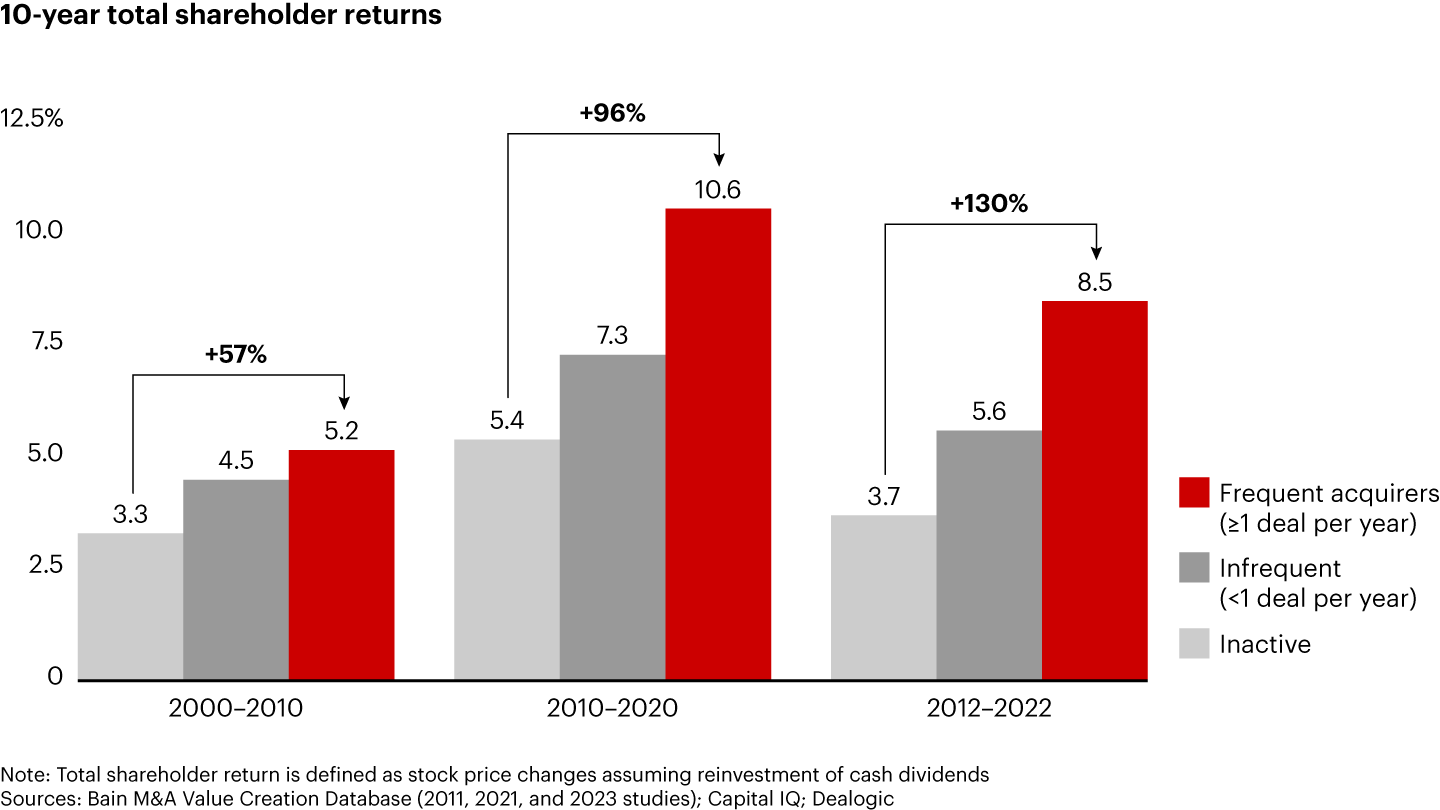
      Frequent acquirers are gaining a performance advantage over time
      Frequent acquirers are gaining a performance advantage over time
      Frequent acquirers are gaining a performance advantage over time

      What are the companies that are active in M&A doing differently? We’ve identified four areas of focus that have been systematically developed by the best acquirers over the past 20 years.

      They’ve broadened the bounds of M&A. In 2004, “Stick to your knitting” was the unofficial rallying cry for M&A, as virtually all deals were aimed at building scale from a core business. And yet there were a few pioneering companies like Cisco Systems, Comcast, and Bank of America that succeeded by buying critical capabilities and/or expanding into new geographies. The focus of M&A moved from cost and defense to growth and offense. The strategic shift from scale to scope reflects a massive change in the way M&A is done, and it has largely rewarded the frequent acquirers that have pursued this strategy and thoughtfully honed their approach, learning from each deal.

      They’ve become more sophisticated with due diligence. In 2004, it would have been unthinkable to conduct a culture assessment. Now it underpins every successful deal. In 2004, companies often relied heavily on a Quality of Earnings audit, a process that was akin to driving a car by looking in the rearview mirror. As options like web scraping and expert networks emerged, the best acquirers quickly made themselves authorities on the businesses they were pursuing.

      They’ve done a lot more deals. Undoubtedly, the No. 1 predictor of a successful acquirer is experience. Twenty years ago, we first demonstrated how frequent acquirers routinely outperformed infrequent and inactive ones in shareholder returns. This was especially true of companies that bought throughout the economic cycle. In the intervening 20 years, we have repeated this analysis and saw the same result. Indeed, our 20-year look back found that frequent acquirers earn more than double the returns of non-acquirers. (It does not take a lot of deals to become a frequent acquirer, at least one per year.) Hyper-acquirers (companies that do five or more deals a year) earn even higher returns—an additional 20% boost.

      They’ve learned that big one-off deals remain risky. In Mastering the Merger, we boldly stated, “The worst strategy a company can employ is to make a few big bets.” Those words proved true in a host of massive deals (let’s pause and remember AOL/Time Warner)—mergers that grabbed headlines but turned out to be utter failures. The riskiness of making big bets has stood the test of time, which is why the best acquirers avoid it. On the other hand, frequency—how much of it you do—does matter.

      Paradox resolved

      The practice of M&A has come a long way. Over the past two decades, companies have done around 660,000 deals worth a total of $56 trillion—and over the last 10 years, the M&A market has visibly expanded, reaching an all-time high in 2021. Companies are doing a lot of M&A, and we believe that they are getting a whole lot better at it. Today, executives report that close to 70% of deals are successful. Many are proud of their track records and willingly share what they are doing differently. Additionally, they share how they’re preparing for continued wins as the bar for successful M&A gets higher amid higher cost of capital for most companies and as competition for quality assets continues unabated.

      Here’s what the decision makers behind some of the most successful deals say are the critical steps.

      Great M&A comes from great corporate strategy. This is an area where M&A thinking has evolved significantly. And it must continue to do so. Beyond the increasing development of growth-oriented scope deals, executives we speak with see opportunities from geopolitical challenges (onshoring), supply chain efficiency, decarbonization, and, dare we say it, artificial intelligence. These opportunities have given rise to a new wave of corporate venturing and innovative partnership strategies, such as Volkswagen’s alliances with 24M Technologies and Vulcan Energy. In effect, changing context and ambitious strategic goals are catalyzing greater creativity in dealmaking.

      Executives need to set themselves up for success by establishing a dedicated team—with an office in the C-suite—to manage the deal process from beginning to end. Noted Mountain Climbers like Thermo Fisher Scientific and Constellation Brands dedicate substantial resources to developing their M&A strategies and faithfully executing them. In particular, the most successful organizations have full-time, dedicated business development teams that are in perpetual motion to fill strategic gaps (in assets or capabilities) through M&A and partnerships. And the leaders of these teams have a place at the senior leadership table. Anything less than this, and the M&A efforts become reactive, episodic, and disconnected from the financial and strategic imperatives of the enterprise.

      As we noted in 2004, most poor deal outcomes could have been avoided with better diligence. This is still true, but the toolbox for conducting corporate diligence work has been replaced. What was once a largely spreadsheet/financial modeling activity now encompasses such things as talent and culture assessments, customer insights, synergy benchmarks, strategic use of clean teams, and pre-integration planning. As a result, organizations are far better prepared for Day 1. By approaching due diligence thoughtfully, and with specific intent, management can detail a thesis that describes how they will add value to an asset and use their access to the target’s data and leadership team to test that thesis. By engaging IT and systems integrators in the diligence process, technology can be enabled to unlock all types of synergy.

      The art of integration has moved from rudimentary to highly sophisticated. We cringe a little when we reread our integration advice from 20 years ago. Our theme in 2004 was to integrate where it matters. While that is still true, the statement implies that the strategic integration decision to make is where in your organization to integrate, function by function. It wasn’t wrong; it was just a bit naive.

      Today, we help to organize and accelerate an integration by defining the approximately 20 critical decisions that will drive value. These decisions are about how the integration is best achieved, rather than where. Some examples of these key decisions might be: “How should we redesign our direct sales effort to give optimal coverage to our key global accounts and optimal exposure to our complete solution offering?” “How will incentives be redesigned to motivate our best sellers while reaching our stretch sales goals?” or “Which enterprise resource planning (ERP) platform will be our financial system of record, and how will we successfully sunset other platforms?”

      Moreover, the integration planning and governance are architected in a way to get these decisions before the integration steering committee quickly, with the needed facts so that the committee can swiftly make a decision. Sure, any complex integration involves more than 20 decisions, but by focusing on the ones that really matter, the organization can delegate the other hundreds of decisions to trusted frontline managers.

      The critical decisions will differ from deal to deal, depending on the asset in question and the strategic objectives. As such, most successful acquirers avoid glib talk of an “integration playbook.”

      Now, what to work on in the next couple of decades.

      In the end, the success or failure of almost all deals also comes down to people and culture, yet this is where companies have advanced the least. There is much more to be done as companies manage the intersection of business aspirations and employee engagement.

      Where are they falling short? Companies underinvest in communications. They underinvest in establishing a “sponsorship spine” to ensure everyone is on board with the inevitable changes. They underinvest in tech tools to measure employee sentiment and employee understanding. They don’t perform retrospectives to see who stayed, who left, who got promoted, who didn’t, and why—information that can help them hone future integrations. And many don’t make any effort to attach economic value to their culture efforts. It may be the first thing CEOs talk about but the last thing they ask their teams to actually do something about.

      Indeed, a company’s ability to put its employees in the best position to be productive and successful will define the winners in the next generation of business combinations.

      Auteurs
      • Headshot of David Harding
        David Harding
        Advisory Partner, Boston
      • Headshot of Dale Stafford
        Dale Stafford
        Associé, New York
      • Headshot of Suzanne Kumar
        Suzanne Kumar
        Practice Executive Vice President, New York
      Contactez-nous
      Expertises fonctionnelles transverses
      • Fusions et Acquisitions
      • M&A Due Diligence
      Comment pouvons-nous vous aider ?
      • M&A Capability
      • M&A Strategy
      Fusions et Acquisitions
      Looking Back at M&A in 2023: Who Wins in a Down Year?

      Deals slowed as buyers and sellers waited for the other to make the first move.

      Voir plus
      Fusions et Acquisitions
      When Buying (vs. Building) Is the Right Move for Engine 2

      Three ways that companies turn to M&A to scale new businesses faster, cheaper, and more effectively.

      Voir plus
      Fusions et Acquisitions
      M&A in Times of Turbulence: Lessons from the Last Recession

      The opportunity cost is huge for companies that stay on the sidelines.

      Voir plus
      M&A Strategy
      Mining M&A

      The next frontier isn’t about avoiding failure; it’s about mastering repeatable success.

      Voir plus
      Fusions et Acquisitions
      Defense M&A

      Bold moves will determine the winners as a continent rearms.

      Voir plus
      First published in avril 2024
      Mots clés
      • Fusions et Acquisitions
      • M&A Capability
      • M&A Due Diligence
      • M&A Strategy

      Comment nous avons aidé nos clients

      An EPC Leader Transforms Itself Amid Intense Volatility

      Lire l’étude de cas

      Fusions et Acquisitions Helping a Healthcare Company Unlock Maximum Value

      Lire l’étude de cas

      A holding company lets go to grow

      Lire l’étude de cas

      Vous souhaitez continuer cette conversation ?

      Nous aidons des dirigeants du monde entier à matérialiser des impacts et des résultats pérennes et créateurs de valeur dans leurs organisations.

      Les points de vue de Bain : notre perspective sur des problématiques auxquelles sont confrontées les entreprises à travers le monde, envoyés chaque mois dans votre boîte de réception. 

      *J’ai lu la politique de confidentialité et j’accepte les conditions.

      Merci de lire notre politique de confidentialité.
      Bain & Company
      Contactez-nous Sustainability Accessibility Conditions d’utilisation Politique de Confidentialité Cookie Policy Mentions Légales Sitemap Log In

      © 1996-2026 Bain & Company, Inc.

      Contacter Bain

      Comment pouvons-nous vous aider ?

      • Business inquiry
      • Career information
      • Press relations
      • Partnership request
      • Speaker request
      Voir tous les bureaux