

M&A Report

En Bref
- In oil and gas, fewer companies are doing more of the deals and creating more of the value.
- Frequent acquirers yielded total shareholder returns that are 130% higher than non-acquirers.
- The most successful companies use deals to launch cross-functional and broadscale efforts to alter the financial, operational, and strategic trajectory of the combined entity.
- Winners amplify synergies by following an accelerated stabilize-integrate-transform methodology.
This article is part of Bain's 2026 M&A Report.
A diverse set of M&A themes played out across the energy and natural resources landscape in 2025, reflecting the unique set of opportunities and challenges facing each sector. In chemicals, OMV and ADNOC combined their assets to create BGI, one of the largest players in the industry; meanwhile, the majority of chemicals companies, such as LyondellBasell and Dow, freed up cash to offset lower margins by pruning their portfolios through divestitures or selling large stakes in assets. Utilities companies, such as AEP and Sempra Energy, also divested and doubled down through organic investments on the parts of their business that could support the huge boom in electricity demand fueled by AI data centers.
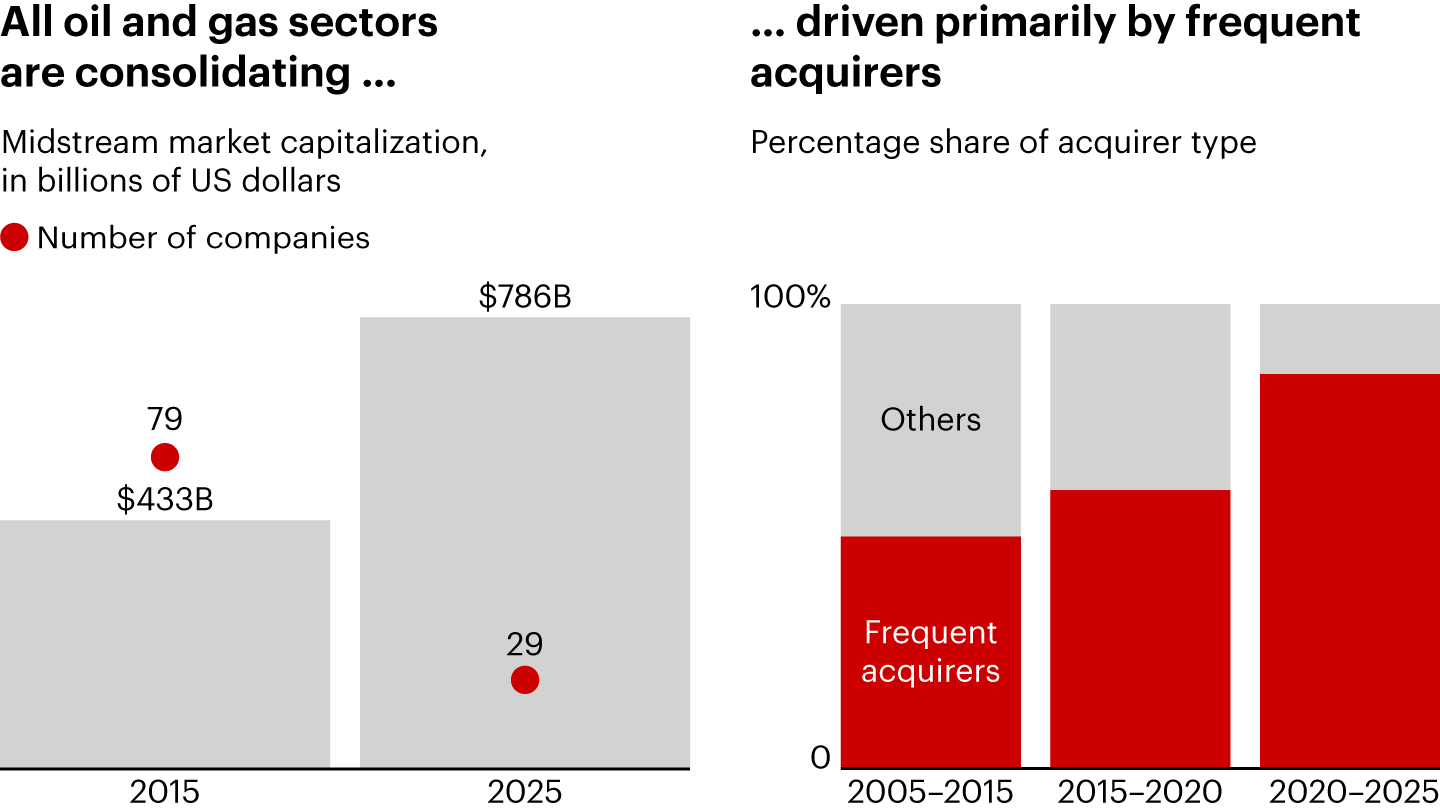
But the most compelling M&A moves across the energy and natural resources sectors took place in oil and gas, where large players and well-capitalized independents alike consolidated across upstream, midstream, and services (see Figure 1). They are aiming to capture scale, cut unit costs, and further integrate value chains to get out ahead of everything from declining oil prices to all-time high demand for natural gas—all while they evaluate the implications of the events in Venezuela on their business and M&A strategy. And it’s not only the large supermajors but also independents such as Diamondback Energy and large midstream companies such as ONEOK and Energy Transfer.
Figure 1

Note: Frequent acquirers perform one or more deals a year
Sources: Dealogic; Bain analysisDigging deep into the oil and gas deal activity, we’ve identified a theme with big implications across the industry. Our decades-long research has confirmed how frequent acquirers—namely, companies engaging in one or more deals each year—routinely outperform their less-active counterparts. And that gap is quickly widening among companies in oil and gas as fewer companies do a larger share of the deals and create increasingly more value. Over the past 10 years, the top 20 oil and gas acquirers accounted for 53% of deal value.
In short, there are fewer winners, and those precious few are outpacing the rest of the industry by a wider margin. The difference in total shareholder returns for frequent acquirers was 57% higher than inactive companies between 2000 and 2010. That jumped to 130% between 2012 and 2022 (see Figure 2). These serial acquirers offer invaluable lessons in how to sharpen M&A skills. They devote particular attention to two key areas: taking a more aggressive approach to finding deals and creating more value by strategically using deals as a catalyst for broad-scale transformation.
Figure 2
Notes: Total shareholder return is defined as stock price changes assuming reinvestment of cash dividends; frequent acquirers perform one or more deals a year, and infrequent acquirers perform less than one deal a year
Sources: Dealogic; SPS; Bain M&A Value Creation Study 2023 (n=1,041 companies for 2000–2010 and 2010–2020, n=2,533 companies for 2012–2022 study)Robust evergreen M&A pipeline management
Companies that are winning with M&A right now are not waiting on the sidelines; they are making the deals and shaping the market. They’re developing their M&A strategy, creating opportunities by knocking on the doors of PE-owned companies, and using deals as an opening to transform. They’re creating value by building platforms. Specifically, we see the leaders focusing on three areas: maintaining an industry gameboard, being proactive, and gaining more confidence.
- Maintain an industry gameboard, including a view of disruptive moves. The gameboard is a strategic map that displays all players in a market, where value flows, and the forces shaping competition. It also includes scenario planning for different M&A combinations, always preemptively evaluating strategic fit rather than waiting to react to shifting market dynamics. One CEO of a large midstream company commented on a recent earnings call that he and his leadership team “obsess over the industry gameboard and M&A opportunities.” Another CFO commented that if there were ever an opportunity to recreate an integrated oil company or fundamentally change your business model, now would be the time given the valuation dislocations that have emerged. For example, several midstream companies are well positioned to move downstream and acquire a company in the petrochemicals industry given how their multiples have declined. Or we could see an integration across midstream and utilities to create an integrated gas company.
- Be proactive—initiate diligence and outreach early. The serial M&A acquirers maintain a running list of their top (typically 15 to 20) targets. They use outside-in diligence and systematically create a deal thesis and detailed financial model for each potential deal, updating that view as market conditions change. They are more thoughtful and comprehensive in diligence than ever before. Further, they don’t wait for investment banking-led bake-offs but rather are proactive and initiate conversations. We know several situations in which a CEO-to-CEO meeting initiated by the eventual acquirer ultimately led to the deal, which happened outside a formal investment banking-led bake-off. In our view, oil and gas executives who aren’t knocking on the doors of PE-owned companies are missing opportunities.
- Gain more confidence by leveraging AI in diligence. Competition for deals is going up, and deal multiples are expanding from 4 times in 2022 to 6.9 times in 2025. Therefore, it is critical to have confidence in the key sources of deal synergies and to go beyond high-level benchmarks and historic examples. One acquirer used AI to better understand cost synergies by constructing a hypothetical model of the target’s maintenance costs for a particular plant; it also used AI for commercial synergies by modeling how product flows to end markets could be better optimized.
Amplifying synergies by following a stabilize-integrate-transform methodology
Traditional approaches to M&A focus primarily on stabilize and integrate. Then, integration teams move on to the next deal or get disbanded too quickly, and they aren’t given the opportunity to define how the combined platform represents a transformational opportunity. When the acquisition is a tuck-in, that may be appropriate. However, when a deal or a series of deals represents a meaningful expansion, companies should rethink regional operations, cross-plant synergies, maintenance, and sourcing strategies to more fundamentally transform how work is done and ultimately the cost base (see Figure 3). In our experience, transform represents at least 50% of the deal synergies.
Figure 3
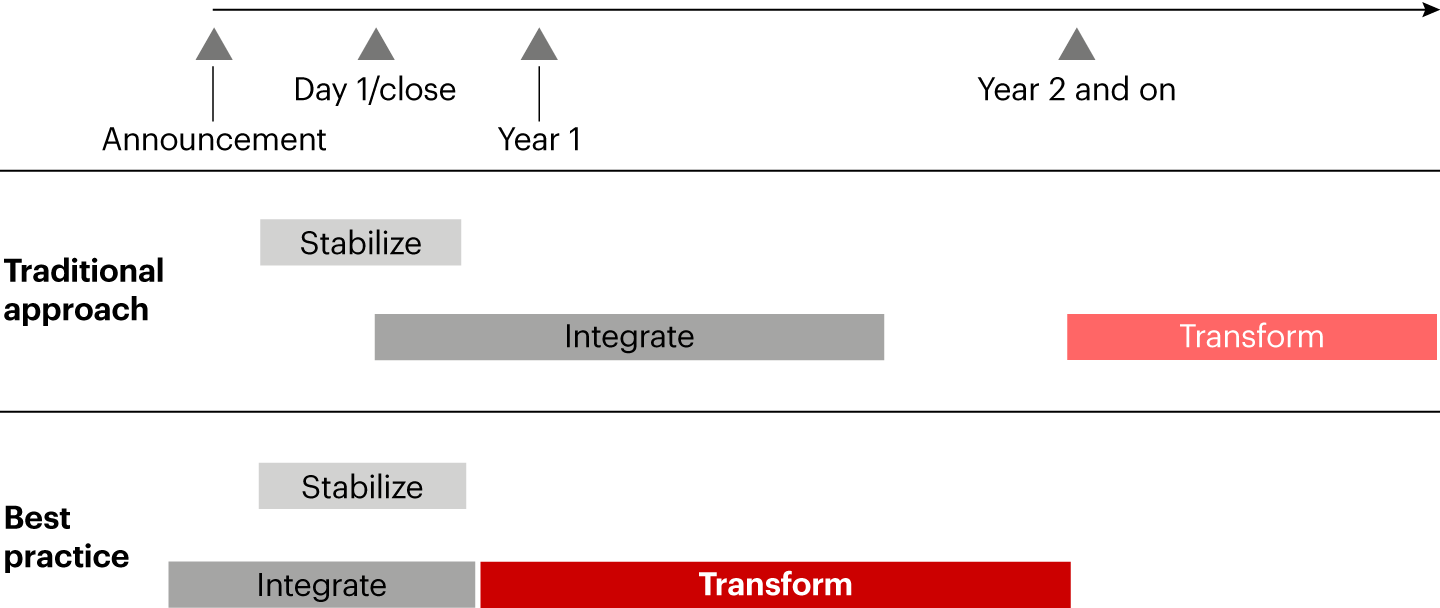

But before companies can transform their business, they need to first stabilize where the imperative is to ensure no operational disruption and deliver management’s base business plan. The second step is to integrate. Serial acquirers have built-in integration capabilities and playbooks that have been deployed in multiple deals, which enable them to capture synergies faster. Integration planning can start early, ideally shortly after the deal is announced. This allows teams to move much more quickly after the transaction closes and often stand teams down within the same year of closing. What we often see missing is taking advantage of cross-functional opportunities and leveraging the power of AI to move faster.
At the same time, this then frees up resources to pursue transformation, which doesn’t happen in most deals in our experience. Or if it does, it’s two or more years after the transaction. The best M&A acquirers pivot to transformation often within the first year of integration.
Despite their success, our experience is that serial acquirers are still leaving significant value on the table by not leveraging large scale M&A to transform their business. Transformation can mean almost anything—from a quick-and-dirty restructuring to a full-scale corporate rescue. In the most literal sense, a full potential transformation is a cross-functional effort to alter the financial, operational, and strategic trajectory of a business, with the goal of producing game-changing results. For example, when Suncor took over operations of Syncrude in the Canadian oil sands, it used the integration to fundamentally review mutual operating philosophies, including maintenance strategies, how the companies shared people and equipment across sites, and what activities it wanted to insource vs. relying on contractors. This allowed Suncor to significantly exceed the synergy targets that were established during diligence.
In Bain’s experience, three key areas that present transformation opportunities are procurement and sourcing strategies, commercial, and always thinking about the next deal.
Procurement and sourcing strategies: Many companies move to best pricing contracts and renegotiate with suppliers to leverage a greater spending base. However, there is an opportunity to go beyond that and more fundamentally evaluate both procurement-driven (“buying better”) and operations-driven (“spending better”) levers. Bain research shows that techniques for spending better, which focus on what companies are buying, not just what they pay for it, can produce 60% of total savings. For example, one company in the Canadian oil sands became such a large buyer of certain types of craft labor that it decided to insource a large number of roles rather than continuing to rely on contractors.
Commercial: In midstream, a larger footprint with expanded access to different end markets allows companies to reimagine how products could flow to take advantage of differences in regional pricing. For example, Keyera’s acquisition of Plains’ Canadian NGL business now gives the company access to both eastern Canada and international markets. In oil field services, acquirers have for decades bought companies for cross-selling opportunities, but they are now creating entirely new solutions through more integrated offerings.
Always thinking about the next deal: The leaders are thinking ahead by not only identifying the next deal but also the subsequent two to three deals that are then made possible. In some cases, the most aggressive companies even start to size the synergies from these potential future transactions when considering the deal economics of the first one. This is something we’ve seen from private equity companies for some time, and it’s starting to be adopted by corporate acquirers.
Phillips 66 recently completed a three-step move that shows how creative M&A and project teams think multiple steps ahead. The first move took place in October 2024, when the company closed its Los Angeles refinery, which was a high cost burden and suffered from weak margins. The next move: Phillips spent $1.4 billion to expand its ownership of two refineries in the Midwest and Texas. The final step took place in October 2025, when the company announced that it would build a new pipeline to connect those two new refineries to California. This series of moves allows Phillips 66 to continue participating in the large California market. But now, it has a more profitable business model.