
Skip to Content
  • Bureaux

    Bureaux

    Amérique du Nord et Amérique du Sud
    • Atlanta
    • Austin
    • Bogota
    • Boston
    • Buenos Aires
    • Chicago
    • Dallas
    • Denver
    • Houston
    • Los Angeles
    • Mexico City
    • Minneapolis
    • Monterrey
    • Montreal
    • New York
    • Rio de Janeiro
    • San Francisco
    • Santiago
    • São Paulo
    • Seattle
    • Silicon Valley
    • Toronto
    • Washington, DC
    Europe, Moyen-Orient et Afrique
    • Amsterdam
    • Athens
    • Berlin
    • Brussels
    • Copenhagen
    • Doha
    • Dubai
    • Dusseldorf
    • Frankfurt
    • Helsinki
    • Istanbul
    • Johannesburg
    • Kyiv
    • Lisbon
    • London
    • Madrid
    • Milan
    • Munich
    • Oslo
    • Paris
    • Riyadh
    • Rome
    • Stockholm
    • Vienna
    • Warsaw
    • Zurich
    Asie et Australie
    • Bangkok
    • Beijing
    • Bengaluru
    • Brisbane
    • Ho Chi Minh City
    • Hong Kong
    • Jakarta
    • Kuala Lumpur
    • Manila
    • Melbourne
    • Mumbai
    • New Delhi
    • Perth
    • Seoul
    • Shanghai
    • Singapore
    • Sydney
    • Tokyo
    Voir tous les bureaux
  • Alumni
  • Presse
  • S’abonner
  • Contacter
  • France | Français

    Sélectionnez votre région et votre langue

    Global
    • Global (English)
    Amérique du Nord et Amérique du Sud
    • Brazil (Português)
    • Argentina (Español)
    • Canada (Français)
    • Chile (Español)
    • Colombia (Español)
    Europe, Moyen-Orient et Afrique
    • France (Français)
    • DACH Region (Deutsch)
    • Italy (Italiano)
    • Spain (Español)
    • Greece (Elliniká)
    Asie et Australie
    • China (中文版)
    • Korea (한국어)
    • Japan (日本語)
  • Saved items (0)
    Saved items (0)

    You have no saved items.

    Bookmark content that interests you and it will be saved here for you to read or share later.

    Explore Bain Insights
  • Expertises Sectorielles
    Menu principal

    Expertises Sectorielles

    • Aerospace et Défense
    • Agroalimentaire
    • Chimie
    • Infrastructures, BTP et Matériaux de Construction
    • Grande Consommation
    • Services Financiers
    • Santé
    • Engins & Equipements Industriels
    • Media et Divertissement
    • Metals
    • Mining
    • Pétrole & Gaz
    • Papier et Emballage
    • Private Equity
    • Secteur Public
    • Distribution
    • Technologie
    • Télécommunications
    • Transportation
    • Travel & Leisure
    • Utilities & Energies Renouvelables
  • Expertises Fonctionnelles
    Menu principal

    Expertises Fonctionnelles

    • Expérience Client
    • ESG
    • Innovation
    • Fusions et Acquisitions
    • Opérations
    • People & Organization
    • Private Equity
    • Sales & Marketing
    • Stratégie
    • IA, Perspectives et Solutions
    • Technology
    • Transformation
  • Digital
  • Points de Vue
  • À propos
    Menu principal

    À propos

    • Notre Activité
    • Nos Valeurs
    • Nos Collaborateurs et Notre Équipe Dirigeante
    • Notre Impact
    • Prix & Récompenses
    • Partenariats Internationaux
    • Evénements
    Further: Our global responsibility
    • Diversité et Inclusion
    • Impact Social
    • Sustainability
    • World Economic Forum
    Learn more about Further
  • Carrières
    Menu principal

    Carrières

    • Rejoignez-nous
      Carrières
      Rejoignez-nous
      • Find Your Place
      • Nos domaines d’expertise
      • Equipes multidisciplinaires
      • Étudiants
      • Stages et programmes
      • Événements de recrutement
    • La vie chez Bain
      Carrières
      La vie chez Bain
      • Blog: Inside Bain
      • Récits de carrière
      • Nos collaborateurs
      • Nos bureaux
      • Soutenir votre évolution professionnelle
      • Groupes d’affinités
      • Avantages chez Bain
    • Histoires d’impact
    • Notre processus de recrutement
      Carrières
      Notre processus de recrutement
      • Ce que vous pouvez attendre
      • Entretiens
    Trouver un poste
  • Bureaux
    Menu principal

    Bureaux

    • Amérique du Nord et Amérique du Sud
      Bureaux
      Amérique du Nord et Amérique du Sud
      • Atlanta
      • Austin
      • Bogota
      • Boston
      • Buenos Aires
      • Chicago
      • Dallas
      • Denver
      • Houston
      • Los Angeles
      • Mexico City
      • Minneapolis
      • Monterrey
      • Montreal
      • New York
      • Rio de Janeiro
      • San Francisco
      • Santiago
      • São Paulo
      • Seattle
      • Silicon Valley
      • Toronto
      • Washington, DC
    • Europe, Moyen-Orient et Afrique
      Bureaux
      Europe, Moyen-Orient et Afrique
      • Amsterdam
      • Athens
      • Berlin
      • Brussels
      • Copenhagen
      • Doha
      • Dubai
      • Dusseldorf
      • Frankfurt
      • Helsinki
      • Istanbul
      • Johannesburg
      • Kyiv
      • Lisbon
      • London
      • Madrid
      • Milan
      • Munich
      • Oslo
      • Paris
      • Riyadh
      • Rome
      • Stockholm
      • Vienna
      • Warsaw
      • Zurich
    • Asie et Australie
      Bureaux
      Asie et Australie
      • Bangkok
      • Beijing
      • Bengaluru
      • Brisbane
      • Ho Chi Minh City
      • Hong Kong
      • Jakarta
      • Kuala Lumpur
      • Manila
      • Melbourne
      • Mumbai
      • New Delhi
      • Perth
      • Seoul
      • Shanghai
      • Singapore
      • Sydney
      • Tokyo
    Voir tous les bureaux
  • Alumni
  • Presse
  • S’abonner
  • Contacter
  • France | Français
    Menu principal

    Sélectionnez votre région et votre langue

    • Global
      Sélectionnez votre région et votre langue
      Global
      • Global (English)
    • Amérique du Nord et Amérique du Sud
      Sélectionnez votre région et votre langue
      Amérique du Nord et Amérique du Sud
      • Brazil (Português)
      • Argentina (Español)
      • Canada (Français)
      • Chile (Español)
      • Colombia (Español)
    • Europe, Moyen-Orient et Afrique
      Sélectionnez votre région et votre langue
      Europe, Moyen-Orient et Afrique
      • France (Français)
      • DACH Region (Deutsch)
      • Italy (Italiano)
      • Spain (Español)
      • Greece (Elliniká)
    • Asie et Australie
      Sélectionnez votre région et votre langue
      Asie et Australie
      • China (中文版)
      • Korea (한국어)
      • Japan (日本語)
  • Saved items  (0)
    Menu principal
    Saved items (0)

    You have no saved items.

    Bookmark content that interests you and it will be saved here for you to read or share later.

    Explore Bain Insights
  • Expertises Sectorielles
    • Expertises Sectorielles

      • Aerospace et Défense
      • Agroalimentaire
      • Chimie
      • Infrastructures, BTP et Matériaux de Construction
      • Grande Consommation
      • Services Financiers
      • Santé
      • Engins & Equipements Industriels
      • Media et Divertissement
      • Metals
      • Mining
      • Pétrole & Gaz
      • Papier et Emballage
      • Private Equity
      • Secteur Public
      • Distribution
      • Technologie
      • Télécommunications
      • Transportation
      • Travel & Leisure
      • Utilities & Energies Renouvelables
  • Expertises Fonctionnelles
    • Expertises Fonctionnelles

      • Expérience Client
      • ESG
      • Innovation
      • Fusions et Acquisitions
      • Opérations
      • People & Organization
      • Private Equity
      • Sales & Marketing
      • Stratégie
      • IA, Perspectives et Solutions
      • Technology
      • Transformation
  • Digital
  • Points de Vue
  • À propos
    • À propos

      • Notre Activité
      • Nos Valeurs
      • Nos Collaborateurs et Notre Équipe Dirigeante
      • Notre Impact
      • Prix & Récompenses
      • Partenariats Internationaux
      • Evénements
      Further: Our global responsibility
      • Diversité et Inclusion
      • Impact Social
      • Sustainability
      • World Economic Forum
      Learn more about Further
  • Carrières
    Recherches les plus fréquentes
    • Agile
    • Digital
    • Stratégie
    Vos recherches précédentes
      Pages récemment visitées

      Content added to saved items

      Saved items (0)

      Removed from saved items

      Saved items (0)

      The Visionary CEO’s Guide to Sustainability

      The Future Is Circular: How Companies Can Prepare to Grow in a Changing World

      The Future Is Circular: How Companies Can Prepare to Grow in a Changing World

      By decoupling economic growth from resource consumption, circular models offer companies their best shot at continued, long-term growth.

      Par Tessa Bysong, Jenny Davis-Peccoud, Joshua Hinkel, Hernan Saenz, et Yelena Ageyeva-Furman

      • min
      }

      Rapport

      The Future Is Circular: How Companies Can Prepare to Grow in a Changing World
      en
      En Bref
      • By 2030, executives expect the share of revenue from circular products and services to have grown 30% from 2021 levels, according to Bain research.
      • Most of the large companies we studied have made specific, measurable circularity commitments, but few are rethinking their full business model.
      • Doing so requires envisioning what the future will look like—including, critically, how profits will be made.
      • Taking five specific actions today, CEOs can accelerate their plans for a more efficient, resilient, and profitable circular future.

      This article is part of Bain’s 2023 CEO Sustainability Guide

      Explore the report

      To thrive long term in a world in which humans annually consume 1.75 times the natural resources the earth can regenerate in 12 months, businesses must decouple growth from resource extraction. In addition to improving environmental sustainability, circularity offers companies in most industries a way to gain competitive advantage at significant scale and thrive in a future in which profits will be made differently.

      Circular practices like recovering resources, extending the life of products, and promoting a sharing economy offer valuable benefits, including greater business resilience, more efficient use of resources, and revenue growth from new customers, services, and innovation. Many business leaders recognize this. In a survey conducted by Bain & Company and the World Economic Forum in October 2022, 35% of executives ranked circularity as one of their organization’s highest priorities, the third highest tally after “optimize supply chain performance” and “operate sustainably.” And in a Bain survey, executives reported that they anticipate 30% growth in share of revenue from circularity between 2021 and 2030.

      Even so, most organizations operate today with a business model built for a linear world. These models won’t thrive in a circular economy. To unlock circularity’s true value, executives must transform two things: their material model—how they source and use resources—and their business model—how they generate revenue and profits (see Figure 1).

      Figure 1
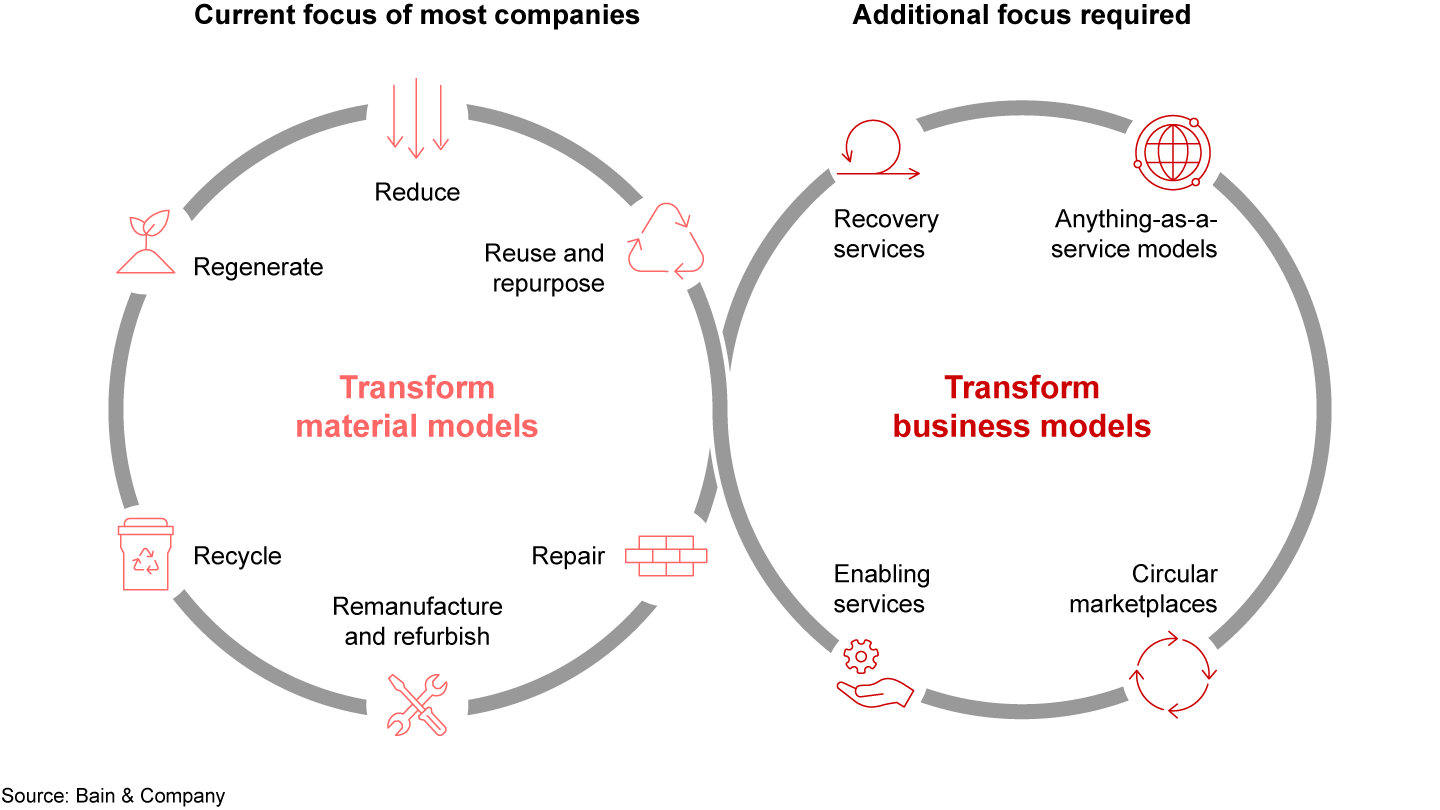
      To build sustainability and long-term economic value, companies must simultaneously redesign the way they use materials and how they construct their business model

      Insurgents like Back Market, a refurbished device marketplace, and the luxury reseller The RealReal are already doing that—disrupting industries with new ways of operating and earning revenue. Bain research has found that 45% of executives expect these types of new entrants to change their industry, and concern about the threat from insurgents is highest among those incumbent companies that have done the most planning for the circular transition.

      Incumbents are acting, too. Of 380 large global companies studied in 10 different industries, 55% have made specific, measurable circularity commitments, according to Bain research. These often focus on recycled inputs and waste reduction. Few have begun to really rethink their full business model, however, and that’s where much of circularity’s potential payoff often lies.

      Companies can begin to comprehensively build for a circular world by taking two important steps:

      1. Define the circular ambition.

      From today’s linear ways of operating, circularity looks very costly. And the value it will add is often underestimated. To overcome that, companies must envision what the future will look like: where money will be spent, how profits will be earned, and which types of companies will earn them. This includes imagining how circular transformations will reshape interaction with customers, suppliers, and the broader ecosystem, and also how circularity models can help tackle pressing operating issues like scarce and diminishing resources, supply chain disruptions, regulation, and increasing environmental damage.

      For most companies, this transition is likely to evolve over the next decade, or potentially longer. Consider a trucking company that is in the midst of a multiyear redesign of its business for a profitable circular future. Triggered by three things—the technology breakthroughs that have fueled the growth of low-emitting electric and autonomous vehicles, usage-based business models, and the fight for recycled and scarce inputs—the company is planning for the possibility that, in the future, customers will buy access to trucking based on usage rather than owning their own trucks.

      At the same time, the company is incorporating circularity into how it competes in today’s marketplace, designing its trucks and components to be more modular and upgradable, and thereby longer lived. This also makes components easier to recover at the end of a vehicle’s useful life for use in remanufacturing. Because reuse extends component lifetime, it is one way to reduce Scope 3 emissions. Supporting sustainable, circular, cost-competitive inputs and boosting uptime also reduces emissions. And all these efforts reduce total operating expenses.

      In this way, thinking about its circular ambition is helping this trucking company position itself to defend its business and navigate potential regulatory changes.

      2. Plan future profits.

      As new business models change how companies earn revenue and the more efficient use of resources reduces costs, the way profits are made will evolve as well.

      That’s why it’s important for every company to understand: 1) where and how it can make money in a circular world, 2) the stages at which its industry and market are likely to reach a level of adoption and maturity that justifies investment in that model, and 3) how that future should influence new products and services being created today.

      Innovative technology, evolving regulations, consumer and customer demand, supply chain volatility, and material scarcity are among the factors that will influence those answers. They won’t always be perfectly predictable, and executives may not know all the answers, but they can and should identify the signposts they need to watch out for, the signals that can indicate an acceleration in the shift to circularity, such as declining unit production costs or the development of supporting infrastructure.

      Consider how the increasing scarcity of materials like lithium and rare earth metals needed for electric vehicle (EV) batteries will shift a portion of car industry profits toward companies collecting, sorting, and recycling EV batteries. While it’s hard to predict exactly how this will play out, manufacturers with access to end-of-life batteries and recycling capabilities will have a strong strategic advantage in the future.

      To understand where companies can make money, it’s critical to understand how market structures will transition in the future and which segments of the value chain will have a disproportionate degree of influence on critical flows of needed resources. Recognizing that the level of influence and control in its industry will shift toward those participants who facilitate the reverse flow of used materials and products, a chemical company is developing a plastics recycling strategy to commercialize recycled materials and gain access to scarce feedstock of postconsumer packaging, including PET and recycled aluminum. This will be a key strategic advantage in the future when these materials become even more scarce.

      Once critical market transitions are identified, companies must develop strategies to access, shift, and influence them, both alone and through an ecosystem of partners and other participants.

      Actions to take now

      CEOs planning for a more efficient, resilient, and profitable circular future benefit from taking certain actions now:

      • Identify strategic opportunities for which circularity can create and accelerate value: new customers, new sources of revenue and monetization models, supply chain resilience, sustainability, and access to scarce supply, among others.
      • Determine how circularity is likely to evolve in your industry (adoption curves), the signals or signposts to watch for signs of increased momentum in customer adoption, and how production cost will come down over time (experience curves).
      • Define the material and business models that will help position the company for maximum competitive advantage.
      • Anticipate transitioning of market structures and resulting distribution of influence and control across the value chain and invest to influence and secure the flow of critical resources.
      • Map out and start building the broader ecosystem partnerships required to scale your circular solutions.

      The authors would like to warmly thank Simone Doms, a practice director in Bain’s Sustainability & Responsibility practice in Munich, for her extensive contributions to this article.

      Read the Next Chapter

      Leading with Vision: Harnessing the Climate Policy Response

      Read our 2023 CEO Sustainability Guide

      Explore the full report Download PDF
      Auteurs
      • Headshot of Tessa Bysong
        Tessa Bysong
        Alumni, Chicago
      • Headshot of Jenny Davis-Peccoud
        Jenny Davis-Peccoud
        Associé, Amsterdam
      • Headshot of Joshua Hinkel
        Joshua Hinkel
        Associé, Dallas
      • Headshot of Hernan Saenz
        Hernan Saenz
        Associé, Dallas
      • Headshot of Yelena Ageyeva-Furman
        Yelena Ageyeva-Furman
        Associé, London
      Contactez-nous
      Synergies sectorielles
      • Distribution
      • Energie et Ressources Naturelles
      • Grande Consommation
      • Produits et Services Industriels de pointe
      Expertises fonctionnelles transverses
      • Développement Durable et Responsabilité Sociétale des Entreprises (RSE)
      • Operating Model & Org Design
      • Opérations
      • Stratégie
      Comment pouvons-nous vous aider ?
      • Circular Economy
      CEO's Guide to Sustainability
      Organizing for Sustainability

      Most companies are way behind on their sustainability goals. Focusing on four things can accelerate progress.

      Voir plus
      CEO's Guide to Sustainability
      From Sustainability Commitments to Impact: Four Pragmatic Questions for Visionary CEOs

      Amid competing priorities, CEOs and consumers still say sustainability matters. By acting now, companies can set the stage for profitable growth.

      Voir plus
      Produits et Services Industriels de pointe
      Embracing the “Do-Say” Gap

      Three pragmatic questions that shift sustainability from ambition to action.

      Voir plus
      Produits et Services Industriels de pointe
      Sustainability: Less Talk and More Action

      Despite elusive targets, the business case is stronger than ever.

      Voir plus
      Energie et Ressources Naturelles
      Sustainable Aviation Fuel: The Supply Race Is On

      European production is projected to fall nearly 20% short of mandate-driven demand by 2030, a big opportunity for global feedstock suppliers and refiners that invest now.

      Voir plus

      Introduction

      • The Questions Every CEO Needs to Ask About Sustainability

      Levers of Change: Technology, Behavior, Policy

      • Selling Sustainability Means Decoding Consumers

      • Does a Purpose Help Brands Grow?

      • Lower Costs, Faster Adoption: Closing the Sustainable Innovation Gap

      • The Future Is Circular: How Companies Can Prepare to Grow in a Changing World

      • Leading with Vision: Harnessing the Climate Policy Response

      Sector Perspectives

      • Building Resilience in Your Business Strategy: Four Imperatives for Leaders

      • The Energy Transition’s Other Big Puzzle: Making the Math Work

      • Can Food and Agriculture Companies Raise Their Game?

      • Fires, Floods, and Loans: How Banks Can Deal with Increasing Climate Risks

      Making It Happen

      • Building a Data-Based Stakeholder Strategy

      • Operations and Supply Chain Decarbonization: Lower Emissions, Higher Performance

      • Making Business Do Better for Everyone

      • Organizing for Sustainability

      • A Talent Strategy for Sustainability: Skills Matter, but Mindset Is Everything

      First published in novembre 2023
      Mots clés
      • CEO's Guide to Sustainability
      • Circular Economy
      • Développement Durable et Responsabilité Sociétale des Entreprises (RSE)
      • Distribution
      • Energie et Ressources Naturelles
      • Grande Consommation
      • Operating Model & Org Design
      • Opérations
      • Produits et Services Industriels de pointe
      • Stratégie

      Comment nous avons aidé nos clients

      Développement Durable et Responsabilité Sociétale des Entreprises (RSE) A Manufacturer Vows to “Push to Zero” Carbon Emissions

      Lire l’étude de cas

      Amélioration de la Performance Constructing a best-in-class global procurement organization

      Lire l’étude de cas

      Opérations Uncovering major savings in procurement

      Lire l’étude de cas

      Vous souhaitez continuer cette conversation ?

      Nous aidons des dirigeants du monde entier à matérialiser des impacts et des résultats pérennes et créateurs de valeur dans leurs organisations.

      Les points de vue de Bain : notre perspective sur des problématiques auxquelles sont confrontées les entreprises à travers le monde, envoyés chaque mois dans votre boîte de réception. 

      *J’ai lu la politique de confidentialité et j’accepte les conditions.

      Merci de lire notre politique de confidentialité.
      Bain & Company
      Contactez-nous Sustainability Accessibility Conditions d’utilisation Politique de Confidentialité Cookie Policy Mentions Légales Sitemap Log In

      © 1996-2026 Bain & Company, Inc.

      Contacter Bain

      Comment pouvons-nous vous aider ?

      • Business inquiry
      • Career information
      • Press relations
      • Partnership request
      • Speaker request
      Voir tous les bureaux