


Brief

|
|
Any company’s decisions lie on a spectrum. In the middle of the spectrum, however, lies a vast and largely unexplored territory. These decisions—both relatively frequent and individually important, requiring the exercise of judgment and the application of experience—represent a potential gold mine for the companies that get there first with advanced analytics. When considering how to deploy advanced analytics, Bain Partner Lori Sherer recommends that companies start by considering their key decision-making processes. Imagine, for example, a property-and-casualty company that specializes in insuring multinational corporations. For every customer, it might have to make risk-assessment decisions about hundreds of facilities around the world. Armies of underwriters make these decisions, each underwriter more or less experienced and each one weighing and sequencing the dozens of variables differently. Now imagine that you employ advanced analytics to codify the approach of the best, most experienced underwriters. You build an analytic model that captures their decision logic. The armies of underwriters then use that model in making their decisions. This is not so much crunching data as simulating a human process. What happens? The need for human knowledge and judgment hasn’t disappeared—you still require skilled, experienced employees. But you have changed the game, using machines to replicate best human practice (see Figure 1). The decision process now leads to results that are:
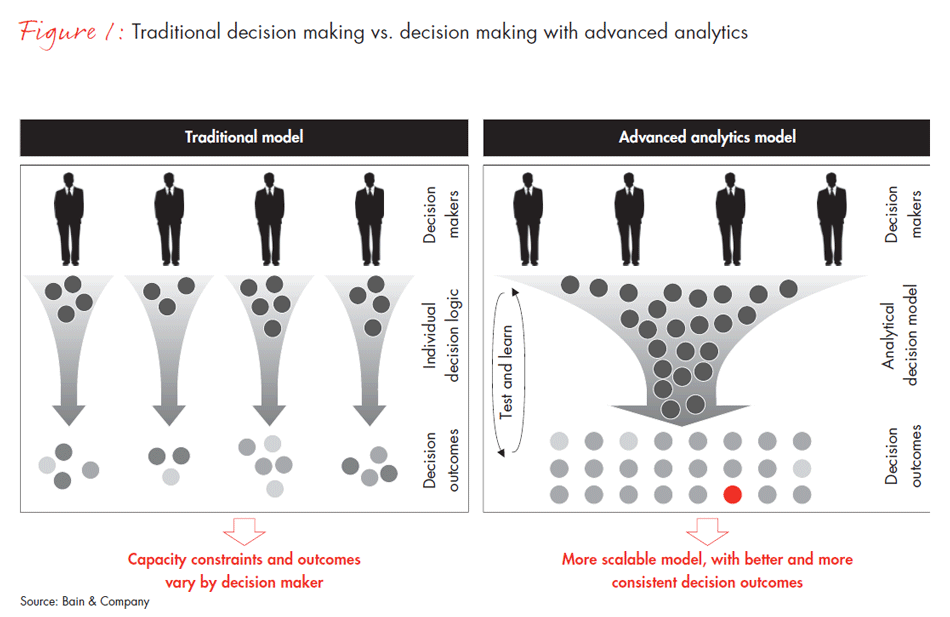 In addition, you have suddenly increased your organization’s test-and-learn capability. Every outcome for every insured facility feeds back into the modeling process, so the model gets better and better. So do the decisions that rely on it. Using analytics in this way is no small matter. You’ll find that decision processes are affected. And not only do you need to build the technological capabilities, you’ll also need to ensure that your people adopt and use the new tools. The human element can sidetrack otherwise promising experiments. We know from extensive research that decisions matter. Companies that make better decisions, that make them faster, and that implement them effectively turn in better financial performance than their rivals and peers. Focused application of analytic tools can help companies make better, quicker decisions—particularly in that broad middle range—and improve their performance accordingly. Michael C. Mankins is a partner with Bain & Company. He is based in the San Francisco office, and he leads Bain’s Organization practice in the Americas. Lori Sherer is a partner with Bain & Company in the San Francisco office and leads the Advanced Analytics practice. |