
Skip to Content
  • Uffici

    Uffici

    Nord e Sud America
    • Atlanta
    • Austin
    • Bogota
    • Boston
    • Buenos Aires
    • Chicago
    • Dallas
    • Denver
    • Houston
    • Los Angeles
    • Mexico City
    • Minneapolis
    • Monterrey
    • Montreal
    • New York
    • Rio de Janeiro
    • San Francisco
    • Santiago
    • São Paulo
    • Seattle
    • Silicon Valley
    • Toronto
    • Washington, DC
    Europa, Medio Oriente e Africa
    • Amsterdam
    • Athens
    • Berlin
    • Brussels
    • Copenhagen
    • Doha
    • Dubai
    • Dusseldorf
    • Frankfurt
    • Helsinki
    • Istanbul
    • Johannesburg
    • Kyiv
    • Lisbon
    • London
    • Madrid
    • Milan
    • Munich
    • Oslo
    • Paris
    • Riyadh
    • Rome
    • Stockholm
    • Vienna
    • Warsaw
    • Zurich
    Asia e Australia
    • Bangkok
    • Beijing
    • Bengaluru
    • Brisbane
    • Ho Chi Minh City
    • Hong Kong
    • Jakarta
    • Kuala Lumpur
    • Manila
    • Melbourne
    • Mumbai
    • New Delhi
    • Perth
    • Seoul
    • Shanghai
    • Singapore
    • Sydney
    • Tokyo
    Guarda tutti gli uffici
  • Alumni
  • Media Center
  • Iscriviti
  • Contattaci
  • Italy | Italiano

    Seleziona il tuo Paese e la tua lingua

    Global
    • Global (English)
    Nord e Sud America
    • Brazil (Português)
    • Argentina (Español)
    • Canada (Français)
    • Chile (Español)
    • Colombia (Español)
    Europa, Medio Oriente e Africa
    • France (Français)
    • DACH Region (Deutsch)
    • Italy (Italiano)
    • Spain (Español)
    • Greece (Elliniká)
    Asia e Australia
    • China (中文版)
    • Korea (한국어)
    • Japan (日本語)
  • Saved items (0)
    Saved items (0)

    You have no saved items.

    Contrassegna il contenuto che ti interessa e verrà salvato qui. Potrai leggerlo o condividerlo in seguito.

    Explore Bain Insights
  • Settori
    Menu principale

    Settori

    • Aerospazio e Difesa
    • Agribusiness
    • Chimica
    • Infrastrutture e Costruzioni
    • Beni di Largo Consumo
    • Servizi Finanziari
    • Sanità
    • Macchinari Industriali
    • Media & Intrattenimento
    • Industria Metallurgica
    • Industria Mineraria
    • Petrolio e Gas
    • Industria Cartaria e Packaging
    • Private Equity
    • Settore Sociale & Pubblico
    • Retail
    • Tecnologia
    • Telecomunicazioni
    • Compagnie Aeree & Trasporti
    • Viaggi e Svago
    • Utility e Rinnovabili
  • Servizi di Consulenza
    Menu principale

    Servizi di Consulenza

    • Customer Experience
    • ESG
    • Innovation
    • M&A and Divestitures
    • Operation
    • People & Organization
    • Private Equity
    • Sales & Marketing
    • Strategia
    • IA, Approfondimenti e Soluzioni
    • Tecnologia
    • Trasformazione
  • Digital
  • Tematiche
  • Informazioni su Bain
    Menu principale

    Informazioni su Bain

    • Che Cosa Facciamo
    • Quello in Cui Crediamo
    • Le Nostre Persone e la Leadership
    • Risultati
    • Premi e Riconoscimenti
    • Organizzazioni Globali
    Further: Our global responsibility
    • Diversità e Inclusione
    • Social Impact
    • Sustainability
    • World Economic Forum
    Learn more about Further
  • Careers
    Menu principale

    Careers

    • Work with Us
      Careers
      Work with Us
      • Find Your Place
      • Our Work Areas
      • Integrated Teams
      • Students
      • Internships & Programs
      • Recruiting Events
    • Life at Bain
      Careers
      Life at Bain
      • Blog: Inside Bain
      • Career Stories
      • Our People
      • Where We Work
      • Supporting Your Growth
      • Affinity Groups
      • Benefits
    • Impact Stories
    • Hiring Process
      Careers
      Hiring Process
      • What to Expect
      • Interviewing
    FIND JOBS
  • Uffici
    Menu principale

    Uffici

    • Nord e Sud America
      Uffici
      Nord e Sud America
      • Atlanta
      • Austin
      • Bogota
      • Boston
      • Buenos Aires
      • Chicago
      • Dallas
      • Denver
      • Houston
      • Los Angeles
      • Mexico City
      • Minneapolis
      • Monterrey
      • Montreal
      • New York
      • Rio de Janeiro
      • San Francisco
      • Santiago
      • São Paulo
      • Seattle
      • Silicon Valley
      • Toronto
      • Washington, DC
    • Europa, Medio Oriente e Africa
      Uffici
      Europa, Medio Oriente e Africa
      • Amsterdam
      • Athens
      • Berlin
      • Brussels
      • Copenhagen
      • Doha
      • Dubai
      • Dusseldorf
      • Frankfurt
      • Helsinki
      • Istanbul
      • Johannesburg
      • Kyiv
      • Lisbon
      • London
      • Madrid
      • Milan
      • Munich
      • Oslo
      • Paris
      • Riyadh
      • Rome
      • Stockholm
      • Vienna
      • Warsaw
      • Zurich
    • Asia e Australia
      Uffici
      Asia e Australia
      • Bangkok
      • Beijing
      • Bengaluru
      • Brisbane
      • Ho Chi Minh City
      • Hong Kong
      • Jakarta
      • Kuala Lumpur
      • Manila
      • Melbourne
      • Mumbai
      • New Delhi
      • Perth
      • Seoul
      • Shanghai
      • Singapore
      • Sydney
      • Tokyo
    Guarda tutti gli uffici
  • Alumni
  • Media Center
  • Iscriviti
  • Contattaci
  • Italy | Italiano
    Menu principale

    Seleziona il tuo Paese e la tua lingua

    • Global
      Seleziona il tuo Paese e la tua lingua
      Global
      • Global (English)
    • Nord e Sud America
      Seleziona il tuo Paese e la tua lingua
      Nord e Sud America
      • Brazil (Português)
      • Argentina (Español)
      • Canada (Français)
      • Chile (Español)
      • Colombia (Español)
    • Europa, Medio Oriente e Africa
      Seleziona il tuo Paese e la tua lingua
      Europa, Medio Oriente e Africa
      • France (Français)
      • DACH Region (Deutsch)
      • Italy (Italiano)
      • Spain (Español)
      • Greece (Elliniká)
    • Asia e Australia
      Seleziona il tuo Paese e la tua lingua
      Asia e Australia
      • China (中文版)
      • Korea (한국어)
      • Japan (日本語)
  • Saved items  (0)
    Menu principale
    Saved items (0)

    You have no saved items.

    Contrassegna il contenuto che ti interessa e verrà salvato qui. Potrai leggerlo o condividerlo in seguito.

    Explore Bain Insights
  • Settori
    • Settori

      • Aerospazio e Difesa
      • Agribusiness
      • Chimica
      • Infrastrutture e Costruzioni
      • Beni di Largo Consumo
      • Servizi Finanziari
      • Sanità
      • Macchinari Industriali
      • Media & Intrattenimento
      • Industria Metallurgica
      • Industria Mineraria
      • Petrolio e Gas
      • Industria Cartaria e Packaging
      • Private Equity
      • Settore Sociale & Pubblico
      • Retail
      • Tecnologia
      • Telecomunicazioni
      • Compagnie Aeree & Trasporti
      • Viaggi e Svago
      • Utility e Rinnovabili
  • Servizi di Consulenza
    • Servizi di Consulenza

      • Customer Experience
      • ESG
      • Innovation
      • M&A and Divestitures
      • Operation
      • People & Organization
      • Private Equity
      • Sales & Marketing
      • Strategia
      • IA, Approfondimenti e Soluzioni
      • Tecnologia
      • Trasformazione
  • Digital
  • Tematiche
  • Informazioni su Bain
    • Informazioni su Bain

      • Che Cosa Facciamo
      • Quello in Cui Crediamo
      • Le Nostre Persone e la Leadership
      • Risultati
      • Premi e Riconoscimenti
      • Organizzazioni Globali
      Further: Our global responsibility
      • Diversità e Inclusione
      • Social Impact
      • Sustainability
      • World Economic Forum
      Learn more about Further
  • Careers
    Ricerche più popolari
    • Agile
    • Digitale
    • Strategia
    La tue ricerche precedenti
      Pagine visitate

      Content added to saved items

      Saved items (0)

      Removed from saved items

      Saved items (0)

      Brief

      The AI Enterprise: Code Red

      The AI Enterprise: Code Red

      Four questions every executive must answer now.

      Di James Anderson, Moez Draief, Florian Mueller, e James Hadley

      • Tempo di lettura min.
      }

      Brief

      The AI Enterprise: Code Red
      en
      In evidenza
      • Leading AI providers have repositioned AI from a tool to an enterprise operating system. The signal is clear: We’re moving from narrow task automation to an integrated enterprise layer of functionally specific AI agents embedded in joint human-agent teams.
      • This shift raises four questions every executive must answer: How will AI reshape your industry and strategy? What tasks should AI do, and where can distinctive human capabilities still support competitive advantage? How do you industrialize the way AI agents are built and governed? And how do you scale AI across the enterprise?
      • The companies pulling ahead are redefining strategy under new AI economics, redesigning workforces around agent-led workflows, building repeatable “agent factories,” and applying deliberate scaling patterns matched to the boldness and urgency their situation demands.

      AI is no longer just a productivity tool; it is shifting how work gets done, how businesses operate, and how companies create value. Winners will reshape around the new competitive dynamics, redesign how work is done, industrialize agent development, and find repeatable patterns to scale AI.

      The catalyst: AI platforms shift from copilot to operating system

      The past two months have marked a step change in AI’s trajectory from productivity tool to enterprise operating system—and capital markets have taken notice.

      Leading AI providers have repositioned their platforms from productivity tools to active enterprise infrastructure. New offerings now enable multistep, goal-directed execution across core business systems, with agent orchestration, governance, and embedded AI becoming standard features. The signal is consistent across providers: AI is no longer a feature bolted onto existing software. It is the operating system for how work gets done.

      Markets have responded sharply. Software indexes fell significantly in just a few trading sessions between late January and early February 2026—the worst start to a year in recent memory for the sector—while broader equity indexes remained roughly flat. The repricing reflects investor conclusions that agentic AI can automate the knowledge work that per-seat SaaS models were built to support. While data and software stocks were particularly exposed, the impact was also felt across marketplace businesses, financial services, and advisory businesses. Hardest hit were those with competitive moats resting on legacy software, nonproprietary data assets, automatable human advice, or marketplaces that could be disintermediated by AI agents.

      The new competitive landscape

      Competitive strategy has been shaped by successive waves of technology disruption—and AI is the next (see Figure 1). The information era rewarded scale and switching costs. The platform era rewarded network effects and lock-in. Competition in the AI era will be defined by something different: the declining marginal cost of intelligence.

      Figure 1
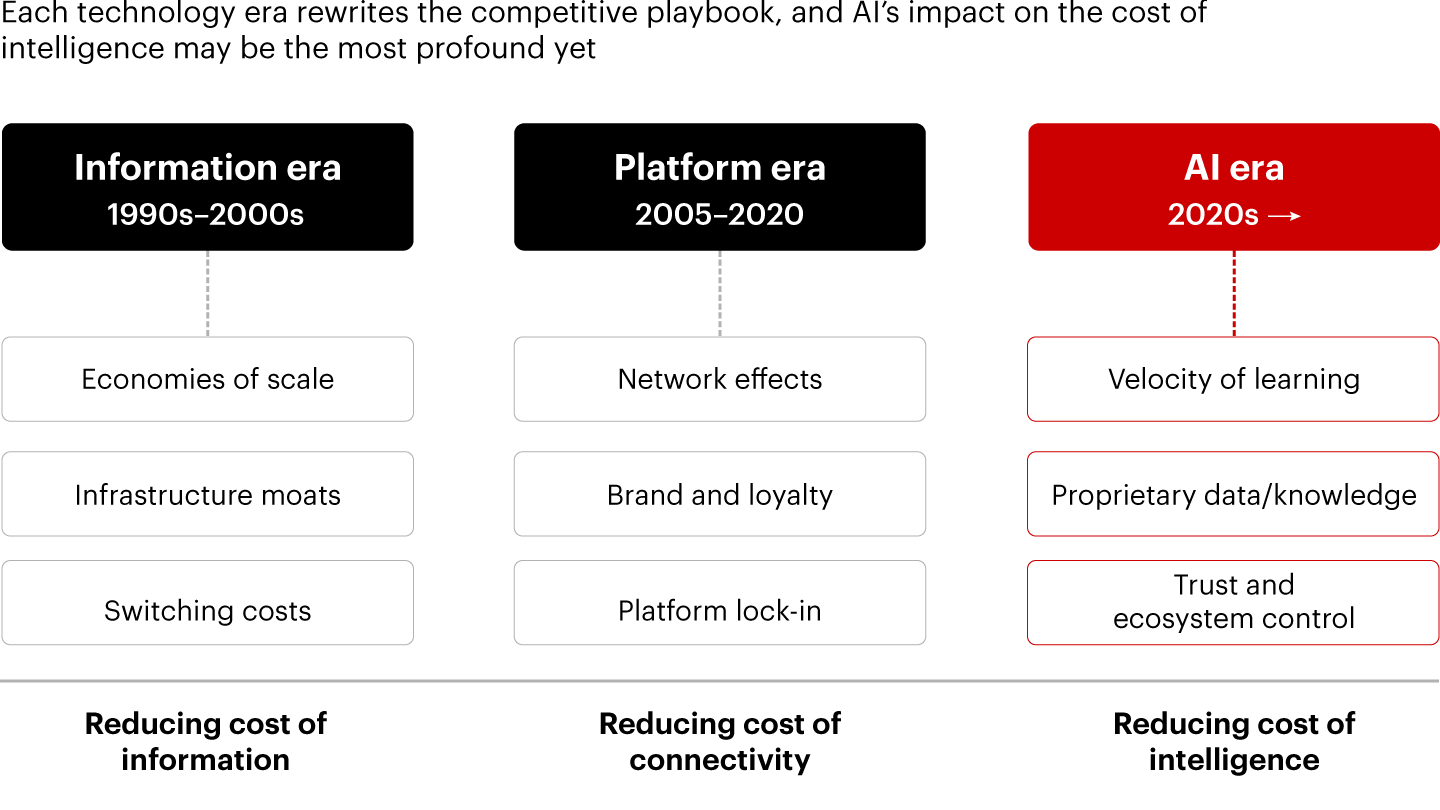
      AI is the latest wave to reshape the basis of competition
      Fonte: Bain & Company

      In most functions, we predict 30%–50% productivity gains from deploying AI agents to augment or automate knowledge work, comparable in magnitude to the globalization and offshoring wave of the 20th century. Ubiquitous access to cheaper intelligence will compress returns to scale, allowing smaller, faster-moving players to compete. Early movers in the AI market itself have already demonstrated that velocity of learning can trump raw scale.

      Three dynamics are reshaping competition.

      Cost and experience curves are being rewritten by AI. Position on these curves is no longer determined by enterprise scale—it is determined by the cumulative duration and velocity of learning. Getting on the new AI experience curve early can create a once-in-a-generation opportunity to build cost and scale advantage. Ecosystem partnerships provide the scale and experience needed to compete, while keeping enterprises lean, focused, and fast.

      Customer differentiation is shifting. AI will enable hyperpersonalization and faster innovation cycles at scale for everyone. In most industries, differentiation will then come from building a proprietary data or knowledge base, being focused enough to better integrate AI into personalized workflows and journeys, and/or cultivating a community that is passionate about helping you continuously improve your proposition.

      Industry control points are moving. As consumers begin more journeys with AI agents—in retail, financial services, travel, and beyond—the question of who “owns” the customer is wide open. The emerging factor determining who wins this control is trust: This is the basis on which an AI agent is permitted to orchestrate a consumer’s or enterprise’s digital life. Trust must be earned, via good governance, transparency, fairness, and reliability.

      Enterprises must rapidly build new strategic assets to compete in the AI era: velocity of learning, proprietary data and knowledge, and trust-based ecosystem control.

      Redesigning work for human-agent teams

      AI transformation requires workflow redesign and workforce modernization in parallel (see Figure 2). One without the other produces either elegant process maps with no capability to deliver or skilled people trapped in obsolete workflows.

      Figure 2
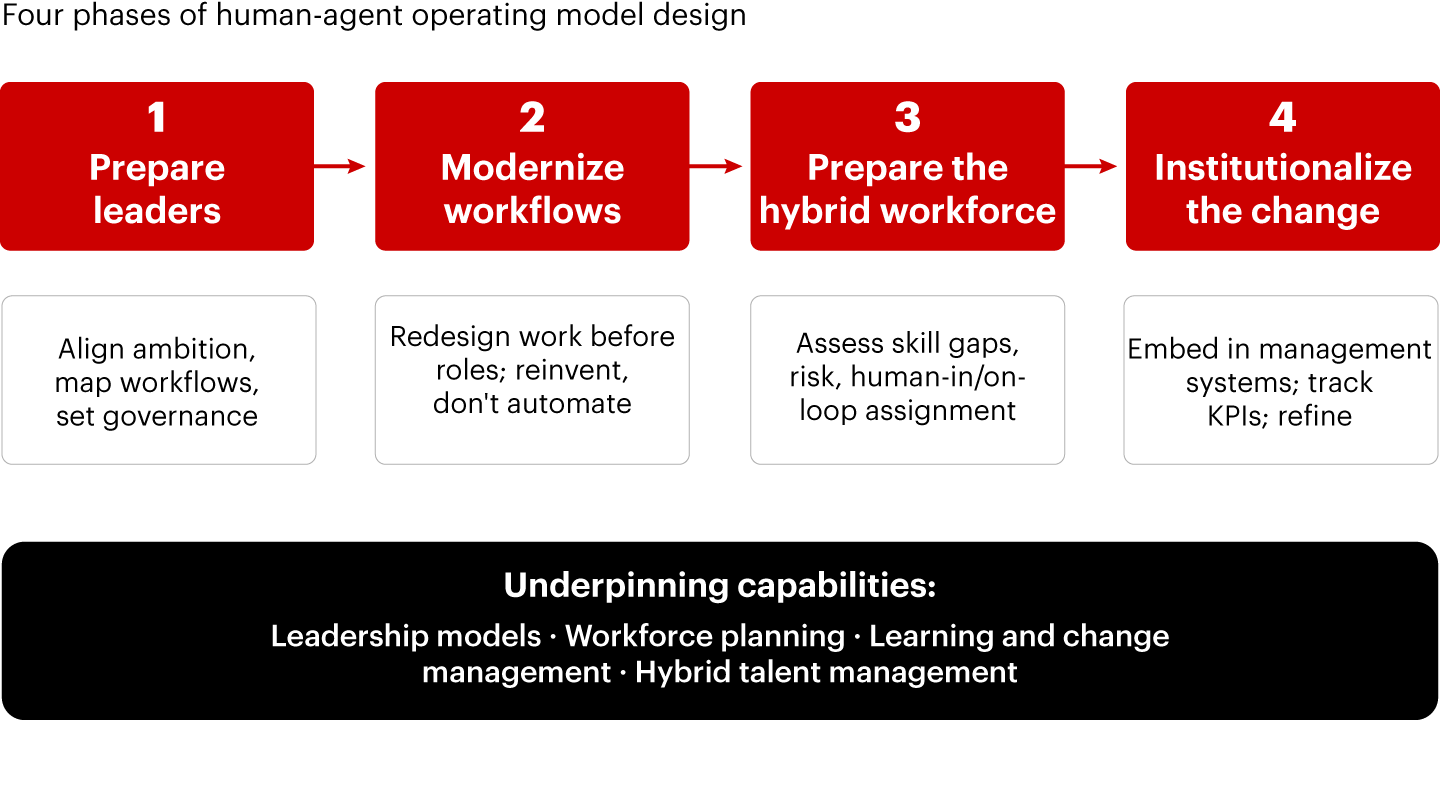
      AI transformation requires parallel workflow and workforce modernization
      Fonte: Bain & Company

      The work moves through four phases:

      Prepare leaders. Align on the breadth, speed, and ambition of the transformation. Map priority workflows—high value, high cost, or mission critical—and identify pools of value, bottlenecks, and failure modes. Set governance, decision rights, and a clear sponsorship spine.

      Modernize the workflow. Redesign the work before redefining roles. Standardize and simplify fragmented processes. Reimagine them with a view of today’s AI capabilities and what will be possible in 6 to 12 months. The key principle: Do not automate yesterday’s process—reinvent it end to end.

      Prepare the hybrid workforce. Assess skill gaps and transition risks. Define where humans remain accountable and where agents execute, distinguishing between “human in the loop” (full supervision) and “human on the loop” (managed oversight). Build targeted reskilling programs and recruit for new roles in workflow engineering, orchestration, and AI governance.

      Institutionalize the change. Embed new workflows in management systems. Track performance for both human and AI execution against defined KPIs. Continuously refine process design and agent autonomy as AI capabilities evolve.

      Over time, the organizational unit of advantage will no longer reside in functions. It will sit in the tightly integrated system of redesigned workflows and a modernized hybrid workforce with continuous feedback loops of human and machine learning.

      Leaders must be thoughtful about how they engage people across the organization. No agentic AI transformation will succeed if the goal appears to be replacing jobs without providing a path to a more fulfilling career. The most effective transformations frame AI as an elevation of people’s work—freeing them from repetitive execution and repositioning them as supervisors, designers, and improvers of agent-led systems.

      Industrializing AI: the agent factory

      Scaling AI across the enterprise demands more than upgrading data science teams or bolting AI onto existing IT capabilities. It requires what we call an agent factory—a repeatable, industrial process for building, testing, deploying, and governing AI agents (see Figure 3).

      Figure 3
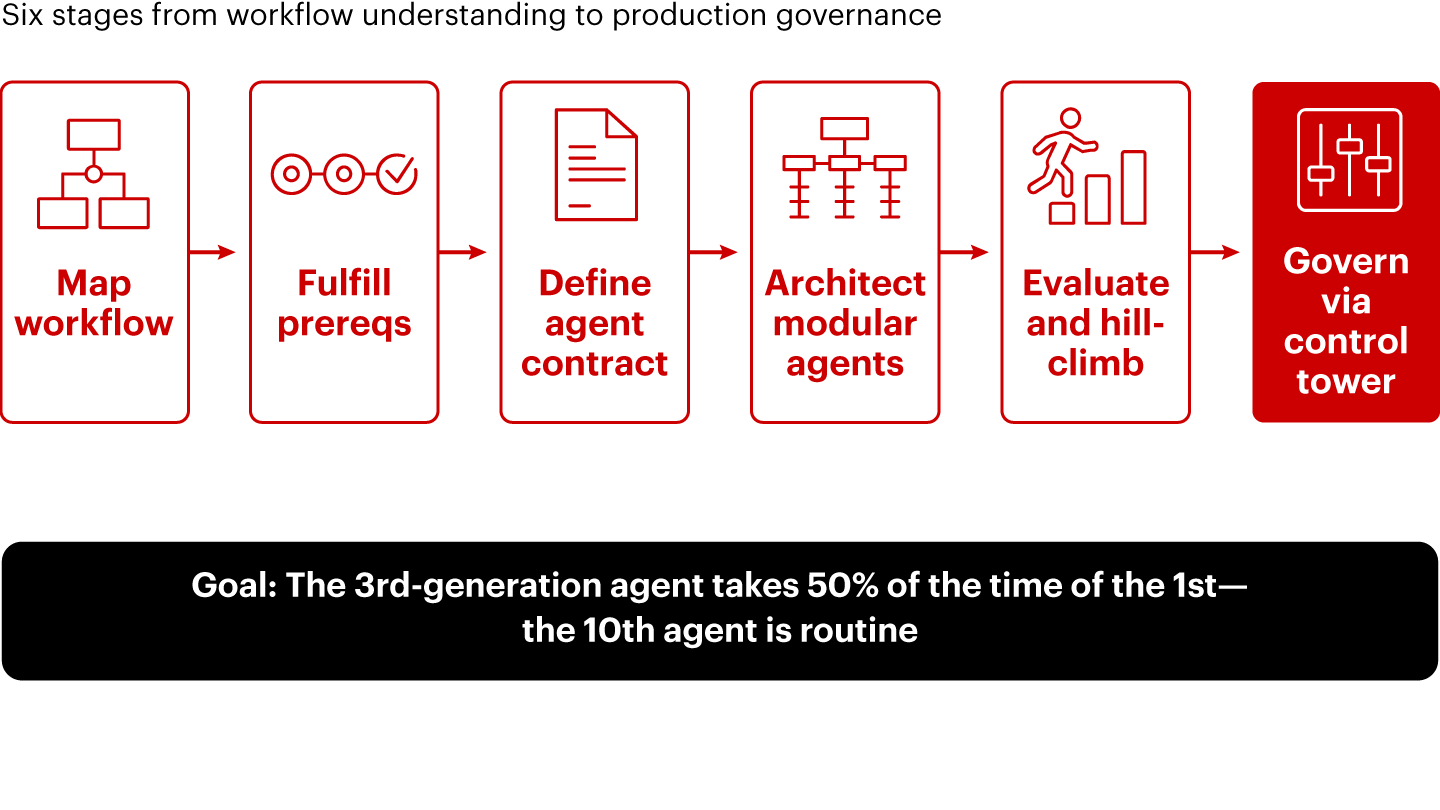
      The agent factory: a repeatable industrial process for AI agents
      Fonte: Bain & Company

      The factory follows a clear sequence.

      Start with the workflow, not the model. Codify process maps—steps, handoffs, decisions, systems. Catalog edge cases and failure modes. The quality of any AI agent is bounded by workflow understanding.

      Fulfill hard prerequisites before development begins. Operational readiness matters more than technical readiness. Secure named subject matter experts and committed business leaders who will own scaling and results.

      Define the agent contract. Each agent must have clear trigger conditions, typed input/output schemas, explicit autonomy boundaries, tool access permissions, quantified performance targets, and defined escalation modes. If the contract cannot be written, the agent is not ready to be built.

      Architect modular, orchestrated systems. Decompose agents into specialized subagents with typed outputs whenever a handoff feeds tools, code, or downstream automation. Prefer deterministic orchestration and validation; use LLM reasoning where flexibility is required.

      Build a rigorous evaluation process. Establish a human-calibrated baseline and a living evaluation set (ground truth where applicable). Run offline testing until minimum performance thresholds are met, then shadow alongside human agents or safe rollout before full deployment.

      Govern via a control tower. Maintain full trace logging, real-time visibility into outcomes, continuous automated evaluation against agent contracts, kill switches for inappropriate actions, and progressive rollout as performance is proven.

      Scaling AI: six deliberate patterns

      Most enterprises are experimenting with AI but failing to scale. The difference between experimentation and impact is a deliberate scaling pattern matched to context. We see six patterns emerging across enterprises:

      • Bottom-up. Deploy general-purpose AI broadly and let teams innovate. (Good for momentum and culture but rarely moves the needle on productivity alone.)
      • Top-down. Focus on 5–10 critical domains, set explicit targets with business owners, and track through stage gates. (Often triggered by frustration with bottom-up results.)
      • Horizontal. Take a proven AI agent or use case and replicate it across similar domains, segments, or geographies; prioritize highest value first, not highest complexity.
      • End-to-end. Zero-base a process and rebuild it with AI embedded. We’ve seen this shorten major workflow cycles from weeks to days. (Best where potential is high but inertia blocks progress.)
      • Longitudinal. Small teams hill-climb performance on high-value use cases through tight iterative cycles. Autonomy increases as results improve.
      • Leapfrog. Small, empowered teams reinvent the business from scratch. (For industries and functions at risk of complete transformation, where incremental moves won’t suffice.)

      The right pattern depends on urgency and the maturity of the AI agent required (see Figure 4). Companies in stable industries can perhaps take the risk of being more incremental. Those facing fundamental disruption must move urgently and bet boldly.

      Figure 4
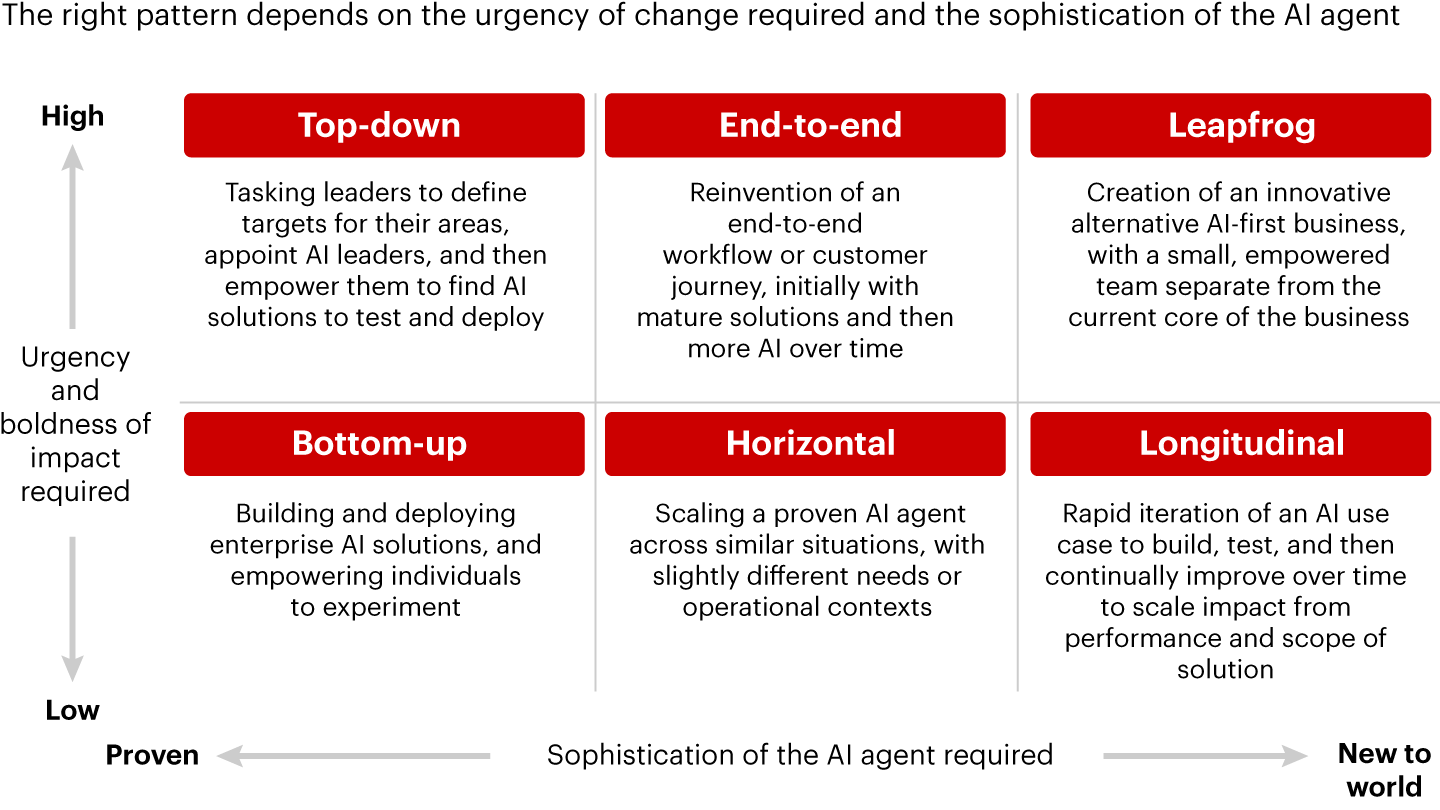
      Six patterns for scaling AI
      Fonte: Bain & Company

      Whatever scaling approach you choose, certain foundational investments are nonnegotiable: getting core data and knowledge in order so AI agents can actually use it, making key business systems accessible to AI, and putting security and governance guardrails in place. These don’t need to be finished before you start, but without them, no amount of ambition will translate into impact at scale.

      What winners will do

      The developments of the past months signal the beginning of the AI enterprise era. Organizations that win will redefine strategy under new AI economics, redesign workforces around agent-led workflows, industrialize how AI is built and governed, and apply deliberate scaling patterns matched to their competitive reality.

      AI is not a technology program. It is a redesign of how work gets done and how enterprises compete. The success of an AI strategy is not what you plan to do—it is how you execute the transformation.

      Autori
      • Headshot of James Anderson
        James Anderson
        Partner, London
      • Headshot of Moez Draief
        Moez Draief
        Partner, London
      • Headshot of Florian Mueller
        Florian Mueller
        Partner, Munich
      • Headshot of James Hadley
        James Hadley
        Partner, London
      Contattaci
      Servizi di consulenza collegati
      • AI, Insights, and Solutions
      • Digital
      Come possiamo aiutarti
      • Artificial Intelligence
      CIO Insights
      Want More Out of Your AI Investments? Think People First

      To unlock AI’s exponential productivity potential, companies must modernize workflow and workforce in tandem.

      Leggi di più
      Artificial Intelligence
      How Agentic AI Is Reshaping Customer Behavior in Italy and Europe

      As global AI use increases, the challenge lies in ensuring users are appropriately empowered by the technology.

      Leggi di più
      CIO Insights
      Life Sciences’ AI Momentum Requires a Workforce Redesign

      AI scalers aren't waiting for new talent—they're building it.

      Leggi di più
      CIO Insights
      Four Ways Leaders Can Make AI Redesigns Stick

      As companies redesign to scale AI, these four lessons help leaders ensure their organizations actually live the new operating model.

      Leggi di più
      Artificial Intelligence Insights
      How to Make Your Organization Five Times Faster

      In the age of AI, there’s no time to wait.

      Leggi di più
      First published in febbraio 2026
      Tags
      • AI, Insights, and Solutions
      • Artificial Intelligence
      • Artificial Intelligence Insights
      • CIO Insights
      • Digital

      Come abbiamo aiutato i nostri clienti

      A Beauty Company Enables Always-On Brand Acceleration

      Leggi un caso di studio

      Organizzazione Reimagining Insurance for the AI Era

      Leggi un caso di studio

      Blockchain-enabled Payment Flows: A Payments Company Reviews its Strategy

      Leggi un caso di studio

      Vuoi continuare la conversazione?

      Aiutiamo i leader globali e le loro aziende ad affrontare problemi e a cogliere le opportunità. Sosteniamo cambiamenti e otteniamo risultati duraturi.

      Bain Insights. Le nostre idee e punti di vista sulle tematiche che le aziende globali affrontano ogni giorno, arrivano nella tua email tutti i mesi.

      *Ho letto l'Informativa sulla Privacy e accetto i termini e le condizioni.

      Si prega di leggere e accettare l’Informativa sulla Privacy
      Bain & Company
      Contattaci Sustainability Accessibility Condizioni d’uso Privacy Cookie Policy Sitemap Log In

      © 1996-2026 Bain & Company, Inc.

      Contatta Bain

      Come posso aiutarti?

      • Business inquiry
      • Career information
      • Press relations
      • Partnership request
      • Speaker request
      Guarda tutti gli uffici