

Global Private Equity Report

In evidenza
- Buy-and-build continues to be one of private equity’s most popular strategies.
- But a sustained period of higher interest rates is making it a lot harder to drive returns, especially for platforms that were relying heavily on multiple arbitrage.
- Generating a strong exit in this environment will require doubling down on a strategy to produce organic growth and better margins—or finding one fast.
This article is part of Bain’s 2024 Global Private Equity Report
There’s a good reason buy-and-build has been a core private equity strategy for as long as the industry has been around: When it works, it works beautifully.
The trouble in today’s market is that making it work can be a major challenge.
We define buy-and-build as an explicit strategy to increase value by using a well-positioned platform company to make at least four repeated add-on acquisitions of smaller companies. The idea is to ensure that 1+1=3 by capturing the benefits of scale and scope.
Historically, the market has encouraged these combinations by assigning higher valuations to larger companies than it does to smaller ones. This opens the door to multiple arbitrage—the practice of creating a large, high-multiple company by tucking in add-on acquisitions at lower multiples. That brings down the average cost of acquisition, sweetening the return at exit.
The recent spike in interest rates, however, disrupts this virtuous scenario in several ways.
Consider a typical platform company acquired several years ago at 12 times earnings and financed with 7 turns of variable-rate debt. The cost of financing today is approximately double what investors were modeling in 2020, meaning it has gotten significantly harder for this company to service its existing debt, let alone fund an opportunistic acquisition strategy to meet growth projections (see Figure 1).
Figure 1


At the same time, multiple arbitrage for this platform is harder to capture. Because higher interest rates are putting downward pressure on asset prices—particularly leveraged assets—a platform acquired and added to in a low-rate environment is probably worth less today than it was a year or two ago. That might upset the anticipated multiple-arbitrage opportunity relative to assets acquired today.
Adjusting to the new reality
For buy-and-build strategies launching today and adjusted for current economics, the math might still work. But many platform deals were started in a low-rate environment and aren’t yet completed. For them, generating an acceptable return has gotten a lot harder.
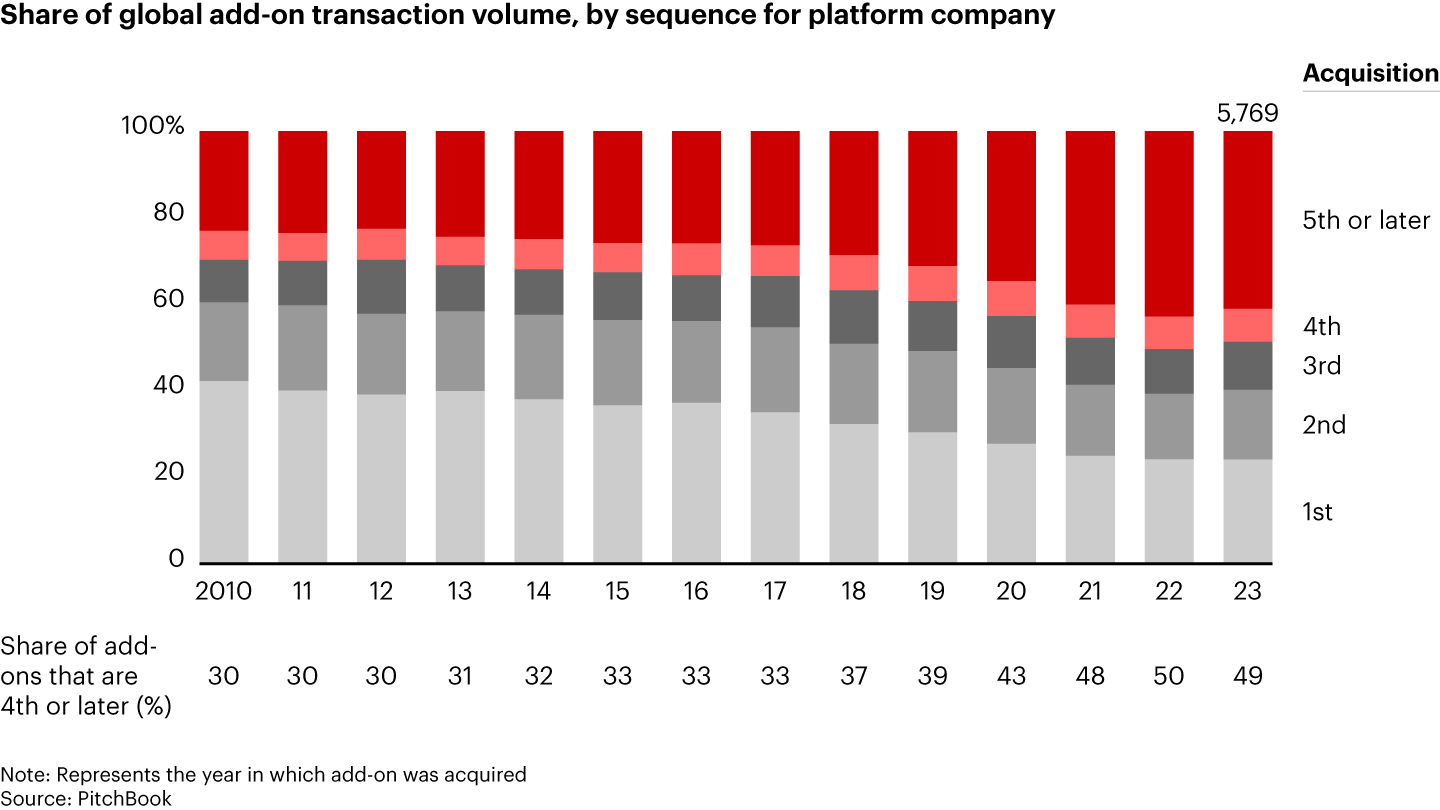
The data suggests that these uncompleted deals comprise a substantial portion of the market. When we last wrote about buy-and-build in 2019, we noted that more than 30% of add-on deals represented at least the fourth acquisition by a single platform company, up from 21% in 2003. Today, that number is close to 50% (see Figure 2). At the same time, the total value of add-ons has declined over the last two years. The implication is that more sponsors are hustling to try to complete buy-and-build strategies than are trying to launch new ones.
Figure 2

Making these deals work at exit is going to require doubling down on organic value creation.
For many, that will mean recharging the deal’s underlying strategic foundation. For others, it will mean finding a new one soon. In the absence of a multiple-arbitrage boost, those that had flimsy strategic rationale from the start are in a particularly difficult place. Looking at a set of 44 buy-and-build deals made between 2010 and 2019, those that depended on multiple arbitrage alone to generate returns had an average multiple on invested capital (MOIC) of 1.4x. Those with a strategic rationale driving accelerated organic growth or meaningful margin improvement had an MOIC of 2.2x.
The deals generating the highest returns start with an essential gating question: What value are you really capturing by making this particular set of acquisitions with this particular platform company?
It’s certainly important that the platform company is in a sector with ample growth potential and sufficient white space for acquisitions. But that’s really just table stakes. What’s critical is a detailed blueprint for how consolidation will open up new customer segments, add lucrative new geographies or channels, expand the customer offering, or substantially improve operations. Even if those opportunities do exist, success ultimately relies on M&A expertise, thoughtful integration, and the capabilities to execute a clear and actionable value-creation plan. Strong returns in today’s market will also require an especially compelling exit story, including clear evidence that what you’ve built will continue to outperform in the years ahead.
What does good look like? Let’s examine three different flavors of success.
EIS: ensuring bigger is, in fact, better
The right strategic logic isn’t always obvious from the outside in and has to be tailored to the business. When Audax Private Equity carved out a noncore distribution business from Genuine Parts Company in 2019, determining the best path forward required some nuance.
At the start, Audax split the business into three parts. It spun off one right away and kept the other two—Genuine Cable Group (GCG) and Engineered & Industrial Solutions (EIS)—as buy-and-build platforms.
Most rollups focus on capturing regional market share, but EIS was inherently more complex. As a value-added distributor of materials and components used in electrical and electronic applications, the company sold to large original equipment manufacturers (OEMs) of products like motors and transformers. The basis of economics in this business lay in expanding the company’s share of a given end product’s bill of materials—selling more materials, components, and value added-services into the same transformer, for instance.
EIS had expertise in these markets, but underinvestment over the years had led to a lack of focus and weak performance. Audax saw an opportunity to rekindle growth by sharpening the company’s focus on its core OEM customers while expanding into related aftermarket channels and cracking promising new end markets such as electric vehicle batteries and alternative energy.
To get there, Audax recruited a new team of executives and challenged them to closely define where EIS should be playing and to create the right go-to-market organization to attack each type of customer differentially. The company supported this focus with a targeted M&A agenda that included acquiring a set of distributors to add scale to the core and expand access to OEM customers, as well as several scope acquisitions like Norberg and Power Grid Supply that opened access to key aftermarket segments.
Bringing all this together has been a process. EIS has transformed its commercial capabilities, adding digital tools, inside selling resources, and a new pricing platform. It has also zeroed in on integration, creating value by unifying enterprise resource planning and IT systems across the full business. There’s still work to do, but earnings at EIS have grown threefold since Audax got involved, and the gross margin profile continues to improve. Most important is that EIS has linked its M&A strategy to a clear commercial roadmap that will drive future growth strategically.
Culture change at scale
It’s axiomatic that scale can reliably drive superior economics for a platform company. But lasting value often comes from marrying scale with a broader strategy of performance improvement. Consider the case of Caliber Collision, which started its journey under private equity ownership in 2008, when Canada’s ONCAP acquired it. Since then, the company has grown steadily through a succession of private equity sponsors and is now owned by Hellman & Friedman, which bought it in 2019 and merged it with another portfolio company called ABRA Auto Body & Glass. Today, it has more than 1,700 centers in the US and has expanded into auto glass and maintenance.
It would be a mistake, however, to view Caliber as a simple growth play. While the original chain was good enough at fixing cars from a quality perspective, it put little emphasis on customer service. That was a liability—not only for customers deciding on where to take their cars but also for their insurance companies, which Caliber relied on for a large share of its business.
Realizing that substantial value lay in creating a better customer experience, new management launched what amounted to a cultural transformation. Adopting the tagline “Restoring the rhythm of your life,” Caliber installed systems and processes to firm up estimates, shorten turnaround time, and improve customer communication. Managers and technicians were not only trained in technical skills but also coached in how to communicate timelines to customers, while explaining everything and showing them empathy at an especially difficult time.
This mission-driven model still sits at the center of Caliber’s growth strategy. For each new Caliber shop, the company deploys a “tiger team” to train up the staff while replacing IT systems and implementing new dashboards to monitor operational key performance indicators (KPIs) like capacity utilization. This repeatable model leads to big jumps in efficiency, high marks for Net Promoter ScoreSM, and low employee turnover—all competitive advantages in an industry never known for warming up to customers.
Size does matter, though. Having a national footprint and strong operations allows Caliber to be a provider of choice for insurance companies, which like to push volume through large, integrated operations that consistently provide high-quality, efficient service. The larger platform also let Caliber expand into branded auto glass and maintenance centers, adding new revenue streams. Increased scale, in other words, has been a critical strategic goal. But without continuous improvement at the shop level, it wouldn’t mean much for long-term performance.
Partner in Pet Food: M&A as a transformation tool
Using M&A strategically to broaden scope can set the right platform company on a new trajectory in terms of where growth is coming from and how profitable it is.
Partner in Pet Food (PPF), for instance, was plugging along just fine when Cinven acquired it in 2018. The company was Europe’s leading private-label pet food operation and had a steady—albeit lower-margin—business. Cinven saw an opportunity to take it up a notch by adding new products, channels, and purchase occasions (snacks, for example). That would create a more vibrant competitor with superior economics.
The firm’s targeted Partner in Pet Food M&A strategy laid out four key objectives: improve efficiency by adding manufacturing expertise in the core business, boost margins by expanding into branded products, open new growth channels (e-commerce, specialty retail), and increase scale by expanding geographically.
The first step was to build a dedicated M&A capability to find and evaluate targets. The team launched a continuous market-screen process to identify companies that would address one of the four strategic focus areas. The highest-potential targets were then evaluated based on a defined set of KPI benchmarks, potential synergies, and the ability to generate a strong return on investment.
A good example was Doggy, a Swedish company PPF acquired in 2020. As Sweden’s largest manufacturer of branded cat and dog food, the company gave PPF quick access to the Nordic region with a lineup of high-margin products sold in specialty stores. A complementary acquisition in Italy opened up that market and pushed PPF into dog and cat snacks, another high-margin product category.
Five key acquisitions over three years have transformed a low-growth commodity pet-food manufacturer into a diversified, branded company with much stronger earnings potential. Revenue has tripled since Cinven bought it, and the company’s new M&A capability has burnished its exit story by ensuring that PPF can pursue more acquisitions in the future.
What these three stories have in common are not the specific levers the deal teams pulled to create value. The right initiatives will always fit the platform company like a bespoke suit. The common denominator is a recognition that “bigger is better” alone isn’t a strategy. Neither is multiple arbitrage. More than anything else, succeeding at buy-and-build is about harnessing benefits of scale and scope to drive sustainable, profitable growth. And that’s never been more true than it is today.
Read our 2024 Global Private Equity Report
More from the report
First published in marzo 2024