
Skip to Content
  • Uffici

    Uffici

    Nord e Sud America
    • Atlanta
    • Austin
    • Bogota
    • Boston
    • Buenos Aires
    • Chicago
    • Dallas
    • Denver
    • Houston
    • Los Angeles
    • Mexico City
    • Minneapolis
    • Monterrey
    • Montreal
    • New York
    • Rio de Janeiro
    • San Francisco
    • Santiago
    • São Paulo
    • Seattle
    • Silicon Valley
    • Toronto
    • Washington, DC
    Europa, Medio Oriente e Africa
    • Amsterdam
    • Athens
    • Berlin
    • Brussels
    • Copenhagen
    • Doha
    • Dubai
    • Dusseldorf
    • Frankfurt
    • Helsinki
    • Istanbul
    • Johannesburg
    • Kyiv
    • Lisbon
    • London
    • Madrid
    • Milan
    • Munich
    • Oslo
    • Paris
    • Riyadh
    • Rome
    • Stockholm
    • Vienna
    • Warsaw
    • Zurich
    Asia e Australia
    • Bangkok
    • Beijing
    • Bengaluru
    • Brisbane
    • Ho Chi Minh City
    • Hong Kong
    • Jakarta
    • Kuala Lumpur
    • Manila
    • Melbourne
    • Mumbai
    • New Delhi
    • Perth
    • Seoul
    • Shanghai
    • Singapore
    • Sydney
    • Tokyo
    Guarda tutti gli uffici
  • Alumni
  • Media Center
  • Iscriviti
  • Contattaci
  • Italy | Italiano

    Seleziona il tuo Paese e la tua lingua

    Global
    • Global (English)
    Nord e Sud America
    • Brazil (Português)
    • Argentina (Español)
    • Canada (Français)
    • Chile (Español)
    • Colombia (Español)
    Europa, Medio Oriente e Africa
    • France (Français)
    • DACH Region (Deutsch)
    • Italy (Italiano)
    • Spain (Español)
    • Greece (Elliniká)
    Asia e Australia
    • China (中文版)
    • Korea (한국어)
    • Japan (日本語)
  • Saved items (0)
    Saved items (0)

    You have no saved items.

    Contrassegna il contenuto che ti interessa e verrà salvato qui. Potrai leggerlo o condividerlo in seguito.

    Explore Bain Insights
  • Settori
    Menu principale

    Settori

    • Aerospazio e Difesa
    • Agribusiness
    • Chimica
    • Infrastrutture e Costruzioni
    • Beni di Largo Consumo
    • Servizi Finanziari
    • Sanità
    • Macchinari Industriali
    • Media & Intrattenimento
    • Industria Metallurgica
    • Industria Mineraria
    • Petrolio e Gas
    • Industria Cartaria e Packaging
    • Private Equity
    • Settore Sociale & Pubblico
    • Retail
    • Tecnologia
    • Telecomunicazioni
    • Compagnie Aeree & Trasporti
    • Viaggi e Svago
    • Utility e Rinnovabili
  • Servizi di Consulenza
    Menu principale

    Servizi di Consulenza

    • Customer Experience
    • ESG
    • Innovation
    • M&A and Divestitures
    • Operation
    • People & Organization
    • Private Equity
    • Sales & Marketing
    • Strategia
    • IA, Approfondimenti e Soluzioni
    • Tecnologia
    • Trasformazione
  • Digital
  • Tematiche
  • Informazioni su Bain
    Menu principale

    Informazioni su Bain

    • Che Cosa Facciamo
    • Quello in Cui Crediamo
    • Le Nostre Persone e la Leadership
    • Risultati
    • Premi e Riconoscimenti
    • Organizzazioni Globali
    Further: Our global responsibility
    • Diversità e Inclusione
    • Social Impact
    • Sustainability
    • World Economic Forum
    Learn more about Further
  • Careers
    Menu principale

    Careers

    • Work with Us
      Careers
      Work with Us
      • Find Your Place
      • Our Work Areas
      • Integrated Teams
      • Students
      • Internships & Programs
      • Recruiting Events
    • Life at Bain
      Careers
      Life at Bain
      • Blog: Inside Bain
      • Career Stories
      • Our People
      • Where We Work
      • Supporting Your Growth
      • Affinity Groups
      • Benefits
    • Impact Stories
    • Hiring Process
      Careers
      Hiring Process
      • What to Expect
      • Interviewing
    FIND JOBS
  • Uffici
    Menu principale

    Uffici

    • Nord e Sud America
      Uffici
      Nord e Sud America
      • Atlanta
      • Austin
      • Bogota
      • Boston
      • Buenos Aires
      • Chicago
      • Dallas
      • Denver
      • Houston
      • Los Angeles
      • Mexico City
      • Minneapolis
      • Monterrey
      • Montreal
      • New York
      • Rio de Janeiro
      • San Francisco
      • Santiago
      • São Paulo
      • Seattle
      • Silicon Valley
      • Toronto
      • Washington, DC
    • Europa, Medio Oriente e Africa
      Uffici
      Europa, Medio Oriente e Africa
      • Amsterdam
      • Athens
      • Berlin
      • Brussels
      • Copenhagen
      • Doha
      • Dubai
      • Dusseldorf
      • Frankfurt
      • Helsinki
      • Istanbul
      • Johannesburg
      • Kyiv
      • Lisbon
      • London
      • Madrid
      • Milan
      • Munich
      • Oslo
      • Paris
      • Riyadh
      • Rome
      • Stockholm
      • Vienna
      • Warsaw
      • Zurich
    • Asia e Australia
      Uffici
      Asia e Australia
      • Bangkok
      • Beijing
      • Bengaluru
      • Brisbane
      • Ho Chi Minh City
      • Hong Kong
      • Jakarta
      • Kuala Lumpur
      • Manila
      • Melbourne
      • Mumbai
      • New Delhi
      • Perth
      • Seoul
      • Shanghai
      • Singapore
      • Sydney
      • Tokyo
    Guarda tutti gli uffici
  • Alumni
  • Media Center
  • Iscriviti
  • Contattaci
  • Italy | Italiano
    Menu principale

    Seleziona il tuo Paese e la tua lingua

    • Global
      Seleziona il tuo Paese e la tua lingua
      Global
      • Global (English)
    • Nord e Sud America
      Seleziona il tuo Paese e la tua lingua
      Nord e Sud America
      • Brazil (Português)
      • Argentina (Español)
      • Canada (Français)
      • Chile (Español)
      • Colombia (Español)
    • Europa, Medio Oriente e Africa
      Seleziona il tuo Paese e la tua lingua
      Europa, Medio Oriente e Africa
      • France (Français)
      • DACH Region (Deutsch)
      • Italy (Italiano)
      • Spain (Español)
      • Greece (Elliniká)
    • Asia e Australia
      Seleziona il tuo Paese e la tua lingua
      Asia e Australia
      • China (中文版)
      • Korea (한국어)
      • Japan (日本語)
  • Saved items  (0)
    Menu principale
    Saved items (0)

    You have no saved items.

    Contrassegna il contenuto che ti interessa e verrà salvato qui. Potrai leggerlo o condividerlo in seguito.

    Explore Bain Insights
  • Settori
    • Settori

      • Aerospazio e Difesa
      • Agribusiness
      • Chimica
      • Infrastrutture e Costruzioni
      • Beni di Largo Consumo
      • Servizi Finanziari
      • Sanità
      • Macchinari Industriali
      • Media & Intrattenimento
      • Industria Metallurgica
      • Industria Mineraria
      • Petrolio e Gas
      • Industria Cartaria e Packaging
      • Private Equity
      • Settore Sociale & Pubblico
      • Retail
      • Tecnologia
      • Telecomunicazioni
      • Compagnie Aeree & Trasporti
      • Viaggi e Svago
      • Utility e Rinnovabili
  • Servizi di Consulenza
    • Servizi di Consulenza

      • Customer Experience
      • ESG
      • Innovation
      • M&A and Divestitures
      • Operation
      • People & Organization
      • Private Equity
      • Sales & Marketing
      • Strategia
      • IA, Approfondimenti e Soluzioni
      • Tecnologia
      • Trasformazione
  • Digital
  • Tematiche
  • Informazioni su Bain
    • Informazioni su Bain

      • Che Cosa Facciamo
      • Quello in Cui Crediamo
      • Le Nostre Persone e la Leadership
      • Risultati
      • Premi e Riconoscimenti
      • Organizzazioni Globali
      Further: Our global responsibility
      • Diversità e Inclusione
      • Social Impact
      • Sustainability
      • World Economic Forum
      Learn more about Further
  • Careers
    Ricerche più popolari
    • Agile
    • Digitale
    • Strategia
    La tue ricerche precedenti
      Pagine visitate

      Content added to saved items

      Saved items (0)

      Removed from saved items

      Saved items (0)

      Brief

      Capital Productivity for Oil and Gas in a Low-Price Environment

      Capital Productivity for Oil and Gas in a Low-Price Environment

      Reducing capital expenditure is a natural response to low oil prices, but the industry needs to continue to explore and develop to meet long-term demand, which continues to grow.

      Di Lodewijk de Graauw, John McCreery and Brian Murphy

      • Tempo di lettura min.
      }

      Brief

      Capital Productivity for Oil and Gas in a Low-Price Environment
      en

      Reducing capital expenditure is a natural response to low oil prices, as demonstrated by the oil and gas industry deferring or canceling $200 billion worth of planned investments over the past two years. Another $1.5 trillion of future spending may be uneconomic at current oil prices.

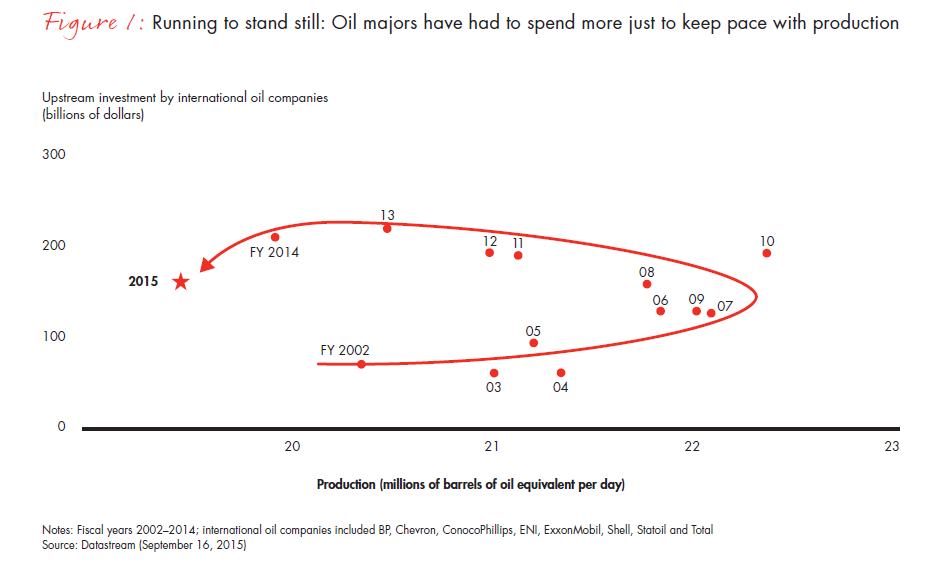
      At the same time, the industry needs to continue to explore and develop to meet long-term demand, which continues to grow, albeit more slowly than before. In fact, over the past decade, major oil companies have had to invest more capital just to maintain production levels, running harder to stand still (see Figure 1).

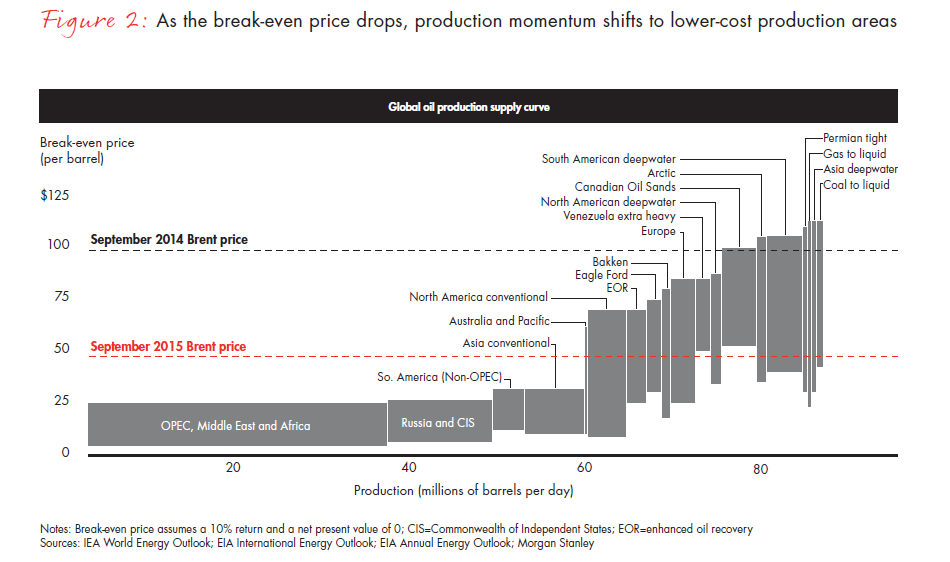
      As the industry establishes a new equilibrium between supply and demand, producers shift from high-cost plays (such as Arctic and ultra-deepwater) to more accessible, low-cost barrels (see Figure 2).

      In this low-cost world, it will be even more important to use capital as efficiently as possible. When oil was $100 per barrel, projects competed against each other for capital, but high returns meant that volume typically won over capital efficiency, resulting in a tripling of annual capex between 2003 and 2013. In the $50-per-barrel world, projects will increasingly struggle to return the cost of capital, so capital efficiency will be essential to get projects funded.
      capital-productivity-for-oil-and-gas-in-a-low-price-environment-fig-01-embed

      capital-productivity-for-oil-and-gas-in-a-low-price-environment-fig-02-embed

      Three fundamental trends to improve capital productivity

      Fortunately, oil and gas companies have room to raise their capital productivity, particularly for projects that are early in the life cycle. We see three broad trends that will fundamentally raise the productivity of capital over the coming decades: innovation, standardization and optionality.

      Innovation. Technology continues to evolve rapidly in oil and gas, improving capital productivity by delivering solutions that help producers deliver more efficiently. The technologies that helped make unconventional production economical over the past decade are the most obvious example. Floating liquefied natural gas (FLNG) platforms are another one. These structures will improve the economics of remote natural gas production as they begin to replace traditional onshore development projects. Advanced analytics will help, too, by improving the predictability of known drilling problems in well planning and execution. When oil prices are low, technology budgets come under severe pressure, so executives should take care not to damage their long-term capacity for innovation.

      Standardization. Industries such as automotive and manufacturing have worked to standardize their production processes, but that has not occurred in oil and gas. Consider subsea operators who still use 28 different shades of yellow to paint their equipment. Standardization improves capital productivity in several ways. First, simplifying and standardizing engineering designs helps prevent unnecessary customization and the urge to gold-plate solutions. One senior executive applies this test: If the new idea were to cost 10 times what the proponent says and the benefit were to be one-tenth of that claimed, would we still do it? Only changes passing the test are implemented.

      Second, the “design one, build many” concept has had some notable successes, with ExxonMobil’s deepwater developments in Angola often cited as the best example. The industry could do more under this concept—for example, in FLNG.

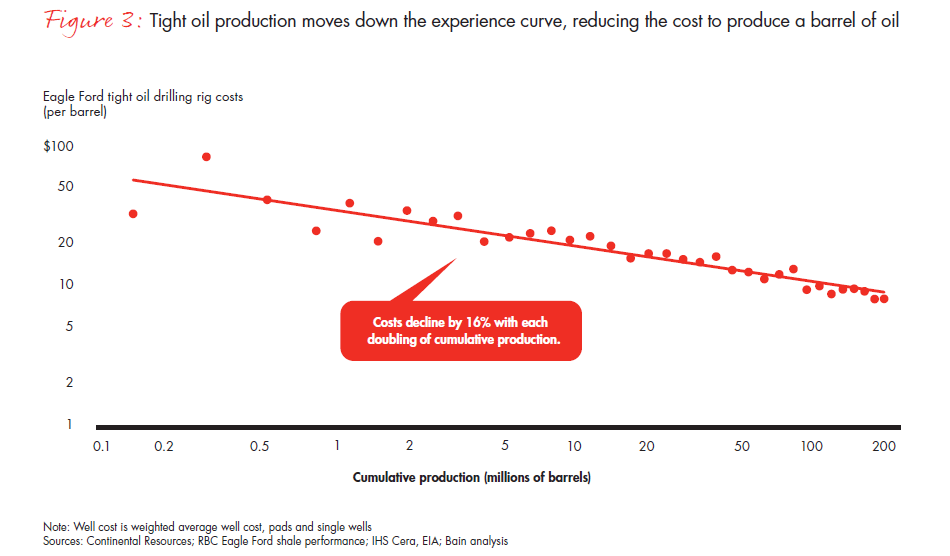
      Standardization also makes it easier for companies to collaborate and eliminate wasteful practices. This is especially true as most development over the next five years will be within known environments (since ultra-deepwater and the Arctic are mostly off the table at today’s oil prices), and companies can continue down the experience curve (see Figure 3).

      capital-productivity-for-oil-and-gas-in-a-low-price-environment-fig-03-embed

      Optionality. For almost 20 years, the industry has worked with decision review gates and a sequential, converging process for project development: a review of conceptual options followed by front-end engineering of one selected option before making a final investment decision and commencement of a detailed design. This approach has served the industry well and should continue to do so.

      Today’s environment places pressure on that process. Markets are volatile, and innovation is accelerating rapidly. Pressure on capital productivity leaves less tolerance for long rework cycles, and if a project fails to pass a stage gate, that may be the end of it.

      We see two implications from this, both of which may require the judgement of more senior project development executives.

      First, companies can learn to make decisions based on imperfect but sufficient information. Too often, they overinvest in defining conceptual designs to reach an outcome that could have been decided more easily. Instead, they can reverse the logic and start with what would be needed for the project to fly. If the cost is off by billions, there’s no need to examine smaller details. Instead, they can move on to alternative concepts.

      Second, they should keep more options open in the early stages, pursuing multiple concepts in competition with each other. Suboptimal options should receive less attention, but the project should maintain a clear understanding of the assumptions underpinning that outcome and monitor the external environment for changes.

      None of this advocates for looser or schedule-driven early-stage development, which can be a train wreck. Project developers still need to make decisions based on value creation and with all due technical and commercial consideration. But projects can proceed with explicit treatment of uncertainty, taking a “wider funnel for longer” at the start with a flexible stage gate system, guided by an appropriately senior gatekeeper.

      Brian Murphy, a partner in Bain's Oil & Gas practice, outlines five action areas for oil and gas companies to implement capital projects in the most productive way.

      Putting capital productivity into motion

      These trends are well documented, but industry leaders will have to focus their efforts to ensure that they contribute to capital productivity within their organizations. Five principles can guide executives as they make capital decisions.

      • Continue to invest. Current conditions represent an opportunity to invest in capital projects in a low-price environment, to make progress on projects while sector inflation takes a breather and people and equipment are less in demand. The opportunity applies to R&D, too, even though reduced revenue puts pressure on budgets. Companies need to prioritize carefully to ensure that they continue to fund technologies that could reduce costs and make challenging opportunities affordable.
      • Design to cost. Too many capital projects start with a cost estimate defined by the engineering and design teams. Taking the reverse approach—that is, understanding what investment is feasible and then deciding what can be done within those constraints—is more realistic in a low-oil-price environment. In fact, setting the cost below a reasonable level spurs creativity and preserves capital until oil prices recover.
      • Collaborate to drive standardization. Internally, companies should adopt best-in-class design objects and measure the uptake of reusable designs from standard catalogs. Externally, companies should be more open to (closely monitored) collaboration with vendors, engineering and procurement contractors, and owner teams to engage collectively in standard, productive solutions. Decision processes and tools that streamline partner interactions and approvals can also help.
      • Challenge the development process. The traditional stage gate process looks increasingly regimented and slow in an industry with volatile prices, shifting markets and accelerating innovation. More agile and iterative methods may be more effective in supporting design to cost, and some industry leaders are experimenting with shorter time periods, parallel processes and rapid development methodologies such as agile and scrum. Others worry that rushing forward without proper review could be disastrous for projects and organizations. Most are trying to get the balance right so that their organizations can be productive but also efficient.
      • Look for opportunities in every step of the process. Project teams have many ways to improve the productivity of capital, including scope reduction, construction excellence and more efficient procurement. Too often, they review these opportunities only before major decision gates, or after an unsuccessful visit to one. Instead, similar to an operating asset, the development project itself needs a constant improvement process. Opportunities to optimize value need to be managed throughout opportunity generation, prioritization, solution generation and implementation. Project leaders should resource and govern these to add value to, rather than slow down, the overall project process.

      Working across all these principles, companies can reduce capex significantly. One major integrated oil company was able to reduce the capital spending costs of a major platform in the Gulf of Mexico by 36% through reengineering work that suggested better productivity was possible from using a subsea platform. In another example, a national oil company cut the time necessary for drilling a well by more than 40%, from 146 days to 83 days, by avoiding side efforts and focusing on better planning and execution.

      As executives work to improve their capital productivity in this low-price environment, they need to remain nimble, pairing the engineering and commercial mindsets where they can, managing the organization toward simplicity and standardization, and maintaining a healthy appetite for investment rather than deferment. Few forecasts suggest a strong price recovery in the medium term, so the need for capital productivity is here to stay.

      Lodewijk de Graauw and Brian Murphy are partners with Bain & Company in Perth. John McCreery is a Bain partner in Houston. All three work with Bain’s Global Oil & Gas practice, and Brian leads the practice in the Asia- Pacific region.


      capital-productivity-for-oil-and-gas-in-a-low-price-environment-fig-01-embed

      capital-productivity-for-oil-and-gas-in-a-low-price-environment-fig-02-embed

      capital-productivity-for-oil-and-gas-in-a-low-price-environment-fig-03-embed
      Autori
      • John McCreery
        Alumni, Houston
      • Headshot of Brian Murphy
        Brian Murphy
        Partner, Perth
      Contattaci
      Industry collegate
      • Energia e Risorse Naturali
      • Petrolio e Gas
      Petrolio e Gas
      Oil & Gas M&A

      Why some companies are winning by a wider margin.

      Leggi di più
      Petrolio e Gas
      Fueling the Future: How Business, Finance, and Policy Can Accelerate the Clean Fuels Market

      Why global clean fuel ambitions are outpacing investment, and what leaders must do to unlock capital and scale viable projects.

      Leggi di più
      Petrolio e Gas
      Positioning Oil & Gas Companies for Today’s Capital Markets

      We interviewed senior investment professionals, and here’s what we heard.

      Leggi di più
      Petrolio e Gas
      Sustaining Capital: From Chaos to Discipline

      Fragmented budgets, poor visibility, and missed forecasts are fixable with the right approach.

      Leggi di più
      Petrolio e Gas
      Energy Capital Expenditures: Steady Growth Ahead

      Utilities, oil and gas, and mining will see uneven capex growth through 2027 as companies balance supply security with energy transition goals.

      Leggi di più
      First published in novembre 2015
      Tags
      • Energia e Risorse Naturali
      • Petrolio e Gas

      Come abbiamo aiutato i nostri clienti

      Organizzazione Moving Beyond an Operating Model Redesign to Live the Model

      Leggi un caso di studio

      Sostenibilità e Corporate Responsibility An Oil and Gas Leader Creates a New Clean Energy Business

      Leggi un caso di studio

      An OFS captures post-merger growth synergies

      Leggi un caso di studio

      Vuoi continuare la conversazione?

      Aiutiamo i leader globali e le loro aziende ad affrontare problemi e a cogliere le opportunità. Sosteniamo cambiamenti e otteniamo risultati duraturi.

      Bain Insights. Le nostre idee e punti di vista sulle tematiche che le aziende globali affrontano ogni giorno, arrivano nella tua email tutti i mesi.

      *Ho letto l'Informativa sulla Privacy e accetto i termini e le condizioni.

      Si prega di leggere e accettare l’Informativa sulla Privacy
      Bain & Company
      Contattaci Sustainability Accessibility Condizioni d’uso Privacy Cookie Policy Sitemap Log In

      © 1996-2026 Bain & Company, Inc.

      Contatta Bain

      Come posso aiutarti?

      • Business inquiry
      • Career information
      • Press relations
      • Partnership request
      • Speaker request
      Guarda tutti gli uffici