

Brief

In evidenza
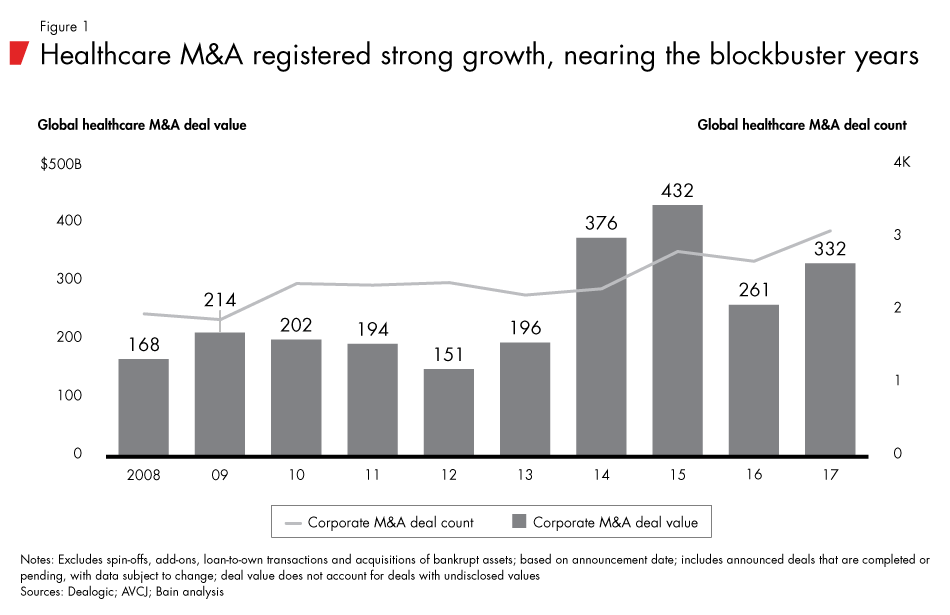
- Corporate M&A surged across healthcare sectors in 2017, reaching a total value of $332 billion, approaching the record levels seen in 2014 and 2015.
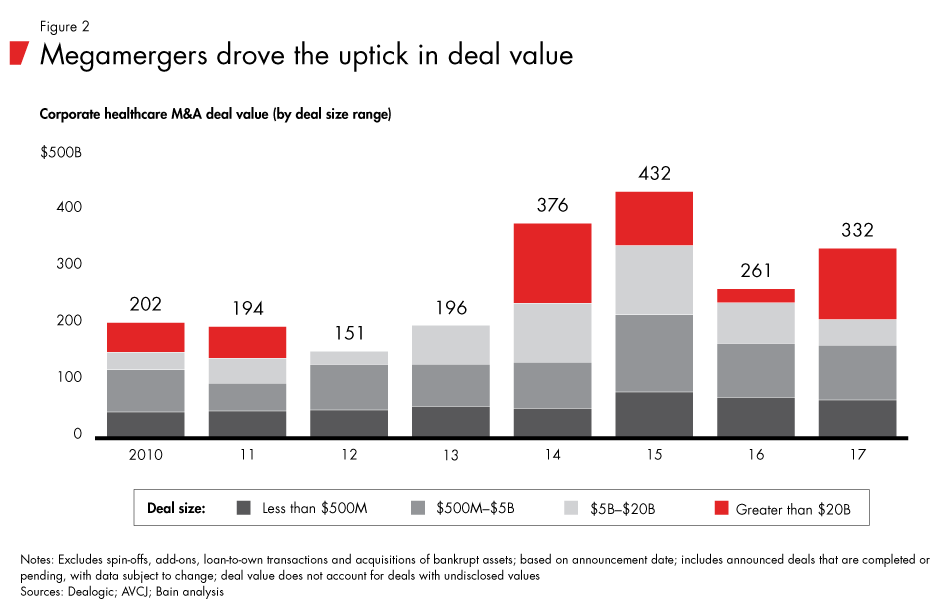
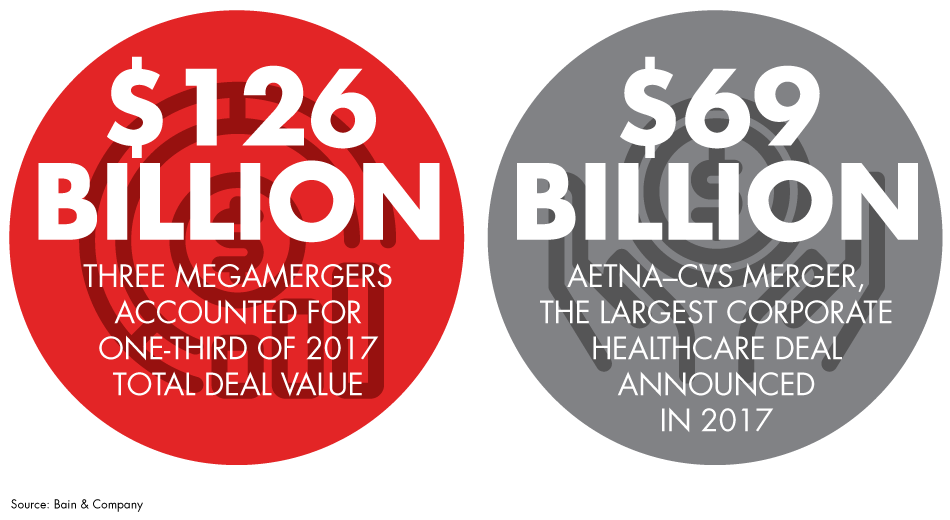
- Three megamergers, with a collective value of $126 billion, accounted for more than one-third of the total.
- Among the forces driving deals were category leadership (building scale within a customer-defined category), outsourced research and development (R&D), and cost reduction through healthcare IT (HCIT).
- Even with valuations at or near all-time highs, we expect companies to continue to rely on M&A as a key catalyst of growth in 2018.
- The continuously changing landscape presents opportunities for forward-looking companies to craft and execute deal theses that alter their growth trajectory.
Global corporate M&A activity in healthcare surged in 2017, fueled by relentless pressure on companies to contain costs and boost returns. Total deal value rose 27%, to $332 billion, while deal count increased 16%, to 3,099 (see Figure 1). Three megamergers (that is, deals valued at greater than $20 billion), with a collective value of $126 billion, accounted for more than one-third of the total (see Figure 2).
While total corporate deal value in healthcare hasn’t quite equaled the peak of $432 billion reached in 2015, average annual activity over the past four years has been strong, nearly twice the level of the previous four years. This level of deal making has profoundly reshaped the healthcare industry, consolidating category leaders and blurring lines between sectors.
Across economies, the entities that pay for healthcare—namely, governments, insurers, employers and consumers—are pressuring providers, drugmakers and medtech companies to stem the endless rise in costs. At the same time, investors accustomed to robust returns from healthcare companies are pushing for continued top- and bottom-line growth. Against this backdrop, companies doing deals over the past few years have pursued four broad strategies in their efforts to gain a competitive edge, using M&A to:
• build or maintain leadership by increasing scale within a category, therapeutic area or call point;
• leverage an asset’s R&D capabilities;
• buy HCIT assets that can help them reduce costs; and
• access new profit pools by reaching across industry sectors.
In the current competitive climate, category leadership continues to be a compelling investment thesis. Johnson & Johnson, for example, took several steps in 2017 to focus its leadership in certain areas. J&J acquired Actelion, a Swiss pharmaceutical company that makes drugs to treat pulmonary hypertension, and it sold hemorrhoid care brands Anusol and Rectinol to Church & Dwight. In the medtech part of its business, J&J sold Codman Neurosurgery to Integra LifeSciences for $1 billion and acquired several smaller equipment and device companies.
In 2017, many pharma and medtech companies made acquisitions designed to leverage the target’s R&D capabilities. In a fragmented and constantly evolving industry, accessing innovation through M&A can provide companies with quick access to new technologies without having to develop them de novo. In a major cross-border deal, Japanese pharma company Takeda acquired US-based Ariad Pharmaceuticals in order to obtain Ariad’s oncology drug pipeline and its scientific capabilities. Medtech giant Becton, Dickinson and Company acquired another US-based medtech company, C.R. Bard, to gain access to Bard’s specialized technology in oncology, vascular medicine, urology and surgery.
Companies are also finding that using M&A to acquire R&D capabilities is an effective way to build positions in emerging technologies such as gene therapy and biosimilars. US-based pharmaceutical company Gilead Sciences entered the chimeric antigen receptor (CAR) T-cell therapy business through its acquisition of Kite Pharma, and Australian biopharma company CSL Behring acquired US-based Calimmune, a company that develops clinical-stage gene therapy solutions.
In the provider and payer sectors, companies made several acquisitions of HCIT companies that specialize in software that can improve efficiency. Change Healthcare acquired Docufill, a cloud-based technology that allows providers to use a single shared form across an organization for credentialing. Medsphere Systems, which offers subscription-based electronic medical record software, merged with Stockell Healthcare, which makes revenue cycle management tools.
As healthcare faces disruption from new entrants and continued downward pricing pressure, established companies are themselves also breaking down barriers. Historically, healthcare companies optimized performance within their sector to combat pricing pressure, but now many companies are questioning the sector boundaries they previously took for granted and reaching across sectors to access new profit pools.
In the largest corporate deal of 2017, CVS Health, a major player in retail health, announced plans to acquire insurer Aetna for $69 billion. The merger, which is subject to regulatory approval, would integrate management of patients’ pharmaceutical use with management of their general health. In another cross-sector deal, Humana, which called off its own planned merger with Aetna in early 2017, announced its acquisition of a 40% stake in Kindred Healthcare’s home care network, with the remaining 60% going to TPG Capital and Welsh, Carson, Anderson & Stowe.
Further blurring the lines that divide healthcare sectors, UnitedHealthcare, a leading US healthcare insurer, acquired Chilean insurer Banmedica for $2.8 billion, and UnitedHealthcare’s Optum unit paid $4.9 billion for DaVita Medical Group, a US-based primary and specialty care provider. In the animal health arena, pet food giant Mars expanded its veterinary care business by acquiring VCA, which operates more than 750 animal hospitals, for $9.1 billion.
Despite valuations at or near record highs, we expect a continued high level of M&A activity in 2018 as healthcare companies continue to look to M&A as a vital component of their growth strategy. We expect the four trends that drove deal activity in 2017 to continue, and we expect three other forces to impact the deal landscape in 2018.
One is evolving laws and regulations. In the US, tax reform will mean lower corporate rates, potentially making healthcare assets attractive to foreign acquirers eager to expand in the world’s largest economy. In Europe, new rules affecting medical device manufacturers, particularly the Medical Device Regulation, will force companies to examine their portfolios and evaluate the significant costs of meeting these requirements. Many may choose to reduce the complexity of their holdings or put themselves up for sale rather than incur the cost of compliance.
The second trend is innovation. In the pharma sector, we expect the development of next-generation platforms such as biosimilars and gene therapy to accelerate. As these technologies are proved out, they’ll disrupt the entire industry, creating buying opportunities not just in new spaces but also putting stress on the valuations of traditional companies.
Finally, the changing nature of total shareholder return (TSR) will likely impact deal activity in 2018. Rising stock markets have been very generous to the shareholders of public healthcare companies, but that’s not something they can count on going forward. According to a Bain analysis, 45% of TSR growth at publicly traded global healthcare companies over the past five years came from an expansion of price-to-earnings multiples—that is more than growth from either revenue or earnings. As P/E multiples likely reach their peak, companies will face renewed pressure to build TSR through revenue growth, margin expansion or financial leverage. If they can’t drive revenue growth internally, they’ll likely look for it in acquisitions, adding further fuel to healthcare M&A.
In an environment this expensive and turbulent, it can be tempting to sit back and wait for prices to come down and for the industry to stabilize. However, companies that wait for valuations to fall before pursuing acquisitions risk missing out on critical growth opportunities and falling behind as their competitors bolster their positions and reshape the healthcare value chain. In an industry rife with continued disruption, companies will need to consider M&A that goes beyond conventional rollups and build-outs and look at deals that are truly radical and transformative.
As forward-looking companies craft their strategies for growth, they’ll determine what role M&A will play in realizing their objectives. Doing this requires establishing a clear point of view on the trajectory of the health-care segments in which they compete, a candid assessment of the assets and capabilities they would need to win in those segments, and, most importantly, a detailed plan for how they could uniquely add value to any potential targets.
What corporate acquirers can learn from private equity’s approach to commercial due diligence
Almost by definition, a PE firm thinking about acquiring a target in a particular healthcare market will know less about that market than a corporate buyer who does business in it every day. PE funds, even those that specialize in healthcare, look at many deals across multiple sectors every year. They often don’t start out as experts.
As a result, PE firms often bring more rigor to the process of commercial due diligence, an area in which corporate business development departments often fall short. PE firms dig deep into a potential target’s position in the marketplace. Even when PE investors have considerable experience in a particular industry, they frequently call in outside experts to test and validate their assumptions.
PE firms take a “clean sheet of paper” approach to commercial due diligence. Unclouded by their own preconceptions, they develop a custom-fit thesis for why a particular acquisition may succeed and why it may fail. They are rigorous and unsentimental in their diligence, and they force themselves to clear high hurdles before they commit to a deal. They expect to pass on more deals than they pursue and to pursue more deals than they can successfully consummate at appropriate valuations.
In contrast, corporate business development teams often feel pressure to close deals in order to meet revenue targets and can be overly reliant on internal data in their market analysis. While their company’s internal market data can be of tremendous value in commercial due diligence, giving it too much weight can obscure complementary, and perhaps conflicting, sources of information.
Here are a few lessons corporate acquirers can learn from PE investors:
- Develop a bespoke deal thesis for every asset. Every deal should meet the “four Cs.” The thesis should be confirmable, meaning that it articulates specific, measurable goals to be tested in the diligence process. It should be chronicled—that is to say, clearly codified in writing. You should reach consensus; the organization should be aligned behind the same thesis. And the thesis should identify how the deal will close the gap, clearly filling a growth or capability need for the company.
- Form an unbiased view of the market. Evaluate the market independent of your role in it. Research growth and profitability trends and next-generation technologies. Spend time in the field interviewing customers, suppliers and competitors, ideally in a blinded fashion. Ask yourself whether you’d enter this market if you weren’t already in it. If the answer is no, ask yourself if you should divest instead of acquire in this market.
- Know your target. Don’t be blinded by potential synergies with your existing businesses. Know how the asset would stand or fall on its own strengths and weaknesses, even if your company is already active in that particular market. Then be prudent in the way you project potential synergies as they are often harder to achieve than you expect.
- Be clear on your deal breakers. Think about things that could go awry, including financial underperformance, regulatory issues, red flags from audits and pension liabilities. Don’t succumb to deal fever. Always be on the lookout for developments that could cause a deal to fail, and be willing to walk away.
- Think ahead. Know what you want to do if you win the asset. Build a value-creation plan, and make sure you have the resources and capabilities in place from the start to support it. For corporate buyers, integration is key. Plan ahead for any carve-outs or divestitures needed to keep the organization focused on the asset’s core activities. Remember: You can’t fix a bad deal thesis with good integration, but you can certainly wreck a good deal thesis with bad integration.
For both corporate acquirers and PE investors, the key to a successful transaction is effective commercial due diligence. Corporate business developers can pick up a few pointers from PE investors—even if they happen to be vying with each other for the same choice asset.
Jeff Haxer is a partner in Bain’s Healthcare practice and is based in Chicago. Dale Stafford leads the firm’s Mergers & Acquisitions practice in the Americas and is based in Washington. Priscilla Schenck is the global practice manager in the firm’s Healthcare practice.
This Bain Brief was excerpted from the Global Healthcare Private Equity and Corporate M&A Report 2018; the sidebar on due diligence is excerpted from the 2017 report. It was prepared by Bain’s Healthcare Private Equity practice and a team led by Jennifer Ferrigan, a manager, and Erin Ney, a senior consultant in Bain’s Healthcare practice. The authors would like to thank Allyson Covello, Onaizah Panhwar, Laila Kassis, Eric Berger, Jeremy Martin, Giovanni Miani, Christian Langel, James Viles, Satyam Mehra, Sunil Chandrasekhar and Brenda Rainey for their contribution; John Peverley, Rahul Singh and Sindhu Nair for their research assistance; and Ron Henkoff for his editorial support. We are grateful to Dealogic, AVCJ and Preqin for the valuable data they provided for this report.
First published in aprile 2018