

Brief

In evidenza
- Despite significant new and unexpected external pressures, Italian companies are holding fast to an ESG transition.
- Their ambition remains firm, with a widespread desire to play an even greater role in the green transition as it continues.
- But companies cannot solve ESG challenges on their own, and institutional involvement is needed for significant success.
The desire to build a better world following Covid-19 has sparked enthusiasm for environmental, social, and governance (ESG) issues across Europe. Nowhere is this stronger than in Italy, where a €261 billion national recovery plan, the largest in the European Union, aims to speed up green investments to transform the economy and fight climate change. Italians—individuals and corporations—are strongly supportive.
Yet the country faces conditions that were unimaginable only months ago. The outbreak of war in Ukraine brought higher prices for key inputs, from fuel and steel to wheat and cooking oil, and caused severe supply-chain constraints. The prospect looms of a higher interest rate environment with increased financial costs for enterprises and greater economic uncertainty, while the war has exposed Italy’s acute energy dependence.
We wanted to know how Italy’s captains of industry were coping with this turbulent environment, how they see their role in Italy’s green transition, and how corporate ESG programs were faring in the depths of crisis.
In exclusive interviews, leading CEOs spoke frankly about the challenges ahead. These candid conversations revealed CEOs who were clear-eyed that ESG remains central to the future of their businesses, but also fully aware of how complex the transformation process will be.
Five key themes emerged:
- CEOs view ESG as a fundamental shift for their businesses that will not be derailed by short-term crises and is crucial to building resilience to current and future shocks.
- CEOs see their role as propelling cultural change within their organizations to get everyone on board. And they see ESG as fundamentally different—and bigger—than other transformational challenges, such as digitalization.
- CEOs think they are doing better on ESG than the country as a whole, which lags the EU on the majority of the UN Sustainable Development Goals (SDGs). But they concede that companies cannot solve the challenges of climate change and other ESG issues alone.
- The impetus for ESG transformations will not be the same for everyone, and may even shift for a single business in response to external events. The role of the CEO is to set a strategy flexible enough to respond to short-term issues without losing sight of long-term ESG objectives.
- Barriers to implementing broad ESG programs remain, starting with the lack of commonly accepted universal standards for defining and measuring ESG metrics, and the need to educate boards and middle management. Since culture is fundamentally about people, this underscores the importance of having a “people lens” for the success of ESG programs.
Throughout the conversations, ESG emerged as a central preoccupation, though not all CEOs see a clear road to value creation. Some industries are still struggling to understand how their businesses can reflect ESG principles. Others are saddled with legacy systems or held back by technological barriers. And sometimes, competing ESG objectives involve trade-offs that are hard to reconcile.
Such conundrums are not unique to a particular industry and they cannot be solved by a single company acting alone. They require industry-wide collaboration and government support to fix. Our conversations with CEOs revealed the extent to which they are reaching out—through open innovation platforms, partnerships with research institutes and start-ups, industry-wide initiatives including lobbying, and education and support for customers and suppliers.
“Sustainability is a value, without which I have no compass.”
These new forms of collaboration around ESG initiatives are undoubtedly creating value for all parties involved. What is missing is greater institutional engagement. ESG issues—from climate change to the UN SDGs—need more constructive dialogue between the private sector and government, regulators, and supranational institutions such as the European Union (EU) and World Trade Organization. These institutions need to understand what companies need—particularly around data and standards, incentives, and timelines—to deliver on ESG.
This mutual understanding can only be achieved through deeper engagement on policy, regulation, and fiscal incentives that can create an ESG-enabling environment for the private sector. In the current context, CEOs told us that having an ESG program, and taking a leading role in driving ESG transformations, was a huge advantage in troubled times. An ESG mindset helps them anticipate risks, build resilience, and find new opportunities for growth. Disruption has only fortified their ESG ambitions.
As one CEO told us: “Sustainability is a value, without which I have no compass.”
War, inflation, uncertainty—and ESG
War in Ukraine has exposed Italy’s dependence on imported gas and triggered a spike in energy prices. It has also disrupted shipments essential to industry.
CEOs were candid about the fact that the war and energy crisis were adding “a layer of complexity” to their ESG programs, particularly when it came to balancing social and environmental prerogatives.
An important role for CEOs will be to determine what weight to give each element of an ESG transformation, and how to balance goals when they conflict.
“The pandemic increased awareness that a new balance between nature, human beings, and society needs to be found.”
CEOs must also decide on the timing of ESG interventions, and when priorities need to change. One energy company began investing in renewables to improve its environmental impact, but in the current energy crisis, it is placing greater emphasis on mitigating the social impact of higher prices. In other words, CEOs in the energy sector say that while the energy crisis continues, the “S” of ESG will trump the “E.” One CEO said: “Energy poverty is a very important issue for our organization.”
The CEO added: “The pandemic accelerated demands for economic sustainability and access to energy, highlighting the responsibilities of energy market players.”
Nevertheless, some CEOs see a silver lining to these overlapping crises. “The pandemic created greater cohesion in dealing with emergencies and has allowed hierarchical barriers to be overcome,” said one interviewee. “This culture change needs to be maintained and reinforced.” Agreeing, another added: “The pandemic increased awareness that a new balance between nature, human beings, and society needs to be found.”
ESG is here to stay, but building an ESG culture will take time
No CEO we spoke to said commitment to ESG goals had diminished. And they feel strongly supported by their stakeholders and society. A European Investment Bank survey on attitudes to climate change found that 81% of Italians favor stricter government measures to curb emissions—one of the strongest levels of support for climate action in the EU.
Reflecting the national mood, Italy’s recovery plan aims to speed up green investments. In addition, a constitutional law approved in February 2022 mandates the state to safeguard the environment, biodiversity, and ecosystems “in the interest of future generations.”
CEOs interpret the country’s new national priorities as a fundamental change for Italy and its private sector.
One chief sustainability officer (CSO) volunteered: “The impact of the ESG revolution is enormous and unprecedented. Looking at our stakeholders, everyone—shareholders, clients, regulators, reference institutions—is pushing for a change and ESG transition.”
Another CEO explained: “I believe that the success of a company cannot be based on the dividends of the next three years, but must be measured in the medium to long term, acknowledging that the value created can be much more relevant.”
Another point on which the majority of CEOs agree is to view ESG as a set of values, a culture, that must be nurtured. They said ESG transformations were fundamentally different from previous transformative challenges, such as digitalization (see Figure 1).
Figure 1
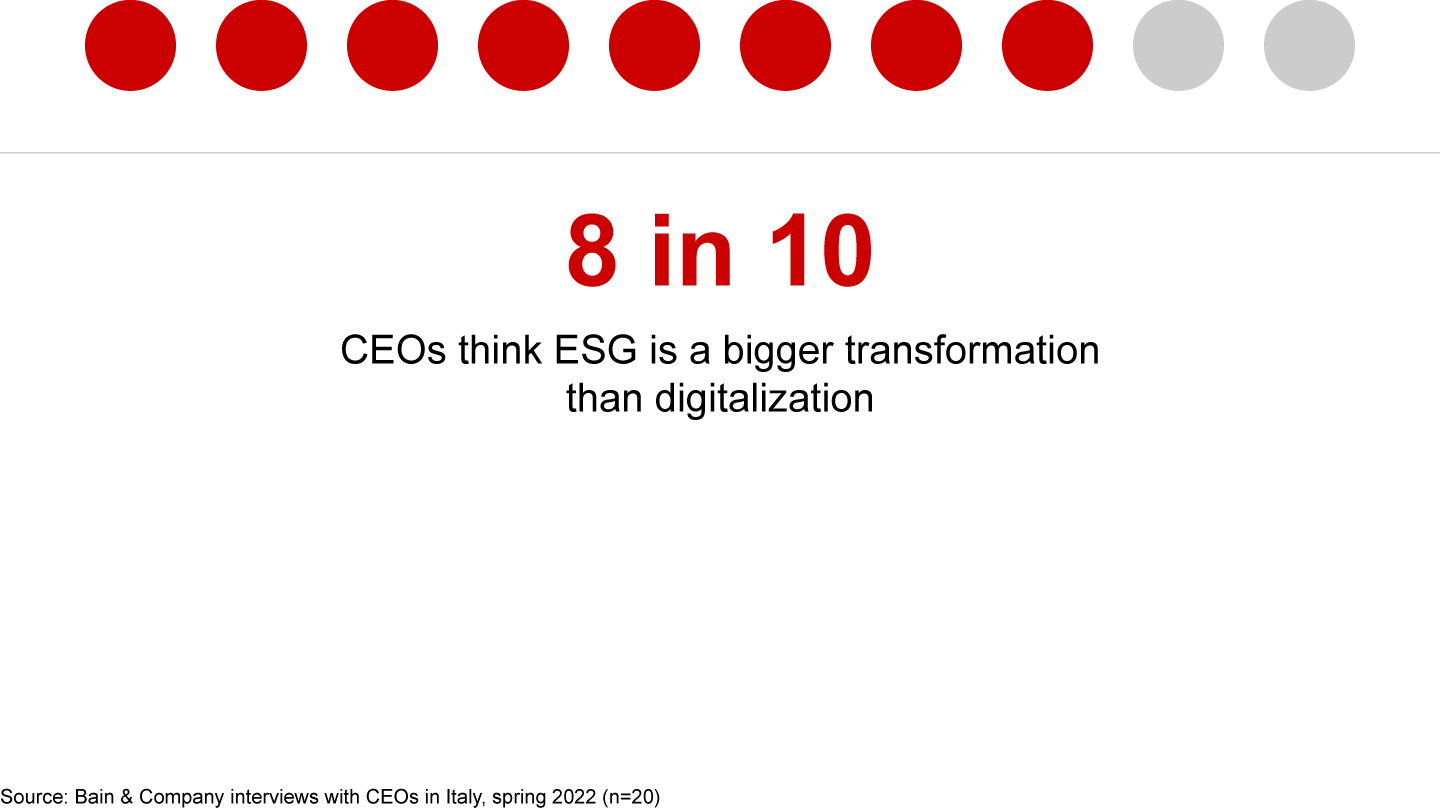

“Digitalization is a tool, while ESG is a value, a mindset; you need to cultivate and build it since you cannot buy it,” one CEO explained, echoing the opinions of many.
With ESG, CEOs see their role as driving cultural change within their organizations. Most acknowledged they don’t yet have everyone on board and say cultural change is a long-term challenge. Much hinges on their length of tenure.
One CEO said: “The most difficult thing to change is mindset. The change management process takes time, and time is always short for a CEO, who normally has a three-year mandate. Changing the management culture is very challenging.”
Top marks?
Most CEOs in our survey give themselves high marks for their achievements so far. By some measures, collective corporate ESG efforts are having a real impact. Per capita emissions have fallen at a steeper rate than the EU average, according to the European Parliament, and while the EU countries have agreed to cut their carbon emissions by at least 55% by 2030 from 1990 levels, Italy set itself an even higher goal of a 60% cut.
Some companies, of course, were born with a social purpose at heart, such as agricultural co-operatives and banks that lend to small businesses in small towns. For these, ESG is simply what they have always done.
But as a country, Italy is underperforming the rest of the EU in broad measures of social well-being. A report on the EU’s progress toward the 17 UN SDGs shows Italy underachieving against 10 out of 17 indicators, and backsliding in 2: social equality and partnerships. Absolute poverty now affects 1 Italian in 10; youth unemployment is over 30%; and women’s participation in the workforce remains 14 percentage points below the EU average.
“Despite having practically a 50-50 gender split, we struggle to find women in top management, and this is a problem that many other companies have.”
Some CEOs are grappling with these social issues through their ESG programs. A significant number mentioned policies to promote women and reduce the gender gap in both pay and representation at senior levels of management. Again, they stressed that nurturing female careers would take time.
“With regard to diversity, despite having practically a 50-50 gender split, we struggle to find women in top management, and this is a problem that many other companies have,” one CEO of a relatively new business said.
Male-dominated legacies are common in more traditional or established groups. One CEO was despondent about the lack of progress in gender equality: “We struggle to attract female managers to senior positions,” he admitted. “Women in middle-management positions are increasing, but only 1 out of 21 managers is a woman.” To address gender issues, he said his company was trying to instill a “culture of change” that includes actions to support female well-being.
The difficulties these companies experience underscore the importance of creating a broader supportive environment. Diversity and inclusion is much more than hitting quotas; it is about creating a truly inclusive workplace for the long term.
Smaller steps and pragmatic goals
In our discussions, CEOs often talked of the need to fine-tune sweeping ESG commitments into initiatives where one can measure tangible progress.
“The great challenge of the next few years will be to move away from ideological positioning toward internal measurement tools and systems to really think about where you are and where you should intervene,” one CEO told us.
One CSO went further: “I think the key factor for success is to take a step-by-step approach. It’s better to do something now and then perfect it than to stand still. We don’t have full visibility of what’s going to happen in the future and, if we wait for the perfect solution, we create an impasse that leads to a gap that risks becoming unbridgeable.”
Another CEO offered the following strategy: “It is important to select only a few principles (three to four maximum, adjustable over time), otherwise you risk becoming frustrated because it is hard to deliver on too many fronts and you won’t see results that generate a positive loop. We now have clear metrics, integrated financial and sustainability reporting … to show the progress made in an understandable way.”
A broad and unfocused ambition, he warns, risks thwarting the efforts made.
ESG is not one-size-fits-all
Some of the most fascinating conversations were with CEOs whose businesses struggle to identify ways to act more responsibly with respect to the environment, society, or their own governance. One chief executive was quite candid: Beyond the imperative to market responsibly and avoid heavier regulation, it was not obvious where they could contribute to ESG. “We are in an industry with very evident complexity,” he explained. “It is therefore even more necessary … for stakeholders to see us as a partner to address potential problems and not as the problem itself.”
“I think the key factor for success is to take a step-by-step approach. It’s better to do something now and then perfect it than to stand still.”
In the food and beverage industry, one CEO listed all the measures his company was taking to source ingredients sustainably, reduce plastic packaging, and eliminate certain ingredients from products. But the bottom line, he said, was that he was still in the “gluttony” business.
These industries have to dig deeper to find value in ESG. The food and beverage CEO was diversifying into healthier products. Another CEO had launched a financial education initiative that helps companies understand how to manage finances better.
Overcoming barriers
Corporate culture, the absence of common standards or measuring systems, insufficient data, and legacy technologies all stand in the way of full ESG transformations.
Culture
CEOs spoke of the difficulties of instilling cultural change and overcoming resistance. Young employees were on board, but middle managers and sometimes even the board of directors needed convincing—and training.
Middle managers are often responsible for delivering operational results and profits. ESG targets add to their administrative burden and sometimes entail additional costs. To get them onside, CEOs said they were working to frame ESG initiatives as an investment in future business opportunities and profitability, rather than as a cost.
“Managers and administrators are the real agents of change,” one CEO said. “We need a training process and a generational change, because either ESG comes from within or it is very complex.”
“It is necessary to start small,” another CEO said. “We initiated cultural dissemination and training of the middle management. But it was controversial at the beginning, with managers asking: If I create value, why should I share it?” The search for an answer led to the company rediscovering “the concept of spirit of service to society.”
Boards
“We need to work on the training of boards so they can understand the strategy and objectives that the company sets itself in the medium to long term,” one CEO said.
Data and standards
For the application of ESG principles to be credible, progress must be measured. All CEOs we talked to were keen to avoid the reputational and legal risks of greenwashing. They said ESG needs to be driven by data so progress is measurable, and so it can show a return on investment.
But the question of what to measure and how to do it is not obvious because ESG still lacks common standards. The problem is compounded when companies are asked to measure their exposure to ESG risks across their value chains.
One CEO explained: “Quantifying the environmental impact of our customers and their projects is a complex exercise because our reference clientele is made up of SMEs which, generally, are not ready for complex reporting.” Data—historical, current, and prospective—on client carbon emissions, for example, was often lacking, hampering efforts to quantify climate risk in loan portfolios.
For banks, ESG transformation is inextricably related to transforming the way their clients do business. A CEO in finance said: “As a bank we must be able, on the one hand, to increase the number of companies embarking on their sustainable transformation paths and, on the other hand, to identify those who fail to do so as soon as possible. Our very survival depends on it. It is a new way of looking at risk.”
Conclusion: From corporate action to broader collaboration
With strong popular support for ESG, a committed private sector, enabling constitutional reforms, and the largest green recovery package in the EU, Italy has the resources and broad backing to create a more equal, inclusive, and sustainable society and economy.
The role of companies in the green transition is expected to become even more central, and our conversations confirmed that ESG initiatives remain intact and vital at the corporate and national level, in spite of destabilizing shocks.
Today’s challenges highlight the close links between E, S, and G. Urgent issues around energy security and food security are drawing social issues into the spotlight, soon after the pandemic underscored the importance of public services such as health and government support for companies and families during lockdowns.
At the same time, what single companies can do alone is limited, while broader collaboration, across industries and with government and institutions, empowered by the right policies, could achieve faster and more far-reaching results.
In this context, two steps can help fortify ambitions:
First, it will help if companies can future-proof their sustainability strategy. A dynamic but flexible strategy helps leaders respond to changing circumstances without losing sight of what they are trying to achieve: governance that is better for society, for the planet, and for future generations. As firms face greater volatility, clearly defined scenarios and signposts that trigger the right actions will help address stakeholder concerns about perceived trade-offs from ESG progress.
Second, companies should redouble their efforts to forge partnerships to accelerate progress. When it comes to ESG, acting together can multiply the effectiveness of initiatives.
What needs to be increased is engagement with institutions at all levels—from local, regional, and national governments to institutions such as the EU. Dialogue is key to achieving greater understanding and support in delivering a net-zero future and the UN SDGs.
Much is being achieved at the corporate level, but these individual efforts can be amplified by joining forces across the value chain, and engaging government and institutions to accelerate change and reach the ambitious goals we have as a country and as Europeans.
First published in dicembre 2022