Skip to Content
  • Uffici

    Uffici

    Nord e Sud America
    • Atlanta
    • Austin
    • Bogota
    • Boston
    • Buenos Aires
    • Chicago
    • Dallas
    • Denver
    • Houston
    • Los Angeles
    • Mexico City
    • Minneapolis
    • Monterrey
    • Montreal
    • New York
    • Rio de Janeiro
    • San Francisco
    • Santiago
    • São Paulo
    • Seattle
    • Silicon Valley
    • Toronto
    • Washington, DC
    Europa, Medio Oriente e Africa
    • Amsterdam
    • Athens
    • Berlin
    • Brussels
    • Copenhagen
    • Doha
    • Dubai
    • Dusseldorf
    • Frankfurt
    • Helsinki
    • Istanbul
    • Johannesburg
    • Kyiv
    • Lisbon
    • London
    • Madrid
    • Milan
    • Munich
    • Oslo
    • Paris
    • Riyadh
    • Rome
    • Stockholm
    • Vienna
    • Warsaw
    • Zurich
    Asia e Australia
    • Bangkok
    • Beijing
    • Bengaluru
    • Brisbane
    • Ho Chi Minh City
    • Hong Kong
    • Jakarta
    • Kuala Lumpur
    • Manila
    • Melbourne
    • Mumbai
    • New Delhi
    • Perth
    • Seoul
    • Shanghai
    • Singapore
    • Sydney
    • Tokyo
    Guarda tutti gli uffici
  • Alumni
  • Media Center
  • Iscriviti
  • Contattaci
  • Italy | Italiano

    Seleziona il tuo Paese e la tua lingua

    Global
    • Global (English)
    Nord e Sud America
    • Brazil (Português)
    • Argentina (Español)
    • Canada (Français)
    • Chile (Español)
    • Colombia (Español)
    Europa, Medio Oriente e Africa
    • France (Français)
    • DACH Region (Deutsch)
    • Italy (Italiano)
    • Spain (Español)
    • Greece (Elliniká)
    Asia e Australia
    • China (中文版)
    • Korea (한국어)
    • Japan (日本語)
  • Saved items (0)
    Saved items (0)

    You have no saved items.

    Contrassegna il contenuto che ti interessa e verrà salvato qui. Potrai leggerlo o condividerlo in seguito.

    Explore Bain Insights
  • Settori
    Menu principale

    Settori

    • Aerospazio e Difesa
    • Agribusiness
    • Chimica
    • Infrastrutture e Costruzioni
    • Beni di Largo Consumo
    • Servizi Finanziari
    • Sanità
    • Macchinari Industriali
    • Media & Intrattenimento
    • Industria Metallurgica
    • Industria Mineraria
    • Petrolio e Gas
    • Industria Cartaria e Packaging
    • Private Equity
    • Settore Sociale & Pubblico
    • Retail
    • Tecnologia
    • Telecomunicazioni
    • Compagnie Aeree & Trasporti
    • Viaggi e Svago
    • Utility e Rinnovabili
  • Servizi di Consulenza
    Menu principale

    Servizi di Consulenza

    • Customer Experience
    • ESG
    • Innovation
    • M&A and Divestitures
    • Operation
    • People & Organization
    • Private Equity
    • Sales & Marketing
    • Strategia
    • IA, Approfondimenti e Soluzioni
    • Tecnologia
    • Trasformazione
  • Digital
  • Tematiche
  • Informazioni su Bain
    Menu principale

    Informazioni su Bain

    • Che Cosa Facciamo
    • Quello in Cui Crediamo
    • Le Nostre Persone e la Leadership
    • Risultati
    • Premi e Riconoscimenti
    • Organizzazioni Globali
    Further: Our global responsibility
    • Diversità e Inclusione
    • Social Impact
    • Sustainability
    • World Economic Forum
    Learn more about Further
  • Careers
    Menu principale

    Careers

    • Work with Us
      Careers
      Work with Us
      • Find Your Place
      • Our Work Areas
      • Integrated Teams
      • Students
      • Internships & Programs
      • Recruiting Events
    • Life at Bain
      Careers
      Life at Bain
      • Blog: Inside Bain
      • Career Stories
      • Our People
      • Where We Work
      • Supporting Your Growth
      • Affinity Groups
      • Benefits
    • Impact Stories
    • Hiring Process
      Careers
      Hiring Process
      • What to Expect
      • Interviewing
    FIND JOBS
  • Uffici
    Menu principale

    Uffici

    • Nord e Sud America
      Uffici
      Nord e Sud America
      • Atlanta
      • Austin
      • Bogota
      • Boston
      • Buenos Aires
      • Chicago
      • Dallas
      • Denver
      • Houston
      • Los Angeles
      • Mexico City
      • Minneapolis
      • Monterrey
      • Montreal
      • New York
      • Rio de Janeiro
      • San Francisco
      • Santiago
      • São Paulo
      • Seattle
      • Silicon Valley
      • Toronto
      • Washington, DC
    • Europa, Medio Oriente e Africa
      Uffici
      Europa, Medio Oriente e Africa
      • Amsterdam
      • Athens
      • Berlin
      • Brussels
      • Copenhagen
      • Doha
      • Dubai
      • Dusseldorf
      • Frankfurt
      • Helsinki
      • Istanbul
      • Johannesburg
      • Kyiv
      • Lisbon
      • London
      • Madrid
      • Milan
      • Munich
      • Oslo
      • Paris
      • Riyadh
      • Rome
      • Stockholm
      • Vienna
      • Warsaw
      • Zurich
    • Asia e Australia
      Uffici
      Asia e Australia
      • Bangkok
      • Beijing
      • Bengaluru
      • Brisbane
      • Ho Chi Minh City
      • Hong Kong
      • Jakarta
      • Kuala Lumpur
      • Manila
      • Melbourne
      • Mumbai
      • New Delhi
      • Perth
      • Seoul
      • Shanghai
      • Singapore
      • Sydney
      • Tokyo
    Guarda tutti gli uffici
  • Alumni
  • Media Center
  • Iscriviti
  • Contattaci
  • Italy | Italiano
    Menu principale

    Seleziona il tuo Paese e la tua lingua

    • Global
      Seleziona il tuo Paese e la tua lingua
      Global
      • Global (English)
    • Nord e Sud America
      Seleziona il tuo Paese e la tua lingua
      Nord e Sud America
      • Brazil (Português)
      • Argentina (Español)
      • Canada (Français)
      • Chile (Español)
      • Colombia (Español)
    • Europa, Medio Oriente e Africa
      Seleziona il tuo Paese e la tua lingua
      Europa, Medio Oriente e Africa
      • France (Français)
      • DACH Region (Deutsch)
      • Italy (Italiano)
      • Spain (Español)
      • Greece (Elliniká)
    • Asia e Australia
      Seleziona il tuo Paese e la tua lingua
      Asia e Australia
      • China (中文版)
      • Korea (한국어)
      • Japan (日本語)
  • Saved items  (0)
    Menu principale
    Saved items (0)

    You have no saved items.

    Contrassegna il contenuto che ti interessa e verrà salvato qui. Potrai leggerlo o condividerlo in seguito.

    Explore Bain Insights
  • Settori
    • Settori

      • Aerospazio e Difesa
      • Agribusiness
      • Chimica
      • Infrastrutture e Costruzioni
      • Beni di Largo Consumo
      • Servizi Finanziari
      • Sanità
      • Macchinari Industriali
      • Media & Intrattenimento
      • Industria Metallurgica
      • Industria Mineraria
      • Petrolio e Gas
      • Industria Cartaria e Packaging
      • Private Equity
      • Settore Sociale & Pubblico
      • Retail
      • Tecnologia
      • Telecomunicazioni
      • Compagnie Aeree & Trasporti
      • Viaggi e Svago
      • Utility e Rinnovabili
  • Servizi di Consulenza
    • Servizi di Consulenza

      • Customer Experience
      • ESG
      • Innovation
      • M&A and Divestitures
      • Operation
      • People & Organization
      • Private Equity
      • Sales & Marketing
      • Strategia
      • IA, Approfondimenti e Soluzioni
      • Tecnologia
      • Trasformazione
  • Digital
  • Tematiche
  • Informazioni su Bain
    • Informazioni su Bain

      • Che Cosa Facciamo
      • Quello in Cui Crediamo
      • Le Nostre Persone e la Leadership
      • Risultati
      • Premi e Riconoscimenti
      • Organizzazioni Globali
      Further: Our global responsibility
      • Diversità e Inclusione
      • Social Impact
      • Sustainability
      • World Economic Forum
      Learn more about Further
  • Careers
    Ricerche più popolari
    • Agile
    • Digitale
    • Strategia
    La tue ricerche precedenti
      Pagine visitate

      Content added to saved items

      Saved items (0)

      Removed from saved items

      Saved items (0)

      Technology Report

      Is Consumption-Based Pricing Right for Your Software?

      Is Consumption-Based Pricing Right for Your Software?

      Some of the most successful SaaS companies charge for their software based on its usage, but that model works only when the conditions are right.

      Di Simon Heap e Sukh Brar

      • Tempo di lettura min.
      }

      Report

      Is Consumption-Based Pricing Right for Your Software?
      en
      In evidenza
      • Charging based on the use of software instead of by subscription is the model fueling some of the fastest-growing and highest-valued SaaS companies, and Bain consumer research points to more growth in the future
      • Companies can determine if this is the right model for them by considering three critical questions: Can we create the right meter? Do our customers want this? Can we develop the capabilities needed?

      This article is part of Bain's 2022 Technology Report.

      Explore the report

      Revenue for software-as-a-service (SaaS) companies has grown 22% a year compounded since 2017, evidence of its popularity with customers tired of underused “shelfware” software licenses and of managing their own infrastructure. Whereas traditional subscription-based SaaS is typically paid in advance based on a predetermined capacity, such as seats licensed, the latest evolution of SaaS uses consumption-based models that calculate the price based on measures of actual use, such as data ingested, messages sent, or hours used. There are many flavors of consumption pricing, ranging from pay-as-you-go to allowances that are burned down and limits that are capped, but all with payment that is ultimately based on usage and aligned with value.

      It has quickly become popular with customers. With consumption pricing, 80% of customers report better alignment with the value they receive, according to Bain & Company research. Nearly half of software companies using it say it has helped them acquire more customers, and two-thirds say it’s helping them increase revenue with existing customers. Indeed, many of today’s most valuable, fastest-growing SaaS companies employ consumption pricing (see Figure 1).

      Figure 1
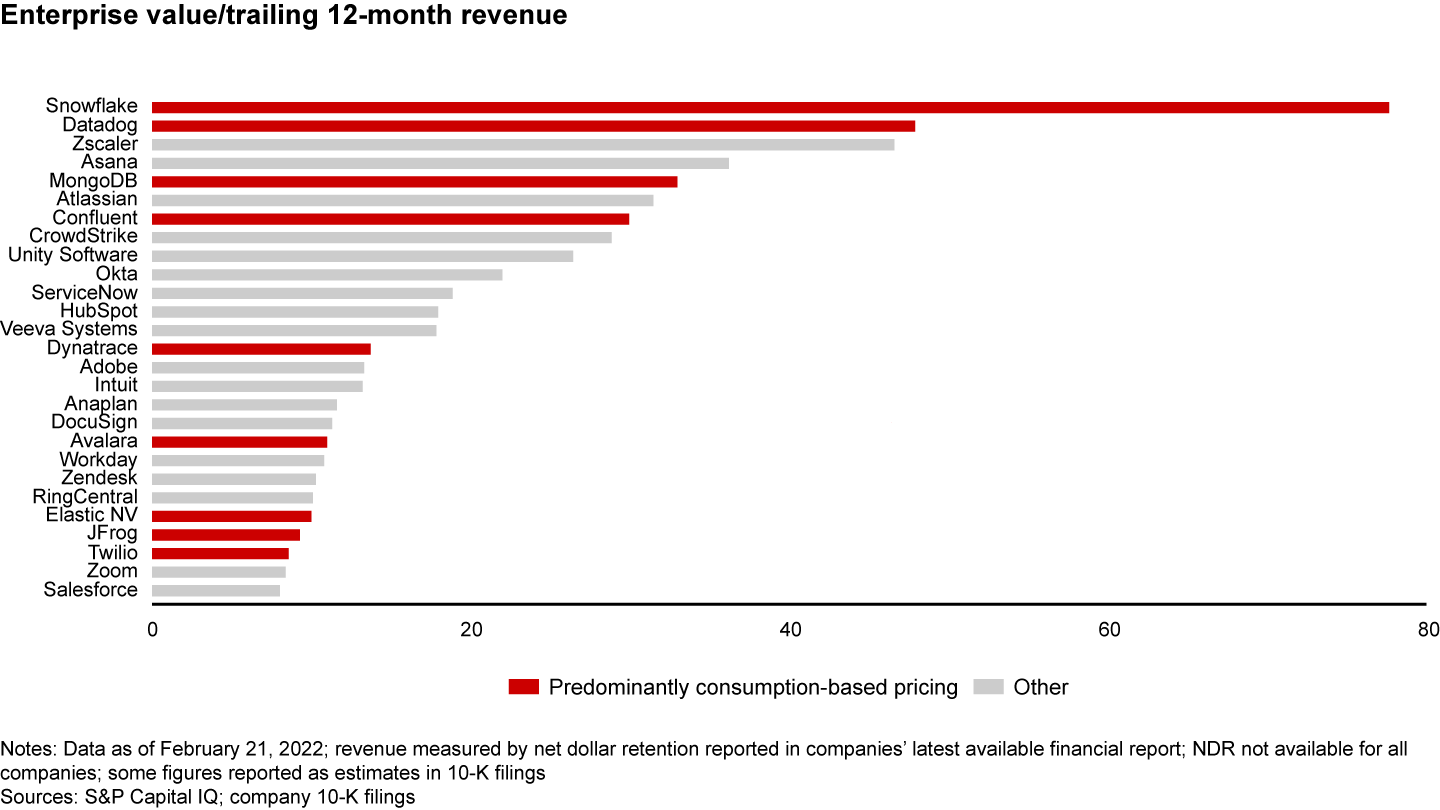
      Consumption-based pricing models are associated with some of the most highly valued software companies

      In 2021, companies with primarily consumption-based models, including Snowflake, JFrog, Elastic NV, Datadog, and Confluent, increased revenue approximately 8 percentage points higher on average than companies that mainly license or sell subscriptions to their software. Among the software companies with the highest valuation multiples, those offering consumption-based pricing on average earned 10 points higher revenue retention from existing customers, as measured by net dollar retention (NDR).

      Our research finds that customers expect to more than double their use of this model in the next one to three years, with most of that growth in the next 12 months. But even with this momentum, consumption-based pricing isn’t suited to every situation (see Figure 2). Three-quarters of software is still sold as a subscription or perpetual license, models that work well when customers know exactly how much they need. Consumption pricing has really taken off with platforms-as-a-service; cloud service providers like Amazon Web Services, Microsoft Azure, and Google Cloud; and infrastructure software and software tools serving developers.

      Figure 2
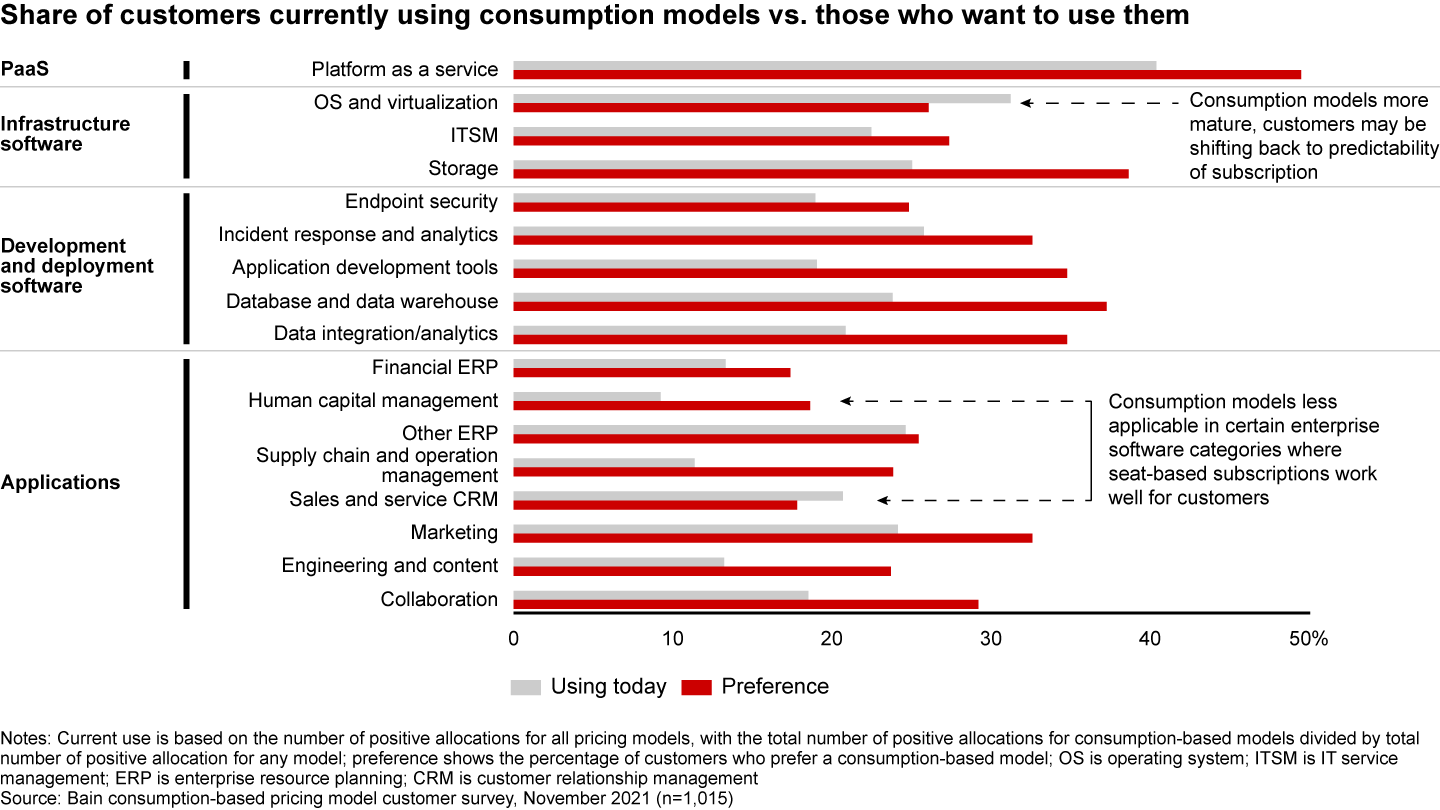
      Customer preference for consumption models outpaces current use for almost all software types

      Choosing the right pricing model

      Consumption models offer potential new growth, but before adopting one, a vendor must think through important strategic, operational, and investment considerations, and realize that this transition can take multiple years. Software companies can begin by asking themselves three guiding questions.

      1. Can we directly tie the value of our offering to a clear, transparent consumption metric that makes sense for both customers and vendors?

      Cloud software company Snowflake offers a usage-based pricing model with two metrics. For data storage, the company charges a certain dollar amount per terabyte per month after compression. For querying data, the metric is a dollar amount per second per warehouse, a flexible figure that enables customers to purchase any size and number of data warehouses. Because these metrics measure the use and value of the product’s two primary functions, they clearly align with the value delivered to customers. Defined and quantitative, they allow for granular tracking, and customers have embraced them. Today, 93% of Snowflake’s revenue is consumption-based.

      A successful meter has several characteristics.

      • Value-based. It aligns with the value customers receive.
      • Flexible. Customers can control how much they use and pay only for that. Snowflake, for example, offers automatic suspension of warehousing charges when no query is running.
      • Scalable. Value moves with consumption instead of being “worth it” only after or before a certain amount of use, and it feels fair to both small and large users.
      • Predictable. Usage can be estimated and used to inform budgeting. This is difficult to achieve. More than 90% of users who prefer subscription models cite a lack of predictability as the main downside of consumption models.
      • Feasible. The meter should be easy to monitor.

      2. Are customers in our industry interested in paying based on consumption, and are competitors offering it?

      In some applications like enterprise software for enterprise resource planning (ERP), human capital management (HCM), and customer relationship management (CRM), subscriptions based on seat count work well, and few customers are interested in changing models. For them, the value of the software lies in each user’s ability to create a unique workspace and workflow for managing customer and prospect pipelines. Start-ups in these categories aren’t using consumption models to disrupt. Operating system and virtualization software customers appreciate how the predictability of subscriptions aligns with corporate budgeting.

      3. Do we have or can we see a path to developing the capabilities to operate the business in a consumption model?

      The selection of the pricing meters and packaged offerings was just the start of a much larger journey for an infrastructure software company that recently shifted to consumption pricing. Each function in the organization has adapted:

      • product development, by engineering telemetry into the product, creating dashboards to inform users of real-time usage, and featuring predictive models for forecasting;
      • sales, by creating “land and expand” sales plays and enablement, and adjusting sales staff incentives to support ongoing consumption instead of Day 1 booking;
      • services, by creating quick-start services that support starting small and then expanding;
      • customer success, by finding ways to support incremental usage;
      • sales operations and finance, by creating a plan to migrate to the new model and a business plan that balances new growth with the short-term drop in revenue expected from current customers who pay less in a consumption model; and
      • systems, by building tools to estimate the cost of using the product and systems that route usage data to billing, customer reporting, financial systems, and sales and customer success dashboards.

      The answers to these three questions will help determine if consumption pricing is right for your company. If it is, there will certainly be work ahead to develop the capabilities and offerings needed to make the transition a success, but it will give your company a shot at growth and valuation rivaling that of some of the best businesses in software.

      Read the Next Chapter

      Product Management: The Key to Unlocking Return on Your Software R&D Investment

      Value Evolution

      • The Rise of Growth Equity Investors

      • A Multicloud World

      • Welcome to Web3

      • The US-China Decoupling

      Competitive Battlegrounds

      • Defending against Disruption

      • The Engine 2 Imperative

      • AI’s Next Frontier

      • The Industrial IoT

      Operational Advantage

      • Beyond the Rule of 40

      • Sales Productivity

      • Consumption-Based Pricing

      • Software R&D Efficiencies

      • The Chip Shortage

      • The Circular Economy

      Read our 2022 Technology Report

      Explore the report Download PDF
      Autori
      • Headshot of Simon Heap
        Simon Heap
        Advisory Partner, Silicon Valley
      • Sukh Brar
        Associate Partner, Seattle
      Contattaci
      Industry collegate
      • Cloud Computing
      • Internet of Things
      • IT Services
      • Semiconductors
      • Software
      • Tecnologia
      Technology Report
      To Scale the Industrial Internet of Things, Don’t Forget Hardware

      Just like software companies, OEMs and hardware makers are critical to getting the industrial IoT to the next level.

      Leggi di più
      Technology Report
      Will Agentic AI Disrupt SaaS?

      Disruption is mandatory. Obsolescence is optional.

      Leggi di più
      CIO Insights
      Despite Tech Layoffs, Competition for Talent Remains Fierce

      Tech workers increasingly value career development opportunities and remote or hybrid work options, while compensation has soared.

      Leggi di più
      Technology Report
      State of the Art of Agentic AI Transformation

      Tech-forward enterprises have cracked the code on ROI for AI. Falling behind is riskier than ever as the next wave of agentic AI raises the stakes.

      Leggi di più
      Tecnologia
      Using Hardware to Scale the Industrial Internet of Things

      Bain partners discuss the opportunity for hardware vendors to help companies develop their IoT pilots.

      Leggi di più
      First published in settembre 2022
      Tags
      • CIO Insights
      • Cloud Computing
      • Internet of Things
      • IT Services
      • Semiconductors
      • Software
      • Technology Report
      • Tecnologia

      Come abbiamo aiutato i nostri clienti

      Sostenibilità e Corporate Responsibility Can Microchips Turbocharge Sustainability Improvement?

      Leggi un caso di studio

      A Go-to-Market Redesign Helps a Tech Company Thrive

      Leggi un caso di studio

      Helping a Midsize ERP Player Compete against the Giants

      Leggi un caso di studio

      Vuoi continuare la conversazione?

      Aiutiamo i leader globali e le loro aziende ad affrontare problemi e a cogliere le opportunità. Sosteniamo cambiamenti e otteniamo risultati duraturi.

      Bain Insights. Le nostre idee e punti di vista sulle tematiche che le aziende globali affrontano ogni giorno, arrivano nella tua email tutti i mesi.

      *Ho letto l'Informativa sulla Privacy e accetto i termini e le condizioni.

      Si prega di leggere e accettare l’Informativa sulla Privacy
      Bain & Company
      Contattaci Sustainability Accessibility Condizioni d’uso Privacy Cookie Policy Sitemap Log In

      © 1996-2026 Bain & Company, Inc.

      Contatta Bain

      Come posso aiutarti?

      • Business inquiry
      • Career information
      • Press relations
      • Partnership request
      • Speaker request
      Guarda tutti gli uffici