

Brief
For years now, telephone companies have been losing the battle for broadband subscriptions in the US, as cable companies have been more successful delivering faster speeds to more households. DSL subscriptions are declining, and even with gains expected in fiber-optic subscriptions, we expect telecoms to lose about 7 percentage points of share against cable through 2020. Cable companies are winning in broadband and in fact putting their bundle of TV, voice and broadband on the backs of networks that can deliver speeds of 50 Mbps or better to 80% of US homes. Telecoms can deliver those speeds to only about 30% of homes today (see Figure 1).
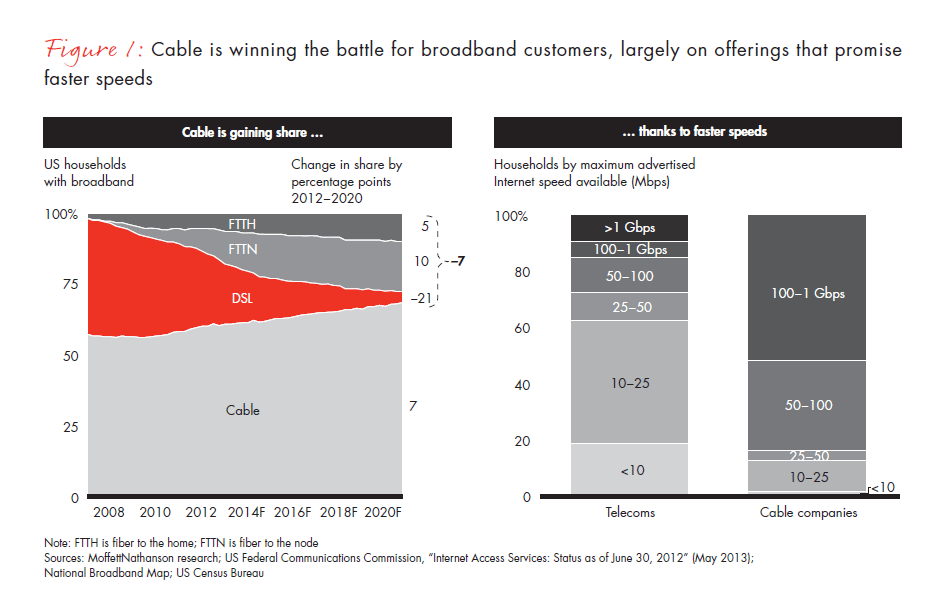
It would not be economically feasible for telecoms to build out national networks that offer the same speeds as cable, and they do not have to. New technologies are making it more economical for telecoms to deliver speeds faster than DSL—and we believe fast enough to meet consumers’ needs to most US neighborhoods. These technologies include more efficient and economical ways to deploy fiber-optic cable, as well as get better speeds out of the copper wires that bring voice telephone service to nearly all households in the US.
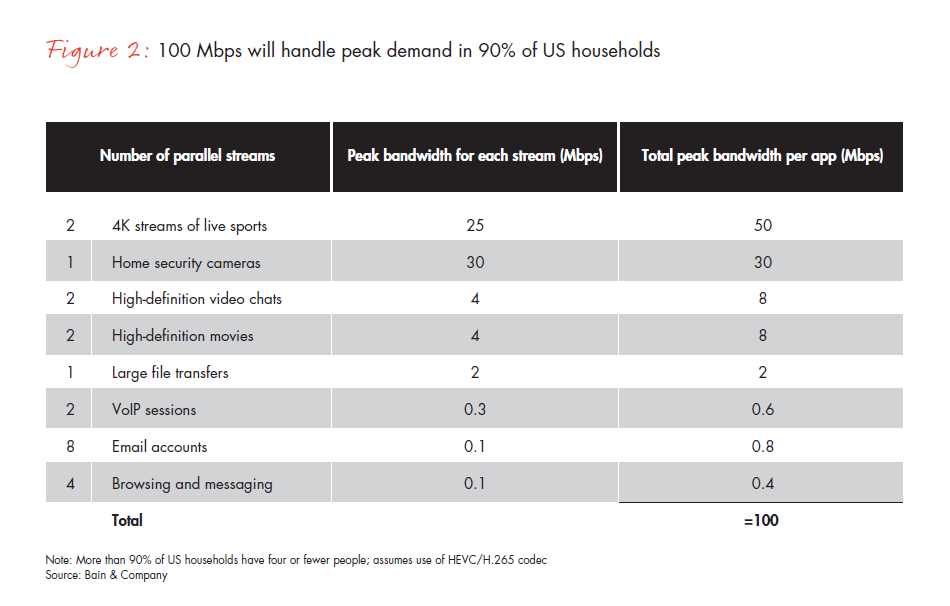
But to compete effectively against cable, telecoms will need to shift the marketing dialogue away from pure speed to actual customers’ needs. We believe that, with a 100 Mbps pipe, telecoms can meet the demands of more than 90% of US households. This is enough to serve a household of four members, with each member viewing a separate stream of high-definition video (see Figure 2).
Given their constrained budgets for capital expenditure, telecoms will need to prioritize the neighborhoods in which they invest based on consumer demographics, geography, competitive dynamics, existing infrastructure and the predicted level of uptake among customers. Bain & Company has built a detailed model that quantifies the economics of broadband delivery for more than 200,000 neighborhoods in the US. Based on this research, we believe telecoms can economically meet consumer demand for broadband in twice as many households as they do today, and they should invest to do so.
Redefine offerings around customer experience
At the end of the day, customer experience when it comes to broadband is all about video. Streaming video has been the main source of Internet traffic growth since 2008, boosting volumes by 50% each year. By the first half of 2013, Netflix and YouTube already accounted for roughly half of peak downstream traffic and were still growing. We expect demand to continue to grow over the next five to 10 years as more data-hungry devices enter homes and more applications incorporate video. Bain research shows that as consumers get more Internet devices, they watch more video (see the Bain report, “The age of curation: From abundance to discovery”).
Both the cable and telecom industries have defined the customer experience solely around bandwidth speed. But at some point, the differences in a poorly understood metric will lose their significance. And consumers will look to other factors to make their decisions, much as consumers have changed the way they purchase PCs from a decade ago, when processor speed was a key decision factor. The challenge for telecoms is to make the speed number less meaningful and establish new areas of differentiation. The low Net Promoter Score (NPS®) earned by many cable companies suggests they have plenty of opportunity to improve the customer experience. Bain’s January 2014 survey of customer loyalty among broadband subscribers found that the leading cable companies had an NPS between –9 and –20; the telecom next-generation broadband services Verizon FiOS and AT&T U-verse were significantly higher, at 22 and 7, respectively.
Boosting telecom speeds
While telecoms work to differentiate their customer service experience from that of cable companies, they must also do what they can to deliver faster speeds. Several new technologies are making it more cost-effective for telecoms to deliver higher-speed bandwidth.
First, new approaches employed by Google and Verizon FiOS reduce the cost of deploying fiber to the home by up to 25%. Micro-trenching—which involves cutting a narrow ditch just deep enough to lay fiber-optic cable in an asphalt roadway or grass median rather than digging a three-foot ditch to bury conduit—plays a big part. Google also motivated local communities to conduct grassroots preregistration campaigns and compare themselves with other potential “fiberhoods” vying for its new service. That way, Google brings costly fiber optics only to neighborhoods where the expected customer uptake justifies the investment. This helps the company design more efficient network architectures and minimize the number of truck rolls to neighborhoods. We believe these improved economics make fiber to the home cost-effective in 23% of homes, compared with only 15% today, a nearly 50% increase.
In an additional third of US households, telecoms can use new technologies to dramatically increase the speeds they can deliver through the copper lines that run from the node (where the fiber-optic cable ends) into individual homes. The most relevant technologies in the near term are bonding, which uses both of the copper pairs that run into the home rather than only one to roughly double the speed, to nearly 50 Mbps, and vectoring, which increases bandwidth by reducing noise on the line similar to the way noise-canceling headphones work. Together, these technologies enable telecoms to deliver download speeds of at least 100 Mbps for households that are up to 3,000 feet from the local access point, and for homes that are much closer, download speeds can be as high as 250 Mbps.
Two other technologies—phantom mode, which introduces a virtual third signal over bonded copper pairs, and G.fast, which uses a higher frequency on the line—are still in development but could be ready in the next three to five years. Both offer the potential to deliver faster speeds over copper, though admittedly only for households relatively close to the local access point.
Finally, in some rural areas where there is surplus LTE capacity, telecoms may be able to create hybrid DSLcellular broadband offers. We believe, however, that wireless broadband will always be more expensive to provide and can succeed only in areas where there is no landbased broadband competitor. Together these technologies enable telecoms to economically deliver competitive broadband to many more households than they do today.
Prioritizing investments
And so the question for telecoms becomes where to invest. Even with these new options, many neighborhoods remain uneconomical to upgrade, so telecoms will need to prioritize investments across their portfolios.
To get a clearer view of the economics, we built a model to evaluate the financial trade-offs of fiber upgrades. We started with data from the US Census Bureau on 210,000 block groups and incorporated details on consumer demographics, geography, competitive dynamics and existing infrastructure. We calculated the cost of upgrading the neighborhoods with various fiber and copper technologies, and given those upgrades, designed plausible scenarios for revenue and share growth. Finally, we compared those scenarios with present cash flows and prioritized investments by the opportunities available.
We first developed a forecast based on the status quo: What would happen if telecoms decided not to invest in upgrades? Our forecast finds that they would continue to lose subscribers to cable and experience increasingly pressured margins. Telecoms’ 30% share of broadband subscribers would likely drop to 20% within 10 years.
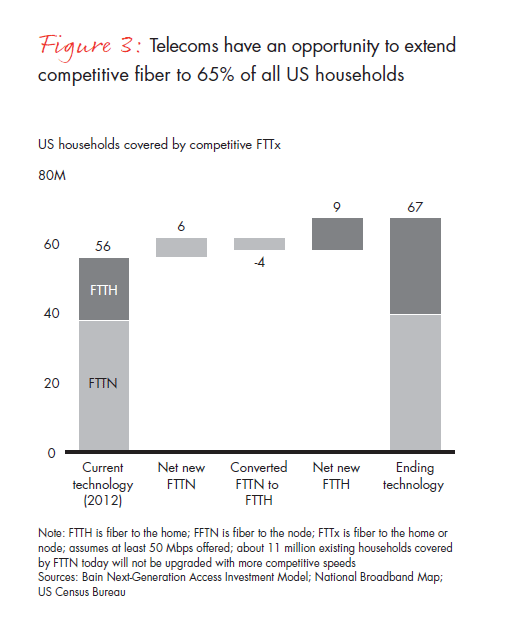
Then we modeled two fundamental upgrade paths: fiber to the home and fiber to the node, considering building density, labor rates and other factors to determine what the incremental contribution of each would be to revenue and profit. This allowed us to determine that telecoms could profitably upgrade their connections to about 40% of US households and deliver competitive broadband to 65%, compared with the 45% being delivered today (see Figure 3). These investments will help telecoms protect their 30% share of total broadband subscribers, as gains in upgraded regions offset losses in areas not economically feasible to upgrade.
Implications
Telecoms have three immediate priorities in their race to win broadband market share. First, they should free investment funds. One interesting insight from our model is that a significant percentage of telecom territories are not only uneconomical to upgrade, but also they actually have a negative net present value under most scenarios. Telecoms must determine how to manage their portfolios to free dollars to invest where they can win.
Second, they need to hold on to customers until they can deploy next-generation broadband. One of the greatest determinants of a telecom’s ultimate share potential is its starting share position. Telecoms must improve their customer loyalty scores in areas where they know they will ultimately deploy high-speed broadband. And finally, they must begin to change their marketing message to emphasize the entire customer experience rather than focus solely on speed.
Cable companies have no such need to change their marketing message, as the current focus on speed plays to their advantage. However, they do need to recognize the threat from next-generation telecom networks, which we estimate could affect more than two-thirds of larger cable companies’ territories. Smaller cable companies are better protected, because they tend to be in more rural areas and less competitive neighborhoods. But across the board, cable executives must decide how much to invest in areas where telecoms are not really competing, as well as in areas where they will compete aggressively.
As they decide, cable companies would be wise not to wait for telecoms to announce their intentions to compete in their market. Market analysis gives insight into where telecoms will likely invest in broadband infrastructure, and cable executives can invest in marketing messages that highlight cable’s advantages and in actions that lock in subscribers.
Network equipment operators and related service providers are another set of companies that will see new opportunities if telecoms invest in new infrastructure. We estimate that if telecoms build out to the extent suggested here, it would result in more than $6 billion of incremental spending on network equipment over the next decade. For them, as well as telecom and cable companies, the intensifying competition for broadband customers is likely to create a new and challenging wave of opportunity.
Ron Kermisch is a partner with Bain & Company in Boston, where Jason Chapman is a manager. John Senior is a Bain partner in New York. They work with Bain’s Telecommunications practice.
First published in maggio 2014