

Brief

AccorHotels Group has spent much of the past decade under digital siege. From one direction, Airbnb threatens to upend its traditional hospitality business model. From the other, online aggregators like Booking.com cut into margins and undermine Accor’s ability to manage its inventory. Accor’s response has been decisive— it has transformed itself into a formidable digital competitor by combining the advantages of both scale and speed. But its years-long effort has also highlighted a key challenge for corporate leaders faced with chronic disruption: Becoming a digital leader is as much about strong, bold management as it is about technological savvy—maybe more.
Many describe digital innovation as a wave, which implies that once it passes, everything will resolve to a new normal. But we see it as a tide that is in constant and powerful flux. Hyperconnectivity; massive, cloud-based computing power; streams of data tamed by predictive analytics— all are colliding with trillions in investment capital to produce a new era for business, characterized by constant innovation, the prevalence of predictive analytics and dramatically accelerating cycle times.
Speed—which has long been something of a holy grail for the leaders of large companies—is no longer a nice-to-have, but an essential capability that will separate winners from losers. It is not just a matter of smart thinking and anticipation. Companies also need to accelerate the deployment of digitally powered processes, customer experiences and ways of working across global organizations and teams. If creating a platform for digital evolution is not among a CEO’s top two priorities over the next two to three years, his or her company runs the risk of being dramatically displaced in its own industry.

More Digital Transformation Insights
Digital transformation is a topic of rich and vital discussion in boardrooms and among executive teams around the world. Here are some insights on what it takes to lead and deliver a digital transformation.
The magnitude of this digital challenge can look overwhelming. But it becomes manageable when leaders understand that a digital transition is not a linear journey, from A to B; it is a voyage toward a target that will shift over time. In this environment, the goal is to create an organization that is close enough to the market to detect when change is essential and agile enough to respond fast with the most competitive solution. While every industry and every company feels the impact of this digital challenge differently, we’ve found that an agile organization has the best chance of finding the correct path and adapting as necessary.
In our experience across many companies in several industries, real and practical digital transition combines managerial practices that leadership teams have examined for years, but have rarely implemented in full: frontline empowerment, organizational flexibility, cross-functional collaboration, decision making based on quantitative analysis, linking strategy to execution and adapting continually. In a digital world, these capabilities form the composite set of must-have skills. Developing those skills is a journey involving the entire organization, to build a new, more adaptable management model. The most advanced leadership teams break the challenge into a series of manageable steps:
Define the problem and a point on the horizon
Imagine the checkout line at a busy hotel hosting a convention— the classic customer pain point for a hospitality company. For Accor, addressing this problem was a critical priority in creating a seamless customer experience. But the company also realized that possible solutions involved crossing over several silos within the organization: Customer-experience experts had to work with the back office to design processes; IT had to develop new apps and software to capture the changes; frontline staff had to be trained to use the new technology; and the sales and guest-experience teams had to mobilize a campaign to promote the improvements. Faced with fastmoving threats on all sides, Accor couldn’t rely on the old system of passing possible solutions across silos, wading through validation loops and meeting threshold tests. Those processes would take months and result in solutions that would be outdated upon arrival. Instead, the company needed to create a management system as agile as the digitally accelerated markets it competed in.
We’ll look at how Accor responded to this insight a little later, but the important point here is that the leadership team knew it had to define the transformation by starting with real customer pain points and working backward to diagnose where things were going wrong. From there, it had to pick a point on the horizon, committing to what a more effective and agile organization would look like. This process is sometimes easier for consumer companies, because digitally enabled competitors are having a demonstrable effect on financial results, making a ready case for freeing up resources to attack the problem. Very often, however, the potential impact, either positive or negative, is not so obvious or compelling—especially in the B2B world, where long-term contracts can give a false sense of security (until the contract breaks badly) and digital improvements to operations take time to implement. In those cases, it is up to the CEO to press the organization to look for problems and diagnose solutions.
Consider how General Electric arrived at the decision to develop and launch its Predix cloud-based industrial application platform. The initiative began when GE’s CEO encouraged the organization to explore how the accelerating trend toward intelligent machines and value-added analytics services might eventually affect the company’s growth. In essence, he challenged his team to act as a change leader—to disrupt before being disrupted—by interpreting the weak signals coming from the market. He asked them to pay special attention to how digital native companies were creating shifts in customer behaviors and to diagnose digital solutions for business challenges that had not yet taken a toll on GE’s profitand- loss statement.
The result was Predix, a cloud-based operating system, which will give GE and its customers a standardized platform for writing software applications to capture and analyze the data flowing from intelligent locomotives, jet engines, factories and other industrial machines and infrastructure. Launched in August 2015, Predix helps companies see how their machines and infrastructure are running, so that they can transform their performance in a multitude of ways. GE has treated the platform as open source, reasoning that it will power the growth of the industrial Internet, which will in turn accrue major benefits to GE. The early success of Predix highlights the CEO’s critical role in challenging the organization to assess its digital competence and to determine how urgently it needs to respond to threats and opportunities.
Few companies are blind to the digital threat—far from it in most cases. Typically, teams in the field are well aware of the digital threats as well as the opportunities within their area of the business. They have launched their own apps, established partnerships with local and national digital players, or have used data to analyze their businesses and make better decisions. The challenge: These efforts tend to be ad hoc and uncoordinated. Without proper framing and orchestration at the company level, the best efforts will fail to get the attention and investment they need. There will be digital nuggets. But turning them into digital gold mines is where the value lies. That requires ruthless prioritization around which projects to scale and in what order.
To help define the starting point for a digital transition, companies in several industry sectors have found it helpful to apply a framework we call Digital 360 (see Figure 1). Like a lighthouse, it guides corporate leaders to a holistic view of the digital threats and opportunities facing key parts of the business, linking them to an overall vision for how digital is reshaping the competitive landscape. This brings order to a chaos of initiatives and provides a clearer basis for narrowing down priorities and managing the cross-functional interdependencies that the best digital solutions often present.
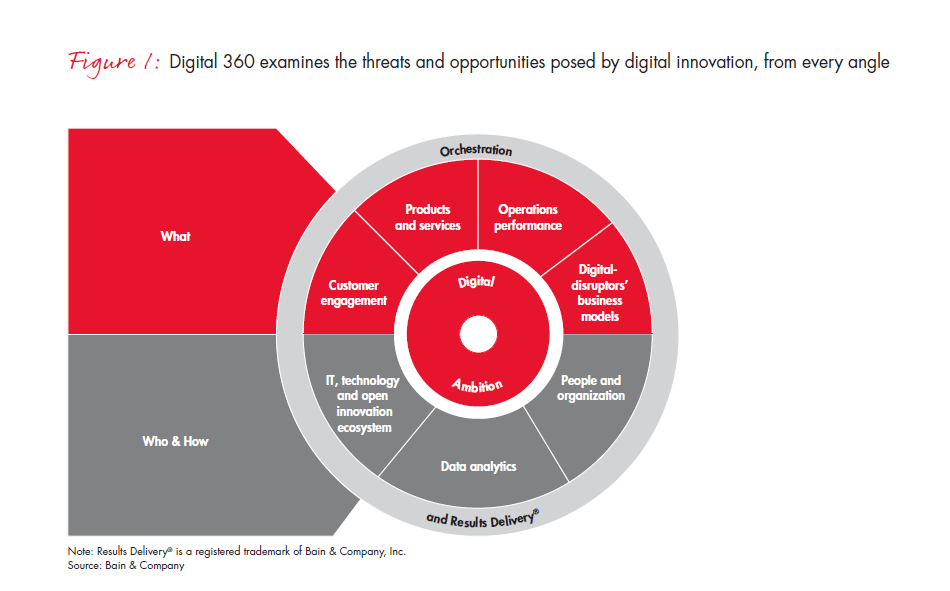
Digital technology affects every company differently, but it tends to create or destroy value in four critical areas of the organization: customer engagement, digital products and services, operational performance, and preparing for disruptive new business models.
The initial assessment of digital readiness diagnoses where the company stands relative to competitors in each of these areas and then lays out the ambition and milestones for the change management effort.
On the customer-facing side, for instance, the framework asks leaders to evaluate whether their customer engagement model is evolving to keep pace with customer behavior. Is the company developing the right digital channels, consistent with the physical channels? Is it using relevant data and analytics to understand customer behaviors and inform better business decisions?
The same kinds of questions apply to product development and operational performance. Are the product people learning fully from tight customer feedback loops and funneling that knowledge into meaningful product improvements? Is production using predictive analysis to model demand so it can optimize the supply chain and asset utilization? Developing a clear point of view on the opportunities or threats in each area will suggest which capabilities need the most attention and where to concentrate investment.
Choreograph the change
But even the clearest digital strategy will fail if your people are unprepared to embrace it. As important as defining what needs to change is setting up the capabilities and processes that define who will enact the change and how. Leaders need to evaluate which emerging technologies can solve specific problems, to what degree digital threats may neutralize their traditional sources of competitive differentiation, and how much their teams and operating models need to adapt. That will help determine the right choreography for the transition by drawing out the magnitude of the overall effort and prioritizing which initiatives need to come in which order.
Three areas of emphasis are critical to enabling change. The first is liberating the IT function from its black box. Ironically, IT has historically been the tightest digital choke point at many companies because it is mired in the old, plodding, project-based approach to application development. Gaining speed depends on adopting a new, more agile development approach that can be applied to the company’s new set of digital priorities.
Second, companies need to harness the revolution in data analytics to analyze the flood of new information flowing through the organization. That will both improve and accelerate decision making.
A third area of emphasis—people—too often gets pushed to the rear. Human capital is clearly at the heart of successful digital transitions. Yet change can be a deep source of anxiety for people, hindering their ability to execute. Fast-changing priorities, shifting resource investments and the need to develop new ways of working understandably shake confidence and enthusiasm. A successful digital transition rests on overcoming this organizational resistance. Leadership teams need to prioritize efforts aimed at generating buy-in. This means defining the change clearly and creating alignment behind it by translating what it means for each part of the organization. People need to understand that as cycle times accelerate, decisions need to be swifter and wired differently than in the past. Staff may need intensive training to learn new skills and behaviors. And everyone needs to have a clear understanding of how their role in the transition affects and depends on others.
Orchestrate the transition
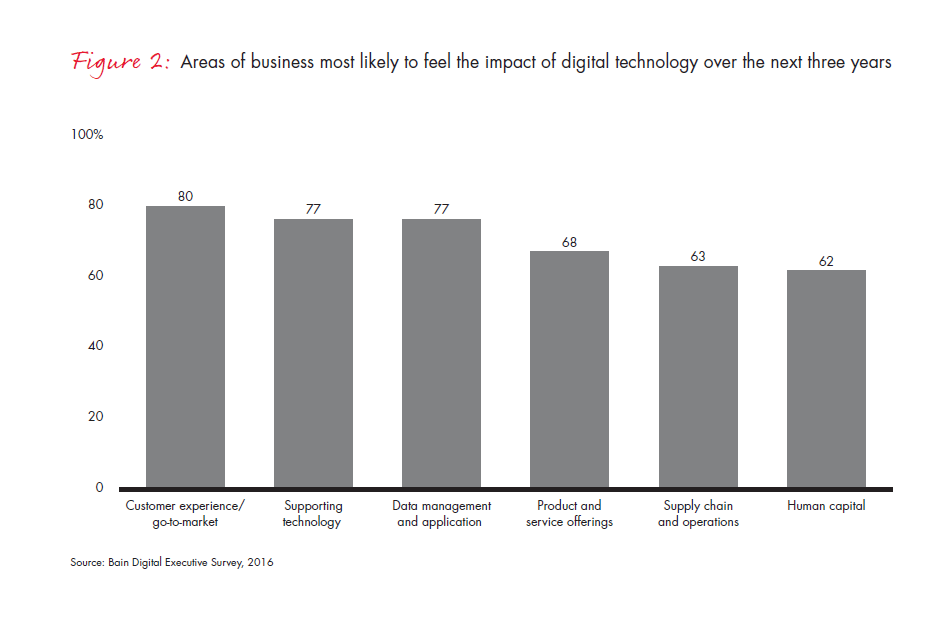
What leaders realize almost immediately through this process is that the most critical initiatives create important cross-dependencies among functions involving customers, products, operations, IT, data management, innovation, finance and employees (see Figure 2).
A good example is the digital evolution in the market for power train compressors. Each compressor currently incorporates hundreds of sensors that send information to the manufacturer about power consumption, vibration, wear and output. Manufacturers are increasingly using this connectedness to address the typical customer pain point: machine downtime. Remote monitoring of each machine, statistically informed by several thousand installed units, enables manufacturers to anticipate problems before they occur, so field service teams can provide predictive maintenance to improve uptime and performance.
Taking full advantage of this type of digitalized model, however, requires quick, effective collaboration across several silos within the organization. Product development teams have to work with field maintenance and commercial teams to develop strategies to upgrade current customers. Data management teams have to develop the predictive algorithms to improve the customer experience, in coordination with the customer-facing teams. Marketing, commercial and finance have to work together to develop new pricing models, since the company isn’t just selling compressors anymore but blending the hardware with a full suite of digitally enabled services that create measurable value for the customer.
Innovating quickly in such businesses requires a new development model. Leading companies are moving toward developing several digital initiatives as prototypes, with clear time constraints for design and deployment. That forces cross-functional teams to create “minimal viable products” and test them on a part of the customer base to get early input. In practice, this brings together all functions during the inception of digital initiatives, representing all components of the process. And it allows teams to learn rapidly from market feedback and adapt accordingly before scaling up deployment across the entire organization.
Accor has adopted a similar approach in the B2C space, to make digital innovation an integral part of its business. Company leaders developed a system to launch as many as 50 digital initiatives per quarter. They roll them out to a select set of 25 hotels that serve as worldwide test-and-learn labs, before deploying the winners across the company’s more than 3,500 hotel properties. This version of agile development brings several functions together to work on each initiative and forces action by imposing a high-speed cadence for rolling out new initiatives. Its effectiveness also relies on sequencing the initiatives at the right frequency, so the organization has time to absorb successive waves of digital innovation. The outcome: Teams feel empowered to break through the usual red tape and overengineering, to produce solutions that are good enough to test—and possibly fail. The true objective is to get something out there, learn from it quickly and adjust as necessary.
One clear implication of this approach is the central importance of an orchestration model for digital—prototyping, risk-taking and mobilizing the front line to push concrete initiatives. The leading digital models to date have been distributed globally throughout an organization via “digital relays” or champions within each geography and business unit. They are centrally orchestrated at a cadence that improves uptake, so the design remains consistent where appropriate.
The CEO’s role is critical here, too. This project teambased approach relies on empowering people at every level of the organization to work together to devise and implement solutions. But that requires some critical organizational and cultural changes. Everyone, for instance, needs access to customer data, as well as the analytics and visualization tools used to interpret it— information that is typically hoarded in a particular part of the organization. Since this democracy of data frequently puts pressure on the middle managers in charge of data and passes decision rights to many others, the CEO must break down the appropriate boundaries, by giving teams permission to set new rules and by providing the strategic framework to buttress the new order. It often makes sense for the CEO to delegate this task to an orchestrator, in the form of a chief digital officer, who is fully empowered to compel change across the organization in the name of the CEO. There isn’t time for anything else. Digital innovation will leave a company behind if it can’t speed up its metabolism.
Turbocharge the organization’s DNA
Ultimately, meeting the digital challenge comes down to speed and agility. Technology is important, but winning depends on how quickly the enterprise can diagnose customer needs and assemble the right technologies into the right solutions. This becomes a distinctive asset. Technology can be replicated, but the ability to read weak signals, anticipate change and swiftly move to action provides a lasting advantage. For leadership, the challenge is to reorient the company’s talent to an operating model that is primed for agile adaptability.
The biggest hurdle is wiring a more flexible mindset into the organization’s DNA. Teams have to get comfortable with change and adaption as a steady state. The most effective innovators have built a digital factory as part of their core value proposition (see Figure 3). This factory receives constant input on how to adapt customer journeys, operational capabilities or the business model, based on new requirements. It then processes those needs by assembling the required digital technologies and feeding solutions into the “rapid design, prototype, test and deploy at scale” process that leads to constant and timely innovation.
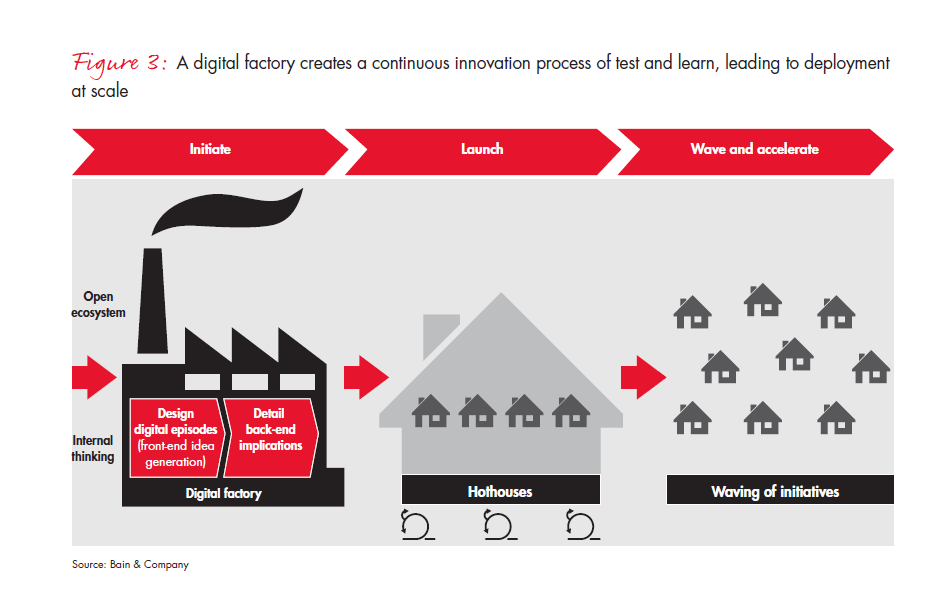
The practical effect is a shift in the mindset of teams, because it forces them to work across functions and accelerates how quickly they move from design to action. That alters the cultural DNA by expecting people to accept more risk-taking and granting the right to learn from failure. They discover that success will no longer be measured by how they maneuver within their functions; instead, success will depend on the results they produce in the market.
In this sense, organizations need to be regularly reprogrammable. They need to anticipate the next wave of digital initiatives, recognize the signals requiring a new or different response and move in concert to deliver solutions through agile operating processes and channels of engagement. Leadership sets the direction, but the line executives must lead this DNA upgrade, with the right support from all domains and heavy input from human resources.
A digital transition is not a Big Bang initiative. Your company will not become Amazon, Alibaba or Facebook overnight—nor should it. Rather, the transition is a steady march forward. It happens day by day and month by month, as a flexible test-and-learn culture creates the digital solutions best suited to your company and its customers. The companies doing it best have embedded the new rules of the game deep within their cultures and operating models. Success for them means never going back to normal, but always moving forward toward a more flexible future.
Laurent-Pierre Baculard is a Bain & Company partner in Paris. Greg Caimi and Elizabeth Spaulding are partners in Bain’s San Francisco office. John Senior is a partner based in Sydney. They lead Bain’s Digital practice.
The authors would like to thank Marina Fajardo, Virginie Flam and Jacqueline Rowlands for their contributions to this brief.
Key contacts in Bain’s Digital practice
Americas
- Greg Caimi in San Francisco
- Peter Guarraia in Chicago
- Elizabeth Spaulding in San Francisco
Asia-Pacific
- Florian Hoppe in Singapore
- John Senior in Sydney
Europe, Middle East and Africa
- Laurent-Pierre Baculard in Paris
- Nicolas Bloch in Brussels
- Andreas Dullweber in Munich
- David Michels in Zürich
- Henrik Naujoks in Zürich
- Michael Schertler in Munich
First published in ottobre 2016