
Skip to Content
  • Uffici

    Uffici

    Nord e Sud America
    • Atlanta
    • Austin
    • Bogota
    • Boston
    • Buenos Aires
    • Chicago
    • Dallas
    • Denver
    • Houston
    • Los Angeles
    • Mexico City
    • Minneapolis
    • Monterrey
    • Montreal
    • New York
    • Rio de Janeiro
    • San Francisco
    • Santiago
    • São Paulo
    • Seattle
    • Silicon Valley
    • Toronto
    • Washington, DC
    Europa, Medio Oriente e Africa
    • Amsterdam
    • Athens
    • Berlin
    • Brussels
    • Copenhagen
    • Doha
    • Dubai
    • Dusseldorf
    • Frankfurt
    • Helsinki
    • Istanbul
    • Johannesburg
    • Kyiv
    • Lisbon
    • London
    • Madrid
    • Milan
    • Munich
    • Oslo
    • Paris
    • Riyadh
    • Rome
    • Stockholm
    • Vienna
    • Warsaw
    • Zurich
    Asia e Australia
    • Bangkok
    • Beijing
    • Bengaluru
    • Brisbane
    • Ho Chi Minh City
    • Hong Kong
    • Jakarta
    • Kuala Lumpur
    • Manila
    • Melbourne
    • Mumbai
    • New Delhi
    • Perth
    • Seoul
    • Shanghai
    • Singapore
    • Sydney
    • Tokyo
    Guarda tutti gli uffici
  • Alumni
  • Media Center
  • Iscriviti
  • Contattaci
  • Italy | Italiano

    Seleziona il tuo Paese e la tua lingua

    Global
    • Global (English)
    Nord e Sud America
    • Brazil (Português)
    • Argentina (Español)
    • Canada (Français)
    • Chile (Español)
    • Colombia (Español)
    Europa, Medio Oriente e Africa
    • France (Français)
    • DACH Region (Deutsch)
    • Italy (Italiano)
    • Spain (Español)
    • Greece (Elliniká)
    Asia e Australia
    • China (中文版)
    • Korea (한국어)
    • Japan (日本語)
  • Saved items (0)
    Saved items (0)

    You have no saved items.

    Contrassegna il contenuto che ti interessa e verrà salvato qui. Potrai leggerlo o condividerlo in seguito.

    Explore Bain Insights
  • Settori
    Menu principale

    Settori

    • Aerospazio e Difesa
    • Agribusiness
    • Chimica
    • Infrastrutture e Costruzioni
    • Beni di Largo Consumo
    • Servizi Finanziari
    • Sanità
    • Macchinari Industriali
    • Media & Intrattenimento
    • Industria Metallurgica
    • Industria Mineraria
    • Petrolio e Gas
    • Industria Cartaria e Packaging
    • Private Equity
    • Settore Sociale & Pubblico
    • Retail
    • Tecnologia
    • Telecomunicazioni
    • Compagnie Aeree & Trasporti
    • Viaggi e Svago
    • Utility e Rinnovabili
  • Servizi di Consulenza
    Menu principale

    Servizi di Consulenza

    • Customer Experience
    • ESG
    • Innovation
    • M&A and Divestitures
    • Operation
    • People & Organization
    • Private Equity
    • Sales & Marketing
    • Strategia
    • IA, Approfondimenti e Soluzioni
    • Tecnologia
    • Trasformazione
  • Digital
  • Tematiche
  • Informazioni su Bain
    Menu principale

    Informazioni su Bain

    • Che Cosa Facciamo
    • Quello in Cui Crediamo
    • Le Nostre Persone e la Leadership
    • Risultati
    • Premi e Riconoscimenti
    • Organizzazioni Globali
    Further: Our global responsibility
    • Diversità e Inclusione
    • Social Impact
    • Sustainability
    • World Economic Forum
    Learn more about Further
  • Careers
    Menu principale

    Careers

    • Work with Us
      Careers
      Work with Us
      • Find Your Place
      • Our Work Areas
      • Integrated Teams
      • Students
      • Internships & Programs
      • Recruiting Events
    • Life at Bain
      Careers
      Life at Bain
      • Blog: Inside Bain
      • Career Stories
      • Our People
      • Where We Work
      • Supporting Your Growth
      • Affinity Groups
      • Benefits
    • Impact Stories
    • Hiring Process
      Careers
      Hiring Process
      • What to Expect
      • Interviewing
    FIND JOBS
  • Uffici
    Menu principale

    Uffici

    • Nord e Sud America
      Uffici
      Nord e Sud America
      • Atlanta
      • Austin
      • Bogota
      • Boston
      • Buenos Aires
      • Chicago
      • Dallas
      • Denver
      • Houston
      • Los Angeles
      • Mexico City
      • Minneapolis
      • Monterrey
      • Montreal
      • New York
      • Rio de Janeiro
      • San Francisco
      • Santiago
      • São Paulo
      • Seattle
      • Silicon Valley
      • Toronto
      • Washington, DC
    • Europa, Medio Oriente e Africa
      Uffici
      Europa, Medio Oriente e Africa
      • Amsterdam
      • Athens
      • Berlin
      • Brussels
      • Copenhagen
      • Doha
      • Dubai
      • Dusseldorf
      • Frankfurt
      • Helsinki
      • Istanbul
      • Johannesburg
      • Kyiv
      • Lisbon
      • London
      • Madrid
      • Milan
      • Munich
      • Oslo
      • Paris
      • Riyadh
      • Rome
      • Stockholm
      • Vienna
      • Warsaw
      • Zurich
    • Asia e Australia
      Uffici
      Asia e Australia
      • Bangkok
      • Beijing
      • Bengaluru
      • Brisbane
      • Ho Chi Minh City
      • Hong Kong
      • Jakarta
      • Kuala Lumpur
      • Manila
      • Melbourne
      • Mumbai
      • New Delhi
      • Perth
      • Seoul
      • Shanghai
      • Singapore
      • Sydney
      • Tokyo
    Guarda tutti gli uffici
  • Alumni
  • Media Center
  • Iscriviti
  • Contattaci
  • Italy | Italiano
    Menu principale

    Seleziona il tuo Paese e la tua lingua

    • Global
      Seleziona il tuo Paese e la tua lingua
      Global
      • Global (English)
    • Nord e Sud America
      Seleziona il tuo Paese e la tua lingua
      Nord e Sud America
      • Brazil (Português)
      • Argentina (Español)
      • Canada (Français)
      • Chile (Español)
      • Colombia (Español)
    • Europa, Medio Oriente e Africa
      Seleziona il tuo Paese e la tua lingua
      Europa, Medio Oriente e Africa
      • France (Français)
      • DACH Region (Deutsch)
      • Italy (Italiano)
      • Spain (Español)
      • Greece (Elliniká)
    • Asia e Australia
      Seleziona il tuo Paese e la tua lingua
      Asia e Australia
      • China (中文版)
      • Korea (한국어)
      • Japan (日本語)
  • Saved items  (0)
    Menu principale
    Saved items (0)

    You have no saved items.

    Contrassegna il contenuto che ti interessa e verrà salvato qui. Potrai leggerlo o condividerlo in seguito.

    Explore Bain Insights
  • Settori
    • Settori

      • Aerospazio e Difesa
      • Agribusiness
      • Chimica
      • Infrastrutture e Costruzioni
      • Beni di Largo Consumo
      • Servizi Finanziari
      • Sanità
      • Macchinari Industriali
      • Media & Intrattenimento
      • Industria Metallurgica
      • Industria Mineraria
      • Petrolio e Gas
      • Industria Cartaria e Packaging
      • Private Equity
      • Settore Sociale & Pubblico
      • Retail
      • Tecnologia
      • Telecomunicazioni
      • Compagnie Aeree & Trasporti
      • Viaggi e Svago
      • Utility e Rinnovabili
  • Servizi di Consulenza
    • Servizi di Consulenza

      • Customer Experience
      • ESG
      • Innovation
      • M&A and Divestitures
      • Operation
      • People & Organization
      • Private Equity
      • Sales & Marketing
      • Strategia
      • IA, Approfondimenti e Soluzioni
      • Tecnologia
      • Trasformazione
  • Digital
  • Tematiche
  • Informazioni su Bain
    • Informazioni su Bain

      • Che Cosa Facciamo
      • Quello in Cui Crediamo
      • Le Nostre Persone e la Leadership
      • Risultati
      • Premi e Riconoscimenti
      • Organizzazioni Globali
      Further: Our global responsibility
      • Diversità e Inclusione
      • Social Impact
      • Sustainability
      • World Economic Forum
      Learn more about Further
  • Careers
    Ricerche più popolari
    • Agile
    • Digitale
    • Strategia
    La tue ricerche precedenti
      Pagine visitate

      Content added to saved items

      Saved items (0)

      Removed from saved items

      Saved items (0)

      Energy & Natural Resources Report

      M&A Opportunities in the Energy Transition

      M&A Opportunities in the Energy Transition

      Many energy and natural resources companies are turning to acquisitions to rebalance their carbon portfolio and to green their operations.

      Di Whit Keuer, Hyukjin Lee, e Arnaud Leroi

      • Tempo di lettura min.
      }

      Report

      M&A Opportunities in the Energy Transition
      en
      In evidenza
      • Despite low deal activity in 2021, more companies are turning to M&A to acquire lower-carbon assets, particularly in renewable power generation.
      • Energy transition deals accounted for about 20% of all energy-sector deals greater than $1 billion in 2021.
      • More companies are using deals to green existing operations and strengthen ESG assets; build green energy hubs and an integrated value chain to assist the energy transition; reshape business models; and invest in start-ups to acquire disruptive technology.

      This article is part of Bain’s Energy and Natural Resources Report 2022

      Explore the report

      M&A activity in the energy and natural resources industry remained sluggish in 2021, rebounding only around 20% from 2020 and not yet recovering to prepandemic levels. Partly, this was the result of companies looking for demand to stabilize. Then, as stabilization largely took place, a second factor came into play: Companies began sharpening their capital discipline, which slowed dealmaking as fewer deals met their higher hurdle rates.

      We believe that conditions are primed for an upswing propelled by a resurgence in industry consolidation and portfolio management. The oil and gas industry is still highly fragmented in many sectors, and multiples remain depressed, setting the stage for consolidation to unlock new levels of efficiency. The conflict in Ukraine adds more complexity to the market, with many companies actively reviewing their portfolio and some exiting their Russian positions as BP has done.

      Meanwhile, there will be growing opportunities for portfolio management across energy and natural resources, especially in chemicals. Over the years, companies have expanded their portfolios to the point that there’s now a lack of natural synergies among assets and a high degree of complexity.

      Above all, though, companies will turn to M&A to make more progress on the monumental journey of moving the world closer to a lower-carbon, sustainable future while also keeping their current businesses running. Many large companies have already pursued deals that accelerate their participation in the energy transition that, at its heart, requires all companies to reinvent themselves.

      In 2021, energy transition deals accounted for about 20% of all energy-sector deals greater than $1 billion (see Figure 1).

      Figure 1
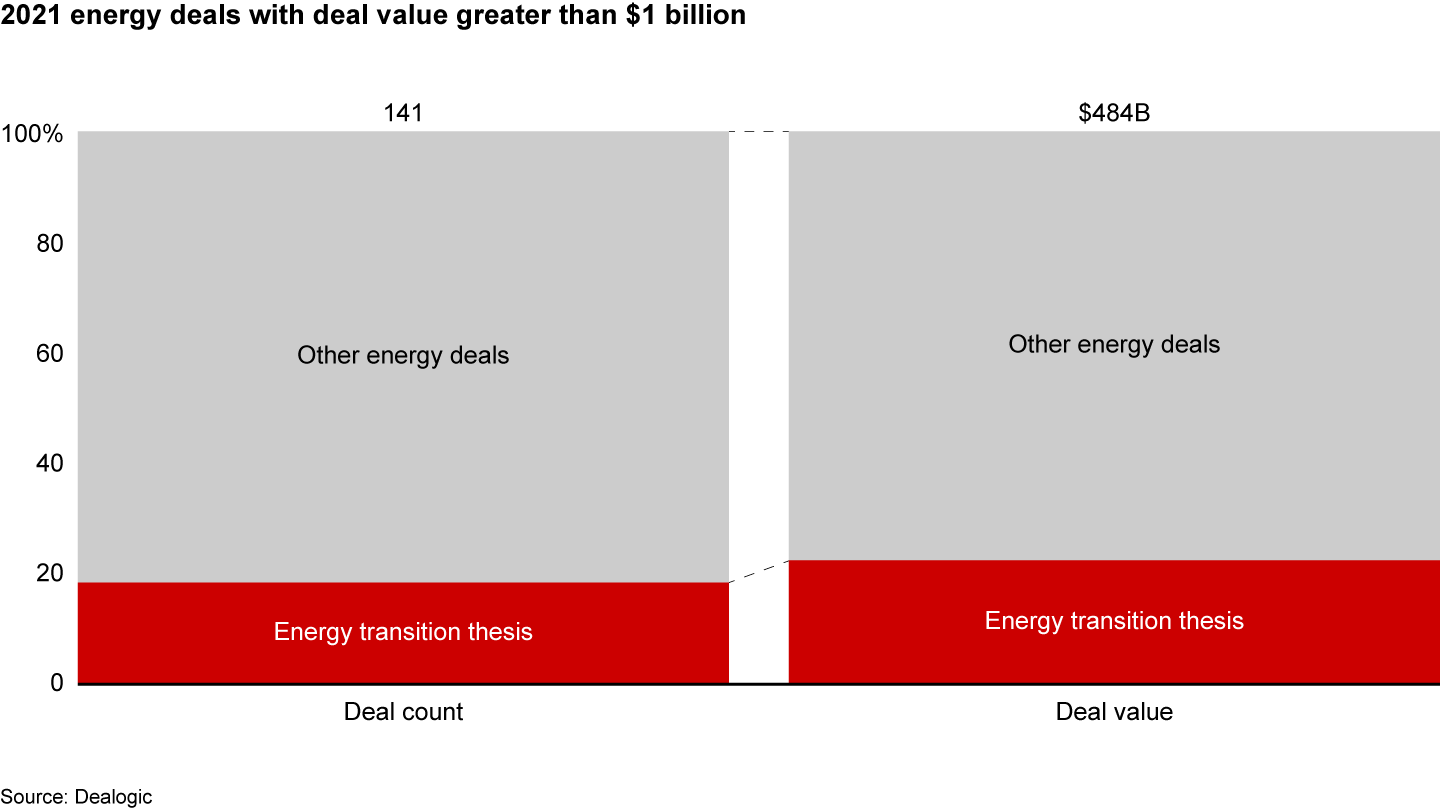
      Energy transition theses accounted for about 20% of large deals in the energy industry in 2021

      The energy and natural resources industry’s reliance on M&A in 2022 to deliver the energy transition will play out across seven themes.

      Greening existing operations and strengthening environmental, social, and corporate governance (ESG) assets. Companies are aggressively making deals aimed at reducing carbon production from their operations to meet net-zero targets. For example, Occidental Petroleum, one of the top producers in the US’s Permian Basin, is acquiring solar generation assets to power its drilling and completions operations. At the same time, Suncor is partnering with other oil sands producers while investing to commercialize carbon-capture technology.

      Building green energy hubs. Deals are also fueling companies’ efforts to move beyond greening their existing operations and toward fundamentally changing their inputs, production processes, or products. BP and Equinor’s strategic partnership, Northern Endurance Partnership, was formed together with Eni, National Grid, Shell, and Total to create a refinery of the future that will act as a green energy hub within an industrial cluster. It will maintain integrated sourcing and production of renewable energy, with new feedstock streams and lower greenhouse gas fuels and products.

      Repositioning portfolios toward the energy transition. Companies are using M&A to accelerate shifts in their portfolios. This involves both divestments of high-carbon assets as well as investments in the energy transition. An example is Shell, which sold acreage in the Permian Basin to ConocoPhillips for $9.5 billion, in a move to help accelerate the company’s portfolio shift driven by the energy transition. Another example is LyondellBasell’s joint venture with Suez (now Veolia) and acquisition of European plastics-recycling company Quality Circular Polymers to mechanically convert consumer waste into 25,000 tons of polypropylene and high-density polyethylene per year. Utilities have been acquiring more renewable assets, and at higher multiples than we’ve seen for traditional gas-powered assets. Some utilities also are seizing opportunities in smart grid technologies and distributed storage, such as Southern’s 2016 acquisition of PowerSecure, a provider of smart grid services. Private equity firms play a big role in this shift to green operations by buying energy companies’ traditional high-carbon assets.

      Establishing a critical position on the value chain to deliver energy transition products and services. BP made a move in this direction when it acquired the UK’s largest electric vehicle-charging company, which at the time operated more than 6,500 charging ports.

      Using M&A to reshape business models. Some companies have found that fully monetizing energy transition assets requires them to buy new capabilities for transformed business models. For example, Shell has a license to sell power to industrial customers in the UK electricity sector.

      Carving out new growth businesses. More companies are carving out, or “ring-fencing,” assets that take advantage of the energy transition opportunities. For example, LG Energy Solution, which LG Chem spun out as a separate entity in 2020, raised $10.7 billion to reach a valuation of $98 billion in a January 2022 IPO on enthusiasm for its EV battery business, a move that allowed the new subsidiary to trade at a multiple about eight times greater than its parent. The sector did something like this 10 to 15 years ago, when many companies put their infrastructure assets into master limited partnerships (MLPs), a trend that raised valuations across the board. Managing new growth businesses in this way can attract a new class of investors that are targeting this asset class in expectation of higher multiples than for the legacy business.

      Making strategic investments in start-ups to acquire disruptive technology. Finally, more companies will make early-stage investments in, or partner with, young companies that can help them become disrupters themselves. That’s the goal of a large petrochemical company’s investment in a blockchain company, or BASF’s corporate venture capital investment in LanzaTech, a carbon-recycling company.

      How winning companies do it

      In their effort to rely on deals to deliver the energy transition, some companies will emerge as leaders. Here’s how M&A practitioners in energy and natural resources can boost the odds of success.

      Take an activist approach to portfolio management. As portfolios change and become more diverse, companies need to undertake more frequent asset reviews to manage their business through this change. This review is critical in ensuring that the existing business continues to meet current goals and would clear the same hurdles for investment today. Leaders need to be prepared to either invest in improvement or divest those areas where performance is falling short of what’s needed for today’s corporate strategy.

      Set a capital allocation strategy that’s tied to the corporate strategy, and lean toward the energy transition. That means recognizing that investments should target mature solutions like renewables, as well as less mature and more innovative solutions. It also means being disciplined about exploring profitable growth options in low carbon along multiple growth horizons.

      Incorporate ESG considerations into due diligence. Buyers need to actively understand and assess the relative performance of the target across critical ESG dimensions. This benchmarking exercise allows companies not only to understand the target’s true value, but also anticipate any costs associated with bringing the target in line with the buyer’s ESG strategy. This needs to feed into value creation planning and integration in order to unlock the full potential of the combination (see “The ESG Imperative in M&A”).

      Evolve the joint venture playbook to accelerate an energy transition strategy. This is a historic area of strength for many energy and natural resources companies as they’ve used joint ventures to partner in the development of oil and gas fields or large petrochemical complexes, often with state-owned enterprises. In addition to these traditional uses of joint ventures, companies increasingly are favoring joint ventures to accelerate energy transition strategies and combine expertise along the value chain, as it’s difficult for one company to have all the capabilities required. For example, there are several joint ventures globally related to the chemical recycling of plastic waste. These joint ventures involve three parties: traditional waste companies with expertise in the collection and preparation of waste and recyclable materials, a company with proprietary mechanical or chemical recycling technology, and a traditional chemical company with experience in processing and operating hydrocarbon and chemical plants (see “Delivering Results in Joint Ventures and Alliances Requires a New Playbook”).

      Fluid M&A market dynamics will provide myriad opportunities for resilient companies to transform their portfolios and reposition themselves for the great energy transition. The best companies view the industry’s era of complex uncertainties and unprecedented change for what it is: a time of historic possibilities.

      Read the Next Chapter

      Deliver Decarbonization with Visionary Pragmatism

      Data-rich perspectives

      • Execs on energy transition

      • Investing in Engine 2

      • Energy investors and ESG

      • Responding to Ukraine crisis

      Transition trends

      • Talent and inclusivity

      • Building coalitions for decarbonization

      • Circularity in plastics

      Strategic capabilities

      • How to do Engine 2

      • Operations through disruptions

      • Pricing and inflation

      • M&A opportunities

      • Delivering decarbonization

      Read our Energy and Natural Resources Report 2022

      Explore the full report Download PDF
      Autori
      • Headshot of Whit Keuer
        Whit Keuer
        Partner, Dallas
      • Hyukjin Lee
        Alumni, Seoul
      • Headshot of Arnaud Leroi
        Arnaud Leroi
        Partner, Paris
      Contattaci
      Industry collegate
      • Agribusiness
      • Chimica
      • Energia e Risorse Naturali
      • Industria Metallurgica e Mineraria
      • Petrolio e Gas
      • Utility e Rinnovabili
      Servizi di consulenza collegati
      • Strategia
      Energy and Natural Resources Report
      Creating a Coordinated Approach to Decarbonization

      Energy and natural resources companies are building broad coalitions to develop policies that accelerate decarbonization.

      Leggi di più
      Energy and Natural Resources Report
      The Energy Transition’s Other Big Puzzle: Making the Math Work

      Strong investment returns are within reach for companies that focus on the fundamentals and aren’t afraid to get creative.

      Leggi di più
      Energia e Risorse Naturali
      Sustaining Capital: From Chaos to Discipline

      Fragmented budgets, poor visibility, and missed forecasts are fixable with the right approach.

      Leggi di più
      Strategia
      Betting on the Future without a Plan B?

      Fewer than half of CEOs say their companies have what it takes to thrive in today’s volatile world.

      Leggi di più
      Energy and Natural Resources Report
      State of the Transition 2023: Global Energy and Natural Resource Executive Perspectives

      Bain’s third annual survey on the energy transition finds executives increasing investments in low-carbon businesses, but skeptical of consumers’ willingness to pay more.

      Leggi di più
      First published in giugno 2022
      Tags
      • Agribusiness
      • Chimica
      • Energia e Risorse Naturali
      • Energy and Natural Resources Report
      • Industria Metallurgica e Mineraria
      • Petrolio e Gas
      • Strategia
      • Utility e Rinnovabili

      Come abbiamo aiutato i nostri clienti

      An Environmental Services Company Captures Massive Savings from a Merger

      Leggi un caso di studio

      Organizzazione Centralization boosts performance for an energy giant

      Leggi un caso di studio

      Revitalizing a utility's market position with customer loyalty

      Leggi un caso di studio

      Vuoi continuare la conversazione?

      Aiutiamo i leader globali e le loro aziende ad affrontare problemi e a cogliere le opportunità. Sosteniamo cambiamenti e otteniamo risultati duraturi.

      Bain Insights. Le nostre idee e punti di vista sulle tematiche che le aziende globali affrontano ogni giorno, arrivano nella tua email tutti i mesi.

      *Ho letto l'Informativa sulla Privacy e accetto i termini e le condizioni.

      Si prega di leggere e accettare l’Informativa sulla Privacy
      Bain & Company
      Contattaci Sustainability Accessibility Condizioni d’uso Privacy Cookie Policy Sitemap Log In

      © 1996-2026 Bain & Company, Inc.

      Contatta Bain

      Come posso aiutarti?

      • Business inquiry
      • Career information
      • Press relations
      • Partnership request
      • Speaker request
      Guarda tutti gli uffici