
Skip to Content
  • Uffici

    Uffici

    Nord e Sud America
    • Atlanta
    • Austin
    • Bogota
    • Boston
    • Buenos Aires
    • Chicago
    • Dallas
    • Denver
    • Houston
    • Los Angeles
    • Mexico City
    • Minneapolis
    • Monterrey
    • Montreal
    • New York
    • Rio de Janeiro
    • San Francisco
    • Santiago
    • São Paulo
    • Seattle
    • Silicon Valley
    • Toronto
    • Washington, DC
    Europa, Medio Oriente e Africa
    • Amsterdam
    • Athens
    • Berlin
    • Brussels
    • Copenhagen
    • Doha
    • Dubai
    • Dusseldorf
    • Frankfurt
    • Helsinki
    • Istanbul
    • Johannesburg
    • Kyiv
    • Lisbon
    • London
    • Madrid
    • Milan
    • Munich
    • Oslo
    • Paris
    • Riyadh
    • Rome
    • Stockholm
    • Vienna
    • Warsaw
    • Zurich
    Asia e Australia
    • Bangkok
    • Beijing
    • Bengaluru
    • Brisbane
    • Ho Chi Minh City
    • Hong Kong
    • Jakarta
    • Kuala Lumpur
    • Manila
    • Melbourne
    • Mumbai
    • New Delhi
    • Perth
    • Seoul
    • Shanghai
    • Singapore
    • Sydney
    • Tokyo
    Guarda tutti gli uffici
  • Alumni
  • Media Center
  • Iscriviti
  • Contattaci
  • Italy | Italiano

    Seleziona il tuo Paese e la tua lingua

    Global
    • Global (English)
    Nord e Sud America
    • Brazil (Português)
    • Argentina (Español)
    • Canada (Français)
    • Chile (Español)
    • Colombia (Español)
    Europa, Medio Oriente e Africa
    • France (Français)
    • DACH Region (Deutsch)
    • Italy (Italiano)
    • Spain (Español)
    • Greece (Elliniká)
    Asia e Australia
    • China (中文版)
    • Korea (한국어)
    • Japan (日本語)
  • Saved items (0)
    Saved items (0)

    You have no saved items.

    Contrassegna il contenuto che ti interessa e verrà salvato qui. Potrai leggerlo o condividerlo in seguito.

    Explore Bain Insights
  • Settori
    Menu principale

    Settori

    • Aerospazio e Difesa
    • Agribusiness
    • Chimica
    • Infrastrutture e Costruzioni
    • Beni di Largo Consumo
    • Servizi Finanziari
    • Sanità
    • Macchinari Industriali
    • Media & Intrattenimento
    • Industria Metallurgica
    • Industria Mineraria
    • Petrolio e Gas
    • Industria Cartaria e Packaging
    • Private Equity
    • Settore Sociale & Pubblico
    • Retail
    • Tecnologia
    • Telecomunicazioni
    • Compagnie Aeree & Trasporti
    • Viaggi e Svago
    • Utility e Rinnovabili
  • Servizi di Consulenza
    Menu principale

    Servizi di Consulenza

    • Customer Experience
    • ESG
    • Innovation
    • M&A and Divestitures
    • Operation
    • People & Organization
    • Private Equity
    • Sales & Marketing
    • Strategia
    • IA, Approfondimenti e Soluzioni
    • Tecnologia
    • Trasformazione
  • Digital
  • Tematiche
  • Informazioni su Bain
    Menu principale

    Informazioni su Bain

    • Che Cosa Facciamo
    • Quello in Cui Crediamo
    • Le Nostre Persone e la Leadership
    • Risultati
    • Premi e Riconoscimenti
    • Organizzazioni Globali
    Further: Our global responsibility
    • Diversità e Inclusione
    • Social Impact
    • Sustainability
    • World Economic Forum
    Learn more about Further
  • Careers
    Menu principale

    Careers

    • Work with Us
      Careers
      Work with Us
      • Find Your Place
      • Our Work Areas
      • Integrated Teams
      • Students
      • Internships & Programs
      • Recruiting Events
    • Life at Bain
      Careers
      Life at Bain
      • Blog: Inside Bain
      • Career Stories
      • Our People
      • Where We Work
      • Supporting Your Growth
      • Affinity Groups
      • Benefits
    • Impact Stories
    • Hiring Process
      Careers
      Hiring Process
      • What to Expect
      • Interviewing
    FIND JOBS
  • Uffici
    Menu principale

    Uffici

    • Nord e Sud America
      Uffici
      Nord e Sud America
      • Atlanta
      • Austin
      • Bogota
      • Boston
      • Buenos Aires
      • Chicago
      • Dallas
      • Denver
      • Houston
      • Los Angeles
      • Mexico City
      • Minneapolis
      • Monterrey
      • Montreal
      • New York
      • Rio de Janeiro
      • San Francisco
      • Santiago
      • São Paulo
      • Seattle
      • Silicon Valley
      • Toronto
      • Washington, DC
    • Europa, Medio Oriente e Africa
      Uffici
      Europa, Medio Oriente e Africa
      • Amsterdam
      • Athens
      • Berlin
      • Brussels
      • Copenhagen
      • Doha
      • Dubai
      • Dusseldorf
      • Frankfurt
      • Helsinki
      • Istanbul
      • Johannesburg
      • Kyiv
      • Lisbon
      • London
      • Madrid
      • Milan
      • Munich
      • Oslo
      • Paris
      • Riyadh
      • Rome
      • Stockholm
      • Vienna
      • Warsaw
      • Zurich
    • Asia e Australia
      Uffici
      Asia e Australia
      • Bangkok
      • Beijing
      • Bengaluru
      • Brisbane
      • Ho Chi Minh City
      • Hong Kong
      • Jakarta
      • Kuala Lumpur
      • Manila
      • Melbourne
      • Mumbai
      • New Delhi
      • Perth
      • Seoul
      • Shanghai
      • Singapore
      • Sydney
      • Tokyo
    Guarda tutti gli uffici
  • Alumni
  • Media Center
  • Iscriviti
  • Contattaci
  • Italy | Italiano
    Menu principale

    Seleziona il tuo Paese e la tua lingua

    • Global
      Seleziona il tuo Paese e la tua lingua
      Global
      • Global (English)
    • Nord e Sud America
      Seleziona il tuo Paese e la tua lingua
      Nord e Sud America
      • Brazil (Português)
      • Argentina (Español)
      • Canada (Français)
      • Chile (Español)
      • Colombia (Español)
    • Europa, Medio Oriente e Africa
      Seleziona il tuo Paese e la tua lingua
      Europa, Medio Oriente e Africa
      • France (Français)
      • DACH Region (Deutsch)
      • Italy (Italiano)
      • Spain (Español)
      • Greece (Elliniká)
    • Asia e Australia
      Seleziona il tuo Paese e la tua lingua
      Asia e Australia
      • China (中文版)
      • Korea (한국어)
      • Japan (日本語)
  • Saved items  (0)
    Menu principale
    Saved items (0)

    You have no saved items.

    Contrassegna il contenuto che ti interessa e verrà salvato qui. Potrai leggerlo o condividerlo in seguito.

    Explore Bain Insights
  • Settori
    • Settori

      • Aerospazio e Difesa
      • Agribusiness
      • Chimica
      • Infrastrutture e Costruzioni
      • Beni di Largo Consumo
      • Servizi Finanziari
      • Sanità
      • Macchinari Industriali
      • Media & Intrattenimento
      • Industria Metallurgica
      • Industria Mineraria
      • Petrolio e Gas
      • Industria Cartaria e Packaging
      • Private Equity
      • Settore Sociale & Pubblico
      • Retail
      • Tecnologia
      • Telecomunicazioni
      • Compagnie Aeree & Trasporti
      • Viaggi e Svago
      • Utility e Rinnovabili
  • Servizi di Consulenza
    • Servizi di Consulenza

      • Customer Experience
      • ESG
      • Innovation
      • M&A and Divestitures
      • Operation
      • People & Organization
      • Private Equity
      • Sales & Marketing
      • Strategia
      • IA, Approfondimenti e Soluzioni
      • Tecnologia
      • Trasformazione
  • Digital
  • Tematiche
  • Informazioni su Bain
    • Informazioni su Bain

      • Che Cosa Facciamo
      • Quello in Cui Crediamo
      • Le Nostre Persone e la Leadership
      • Risultati
      • Premi e Riconoscimenti
      • Organizzazioni Globali
      Further: Our global responsibility
      • Diversità e Inclusione
      • Social Impact
      • Sustainability
      • World Economic Forum
      Learn more about Further
  • Careers
    Ricerche più popolari
    • Agile
    • Digitale
    • Strategia
    La tue ricerche precedenti
      Pagine visitate

      Content added to saved items

      Saved items (0)

      Removed from saved items

      Saved items (0)

      Brief

      Memo to CEOs: Break Your Inertia on Sustainability

      Memo to CEOs: Break Your Inertia on Sustainability

      If sustainability is so important to corporate leaders, why aren’t they spending more time on it?

      Di Dalton Maine, Andrew Keech, e Sasha Duchnowski

      • Tempo di lettura min.
      }

      Brief

      Memo to CEOs: Break Your Inertia on Sustainability
      en
      In evidenza
      • Most CEOs say that environmental sustainability is important, but few give it as much time as they do to other priorities.
      • One reason is that they don’t have access to current, comprehensive data on their environmental sustainability efforts, which hinders good decision making.
      • Many also struggle to measure returns on investments in environmental sustainability, since some efforts take years to pay off and are beyond the four walls of the organization.
      • A structured approach that includes a rigorous assessment, a plan for action, and greater accountability for executives can help break the inertia and raise sustainability to the prominence it deserves.

      Ask CEOs in energy and natural resources industries what’s most important to them and their legacy, and the issues of environmental stewardship and sustainability often rank high on the list. For many senior executives, this touches at the core of their contribution: What will be the societal legacy of their tenure as CEO? Have they used their influence to leave the world in a better place than they found it? Will their children be proud of the impact they’ve had?

      However, if you look at where CEOs spend their time, environmental sustainability ranks low—much lower than you might expect, given the importance leaders place on it (see Figure 1). Too often, CEOs find themselves in a reactive mode, addressing environmental issues only when an issue threatens to create public relations problems or limit business performance.

      Figure 1
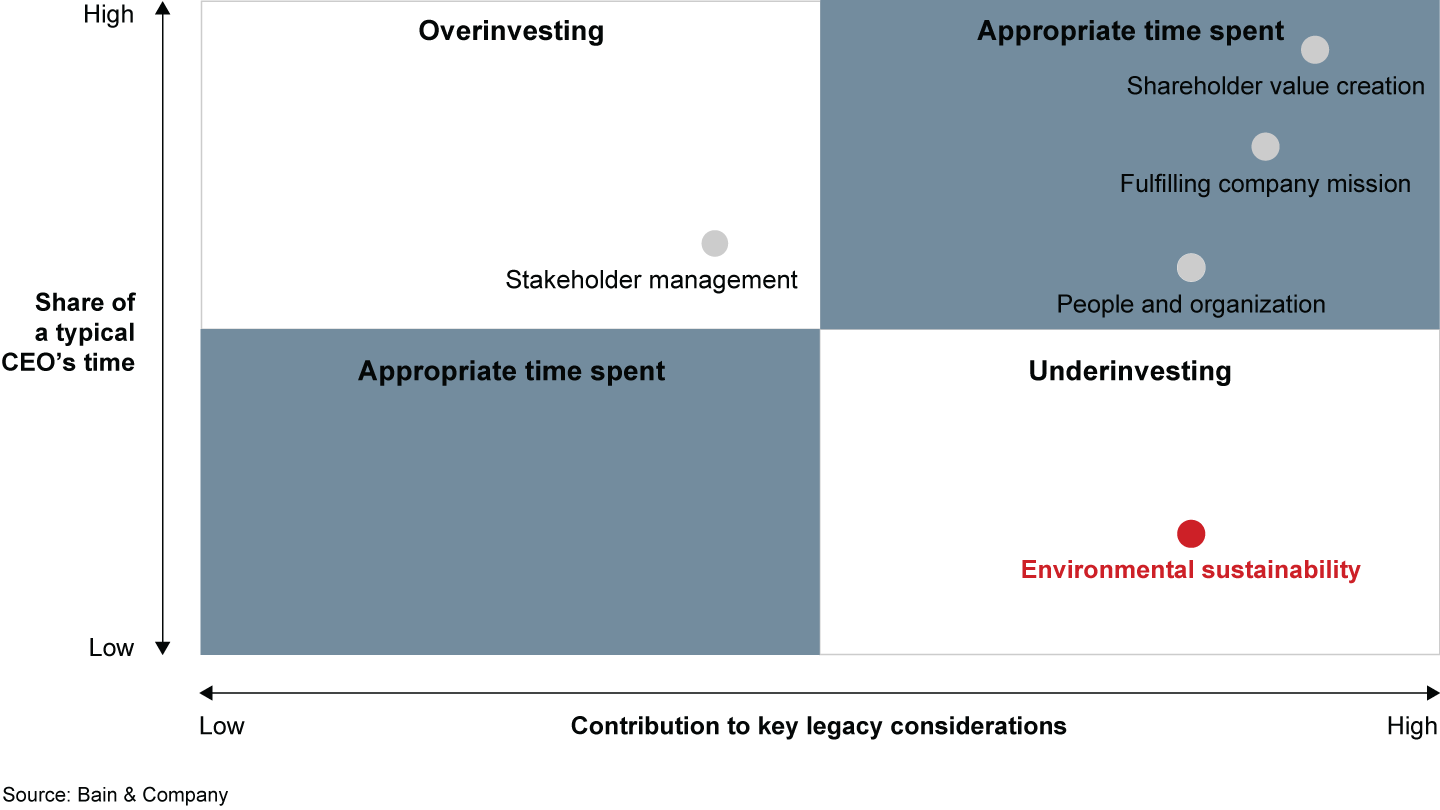
      Most CEOs rank environmental sustainability as an important issue, but devote relatively little time to it
      Most CEOs rank environmental sustainability as an important issue, but devote relatively little time to it
      Most CEOs rank environmental sustainability as an important issue, but devote relatively little time to it

      In addition to its prominence as a key legacy issue for CEOs, environmental sustainability has become a critical business issue. Consumers and customers are demanding greater accountability from corporations, top young talent is increasingly attracted to companies with a proactive environmental agenda and investors are beginning to favor companies that are leading in this arena.

      Despite this, few important issues on a CEO’s agenda are managed as reactively as environmental sustainability. Often the majority of CEO time dedicated to the topic is spent responding to regulatory or nongovernmental organization (NGO) pressures, or managing near-term risks or crises. Given the importance CEOs place on the topic, why do so many manage environmental sustainability this way?

      There are several reasons why this critical issue fails to get the place it deserves on the CEO’s agenda.

      • Bundled with a broad set of corporate responsibility issues. As environmental sustainability becomes an existential issue in some sectors, as well as an emerging opportunity for new business, CEOs must ensure that it doesn’t get lost in the mix of corporate social responsibility (CSR) programs. Environmental sustainability is increasingly likely to demand more time and resources from the organization than other CSR topics like philanthropy or governmental relations. Today, however, CEOs might receive a quarterly scorecard from an executive charged with all of these issues, rather than getting continuous and executable information on this one—which seems out of sync with the elevated prominence the topic requires in many corporations.

      • Unclear how to make decisions. CEOs can’t act on environmental sustainability issues if they don’t have the data they need to make smart decisions. When we ask CEOs to identify the five most pressing environmental issues across their supply chain, most can’t answer the question. They certainly know where they’re at risk of not getting a permit based on environmental restrictions, and they probably know where NGOs, shareholders and customers are pressuring them to act on certain issues. But these are reactive stances. Most CEOs aren’t taking a proactive, holistic approach to environmental sustainability the way they would with other business decisions.

      • Difficult to measure returns. Traditional metrics do a poor job of indicating the return on investment for environmental sustainability. While some actions offer traditional returns, much of the holistic return lies in avoiding future problems, strengthening a future competitive advantage, or improving the profile of the company for employees and investors.

      Given these barriers, it should come as no surprise that nearly half of all environmental sustainability programs are considered failures by the companies deploying them—and the failure rate is increasing over time as programs become more ambitious.

      Take action

      Bain’s environmental sustainability work with senior executives demonstrates that they don’t have to settle for a reactive mode. Companies can better measure and manage their environmental footprint by applying some of the same rigorous analysis and processes they apply to other issues critical to their business.

      In some ways, a sustainability transformation is like a cost transformation, requiring a defined ambition, a data-driven assessment of the current state, identification of opportunities and priorities, and a well-executed change program (see Figure 2). Taking these steps can help CEOs break the inertia that hampers so many environmental sustainability programs, and implement lasting change.

      Figure 2
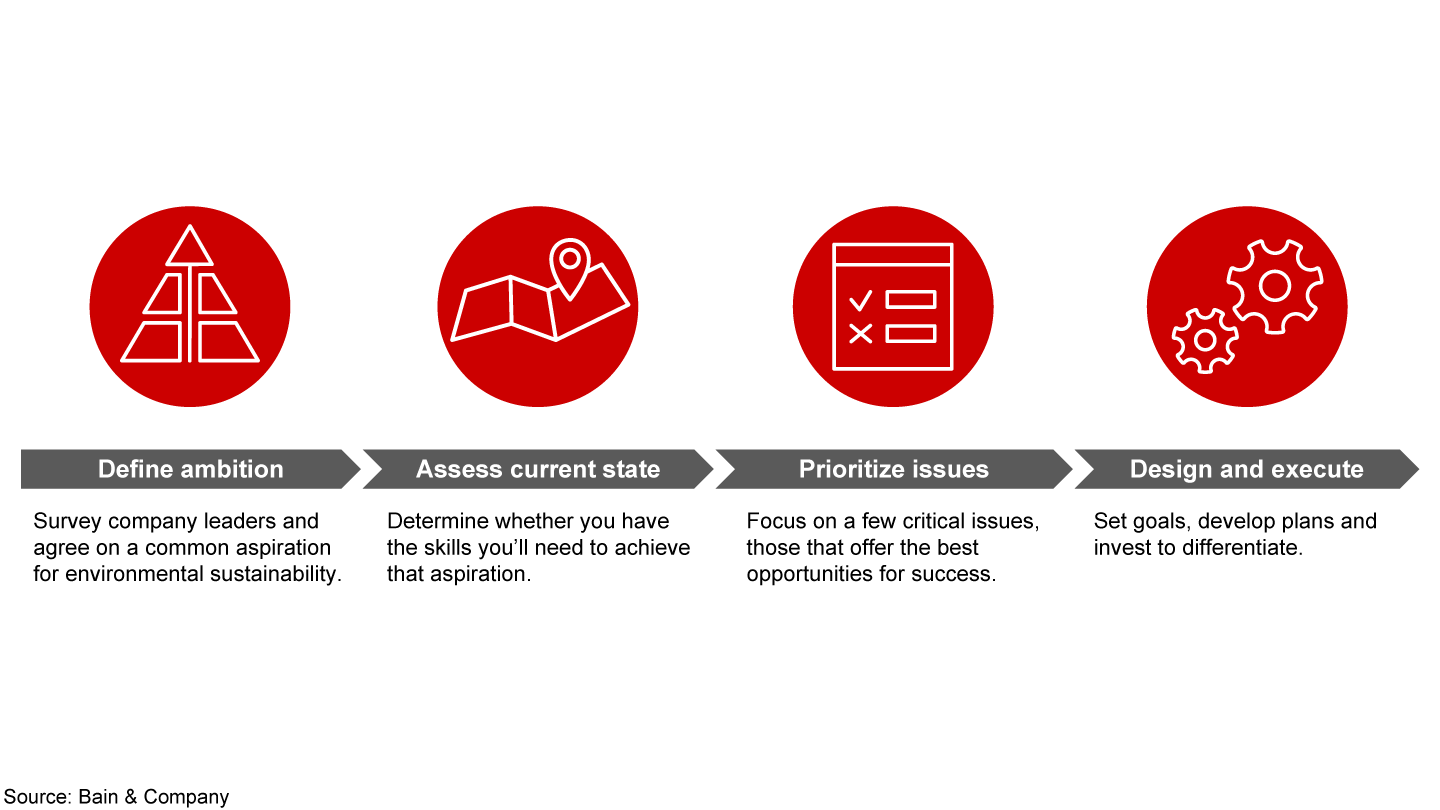
      A structured plan helps executives identify and pursue their best environmental opportunities
      A structured plan helps executives identify and pursue their best environmental opportunities
      A structured plan helps executives identify and pursue their best environmental opportunities

      Several specific steps can help CEOs get started on managing this elusive task.

      • Ensure environmental sustainability receives its own focus. Environmental sustainability joined the corporate agenda as one of a handful of social issues, but for many, it has become more urgent, even existential in some sectors. Identifying it as such forces executives to develop a consensus on what the organization wants to achieve. Do you want to be at the forefront of environmental sustainability, or are you aiming to reduce your impact by some measurable amount? How can you retain your social license to operate over the next decade and beyond? How will your actions position you against competitors?

      • Put a data-driven business leader in charge. Treat environmental sustainability like any other critical issue by assigning it to a leader with a proven track record. This executive should be someone who can make data-based decisions on sustainability in the same way they would make a decision about an investment in a hard asset or acquisition. Among their first tasks: assessing the company’s capabilities to measure and act on environmental issues. This will uncover lost opportunities and identify capabilities that need to be developed.

      • Find the data you need to make smart decisions. Most companies well understand the sustainability issues that receive consistent external scrutiny or that pose an existential threat to their companies. Fewer are aware of how much they can impact their environmental footprint in broader ways, particularly beyond the four walls of their organization. Looking upstream to suppliers and downstream to customers enables companies to develop a holistic heat map of opportunities, and will identify where partnerships are necessary to bring about those changes. One leading natural resources player that was addressing the sustainability of its processing plants was surprised to discover it could achieve greater, faster impact by focusing on targeted improvements in its supply chain. Another discovered a win-win opportunity to help its customers reduce their own carbon profile by using their products more efficiently. By reprioritizing focus, these companies improved their environmental impact more rapidly and cost-effectively than they could have by focusing only on reactive or internal items.

      Nurture persistence

      Communicating a commitment to environmental sustainability is easy and sure to earn praise for any CEO that asserts good intentions. Maintaining focus over time is much harder. Rarely is the topic of greening your business the most urgent issue of the day. Waiting for that day will leave CEOs in a reactive stance.

      As much as any important transformational topic, environmental sustainability requires some structure to make it happen and some forcing functions to keep it moving. Setting up a regular cadence of meetings with the head of environmental sustainability and other senior executives is one way to force prominence and follow-through on the issues. Incorporating the right metrics in a visible business performance dashboard is another.

      Finally, in most companies, the CEO alone has the ability to elevate environmental sustainability as a critical business priority within the company. After all, it’s the CEO whose legacy will be defined in part by the actions taken during their watch. Chief executives who are serious about making an impact must lead from the top, give the issue the time and attention it deserves, and drive the organizational commitment needed to break through business as usual. Successful CEOs don’t wait for external forces to dictate their agenda on other critical business issues. Why should sustainability be any different?

      Dalton Maine and Sasha Duchnowski are partners and Andrew Keech is a principal in Bain & Company’s Global Energy & Natural Resources practice.  All three are based in Chicago.

      Autori
      • Headshot of Dalton Maine
        Dalton Maine
        Partner, Chicago
      • Headshot of Andrew Keech
        Andrew Keech
        Partner, Chicago
      • Headshot of Sasha Duchnowski
        Sasha Duchnowski
        Partner, Chicago
      Contattaci
      Servizi di consulenza collegati
      • Sostenibilità e Corporate Responsibility
      Come possiamo aiutarti
      • Sustainability in Private Equity
      Energia e Risorse Naturali
      Rethinking Energy and Natural Resources for a Net-Zero Carbon Future

      A new model of leadership shows how to address sustainability and emissions issues while retaining support from customers and investors.

      Leggi di più
      Sustainability in Private Equity
      Climate Week NYC 2025: Sustainability Integrates into the Core

      Leaders shift from pledges to practical solutions, revealing how energy, finance, manufacturing, and food systems are turning sustainability into strategy.

      Leggi di più
      Sostenibilità e Corporate Responsibility
      How AI Is Starting to Transform Circular Packaging

      There are 15 AI use cases companies across the value chain can use today to accelerate circularity.

      Leggi di più
      Sustainability in Private Equity
      Sustainability Value Creation

      A framework for driving financial value through sustainability in private markets.

      Leggi di più
      Sostenibilità e Corporate Responsibility
      Exploring AI for Packaging Circularity

      AI is already creating value across the packaging lifecycle, from optimising design and reducing material use to improving sorting and traceability.

      Leggi di più
      First published in marzo 2020
      Tags
      • Sostenibilità e Corporate Responsibility
      • Sustainability in Private Equity

      Come abbiamo aiutato i nostri clienti

      Sostenibilità e Corporate Responsibility Can Microchips Turbocharge Sustainability Improvement?

      Leggi un caso di studio

      Sostenibilità e Corporate Responsibility A Powerful Carbon Accounting Platform Helps IndustrialCo Optimize Its ESG Strategy

      Leggi un caso di studio

      Sostenibilità e Corporate Responsibility How an Asian State-Linked Investment Fund Became a Sustainability Leader

      Leggi un caso di studio

      Vuoi continuare la conversazione?

      Aiutiamo i leader globali e le loro aziende ad affrontare problemi e a cogliere le opportunità. Sosteniamo cambiamenti e otteniamo risultati duraturi.

      Bain Insights. Le nostre idee e punti di vista sulle tematiche che le aziende globali affrontano ogni giorno, arrivano nella tua email tutti i mesi.

      *Ho letto l'Informativa sulla Privacy e accetto i termini e le condizioni.

      Si prega di leggere e accettare l’Informativa sulla Privacy
      Bain & Company
      Contattaci Sustainability Accessibility Condizioni d’uso Privacy Cookie Policy Sitemap Log In

      © 1996-2026 Bain & Company, Inc.

      Contatta Bain

      Come posso aiutarti?

      • Business inquiry
      • Career information
      • Press relations
      • Partnership request
      • Speaker request
      Guarda tutti gli uffici