
Skip to Content
  • Uffici

    Uffici

    Nord e Sud America
    • Atlanta
    • Austin
    • Bogota
    • Boston
    • Buenos Aires
    • Chicago
    • Dallas
    • Denver
    • Houston
    • Los Angeles
    • Mexico City
    • Minneapolis
    • Monterrey
    • Montreal
    • New York
    • Rio de Janeiro
    • San Francisco
    • Santiago
    • São Paulo
    • Seattle
    • Silicon Valley
    • Toronto
    • Washington, DC
    Europa, Medio Oriente e Africa
    • Amsterdam
    • Athens
    • Berlin
    • Brussels
    • Copenhagen
    • Doha
    • Dubai
    • Dusseldorf
    • Frankfurt
    • Helsinki
    • Istanbul
    • Johannesburg
    • Kyiv
    • Lisbon
    • London
    • Madrid
    • Milan
    • Munich
    • Oslo
    • Paris
    • Riyadh
    • Rome
    • Stockholm
    • Vienna
    • Warsaw
    • Zurich
    Asia e Australia
    • Bangkok
    • Beijing
    • Bengaluru
    • Brisbane
    • Ho Chi Minh City
    • Hong Kong
    • Jakarta
    • Kuala Lumpur
    • Manila
    • Melbourne
    • Mumbai
    • New Delhi
    • Perth
    • Seoul
    • Shanghai
    • Singapore
    • Sydney
    • Tokyo
    Guarda tutti gli uffici
  • Alumni
  • Media Center
  • Iscriviti
  • Contattaci
  • Italy | Italiano

    Seleziona il tuo Paese e la tua lingua

    Global
    • Global (English)
    Nord e Sud America
    • Brazil (Português)
    • Argentina (Español)
    • Canada (Français)
    • Chile (Español)
    • Colombia (Español)
    Europa, Medio Oriente e Africa
    • France (Français)
    • DACH Region (Deutsch)
    • Italy (Italiano)
    • Spain (Español)
    • Greece (Elliniká)
    Asia e Australia
    • China (中文版)
    • Korea (한국어)
    • Japan (日本語)
  • Saved items (0)
    Saved items (0)

    You have no saved items.

    Contrassegna il contenuto che ti interessa e verrà salvato qui. Potrai leggerlo o condividerlo in seguito.

    Explore Bain Insights
  • Settori
    Menu principale

    Settori

    • Aerospazio e Difesa
    • Agribusiness
    • Chimica
    • Infrastrutture e Costruzioni
    • Beni di Largo Consumo
    • Servizi Finanziari
    • Sanità
    • Macchinari Industriali
    • Media & Intrattenimento
    • Industria Metallurgica
    • Industria Mineraria
    • Petrolio e Gas
    • Industria Cartaria e Packaging
    • Private Equity
    • Settore Sociale & Pubblico
    • Retail
    • Tecnologia
    • Telecomunicazioni
    • Compagnie Aeree & Trasporti
    • Viaggi e Svago
    • Utility e Rinnovabili
  • Servizi di Consulenza
    Menu principale

    Servizi di Consulenza

    • Customer Experience
    • ESG
    • Innovation
    • M&A and Divestitures
    • Operation
    • People & Organization
    • Private Equity
    • Sales & Marketing
    • Strategia
    • IA, Approfondimenti e Soluzioni
    • Tecnologia
    • Trasformazione
  • Digital
  • Tematiche
  • Informazioni su Bain
    Menu principale

    Informazioni su Bain

    • Che Cosa Facciamo
    • Quello in Cui Crediamo
    • Le Nostre Persone e la Leadership
    • Risultati
    • Premi e Riconoscimenti
    • Organizzazioni Globali
    Further: Our global responsibility
    • Diversità e Inclusione
    • Social Impact
    • Sustainability
    • World Economic Forum
    Learn more about Further
  • Careers
    Menu principale

    Careers

    • Work with Us
      Careers
      Work with Us
      • Find Your Place
      • Our Work Areas
      • Integrated Teams
      • Students
      • Internships & Programs
      • Recruiting Events
    • Life at Bain
      Careers
      Life at Bain
      • Blog: Inside Bain
      • Career Stories
      • Our People
      • Where We Work
      • Supporting Your Growth
      • Affinity Groups
      • Benefits
    • Impact Stories
    • Hiring Process
      Careers
      Hiring Process
      • What to Expect
      • Interviewing
    FIND JOBS
  • Uffici
    Menu principale

    Uffici

    • Nord e Sud America
      Uffici
      Nord e Sud America
      • Atlanta
      • Austin
      • Bogota
      • Boston
      • Buenos Aires
      • Chicago
      • Dallas
      • Denver
      • Houston
      • Los Angeles
      • Mexico City
      • Minneapolis
      • Monterrey
      • Montreal
      • New York
      • Rio de Janeiro
      • San Francisco
      • Santiago
      • São Paulo
      • Seattle
      • Silicon Valley
      • Toronto
      • Washington, DC
    • Europa, Medio Oriente e Africa
      Uffici
      Europa, Medio Oriente e Africa
      • Amsterdam
      • Athens
      • Berlin
      • Brussels
      • Copenhagen
      • Doha
      • Dubai
      • Dusseldorf
      • Frankfurt
      • Helsinki
      • Istanbul
      • Johannesburg
      • Kyiv
      • Lisbon
      • London
      • Madrid
      • Milan
      • Munich
      • Oslo
      • Paris
      • Riyadh
      • Rome
      • Stockholm
      • Vienna
      • Warsaw
      • Zurich
    • Asia e Australia
      Uffici
      Asia e Australia
      • Bangkok
      • Beijing
      • Bengaluru
      • Brisbane
      • Ho Chi Minh City
      • Hong Kong
      • Jakarta
      • Kuala Lumpur
      • Manila
      • Melbourne
      • Mumbai
      • New Delhi
      • Perth
      • Seoul
      • Shanghai
      • Singapore
      • Sydney
      • Tokyo
    Guarda tutti gli uffici
  • Alumni
  • Media Center
  • Iscriviti
  • Contattaci
  • Italy | Italiano
    Menu principale

    Seleziona il tuo Paese e la tua lingua

    • Global
      Seleziona il tuo Paese e la tua lingua
      Global
      • Global (English)
    • Nord e Sud America
      Seleziona il tuo Paese e la tua lingua
      Nord e Sud America
      • Brazil (Português)
      • Argentina (Español)
      • Canada (Français)
      • Chile (Español)
      • Colombia (Español)
    • Europa, Medio Oriente e Africa
      Seleziona il tuo Paese e la tua lingua
      Europa, Medio Oriente e Africa
      • France (Français)
      • DACH Region (Deutsch)
      • Italy (Italiano)
      • Spain (Español)
      • Greece (Elliniká)
    • Asia e Australia
      Seleziona il tuo Paese e la tua lingua
      Asia e Australia
      • China (中文版)
      • Korea (한국어)
      • Japan (日本語)
  • Saved items  (0)
    Menu principale
    Saved items (0)

    You have no saved items.

    Contrassegna il contenuto che ti interessa e verrà salvato qui. Potrai leggerlo o condividerlo in seguito.

    Explore Bain Insights
  • Settori
    • Settori

      • Aerospazio e Difesa
      • Agribusiness
      • Chimica
      • Infrastrutture e Costruzioni
      • Beni di Largo Consumo
      • Servizi Finanziari
      • Sanità
      • Macchinari Industriali
      • Media & Intrattenimento
      • Industria Metallurgica
      • Industria Mineraria
      • Petrolio e Gas
      • Industria Cartaria e Packaging
      • Private Equity
      • Settore Sociale & Pubblico
      • Retail
      • Tecnologia
      • Telecomunicazioni
      • Compagnie Aeree & Trasporti
      • Viaggi e Svago
      • Utility e Rinnovabili
  • Servizi di Consulenza
    • Servizi di Consulenza

      • Customer Experience
      • ESG
      • Innovation
      • M&A and Divestitures
      • Operation
      • People & Organization
      • Private Equity
      • Sales & Marketing
      • Strategia
      • IA, Approfondimenti e Soluzioni
      • Tecnologia
      • Trasformazione
  • Digital
  • Tematiche
  • Informazioni su Bain
    • Informazioni su Bain

      • Che Cosa Facciamo
      • Quello in Cui Crediamo
      • Le Nostre Persone e la Leadership
      • Risultati
      • Premi e Riconoscimenti
      • Organizzazioni Globali
      Further: Our global responsibility
      • Diversità e Inclusione
      • Social Impact
      • Sustainability
      • World Economic Forum
      Learn more about Further
  • Careers
    Ricerche più popolari
    • Agile
    • Digitale
    • Strategia
    La tue ricerche precedenti
      Pagine visitate

      Content added to saved items

      Saved items (0)

      Removed from saved items

      Saved items (0)

      Brief

      Mobile Payments: Finally Ready to Take Off?

      Mobile Payments: Finally Ready to Take Off?

      After a decade of false starts, consumers are finally beginning to use mobile payments. Is your company ready for them?

      Di Steve Bertrand and Karim Ahmad

      • Tempo di lettura min.

      Brief

      Mobile Payments: Finally Ready to Take Off?
      en

      For at least a decade, there’s been something mirage-like about mobile payments: They have always seemed just over the horizon and receding as we think we’re getting closer.

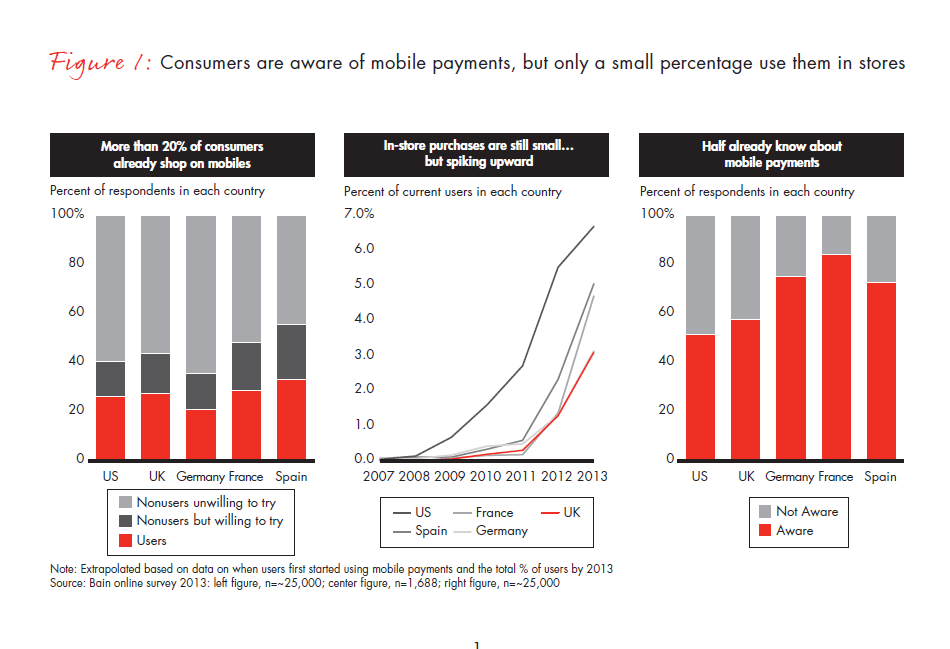
      We think that’s about to change, given an unprecedented rise in the momentum among consumers and investors—providing that the players can overcome the technical and behavioral hurdles that remain. Our recent survey of approximately 25,000 consumers in the US and major Western European markets found that many are already shopping on their mobiles, some are using them for payments and many more expect to do so over the next few years (see Figure 1).

      is-your-company-ready-for-mobile-payments-fig-01_embed

      Start-ups have produced much innovation, but we also see sustained and growing investment from retailers, banks and mobile operators, as well as from top technology players, including Amazon, Apple, Facebook, Google, Microsoft and Samsung. Small pilots are giving way to full national rollouts, as in Spain, where the initial pilot by La Caixa, Telefonica and Visa Europe in the city of Sitges has expanded into a national rollout planned for February 2014, and in the US, where Isis relies on its partnerships with telecom operators to market aggressively to customers when they buy a new handset.

      In-store mobile payments are relatively small today, with only 3% to 7% of consumers using their phones to buy coffee, books or other physical goods in stores. But that number is growing fast: Nearly twice as many consumers started using mobile payments in 2013 as they did in 2012. Another 16% to 27%, depending on the country, say they are willing to try.

      Will consumers change how they buy?

      Notwithstanding this small but significant show of enthusiasm, payment habits remain difficult to change. Most consumers believe the way they pay for things today is good enough—although when nudged they admit to minor annoyances like the many receipts they are left with or the number of steps involved in a card purchase. History suggests they will adopt new forms of financial technology when the benefits become clear, as they did with online and mobile banking. Despite massive investments and hype, a clearer customer benefit remains the missing piece needed to trigger mass adoption of mobile payments.

      Our work looked at how different segments of customers think about mobile payments. For about a quarter of consumers who said they would consider using their mobiles for purchases, the novelty is reason enough to try it. Another segment (13%) is attracted by financial rewards such as discounts, location-based coupons and better loyalty offers. Many in this group are willing to trade their personal data in exchange for better, more relevant offers. Daily deals (like those from Groupon) or mobile coupons (such as those from UK mobile operator consortium Weve) are among the forms taking shape.

      The largest segment, representing about two-thirds of consumers, want more convenience from mobile payments—whether it’s a faster checkout, the ability to see a balance or other benefits. LifeLock’s Lemon app bases its offer on simplifying how users carry and store their many cards and receipts. McDonald’s is testing an app that lets customers order and pay before they reach the store, and pick up their order inside or in the drive-through. And some of the most forward-thinking applications integrate customers’ payment activities with money management and budgeting software, to allow real-time financial management without entering details from receipts.

      Regardless of the specific value proposition, successful mobile payment solutions will have to address consumers’ biggest concerns: security, privacy and convenience. In some markets, speed, ease of use and the ability to choose funding sources are also concerns. In France and Spain, customers like the security of two-step verification (for example, an ID code and a physical chip) because they’re already comfortable with that method for credit card purchases. Addressing these concerns as they develop, deploy and market their mobile payment propositions will be critical to success.

      Can providers overcome barriers?

      Real structural barriers remain in some markets, and these will continue to slow adoption rates. In the US, payment systems and technologies remain fragmented, and any US mobile payment solution is likely to be built on top of the existing credit card networks. The US lags behind other markets in upgrading its point-of-sale terminals to allow them to accept advanced payment technologies, including credit cards with contactless chips or near-field communications (NFC).

      In Germany, on the other hand, consumers rely less on credit cards and more on direct bank transfers. Because of this, any mobile payment system that takes hold in Germany will be different from that in other markets.

      Across markets, retailers will need to upgrade their IT systems if they are to take full advantage of the loyalty and couponing opportunities presented by mobile payments. This could present yet another set of modifications necessary for retailers whose complex IT systems have evolved over the years as multiple layers of new and legacy code. Those with newer systems or who have managed to keep their legacy systems up to date may find it easier to justify the investment than those who are dealing with systems full of spaghetti code. Without the loyalty and other data-based benefits, those who are operating on razor-thin margins will ask why they should accept mobile payments.

      First-mover rewards

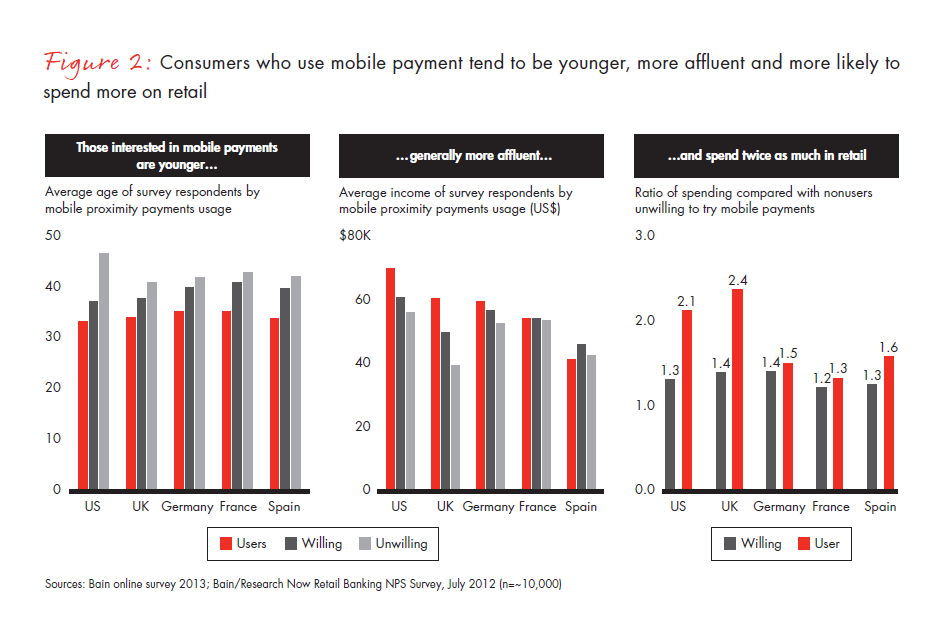
      Despite these barriers, we believe there will be significant advantage for companies that act now to shape their approach, as mobile payments move toward the mainstream over the next three years. Mobile payment users tend to be younger and (in the US, UK and Germany) more affluent than the average consumer. They spend more than twice as much through digital channels and tend to shop more often. Banks and retailers that move quickly will gain the interest and loyalty of the valuable consumers who are the primary early adopters of mobile payments (see Figure 2).

      is-your-company-ready-for-mobile-payments-fig-02_embed

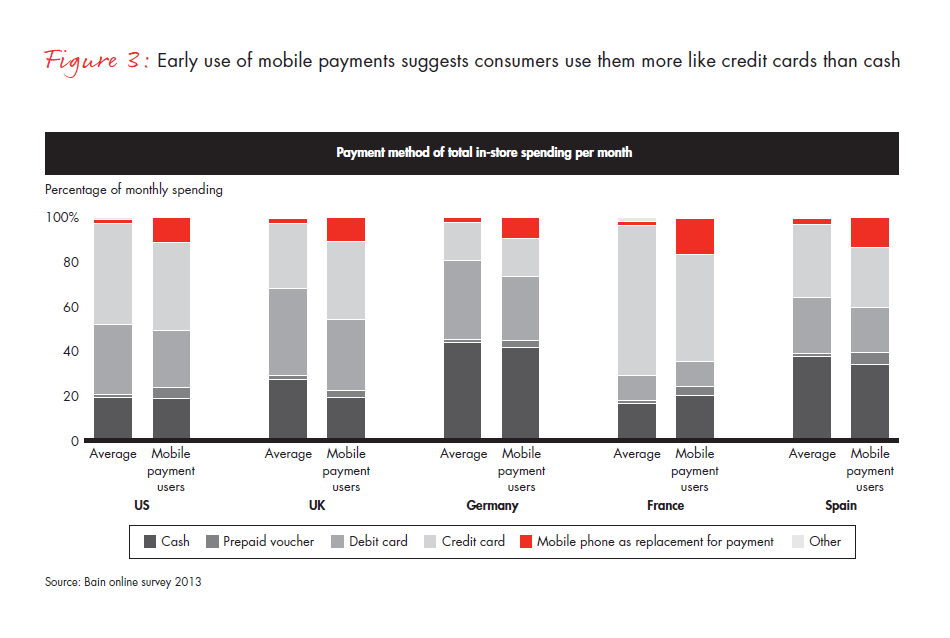
      Early indicators suggest that consumers view and use mobile payments as an extension of credit or debit cards, rather than as a substitute for cash. Since mobile payment systems are likely to depend on the bank card system in many markets, card providers may want to prepare for some payment to shift from plastic to mobile and should view this as just another way their customers use their payment networks (see Figure 3).
      is-your-company-ready-for-mobile-payments-fig-03_embed

      In the markets we surveyed, consumers expect banks to provide their digital wallet, and they trust banks more to do this than they trust other types of companies including retailers, start-ups or related technology providers. Banks and card providers that move too slowly could miss opportunities to build customer loyalty, acquire affluent new customers and hold a coveted spot among the top two apps that customers we surveyed said they were likely to keep on their mobile devices. Some European banks are moving more rapidly than US banks, particularly in France and Spain. Banque Populaire and Caisse d’Epargne (BPCE), for example, introduced the S-money electronic wallet in 2012; it allows customers to transfer money to family, friends and some businesses online and in stores. US banks have taken a more cautious approach, citing the unclear business case and a highly fragmented market with no standard yet.

      For retailers, mobile payments will become a critical part of future strategy. Many are already planning for mobile technology in their future stores. They expect mobile payments to increase customer loyalty by helping to support an omnichannel experience—that is, a unified shopping experience in the store and across digital and mobile channels. Mobile payments should also help them acquire new customers with more targeted and relevant offers based on better data collected from mobile payments. A segment of users, particularly large in France and Spain, say they are open to receiving location-based offers from retailers.

      Why wait?

      While it’s difficult to say with certainty when mobile payments will hit critical mass, these are questions that banks, retailers and others should be asking now:

      • Do you know where your value will come from?
      • Do you have the capabilities to deliver? Which partners will you need to succeed?
      • What’s the risk for continuing to wait, before you embrace the coming wave?
      • Does your company have a plan for making the most of mobile payments?

      Steve Bertrand is a partner with Bain & Company in London, where he leads the firm’s Technology practice for Europe, the Middle East and Africa. Karim Ahmad is a Bain partner in Atlanta.

      The authors would like to acknowledge the contributions of Jayne Zecha, a principal with Bain & Company in London.


      is-your-company-ready-for-mobile-payments-fig-01_full

      is-your-company-ready-for-mobile-payments-fig-02_full

      is-your-company-ready-for-mobile-payments-fig-03_full
      Autori
      • Headshot of Stephen Bertrand
        Stephen Bertrand
        Partner, New York
      Contattaci
      Industry collegate
      • Tecnologia
      Enterprise Technology
      Big Data: la sfida e’ organizzativa
      Leggi di più
      Servizi Finanziari
      Customer Loyalty in Retail Banking: Global Edition 2013

      What it takes to make loyalty pay off.

      Leggi di più
      Tecnologia
      How to Keep Control of an IT System That's Outsourced to Multiple Suppliers

      To master increasingly complex IT, companies are turning to multiple suppliers. But that strategy creates another risk: loss of control over mission-critical functions.

      Leggi di più
      Tecnologia
      Why SaaS Stocks Have Dropped—and What It Signals for Software’s Next Chapter

      A sharp reset in valuations reflects AI-driven disruption, slowing retention, and a growing divide between incumbents and future winners.

      Leggi di più
      Tecnologia
      Software M&A

      The good news: Most deal best practices still apply to AI acquisitions.

      Leggi di più
      First published in febbraio 2014
      Tags
      • Tecnologia

      Come abbiamo aiutato i nostri clienti

      Sostenibilità e Corporate Responsibility Can Microchips Turbocharge Sustainability Improvement?

      Leggi un caso di studio

      Increased sales productivity frees selling time and saves millions

      Leggi un caso di studio

      Aggressively growing an IT service provider with a high-performance culture

      Leggi un caso di studio

      Vuoi continuare la conversazione?

      Aiutiamo i leader globali e le loro aziende ad affrontare problemi e a cogliere le opportunità. Sosteniamo cambiamenti e otteniamo risultati duraturi.

      Bain Insights. Le nostre idee e punti di vista sulle tematiche che le aziende globali affrontano ogni giorno, arrivano nella tua email tutti i mesi.

      *Ho letto l'Informativa sulla Privacy e accetto i termini e le condizioni.

      Si prega di leggere e accettare l’Informativa sulla Privacy
      Bain & Company
      Contattaci Sustainability Accessibility Condizioni d’uso Privacy Cookie Policy Sitemap Log In

      © 1996-2026 Bain & Company, Inc.

      Contatta Bain

      Come posso aiutarti?

      • Business inquiry
      • Career information
      • Press relations
      • Partnership request
      • Speaker request
      Guarda tutti gli uffici