

Brief
Pricing has long been one of the most vexing challenges for consumer goods companies.
Many face ballooning trade rates with collapsing ROIs, volatile commodity prices pressuring gross margins, contentious customer negotiations and sticky retail price points. Now, with mounting evidence that household penetration is the most important factor for growing brands, more consumer goods executives are taking a serious new look at their pricing strategies (see below, “Why penetration matters so much”). They know pricing can be used to increase penetration (defined as the percentage of households in a market buying a particular brand in a given year). The trouble is, they often don’t know the best approach—or even where to start.
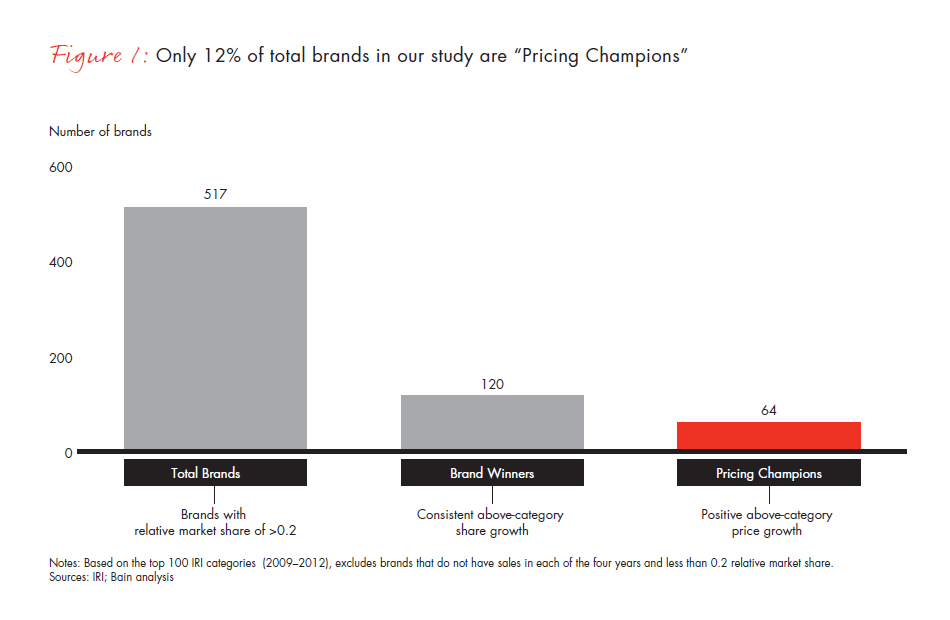
When executives look internally, they often find an organization that seems to be working against itself. At many companies, the key constituents involved in price decisions rarely share a common view of pricing’s role. Finance wants to increase prices to boost top-line growth or profits—and to cover costs and stay ahead of inflation. Sales wants to win share through discounting to retailers. Marketing wants to rely on prices to build brand loyalty, tap into new occasions or fuel marketing investment. With almost zero alignment on the ultimate pricing objective, it’s no wonder so few executives are satisfied with their pricing efforts. In fact, a Bain & Company study found that only 12% of consumer brands have winning price strategies (see Figure 1).
But while many companies struggle with pricing, some are getting it right, systematically relying on price as a tool to increase household penetration and growth. What do they do differently? Our research and experience working with hundreds of clients have helped us see how winners rely on pricing to extend household reach, not narrow it. They take a unified approach: Marketing aims to constantly recruit new households, not just those who seem loyal today. Sales looks to maximize household reach across channel customers, not share within a particular channel. And Finance works to increase total dollar margin to reinvest in reach marketing.
Although the tactics may vary across brand portfolios and companies, successful companies typically tackle pricing across four dimensions:
- Pricing strategy
- Pricing architecture
- Customer and trade execution
- Capabilities
We’ll look at these one by one.
Pricing strategy: Do I go up or down?
The fundamental pricing strategy question is: To maximize household penetration, should I take my average portfolio or brand price up or down? Many believe microeconomic theory dictates that the only way to increase reach is to lower prices. Yet pricing up is almost always better than pricing down in the long run. Extending reach requires innovation and marketing—and you need higher prices to fuel investment in both. Competitors have a much harder time following world-class innovation and marketing than they do lowering prices.
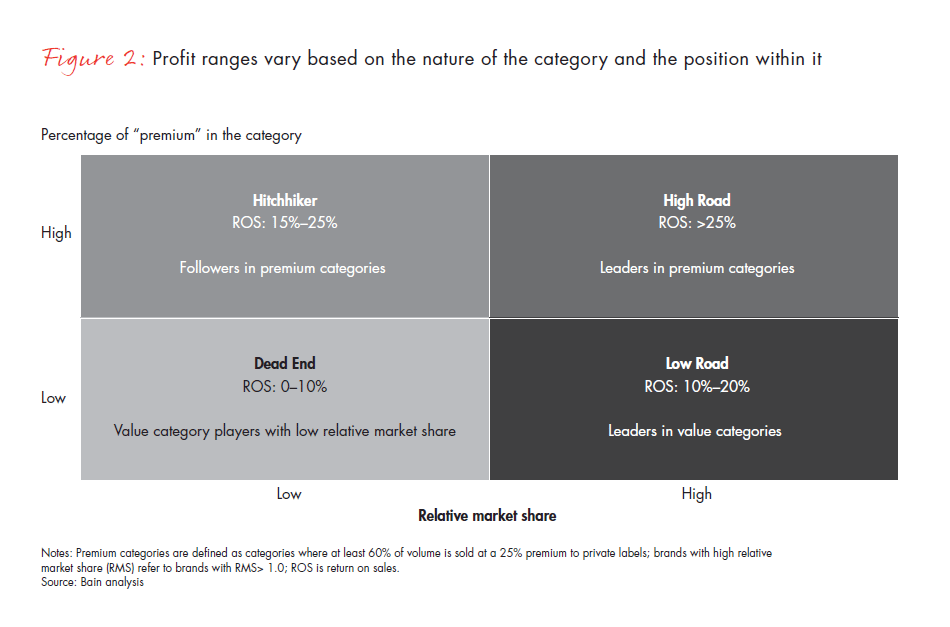
In fact, our groundbreaking research on category profitability determined more than two decades ago—and reconfirmed by follow-up analysis in 2011—the value of gaining share in a category that’s trending premium. The reason: Profits in premium categories are twice those of returns in discount categories (see the Bain Brief “High road–low road, revisited” and Figure 2).
Consider a leading global cosmetics company. For years, the company held its premium prices flat, fearing the price premium (three to four times higher than mass products) was simply too high to attract new consumers. But after a rigorous market analysis, it determined that flat prices were unlikely to attract new households in most markets. Mass consumers were willing to trade up only if they found a product that was dramatically better for them. So, increases in household penetration would come only from breakthroughs in innovation, the in-store experience and heavy advertising. By raising prices, the company was able to dramatically boost its investments in these true contributors to household penetration. Moreover, its competitors quickly followed, limiting share erosion and expanding the pie for all players.
Pricing architecture: When a family pack limits growth
The basic pricing architecture question is this: What will boost incremental household penetration in my category? Having considered the strategic decision to move average portfolio or brand prices up or down, consumer goods companies must also determine if there are too many products competing within a price band or if there are crucial price bands or pack sizes that are underserved. Making that assessment allows them to design new offerings targeted at untapped households.
For years, Oreo cookies introduced a variety of flavors—everything from Double Stuf to Birthday Cake Oreos—but almost always in a relatively consistent family-sized package. Innovations were aimed at creating retail news but failed to attract new households. Brand growth and pricing power stayed relatively anemic until the Oreo team realized that its base pack offering was simply the wrong size: It was too small for large households and too big (and expensive) for small ones. Offering both small and large pack sizes helped unleash a wave of new growth at higher prices. This important move, together with increasing investment in king-size and lunchbox formats, catapulted Oreo into one of the great brand growth stories of the last 10 years.
The lesson: If you have a high number of “in-and-out” innovations that churn without expanding your business, ask whether you really understand incremental consumption at a household level. Determining what’s most likely to unlock incremental households, and then designing a pricing architecture to support it, can unleash considerable growth.
Customer and trade execution: Working with retailers
If effective strategy helps to set the price and pricing architecture helps use pack size to capture new households, then effective customer and trade execution helps to get the price. The trick to getting pricing right with customers is to ask, “How should we change retail prices and the broader retail environment to attract new households?” More often than not, we find sales teams focus more on winning share than on winning new households. While there is an obvious linkage between the two, a share focus can lead companies in the wrong direction. With brand loyalty difficult to achieve in most categories and with more shoppers waiting until they’re in the aisle to choose among competing brands, many companies make the mistake of instinctively turning to temporary pricing. But consider the scourge of Temporary Price Reductions (TPRs), on-shelf discounts that do almost nothing to engage consumers. TPR rates often consume more than 50% of a trade budget and do little to truly move the needle.
We encourage sales teams to think through three layers of questions. What are the fundamental activities required to attract new households: an optimized assortment, feature and display execution, digital and social media, in-store merchandising support? What level of pricing do I need to encourage my retail partner to execute in this new in-store environment? How do I optimize my portfolio of retail accounts, recognizing that not all customers will cooperate?
When they start to answer these questions, most consumer goods executives find the classic trade execution metrics—ROI, pass-through, profitability—are usually insufficient. The problem is tricky because none of those measures serves as a good, long-term predictor of sustainable growth. Yet they are often embedded in the sales culture and important to in-year financial results. So, how do you go about reorienting pricing strategies to support the long-term goal of boosting household penetration? The answer always involves three tactics:
- Winning companies build a compelling category management story for both internal and external consumption that does two things: It avoids such consequences as the pantry loading that occurs through buy-one, get-one-free promotions, and at the same time it attracts new households.
- Winners identify the required in-store real estate and merchandising within and across customers to increase consideration of their products and design strong pay-for-performance programs to capture it.
- Winners use select price increases to fuel the investment required for both of the above.
A leading company in the European beer market recognized that it had a trade investment problem: If it raised prices, it ran the risk of being delisted. If it lowered prices through promotion, competitors would follow them down. Because prices were the same for all players, it was a relatively minor factor in consumer decisions. What this beer company realized was that their promotional investment would be best spent on activities that would grow penetration, in this case by promoting new pack types and occasions.
For its part, Hershey took multiple trade execution steps that expanded penetration. Among them: The chocolate maker developed a successful pay-for-performance trade program that rewarded retailers for activities that delivered incremental sales. It also put more emphasis on in-store and on-shelf placements that would increase consideration among shoppers—the precursor to improving penetration.
Capabilities: Organizing for continual improvement
Most consumer goods executives lament that pricing changes simply don’t stick within their organization. A key reason: It’s one of the few tools available to meet short-term expectations—and that’s how it’s typically used. Also, building solid capabilities requires time and patience. It takes a rigorous effort to attract, train and retain the right talent, and companies need to create a repeatable model to maintain momentum on pricing changes. In our experience, companies see long-lasting results only when they address the organizational barriers holding them back. How can companies manage the challenge? Here are three strategies:
Change incentives. Particularly in Sales, the best companies adjust incentives to reward activities that increase long-term household penetration instead of short-term sales. That could mean rewarding better distribution for core SKUs (versus in-and-out new products), consistent feature and display activity, and minimizing TPR activity. Winners establish a closed feedback loop designed to ensure that pricing decisions ultimately deliver on penetration strategy.
Build a business system that delivers your pricing and penetration strategy. Many companies have business systems (everything from overhead investments to supply chains to IT) that are simply not built to provide what is needed—either because what is needed is not clear or because it changes every year. Some businesses require the ability to deliver innovation, others require packaging flexibility and almost all require better visibility into and oversight of promotional spending. A clear growth and pricing strategy gives executives liberating clarity on the right business system changes to make.
Give pricing a home. Everyone has a stake in pricing but, as we mentioned earlier, there’s rarely integration among Marketing, Sales and Finance. That leads to poor decisions. The typical symptom: tactical, reactive pricing decisions are dominated by Sales, while Marketing and Finance feel frustrated by a lack of transparency and insufficient analysis behind those decisions. We believe pricing deserves a true home, one with a dedicated, cross-functional decision-making body supported by an A-grade general manager. The best companies form a single pricing group to take control of pricing and oversee the necessary changes that will help them use pricing to increase household penetration. It’s a global team, with representatives from each region and brand. In our experience, when companies take this big step of creating such a team, they elevate the science of pricing in the organization.
A global pricing team solves the misalignment—and misdirection—that plagues so many consumer goods companies. With Sales, Marketing and Finance working in tandem toward the same goal, these companies find themselves steadily expanding household penetration. They’ve invested to understand and gain from the power of pricing. Meanwhile, their competitors, who often view pricing and penetration as opposing forces and allow pricing to fall between the organizational cracks, just as steadily lose ground. That’s why we always approach companies with a single question with big implications: Who’s the one executive in the company who owns pricing decisions?
It’s surprising how many companies can’t answer.
Why penetration matters so much
Most consumer goods executives are surprised at just how fundamentally important penetration is to growth (see the Bain Brief “The biggest contributor to brand growth”). Brand plans typically call for increasing a product’s buy rate by tapping into a well-segmented group and getting them to become loyal shoppers who buy larger and larger quantities over time. But across categories and countries, increasing penetration is the primary way to build big brands. This is a key insight from the research of the Ehrenberg-Bass Institute for Marketing Science, summarized by Professor Byron Sharp, director of the Institute, in his book How Brands Grow, based on decades of observations of buying behavior. And evidence from our brand research and analysis of more than 100,000 shoppers around the world, based on data collected by Kantar Worldpanel, shows confirms that penetration is more important than buy rate for growth. In almost every category we examined globally, leaders tend to outperform on penetration, not buy rate.
From our experience, loyalty across categories doesn’t vary significantly over time, but household penetration does. However, penetration is a leaky bucket, and even top brands can experience churn rates of nearly 50%. That’s why winners continually invest to acquire more new consumers every year than they lose.
Despite the overwhelming importance of increasing household penetration, it’s often only tangentially considered in pricing decisions. Historically, many companies have viewed pricing and penetration as opposing forces that need to be carefully balanced. But we’ve found that pricing masters understand that these forces work hand in hand. When done effectively, adding the household penetration lens to both pricing strategy and pricing tactics increases top- and bottom-line returns.
Lee Delaney, a partner in Bain & Company’s Boston office, leads the firm’s Consumer Products practice in the Americas. Andrew Cohen is a partner in Melbourne. Tim Morningstar is a partner in Boston. Odd Erik Hansen is a partner in Copenhagen. All are members of Bain & Company’s Consumer Products practice.
First published in settembre 2014