Skip to Content
  • Uffici

    Uffici

    Nord e Sud America
    • Atlanta
    • Austin
    • Bogota
    • Boston
    • Buenos Aires
    • Chicago
    • Dallas
    • Denver
    • Houston
    • Los Angeles
    • Mexico City
    • Minneapolis
    • Monterrey
    • Montreal
    • New York
    • Rio de Janeiro
    • San Francisco
    • Santiago
    • São Paulo
    • Seattle
    • Silicon Valley
    • Toronto
    • Washington, DC
    Europa, Medio Oriente e Africa
    • Amsterdam
    • Athens
    • Berlin
    • Brussels
    • Copenhagen
    • Doha
    • Dubai
    • Dusseldorf
    • Frankfurt
    • Helsinki
    • Istanbul
    • Johannesburg
    • Kyiv
    • Lisbon
    • London
    • Madrid
    • Milan
    • Munich
    • Oslo
    • Paris
    • Riyadh
    • Rome
    • Stockholm
    • Vienna
    • Warsaw
    • Zurich
    Asia e Australia
    • Bangkok
    • Beijing
    • Bengaluru
    • Brisbane
    • Ho Chi Minh City
    • Hong Kong
    • Jakarta
    • Kuala Lumpur
    • Manila
    • Melbourne
    • Mumbai
    • New Delhi
    • Perth
    • Seoul
    • Shanghai
    • Singapore
    • Sydney
    • Tokyo
    Guarda tutti gli uffici
  • Alumni
  • Media Center
  • Iscriviti
  • Contattaci
  • Italy | Italiano

    Seleziona il tuo Paese e la tua lingua

    Global
    • Global (English)
    Nord e Sud America
    • Brazil (Português)
    • Argentina (Español)
    • Canada (Français)
    • Chile (Español)
    • Colombia (Español)
    Europa, Medio Oriente e Africa
    • France (Français)
    • DACH Region (Deutsch)
    • Italy (Italiano)
    • Spain (Español)
    • Greece (Elliniká)
    Asia e Australia
    • China (中文版)
    • Korea (한국어)
    • Japan (日本語)
  • Saved items (0)
    Saved items (0)

    You have no saved items.

    Contrassegna il contenuto che ti interessa e verrà salvato qui. Potrai leggerlo o condividerlo in seguito.

    Explore Bain Insights
  • Settori
    Menu principale

    Settori

    • Aerospazio e Difesa
    • Agribusiness
    • Chimica
    • Infrastrutture e Costruzioni
    • Beni di Largo Consumo
    • Servizi Finanziari
    • Sanità
    • Macchinari Industriali
    • Media & Intrattenimento
    • Industria Metallurgica
    • Industria Mineraria
    • Petrolio e Gas
    • Industria Cartaria e Packaging
    • Private Equity
    • Settore Sociale & Pubblico
    • Retail
    • Tecnologia
    • Telecomunicazioni
    • Compagnie Aeree & Trasporti
    • Viaggi e Svago
    • Utility e Rinnovabili
  • Servizi di Consulenza
    Menu principale

    Servizi di Consulenza

    • Customer Experience
    • ESG
    • Innovation
    • M&A and Divestitures
    • Operation
    • People & Organization
    • Private Equity
    • Sales & Marketing
    • Strategia
    • IA, Approfondimenti e Soluzioni
    • Tecnologia
    • Trasformazione
  • Digital
  • Tematiche
  • Informazioni su Bain
    Menu principale

    Informazioni su Bain

    • Che Cosa Facciamo
    • Quello in Cui Crediamo
    • Le Nostre Persone e la Leadership
    • Risultati
    • Premi e Riconoscimenti
    • Organizzazioni Globali
    Further: Our global responsibility
    • Diversità e Inclusione
    • Social Impact
    • Sustainability
    • World Economic Forum
    Learn more about Further
  • Careers
    Menu principale

    Careers

    • Work with Us
      Careers
      Work with Us
      • Find Your Place
      • Our Work Areas
      • Integrated Teams
      • Students
      • Internships & Programs
      • Recruiting Events
    • Life at Bain
      Careers
      Life at Bain
      • Blog: Inside Bain
      • Career Stories
      • Our People
      • Where We Work
      • Supporting Your Growth
      • Affinity Groups
      • Benefits
    • Impact Stories
    • Hiring Process
      Careers
      Hiring Process
      • What to Expect
      • Interviewing
    FIND JOBS
  • Uffici
    Menu principale

    Uffici

    • Nord e Sud America
      Uffici
      Nord e Sud America
      • Atlanta
      • Austin
      • Bogota
      • Boston
      • Buenos Aires
      • Chicago
      • Dallas
      • Denver
      • Houston
      • Los Angeles
      • Mexico City
      • Minneapolis
      • Monterrey
      • Montreal
      • New York
      • Rio de Janeiro
      • San Francisco
      • Santiago
      • São Paulo
      • Seattle
      • Silicon Valley
      • Toronto
      • Washington, DC
    • Europa, Medio Oriente e Africa
      Uffici
      Europa, Medio Oriente e Africa
      • Amsterdam
      • Athens
      • Berlin
      • Brussels
      • Copenhagen
      • Doha
      • Dubai
      • Dusseldorf
      • Frankfurt
      • Helsinki
      • Istanbul
      • Johannesburg
      • Kyiv
      • Lisbon
      • London
      • Madrid
      • Milan
      • Munich
      • Oslo
      • Paris
      • Riyadh
      • Rome
      • Stockholm
      • Vienna
      • Warsaw
      • Zurich
    • Asia e Australia
      Uffici
      Asia e Australia
      • Bangkok
      • Beijing
      • Bengaluru
      • Brisbane
      • Ho Chi Minh City
      • Hong Kong
      • Jakarta
      • Kuala Lumpur
      • Manila
      • Melbourne
      • Mumbai
      • New Delhi
      • Perth
      • Seoul
      • Shanghai
      • Singapore
      • Sydney
      • Tokyo
    Guarda tutti gli uffici
  • Alumni
  • Media Center
  • Iscriviti
  • Contattaci
  • Italy | Italiano
    Menu principale

    Seleziona il tuo Paese e la tua lingua

    • Global
      Seleziona il tuo Paese e la tua lingua
      Global
      • Global (English)
    • Nord e Sud America
      Seleziona il tuo Paese e la tua lingua
      Nord e Sud America
      • Brazil (Português)
      • Argentina (Español)
      • Canada (Français)
      • Chile (Español)
      • Colombia (Español)
    • Europa, Medio Oriente e Africa
      Seleziona il tuo Paese e la tua lingua
      Europa, Medio Oriente e Africa
      • France (Français)
      • DACH Region (Deutsch)
      • Italy (Italiano)
      • Spain (Español)
      • Greece (Elliniká)
    • Asia e Australia
      Seleziona il tuo Paese e la tua lingua
      Asia e Australia
      • China (中文版)
      • Korea (한국어)
      • Japan (日本語)
  • Saved items  (0)
    Menu principale
    Saved items (0)

    You have no saved items.

    Contrassegna il contenuto che ti interessa e verrà salvato qui. Potrai leggerlo o condividerlo in seguito.

    Explore Bain Insights
  • Settori
    • Settori

      • Aerospazio e Difesa
      • Agribusiness
      • Chimica
      • Infrastrutture e Costruzioni
      • Beni di Largo Consumo
      • Servizi Finanziari
      • Sanità
      • Macchinari Industriali
      • Media & Intrattenimento
      • Industria Metallurgica
      • Industria Mineraria
      • Petrolio e Gas
      • Industria Cartaria e Packaging
      • Private Equity
      • Settore Sociale & Pubblico
      • Retail
      • Tecnologia
      • Telecomunicazioni
      • Compagnie Aeree & Trasporti
      • Viaggi e Svago
      • Utility e Rinnovabili
  • Servizi di Consulenza
    • Servizi di Consulenza

      • Customer Experience
      • ESG
      • Innovation
      • M&A and Divestitures
      • Operation
      • People & Organization
      • Private Equity
      • Sales & Marketing
      • Strategia
      • IA, Approfondimenti e Soluzioni
      • Tecnologia
      • Trasformazione
  • Digital
  • Tematiche
  • Informazioni su Bain
    • Informazioni su Bain

      • Che Cosa Facciamo
      • Quello in Cui Crediamo
      • Le Nostre Persone e la Leadership
      • Risultati
      • Premi e Riconoscimenti
      • Organizzazioni Globali
      Further: Our global responsibility
      • Diversità e Inclusione
      • Social Impact
      • Sustainability
      • World Economic Forum
      Learn more about Further
  • Careers
    Ricerche più popolari
    • Agile
    • Digitale
    • Strategia
    La tue ricerche precedenti
      Pagine visitate

      Content added to saved items

      Saved items (0)

      Removed from saved items

      Saved items (0)

      Technology Report

      Quantum Computing Moves from Theoretical to Inevitable

      Quantum Computing Moves from Theoretical to Inevitable

      Quantum will likely become part of a mosaic, working with classical computing to solve big problems.

      Di Gabe Dunn, Velu Sinha, Laurent-Pierre Baculard, Syed Ali, e Willy Chang

      • First published on settembre 23, 2025
      • Tempo di lettura min.
      }

      Report

      Quantum Computing Moves from Theoretical to Inevitable
      en
      In evidenza
      • Quantum computing is advancing, with up to $250 billion impact possible. But full potential isn’t guaranteed and may be gradual. 
      • Quantum is poised to augment, not replace, classical computing, each applied where most appropriate to provide solutions.
      • Cybersecurity is the most pressing concern. Deploying post-quantum cryptography (PQC) can protect data from decryption.
      • In industries where quantum hits first, talent gaps and long lead times mean leaders should start planning now.

      This article is part of Bain’s Technology Report 2025

      Explore the report

      Over the past two years, quantum computing has moved closer to practical, real-world applications. Breakthroughs in fidelity, error correction, and scaling qubits (the basic units of quantum computing, like the 0’s and 1’s bits in classical computing) across platforms signal that it’s not a question of if but when.

      Investment is following suit. Tech giants like Alphabet, IBM, and Microsoft are doubling down, while governments are scaling national quantum strategies. And it’s not just computing: Quantum sensing, communication, and annealing (a technique for solving optimization problems) are already at work.

      Given the early state of commercialization, expansive and open-minded approaches are critical for the development of specific types of qubits; the infrastructure necessary to scale and manage quantum components that will run alongside the host classical systems; and algorithms and middleware tools for connecting with data sets and sharing results.

      IBM has taken this broad view, developing several generations of quantum-related technologies over the past 20 to 30 years. The company has generated interest in its quantum computing systems among academic and industrial users, in some cases by supporting solution providers as they explore the market.

      But the field remains open. No single technology or vendor has pulled ahead, and many technical hurdles remain. Experimentation costs have fallen, and companies can now embark on exploring quantum with relatively modest entry costs. The opportunities and uncertainties make preparation and agility key.

      Quantum’s big market potential: Big but uncertain

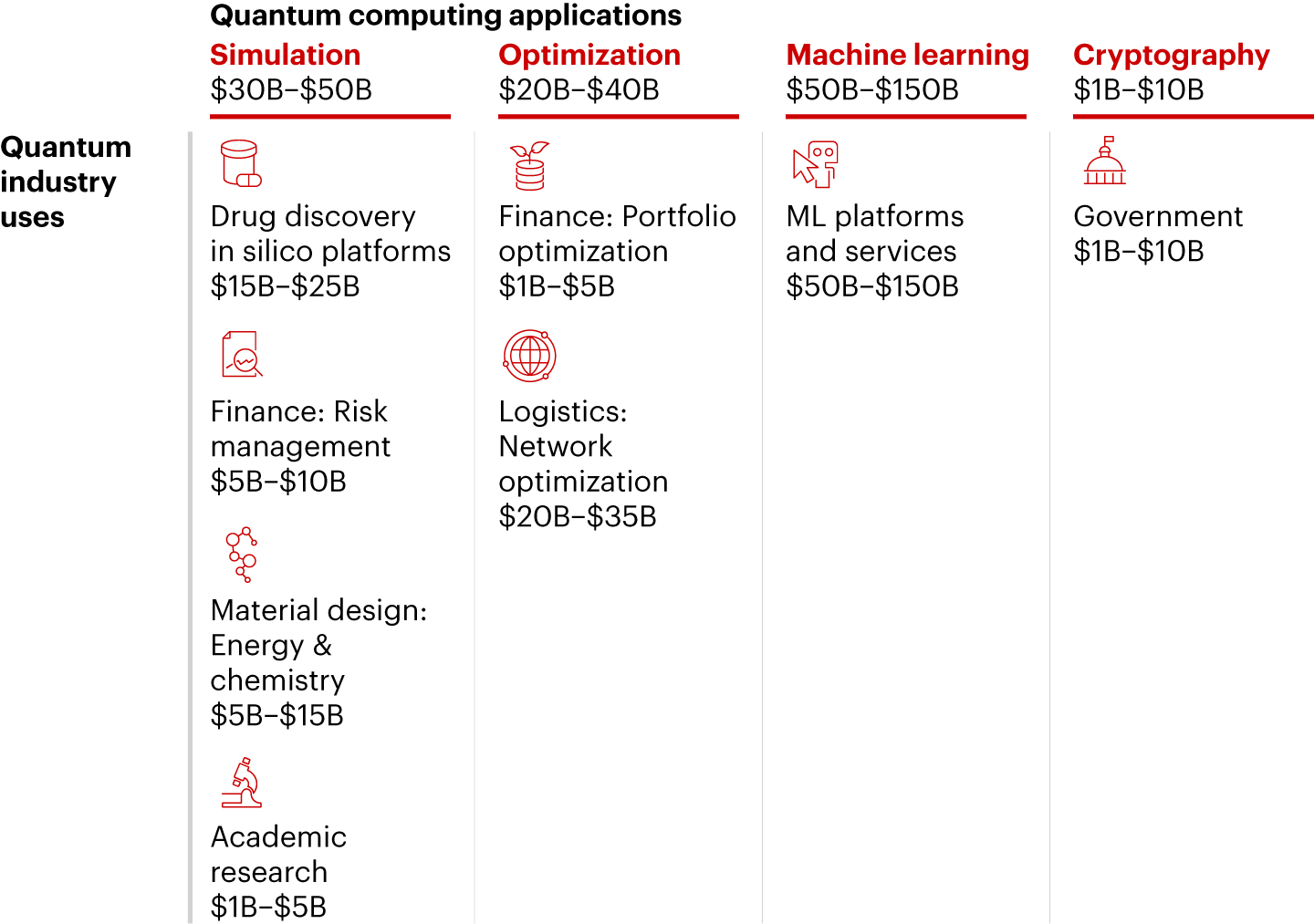
      Quantum could unlock as much as $250 billion of market value across industries like pharmaceuticals, finance, logistics, and materials science (see Figure 1). While the full potential is immense, the pace of progress and extent of realization are uncertain, and many advances will need to be made beyond qubit scaling. To reach full market potential, a fully capable, fault tolerant computer at scale will be needed—and that’s still years away.

      Figure 1
      Quantum computing’s market potential could be between $100 billion and $250 billion
      Fonte: Bain analysis

      At least four major barriers stand in the way:

      • Hardware maturity: Quantum computing faces steep technological hurdles before it can reach full potential, many having to do with the need to convert or hold information in the fragile quantum state. These include physical scaling, fidelity and error correction, coherence times (that is, how long a qubit can retain its quantum state), quantum memory (similarly, the ability to store quantum information reliably over time), data loading (the process of converting traditional data to quantum information), and qubit control bottlenecks (the ability to manipulate qubits without losing fidelity or picking up cross-talk). Although some might hope for a Moore’s law relative to qubit scaling, the nature of quantum devices and the challenges of scaling here are quite different, and their difficulty increases exponentially with qubit count.

      • Algorithm maturity: While quantum computing hardware garners most of the headlines, for many use cases, practical application will require major advances in quantum algorithms (QA). Research is ongoing and major progress has been made in optimizing existing quantum algorithms, but the pace of new QA development has slowed.

      • Quantum machine learning (QML): Over half the projected market value (about $150 billion) sits here, but it’s still mostly theoretical. Key algorithmic and data-loading bottlenecks suggest this could be among the later use cases realized, and the applications for the highest-value machine-learning cases (generative AI, LLMs) remain even more speculative.

      • Practical ROI: Many current quantum targets, including simulation and optimization, are already being tackled with “good enough” classical computing. To justify using quantum computing instead, it would need to deliver real, sustained performance and cost advantages in places where classical computing approaches fall short, even as classical computing continues to advance. 

      Some expect a single “quantum breakthrough,” but we anticipate more of a gradual curve: early wins in narrow domains within five to ten years with broader adoption unfolding over time.

      The market today for quantum computing hardware and services is less than $1 billion a year. Barring a major breakthrough, roadmaps suggest that over the next five to ten years we’ll see initial examples of quantum supremacy—quantum computers outperforming classical approaches in practical and useful applications—although the scope of application will be limited. These earliest practical applications in simulation (for example, metallodrug- and metalloprotein-binding affinity, battery and solar material research, or credit derivative pricing) and optimization (logistics, portfolio analysis) will boost the quantum computing market to between $5 billion and $15 billion by 2035—still a far cry from the $250 billion a fully capable, full-potential quantum computing could unlock.

      Getting ahead means choosing the right pilot use cases and investing in talent and technical readiness now. 

      Cybersecurity: Quantum’s immediate implication 

      The potential for quantum computing to overcome today’s best encryption is real. Although today’s quantum computing can’t break state-of-the-art encryption yet, some malicious organizations have embarked on a strategy of “harvest now, decrypt later,” intending to store sensitive data for five years or more, until the evolution of quantum empowers them to break the encryption.

      Bain’s recent survey on the implications of post-quantum cryptography (PQC) on cybersecurity found that 73% of IT security professionals expect this to be a material risk within five years, and 32% expect it within three years, though some expect it will take longer (see Figure 2). However, even if it takes years for quantum to crack today’s levels of encryption, PQC is becoming a necessity. Still, only 9% of tech leaders surveyed said they have a roadmap in place for dealing with it.

      Figure 2
      Most tech leaders recognize quantum’s cybersecurity risk, but very few have a plan to address it

      Note: The survey population varies by question because respondents were screened out based on certain criteria, ranging from 182 to 226 participants

      Fonte: Bain Post Quantum Cryptography (PQC) Survey, May 2025

      The transition isn’t easy; it requires mapping the company’s cryptographic landscape, updating protocols, and ensuring compliance. Companies will need to update their IT and cyber technology stacks with PQC-enabled solutions. For large or legacy-heavy organizations, this process could take years.

      A future of hybrid solutions

      Quantum computing will not replace classical computing—it will complement it, becoming an important part of a broad mosaic of solutions. Quantum computing will play a targeted role, solving specific problems where classical systems fall short. Quantum computing is likely to replace supercomputing tasks in initial applications, where it won’t compete with high-performance data centers. As it evolves, it’s likely to take on a wider range of activity, but still in a hybrid fashion where it will work with classical computing to form complete solutions. Already, much of the focus is on developing architectures in which quantum and classical computing work well together.

      The future compute stack will be a mosaic, with quantum processors alongside CPUs, GPUs, and other accelerators optimized for specific functions. Winning companies will be those who can knit these together into a unified, high-performing system.

      Symmetrically, the future of analytics will be a mosaic, too: with capabilities ranging from simple regressions to AI, agentic, high-performance compute capabilities and quantum algorithms, each evolving in complementary fashion and directed at specific business problems.

      Mobilize today; lead tomorrow 

      For many companies, the most pressing need is securing data for a post-quantum world. In sectors where quantum is likely to have a near-term impact, developing readiness is more operational than technical. That means defining target use cases, building capabilities, forming partnerships, and scanning for signals in a fast-moving space.

      Working with companies to assess their quantum readiness, we’ve seen it takes three to four years on average to go from awareness to a structured approach that includes a strategic roadmap, an ecosystem of partnerships, and pilot programs. Moving quantum use cases from R&D out to business units and functions, including the time needed to experiment and climb learning curves, can take between six and nine months. This reflects the time needed for mathematical modeling, algorithm tuning, formatting incoming and outgoing data, deployment, interpretation, impact on competitiveness, as well as recruiting and training the right people. The challenge today is navigating between moving too quickly (including overinvesting) in a not-yet-mature technology and moving too slowly, which could leave a company struggling to keep pace with competitors.

      Most companies are still in the early stages. With talent scarce and the learning curve steep, those who move now will shape the quantum landscape later.

      Read the Next Section

      State of the Art of Agentic AI Transformation

      More from the report

      • Tech's Most Valuable

      • Globally Fragmented Tech

      • Tech Investing's New Rules

      • AI Disrupts SaaS

      • AI's Appetite for Compute Power

      • Humanoid Robots

      • Quantum's Potential

      • Agentic AI Transformation

      • AI in Sales

      • Gen AI in Software Development

      • Agentic AI Architecture

      Read our Technology Report 2025

      EXPLORE THE FULL REPORT DOWNLOAD THE PDF
      Autori
      • Headshot of Gabe Dunn
        Gabe Dunn
        Associate Partner, San Francisco
      • Headshot of Velu Sinha
        Velu Sinha
        Partner, Austin
      • Headshot of Laurent-Pierre Baculard
        Laurent-Pierre Baculard
        Partner, Paris
      • Headshot of Syed Ali
        Syed Ali
        Partner, Houston
      • Headshot of Willy Chang
        Willy Chang
        Partner, Singapore
      Contattaci
      Industry collegate
      • Cybersecurity
      • Hardware
      • Tecnologia
      Servizi di consulenza collegati
      • AI, Insights, and Solutions
      • Digital
      • Enterprise Technology
      Come possiamo aiutarti
      • Artificial Intelligence
      Technology Report
      Five Functions Where AI Is Already Delivering

      Spurred on by early success, companies of all sizes are increasing their spending on generative AI.

      Leggi di più
      Technology Report
      How Can We Meet AI’s Insatiable Demand for Compute Power?

      Technological innovation, new revenue, and public support may be needed to fund and supply enough electricity.

      Leggi di più
      Tecnologia
      Humanoid Robots: How Early Commercial Exploration Can Lead to Large-Scale Use

      Although early uses exist, core technologies are years away from offering human-level capability.

      Leggi di più
      Artificial Intelligence Insights
      What Business Leaders Need to Know About AI Sovereignty

      Aligning business strategy with national AI priorities is necessary to compete and scale.

      Leggi di più
      Artificial Intelligence Insights
      Reimagining Merchandising in the Era of Agentic AI

      The future of merchandising is not better analysis, but faster, smarter execution—and agentic AI is what makes that possible.

      Leggi di più
      Tags
      • AI, Insights, and Solutions
      • Artificial Intelligence
      • Artificial Intelligence Insights
      • CIO Insights
      • Cybersecurity
      • Digital
      • Enterprise Technology
      • Hardware
      • Technology Report
      • Tecnologia

      Come abbiamo aiutato i nostri clienti

      How a Data-Driven Mindset Powers McAfee’s Growth

      Leggi un caso di studio

      Helping a Midsize ERP Player Compete against the Giants

      Leggi un caso di studio

      Aggressively growing an IT service provider with a high-performance culture

      Leggi un caso di studio

      Vuoi continuare la conversazione?

      Aiutiamo i leader globali e le loro aziende ad affrontare problemi e a cogliere le opportunità. Sosteniamo cambiamenti e otteniamo risultati duraturi.

      Bain Insights. Le nostre idee e punti di vista sulle tematiche che le aziende globali affrontano ogni giorno, arrivano nella tua email tutti i mesi.

      *Ho letto l'Informativa sulla Privacy e accetto i termini e le condizioni.

      Si prega di leggere e accettare l’Informativa sulla Privacy
      Bain & Company
      Contattaci Sustainability Accessibility Condizioni d’uso Privacy Cookie Policy Sitemap Log In

      © 1996-2026 Bain & Company, Inc.

      Contatta Bain

      Come posso aiutarti?

      • Business inquiry
      • Career information
      • Press relations
      • Partnership request
      • Speaker request
      Guarda tutti gli uffici