
Skip to Content
  • Uffici

    Uffici

    Nord e Sud America
    • Atlanta
    • Austin
    • Bogota
    • Boston
    • Buenos Aires
    • Chicago
    • Dallas
    • Denver
    • Houston
    • Los Angeles
    • Mexico City
    • Minneapolis
    • Monterrey
    • Montreal
    • New York
    • Rio de Janeiro
    • San Francisco
    • Santiago
    • São Paulo
    • Seattle
    • Silicon Valley
    • Toronto
    • Washington, DC
    Europa, Medio Oriente e Africa
    • Amsterdam
    • Athens
    • Berlin
    • Brussels
    • Copenhagen
    • Doha
    • Dubai
    • Dusseldorf
    • Frankfurt
    • Helsinki
    • Istanbul
    • Johannesburg
    • Kyiv
    • Lisbon
    • London
    • Madrid
    • Milan
    • Munich
    • Oslo
    • Paris
    • Riyadh
    • Rome
    • Stockholm
    • Vienna
    • Warsaw
    • Zurich
    Asia e Australia
    • Bangkok
    • Beijing
    • Bengaluru
    • Brisbane
    • Ho Chi Minh City
    • Hong Kong
    • Jakarta
    • Kuala Lumpur
    • Manila
    • Melbourne
    • Mumbai
    • New Delhi
    • Perth
    • Seoul
    • Shanghai
    • Singapore
    • Sydney
    • Tokyo
    Guarda tutti gli uffici
  • Alumni
  • Media Center
  • Iscriviti
  • Contattaci
  • Italy | Italiano

    Seleziona il tuo Paese e la tua lingua

    Global
    • Global (English)
    Nord e Sud America
    • Brazil (Português)
    • Argentina (Español)
    • Canada (Français)
    • Chile (Español)
    • Colombia (Español)
    Europa, Medio Oriente e Africa
    • France (Français)
    • DACH Region (Deutsch)
    • Italy (Italiano)
    • Spain (Español)
    • Greece (Elliniká)
    Asia e Australia
    • China (中文版)
    • Korea (한국어)
    • Japan (日本語)
  • Saved items (0)
    Saved items (0)

    You have no saved items.

    Contrassegna il contenuto che ti interessa e verrà salvato qui. Potrai leggerlo o condividerlo in seguito.

    Explore Bain Insights
  • Settori
    Menu principale

    Settori

    • Aerospazio e Difesa
    • Agribusiness
    • Chimica
    • Infrastrutture e Costruzioni
    • Beni di Largo Consumo
    • Servizi Finanziari
    • Sanità
    • Macchinari Industriali
    • Media & Intrattenimento
    • Industria Metallurgica
    • Industria Mineraria
    • Petrolio e Gas
    • Industria Cartaria e Packaging
    • Private Equity
    • Settore Sociale & Pubblico
    • Retail
    • Tecnologia
    • Telecomunicazioni
    • Compagnie Aeree & Trasporti
    • Viaggi e Svago
    • Utility e Rinnovabili
  • Servizi di Consulenza
    Menu principale

    Servizi di Consulenza

    • Customer Experience
    • ESG
    • Innovation
    • M&A and Divestitures
    • Operation
    • People & Organization
    • Private Equity
    • Sales & Marketing
    • Strategia
    • IA, Approfondimenti e Soluzioni
    • Tecnologia
    • Trasformazione
  • Digital
  • Tematiche
  • Informazioni su Bain
    Menu principale

    Informazioni su Bain

    • Che Cosa Facciamo
    • Quello in Cui Crediamo
    • Le Nostre Persone e la Leadership
    • Risultati
    • Premi e Riconoscimenti
    • Organizzazioni Globali
    Further: Our global responsibility
    • Diversità e Inclusione
    • Social Impact
    • Sustainability
    • World Economic Forum
    Learn more about Further
  • Careers
    Menu principale

    Careers

    • Work with Us
      Careers
      Work with Us
      • Find Your Place
      • Our Work Areas
      • Integrated Teams
      • Students
      • Internships & Programs
      • Recruiting Events
    • Life at Bain
      Careers
      Life at Bain
      • Blog: Inside Bain
      • Career Stories
      • Our People
      • Where We Work
      • Supporting Your Growth
      • Affinity Groups
      • Benefits
    • Impact Stories
    • Hiring Process
      Careers
      Hiring Process
      • What to Expect
      • Interviewing
    FIND JOBS
  • Uffici
    Menu principale

    Uffici

    • Nord e Sud America
      Uffici
      Nord e Sud America
      • Atlanta
      • Austin
      • Bogota
      • Boston
      • Buenos Aires
      • Chicago
      • Dallas
      • Denver
      • Houston
      • Los Angeles
      • Mexico City
      • Minneapolis
      • Monterrey
      • Montreal
      • New York
      • Rio de Janeiro
      • San Francisco
      • Santiago
      • São Paulo
      • Seattle
      • Silicon Valley
      • Toronto
      • Washington, DC
    • Europa, Medio Oriente e Africa
      Uffici
      Europa, Medio Oriente e Africa
      • Amsterdam
      • Athens
      • Berlin
      • Brussels
      • Copenhagen
      • Doha
      • Dubai
      • Dusseldorf
      • Frankfurt
      • Helsinki
      • Istanbul
      • Johannesburg
      • Kyiv
      • Lisbon
      • London
      • Madrid
      • Milan
      • Munich
      • Oslo
      • Paris
      • Riyadh
      • Rome
      • Stockholm
      • Vienna
      • Warsaw
      • Zurich
    • Asia e Australia
      Uffici
      Asia e Australia
      • Bangkok
      • Beijing
      • Bengaluru
      • Brisbane
      • Ho Chi Minh City
      • Hong Kong
      • Jakarta
      • Kuala Lumpur
      • Manila
      • Melbourne
      • Mumbai
      • New Delhi
      • Perth
      • Seoul
      • Shanghai
      • Singapore
      • Sydney
      • Tokyo
    Guarda tutti gli uffici
  • Alumni
  • Media Center
  • Iscriviti
  • Contattaci
  • Italy | Italiano
    Menu principale

    Seleziona il tuo Paese e la tua lingua

    • Global
      Seleziona il tuo Paese e la tua lingua
      Global
      • Global (English)
    • Nord e Sud America
      Seleziona il tuo Paese e la tua lingua
      Nord e Sud America
      • Brazil (Português)
      • Argentina (Español)
      • Canada (Français)
      • Chile (Español)
      • Colombia (Español)
    • Europa, Medio Oriente e Africa
      Seleziona il tuo Paese e la tua lingua
      Europa, Medio Oriente e Africa
      • France (Français)
      • DACH Region (Deutsch)
      • Italy (Italiano)
      • Spain (Español)
      • Greece (Elliniká)
    • Asia e Australia
      Seleziona il tuo Paese e la tua lingua
      Asia e Australia
      • China (中文版)
      • Korea (한국어)
      • Japan (日本語)
  • Saved items  (0)
    Menu principale
    Saved items (0)

    You have no saved items.

    Contrassegna il contenuto che ti interessa e verrà salvato qui. Potrai leggerlo o condividerlo in seguito.

    Explore Bain Insights
  • Settori
    • Settori

      • Aerospazio e Difesa
      • Agribusiness
      • Chimica
      • Infrastrutture e Costruzioni
      • Beni di Largo Consumo
      • Servizi Finanziari
      • Sanità
      • Macchinari Industriali
      • Media & Intrattenimento
      • Industria Metallurgica
      • Industria Mineraria
      • Petrolio e Gas
      • Industria Cartaria e Packaging
      • Private Equity
      • Settore Sociale & Pubblico
      • Retail
      • Tecnologia
      • Telecomunicazioni
      • Compagnie Aeree & Trasporti
      • Viaggi e Svago
      • Utility e Rinnovabili
  • Servizi di Consulenza
    • Servizi di Consulenza

      • Customer Experience
      • ESG
      • Innovation
      • M&A and Divestitures
      • Operation
      • People & Organization
      • Private Equity
      • Sales & Marketing
      • Strategia
      • IA, Approfondimenti e Soluzioni
      • Tecnologia
      • Trasformazione
  • Digital
  • Tematiche
  • Informazioni su Bain
    • Informazioni su Bain

      • Che Cosa Facciamo
      • Quello in Cui Crediamo
      • Le Nostre Persone e la Leadership
      • Risultati
      • Premi e Riconoscimenti
      • Organizzazioni Globali
      Further: Our global responsibility
      • Diversità e Inclusione
      • Social Impact
      • Sustainability
      • World Economic Forum
      Learn more about Further
  • Careers
    Ricerche più popolari
    • Agile
    • Digitale
    • Strategia
    La tue ricerche precedenti
      Pagine visitate

      Content added to saved items

      Saved items (0)

      Removed from saved items

      Saved items (0)

      Brief

      Retail and Gen AI: Now Scale Those Terrific Early Returns

      Retail and Gen AI: Now Scale Those Terrific Early Returns

      Prioritizing families of use cases can accelerate both savings and revenue gains.

      Di Mikey Vu, Kyle Goldman, Louise Keely, Carla Nasr, e François Vayleux

      • Tempo di lettura min.
      }

      Brief

      Retail and Gen AI: Now Scale Those Terrific Early Returns
      en
      In evidenza
      • Generative AI pilot projects have delivered spectacular results, but retailers must now rapidly deploy the new technology at scale to avoid falling behind.
      • Retailers can accelerate their scaling efforts by prioritizing families of use cases, such as those that personalize a shopper’s experience or automate software development.
      • To avoid repeating mistakes made in the Internet’s infancy, retailers must also ensure their generative AI rollouts pass tests in three key areas: change management, democratization, and talent.

      Retailers have had access to generative AI tools for more than a year now—time enough for almost all to see the new technology’s undeniable power. While the speed and scope of experimentation have varied across the industry, most retailers are now convinced that generative AI will rapidly improve productivity, easing the industry-wide pressure on margins through an array of cost savings.

      Some retailers have gone further. Recognizing generative AI’s potential to redefine how people shop, they’ve experimented in areas such as conversational search and personalized apps. The early success of these experiments has bred confidence that generative AI will significantly boost revenues. And that boost won’t just be in the medium term. Enhancements such as SEO-friendly automation of product pages and AI-written summaries of customer reviews are likely to lift sales in the short term.

      The first year of the generative AI era has also caused retailers to think hard about its long-term impact. Some see a reckoning on the horizon, fearing that if they don’t exploit the technology fully, they will be disintermediated. One worry is that big tech companies will muscle in on the early stages of the shopping journey, such as inspiration and curation. Another fear is of being shouldered aside by digital insurgents that are simply faster at implementing generative AI in a compelling way.

      With so much in flux, it’s hard to quantify the longer-term risk—existential or otherwise—posed by these scenarios. However, executive teams don’t need a crystal ball to know that moving from experimentation to scaling should be their strategic priority for generative AI today. That goes for all retailers, no matter how far they got with pilots in 2023 and early 2024.

      Accelerated scaling is vital because shoppers are starting to adopt AI tools at scale in their daily lives, thanks to products such as ChatGPT and Microsoft’s Copilot. Behind-the-scenes AI improvements at early-adopting retailers, such as natural language search and customer review summaries, are also beginning to reshape the act of shopping itself. If retailers don’t soon expand generative AI beyond a few test-and-learn corners of their website or a scattering of internal use cases, they won’t keep up with the transformational benefits the technology will bring to the customer experience as it goes mainstream. Shopper expectations are already rising.

      Retail’s thin margins are another reason scaling is so important. Generative AI–powered productivity enhancements and cost savings could be a game changer for retailers in the vanguard of adoption, boosting their margins and providing fuel to grab share from slower rivals.

      Scaling is never easy, of course. Although the rollout of generative AI will be a lighter lift than many big tech investments, with progress counted in months rather than years, the new technology will profoundly alter the nature of jobs across a wide range of retail functions, which creates a particular scaling challenge. But retailers should be energized by the task. The return on investment for generative AI initiatives is shaping up to be extraordinarily promising. Indeed, if retailers were to rank every investment opportunity across their business in terms of the multiples likely to be returned, scaled generative AI projects would probably monopolize the top 10.

      Getting family-sized benefits from generative AI

      So, how can retailers move from standalone pilots to a more scaled approach to generative AI that will give them an edge in key strategic areas? One powerful approach that’s particularly well suited to retail involves prioritizing families of use cases that share similar objectives and technical foundations. By grouping initiatives like this, retail executive teams can chart a path to productivity and revenue gains that are meaningful at the company level, not just for an individual function.

      Such an approach can accelerate and lower the cost of development (through a greater reliance on reusable modules and methodology) while streamlining maintenance (through updates that cascade down from the master use case). It can also demystify the generative AI journey for the broader organization, give greater visibility to the adoption effort, and make it easier to set up teams to seize both short-term and longer-term opportunities.

      One highly promising family of use cases centers on personalizing the customer experience, including the way a retailer communicates with shoppers. That promise is already starting to be realized by one retailer at the forefront of strategic generative AI adoption. Its early personalization efforts have included an AI-powered conversational shopping assistant that is on track to boost its conversion rate by 7 percentage points or more and is likely to generate additional revenue amounting to 24 times the investment required.

      Our experience advising on generative AI globally suggests that many retailers should be able to increase their revenue by 5% to 10% overall through a suite of personalization initiatives, including shopping assistants like the one mentioned above, enhanced search, and localized shopper recommendations (see Figure 1).


      Figure 1
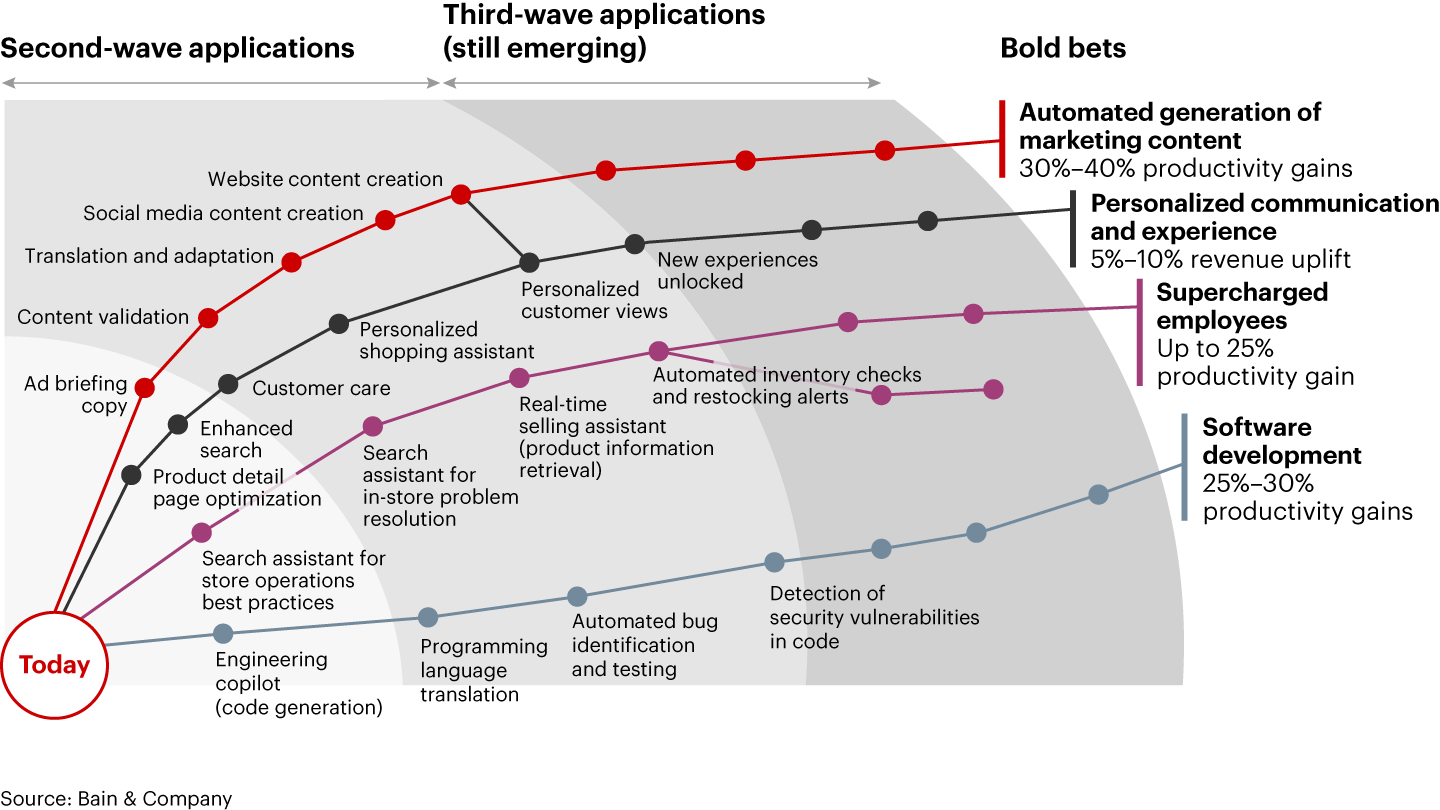
      Retailers can chart a path from early experiments to bold gains by focusing on families of use cases

      Personalization of shopper communication and experience isn’t the only area in which initial experiments by retailers can become bold strategic moves via a focus on use case families.

      Retailers are likely to have experimented already with using generative AI to enhance and streamline their marketing efforts—with promising results. Bigger rewards now lie in store for executive teams that wrap these initiatives into a broader push to automate generation of marketing collateral in areas such as translation and repurposing of content, social media, and the creation of dynamic and personalized landing pages. We estimate that this broader family of use cases can deliver marketing productivity gains of 30% to 40%.

      Retailers can also reap rich productivity gains from a family-based approach in software development. Early experience here has been compelling. For instance, the early-adopting retailer mentioned above has realized 25%–40% productivity gains from a copilot that automates coding tasks, with savings equivalent to more than 50 times the sum invested. A family-of-use-cases approach could extend early gains such as these across a broader canvas and longer time frame.

      There’s another family of use cases that we call “supercharged employees,” spanning generative AI enhancements that reshape the way retail employees work on the front line, in warehouses, and at HQ. Our estimate today is that measures such as these could boost productivity by 5% to 25%.

      Three tests will be key to scaling generative AI

      There are many variables that will determine the ultimate payoff from bold bets on generative AI scaling. From what we’ve seen so far, though, we think the outcomes will particularly depend on whether a retailer can pass three tests.

      The change management test. Just making things faster or cheaper won’t be enough: Jobs need to be entirely redesigned, both on the front line and at the corporate level (see Figure 2). But even as retailers push to realize generative AI’s full potential, they must keep their employees reassured, motivated, and engaged. This will require deft communication and planning, not least because the redesign of work won’t be a one-off. Improvements made now should facilitate future evolution, too.

      Consider the following example. It used to be enough to circulate best practice guidance from the top down, maybe via a clunky PDF. Generative AI allows the same distilled wisdom to be shared in a faster and more conversational way. Yet the real gain will be from using generative AI to keep refining the content, using unstructured input from the field. For instance, the central operations team could interview top sales associates and use generative AI to see how best practices are evolving and how standard operating procedures are keeping up.

      Figure 2
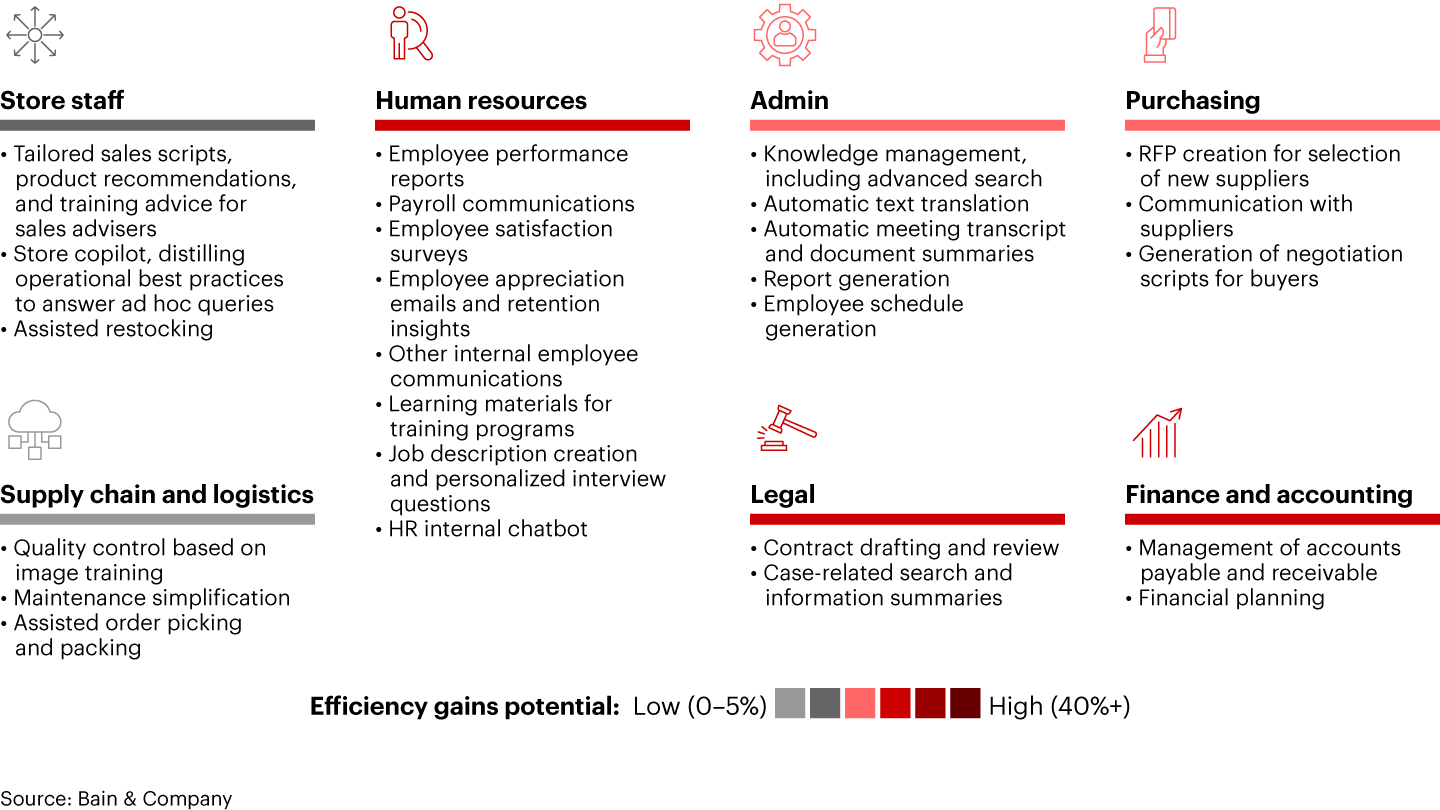
      Generative AI will change how retailers work, both on the front line and at the corporate level

      The democratization test. To move successfully from experimentation to scaled delivery, retailers need to put generative AI tools in the hands of all their employees, not just those in the tech department. At the same time, however, they need to centralize some generative AI–related capabilities to avoid duplication of work and other inefficiencies. Striking the right balance between democratization and centralization is at the heart of this test. For instance, having multiple teams evaluating the reliability of generative AI responses probably isn’t the most streamlined approach; it would be better to build a cross-cutting capability in this area.

      The talent test. Traditional retailers have been upping their digital game, becoming a more credible destination for tech talent, but they are still unlikely to lure elite generative AI engineers. That’s fine. Few companies could pull off that feat in any sector. The real talent test involves upskilling existing employees. One way to pass is to empower a core of early adopters to evangelize and share their experience across the organization. It won’t be a one-off test, either. As best practices in generative AI implementation will often date quickly, retailers must help workers continually update their new skills, both in tech-related roles and across the organization.

      Step back to 1995 for a moment

      Think back to the early days of the Internet three decades ago, when the nascent “information superhighway” was viewed in some quarters as overhyped. Imagine knowing then what we know now about its eventual impact on retail. If they’d had a glimpse of that future transformation, most executive teams in 1995 would have acted very differently, embedding the new technology at the heart of their businesses much faster.

      Generative AI’s impact is likely to be on a similar scale, creating a fresh cohort of winners around the world—it’ll just do it even faster than the web. Over the coming months, there’s a huge opportunity for retailers to invest strategically and be in the vanguard of tomorrow’s AI-assisted pacesetters. It’s time to scale those terrific early returns.

      Autori
      • Headshot of Mikey Vu
        Mikey Vu
        Partner, Austin
      • Headshot of Kyle Goldman
        Kyle Goldman
        Partner, Chicago
      • Headshot of Louise Keely
        Louise Keely
        Alumni, Chicago
      • Headshot of Carla Nasr
        Carla Nasr
        Partner, New York
      • François Vayleux
        Practice Director, Paris
      Contattaci
      Industry collegate
      • Retail
      Servizi di consulenza collegati
      • AI, Insights, and Solutions
      • Digital
      Come possiamo aiutarti
      • Artificial Intelligence
      CIO Insights
      What Should Retailers Do About AI Shoppers?

      Agent-to-agent commerce is here, and the brands that shape it early can determine the future of shopping.

      Leggi di più
      CIO Insights
      Want More Out of Your AI Investments? Think People First

      To unlock AI’s exponential productivity potential, companies must modernize workflow and workforce in tandem.

      Leggi di più
      Retail
      Stay Relevant, Spark Energy: Pedro Arnt, CEO dLocal

      How can a hyperscaler grow at lightning speed without losing its soul? 

      Leggi di più
      Artificial Intelligence
      How Agentic AI Is Reshaping Customer Behavior in Italy and Europe

      As global AI use increases, the challenge lies in ensuring users are appropriately empowered by the technology.

      Leggi di più
      CIO Insights
      Life Sciences’ AI Momentum Requires a Workforce Redesign

      AI scalers aren't waiting for new talent—they're building it.

      Leggi di più
      First published in maggio 2024
      Tags
      • AI, Insights, and Solutions
      • Artificial Intelligence
      • CIO Insights
      • Digital
      • Retail

      Come abbiamo aiutato i nostri clienti

      Inspiring retail employees to think and act like owners

      Leggi un caso di studio

      Retailer's performance improvement boosts shareholder value

      Leggi un caso di studio

      Omnichannel strategy boosts fashion company

      Leggi un caso di studio

      Vuoi continuare la conversazione?

      Aiutiamo i leader globali e le loro aziende ad affrontare problemi e a cogliere le opportunità. Sosteniamo cambiamenti e otteniamo risultati duraturi.

      Bain Insights. Le nostre idee e punti di vista sulle tematiche che le aziende globali affrontano ogni giorno, arrivano nella tua email tutti i mesi.

      *Ho letto l'Informativa sulla Privacy e accetto i termini e le condizioni.

      Si prega di leggere e accettare l’Informativa sulla Privacy
      Bain & Company
      Contattaci Sustainability Accessibility Condizioni d’uso Privacy Cookie Policy Sitemap Log In

      © 1996-2026 Bain & Company, Inc.

      Contatta Bain

      Come posso aiutarti?

      • Business inquiry
      • Career information
      • Press relations
      • Partnership request
      • Speaker request
      Guarda tutti gli uffici