
Skip to Content
  • Uffici

    Uffici

    Nord e Sud America
    • Atlanta
    • Austin
    • Bogota
    • Boston
    • Buenos Aires
    • Chicago
    • Dallas
    • Denver
    • Houston
    • Los Angeles
    • Mexico City
    • Minneapolis
    • Monterrey
    • Montreal
    • New York
    • Rio de Janeiro
    • San Francisco
    • Santiago
    • São Paulo
    • Seattle
    • Silicon Valley
    • Toronto
    • Washington, DC
    Europa, Medio Oriente e Africa
    • Amsterdam
    • Athens
    • Berlin
    • Brussels
    • Copenhagen
    • Doha
    • Dubai
    • Dusseldorf
    • Frankfurt
    • Helsinki
    • Istanbul
    • Johannesburg
    • Kyiv
    • Lisbon
    • London
    • Madrid
    • Milan
    • Munich
    • Oslo
    • Paris
    • Riyadh
    • Rome
    • Stockholm
    • Vienna
    • Warsaw
    • Zurich
    Asia e Australia
    • Bangkok
    • Beijing
    • Bengaluru
    • Brisbane
    • Ho Chi Minh City
    • Hong Kong
    • Jakarta
    • Kuala Lumpur
    • Manila
    • Melbourne
    • Mumbai
    • New Delhi
    • Perth
    • Seoul
    • Shanghai
    • Singapore
    • Sydney
    • Tokyo
    Guarda tutti gli uffici
  • Alumni
  • Media Center
  • Iscriviti
  • Contattaci
  • Italy | Italiano

    Seleziona il tuo Paese e la tua lingua

    Global
    • Global (English)
    Nord e Sud America
    • Brazil (Português)
    • Argentina (Español)
    • Canada (Français)
    • Chile (Español)
    • Colombia (Español)
    Europa, Medio Oriente e Africa
    • France (Français)
    • DACH Region (Deutsch)
    • Italy (Italiano)
    • Spain (Español)
    • Greece (Elliniká)
    Asia e Australia
    • China (中文版)
    • Korea (한국어)
    • Japan (日本語)
  • Saved items (0)
    Saved items (0)

    You have no saved items.

    Contrassegna il contenuto che ti interessa e verrà salvato qui. Potrai leggerlo o condividerlo in seguito.

    Explore Bain Insights
  • Settori
    Menu principale

    Settori

    • Aerospazio e Difesa
    • Agribusiness
    • Chimica
    • Infrastrutture e Costruzioni
    • Beni di Largo Consumo
    • Servizi Finanziari
    • Sanità
    • Macchinari Industriali
    • Media & Intrattenimento
    • Industria Metallurgica
    • Industria Mineraria
    • Petrolio e Gas
    • Industria Cartaria e Packaging
    • Private Equity
    • Settore Sociale & Pubblico
    • Retail
    • Tecnologia
    • Telecomunicazioni
    • Compagnie Aeree & Trasporti
    • Viaggi e Svago
    • Utility e Rinnovabili
  • Servizi di Consulenza
    Menu principale

    Servizi di Consulenza

    • Customer Experience
    • ESG
    • Innovation
    • M&A and Divestitures
    • Operation
    • People & Organization
    • Private Equity
    • Sales & Marketing
    • Strategia
    • IA, Approfondimenti e Soluzioni
    • Tecnologia
    • Trasformazione
  • Digital
  • Tematiche
  • Informazioni su Bain
    Menu principale

    Informazioni su Bain

    • Che Cosa Facciamo
    • Quello in Cui Crediamo
    • Le Nostre Persone e la Leadership
    • Risultati
    • Premi e Riconoscimenti
    • Organizzazioni Globali
    Further: Our global responsibility
    • Diversità e Inclusione
    • Social Impact
    • Sustainability
    • World Economic Forum
    Learn more about Further
  • Careers
    Menu principale

    Careers

    • Work with Us
      Careers
      Work with Us
      • Find Your Place
      • Our Work Areas
      • Integrated Teams
      • Students
      • Internships & Programs
      • Recruiting Events
    • Life at Bain
      Careers
      Life at Bain
      • Blog: Inside Bain
      • Career Stories
      • Our People
      • Where We Work
      • Supporting Your Growth
      • Affinity Groups
      • Benefits
    • Impact Stories
    • Hiring Process
      Careers
      Hiring Process
      • What to Expect
      • Interviewing
    FIND JOBS
  • Uffici
    Menu principale

    Uffici

    • Nord e Sud America
      Uffici
      Nord e Sud America
      • Atlanta
      • Austin
      • Bogota
      • Boston
      • Buenos Aires
      • Chicago
      • Dallas
      • Denver
      • Houston
      • Los Angeles
      • Mexico City
      • Minneapolis
      • Monterrey
      • Montreal
      • New York
      • Rio de Janeiro
      • San Francisco
      • Santiago
      • São Paulo
      • Seattle
      • Silicon Valley
      • Toronto
      • Washington, DC
    • Europa, Medio Oriente e Africa
      Uffici
      Europa, Medio Oriente e Africa
      • Amsterdam
      • Athens
      • Berlin
      • Brussels
      • Copenhagen
      • Doha
      • Dubai
      • Dusseldorf
      • Frankfurt
      • Helsinki
      • Istanbul
      • Johannesburg
      • Kyiv
      • Lisbon
      • London
      • Madrid
      • Milan
      • Munich
      • Oslo
      • Paris
      • Riyadh
      • Rome
      • Stockholm
      • Vienna
      • Warsaw
      • Zurich
    • Asia e Australia
      Uffici
      Asia e Australia
      • Bangkok
      • Beijing
      • Bengaluru
      • Brisbane
      • Ho Chi Minh City
      • Hong Kong
      • Jakarta
      • Kuala Lumpur
      • Manila
      • Melbourne
      • Mumbai
      • New Delhi
      • Perth
      • Seoul
      • Shanghai
      • Singapore
      • Sydney
      • Tokyo
    Guarda tutti gli uffici
  • Alumni
  • Media Center
  • Iscriviti
  • Contattaci
  • Italy | Italiano
    Menu principale

    Seleziona il tuo Paese e la tua lingua

    • Global
      Seleziona il tuo Paese e la tua lingua
      Global
      • Global (English)
    • Nord e Sud America
      Seleziona il tuo Paese e la tua lingua
      Nord e Sud America
      • Brazil (Português)
      • Argentina (Español)
      • Canada (Français)
      • Chile (Español)
      • Colombia (Español)
    • Europa, Medio Oriente e Africa
      Seleziona il tuo Paese e la tua lingua
      Europa, Medio Oriente e Africa
      • France (Français)
      • DACH Region (Deutsch)
      • Italy (Italiano)
      • Spain (Español)
      • Greece (Elliniká)
    • Asia e Australia
      Seleziona il tuo Paese e la tua lingua
      Asia e Australia
      • China (中文版)
      • Korea (한국어)
      • Japan (日本語)
  • Saved items  (0)
    Menu principale
    Saved items (0)

    You have no saved items.

    Contrassegna il contenuto che ti interessa e verrà salvato qui. Potrai leggerlo o condividerlo in seguito.

    Explore Bain Insights
  • Settori
    • Settori

      • Aerospazio e Difesa
      • Agribusiness
      • Chimica
      • Infrastrutture e Costruzioni
      • Beni di Largo Consumo
      • Servizi Finanziari
      • Sanità
      • Macchinari Industriali
      • Media & Intrattenimento
      • Industria Metallurgica
      • Industria Mineraria
      • Petrolio e Gas
      • Industria Cartaria e Packaging
      • Private Equity
      • Settore Sociale & Pubblico
      • Retail
      • Tecnologia
      • Telecomunicazioni
      • Compagnie Aeree & Trasporti
      • Viaggi e Svago
      • Utility e Rinnovabili
  • Servizi di Consulenza
    • Servizi di Consulenza

      • Customer Experience
      • ESG
      • Innovation
      • M&A and Divestitures
      • Operation
      • People & Organization
      • Private Equity
      • Sales & Marketing
      • Strategia
      • IA, Approfondimenti e Soluzioni
      • Tecnologia
      • Trasformazione
  • Digital
  • Tematiche
  • Informazioni su Bain
    • Informazioni su Bain

      • Che Cosa Facciamo
      • Quello in Cui Crediamo
      • Le Nostre Persone e la Leadership
      • Risultati
      • Premi e Riconoscimenti
      • Organizzazioni Globali
      Further: Our global responsibility
      • Diversità e Inclusione
      • Social Impact
      • Sustainability
      • World Economic Forum
      Learn more about Further
  • Careers
    Ricerche più popolari
    • Agile
    • Digitale
    • Strategia
    La tue ricerche precedenti
      Pagine visitate

      Content added to saved items

      Saved items (0)

      Removed from saved items

      Saved items (0)

      Forbes.com

      Shadow Capital Steps into Spotlight in Private Equity

      Shadow Capital Steps into Spotlight in Private Equity

      Shadow capital’s allure lies in the myriad ways it serves the long-term interests of limited partners and general partners alike.

      Di Hugh MacArthur, Graham Elton, Bill Halloran and Suvir Varma

      • Tempo di lettura min.

      Article

      Shadow Capital Steps into Spotlight in Private Equity
      en

      This article originally appeared on Forbes.com.

      Institutional investors have been spreading their wings in recent years, experimenting with new ways to put money to work in private equity (PE) beyond the conventional constraints of being passive partners in PE funds. As we discuss in Bain & Company’s Global Private Equity Report 2015, the emergence of so-called “shadow capital” is generating a lot of buzz in the PE community as industry participants ponder the potentially large part it will play in the evolving relationship between general partners (GPs) and limited partners (LPs) in the future.

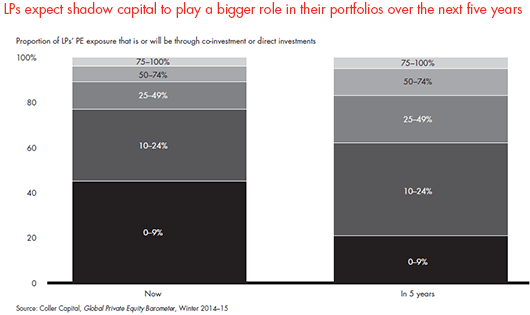
      Shadow capital’s allure lies in the myriad ways it serves the long-term interests of LPs and GPs alike. For LPs, investing outside of the conventional PE fund structure improves their prospects for boosting returns at lower costs. Investing shadow capital also gives LPs greater control over where they put their money to work. By investing actively alongside GPs, LPs are able to develop their own internal capabilities, gain experience in direct investment disciplines and acquire valuable knowledge about industries to which they may not otherwise have access. With all of these positives to recommend it, it is little surprise that LPs expect shadow capital will play an increasingly prominent role in their future investment plans (see figure).

      forbes-pe-report-2015-fig-02-09_embed

      There is also a lot for GPs to like about how shadow capital investments complement their traditional relationships with LPs. In a tough fund-raising environment, GPs can offer the opportunity to co-invest as a sweetener to encourage a current LP to reenlist in a new fund, sign on earlier or commit larger amounts. The large checks they accept to establish separate accounts deepen both GPs’ assets under management and their relationships with LPs. Accepting shadow capital from LPs enables GPs to take on bigger deals without having to form hard-to-manage syndicates with other PE firms that have fallen out of favor.

      Despite the undeniable benefits that shadow capital offers both LPs and GPs, it also has the potential to shake up the PE industry. The focus of much of the discussion today is the risk that more and more shadow capital will end up competing directly against GPs for deals—disintermediating PE firms by making investments that bypass them entirely. A more likely outcome is shadow capital’s potential to chip away at the PE industry’s economics at the margins.

      LPs are exploring four principal alternatives for deploying shadow capital that run along a spectrum from investments they depend on GPs to actively manage for them to those where they exercise greater independence:

      Separate accounts. As they look for efficient ways to rationalize their PE exposure while managing larger investment portfolios, sophisticated LPs are turning to PE firms for help. They are increasingly entrusting firms to oversee the investment of additional assets held in customized accounts that have been set up on their behalf.

      Rather than competing with GPs in their role as PE fund specialists, separate accounts enlarge their responsibility to that of a more general asset manager. Under typical terms of the arrangement, the PE firm is able to tap money it manages in these accounts to invest in buyouts or other predetermined PE categories as opportunities arise.

      To attract that new money, GPs are discounting the prices they charge for their services, reducing fees and carry from the standard “two and twenty.” For many GPs, the trade-off of lower fees in exchange for a larger, steadier volume of assets under management is appealing.

      Co-investments. Accounting for roughly 10% of PE assets under management, co-investing is currently the most common way for LPs to put shadow capital to work. Co-investing appeals to LPs that want to exercise more discretion over where and how their money is deployed, without requiring the deal sourcing, due diligence and portfolio management skills that a seasoned GP would be expected to possess. They also like the no-fee or lower-fee structure that co-investing imposes.

      Co-investing has attracted increased attention in recent years as LPs have gained confidence in the higher returns it can yield. In a recent survey by Preqin, the PE industry data firm, 77% of the LPs said they are now co-investing and more than half said they planned to do more of it in the future.

      But as promising as they look, co-investing programs are difficult to accommodate to everyone’s goals. For their part, GPs cannot make co-investment an option available on every deal or for every LP. Co-investing today is full of gray areas in terms of the promises GPs are prepared to make to LPs. Many are willing to offer it, but the specifics for how or under what circumstances they will be able to follow through are not fully fleshed out. As for LPs, many that are drawn to the idea of co-investing as a good way to proceed lack capabilities needed to process what GPs are offering and end up taking a pass. Still, co-investment seems to be here to stay, because it is yet another way to align the interests of GPs and LPs, even though this application of shadow capital, too, lowers prices and dilutes GPs’ economics.

      Co-sponsorships. A transition to more active investing, co-sponsorships enable institutional investors to put capital to work directly in businesses as equal partners with PE firms. Rather than a rivalry, co-sponsored investments that pair GPs and LPs can be a mutually beneficial division of labor, serving both parties’ interests. GPs gain access to deep pools of cash from sophisticated investors that can add the critical capital to make it possible for a PE fund to win a hotly contested auction. The LP partner gets to leverage and also learn from the expert guidance of a GP partner seasoned in the disciplines of PE due diligence, negotiation and post-acquisition value creation.

      As crucial as an LP’s capital can be to making an acquisition possible, co-sponsorship is still limited to a relatively small number of institutions that have the scale and capabilities to take the leap into more active investing. Co-sponsorships between GPs and LPs during the period between 2009 and 2014 accounted for less than 15% of all deals with a price tag of more than $1 billion. About 60% of these co-sponsorship deals involved just four institutional investors.

      As the GP typically takes the clear lead managing the co-sponsored asset post acquisition, this new type of club investing is better positioned to create value than were the often rancorous GP-only consortium deals of the recent past. But it is still far too early to determine how well co-sponsorships will work out. Just how good the returns are will largely depend on the types of deals the co-sponsors do.

      Solo direct investments. The shadow capital that is most apt to cause GPs to lose sleep is the money in the hands of big LPs investing entirely on their own, independent of PE firms and potentially in direct competition with them. Bain & Company estimates that there may be no more than 100 institutional investors—less than 2% of the overall LP base for PE—that have the heft and the ability to mount direct investment programs, but they command considerable resources. Among leading organizations that have demonstrated an interest in direct investing are big pension funds in Canada and sovereign wealth funds across the Middle East and Asia.

      There are real risks and challenges that any LP contemplating a direct investment program needs to reckon with. To begin with, they need to recreate all of the capabilities and processes a PE firm possesses—from sourcing their own deals and conducting rigorous due diligence to leading robust post-acquisition value-creation plans and managing successful exits. Developing these skills, much less matching the experience that world-class PE firms have attained over years in applying them, takes time and dedication. Above all, it takes top talent to generate the returns that direct investing LPs aim for. Finally, direct investing offers less diversification than committing capital to several PE funds and far more accountability if a direct investment does not pan out, with no GPs to blame for unsatisfactory results.

      The caution practiced by LPs investing directly on their own is evident in the types and sizes of deals they have made to date. Their investments have concentrated in four areas. First, they are cutting their teeth on smaller deals, seldom exceeding $1 billion and tilting toward growth investments, minority stakes or private investments in public equities rather than buyouts. Second, they have been inclined to target low-risk investments in stable companies that have reliable cash flows and strong management teams. Third, they favor deals where they enjoy a home-field advantage, using their information edge to partner with local companies, often in pursuit of regional development programs. Finally, some institutional direct investors, particularly sovereign wealth funds in Asia and the Middle East, pursue deals that are influenced as much by the strategic goals of the sovereign entity on whose behalf they invest—in such areas as financial services, energy, telecom and infrastructure—as by financial outcomes.

      Learning to live in the shadow: Lessons for GPs

      The global superabundance of capital—and the influence of shadow capital on PE investing to which it has given rise—are realities that PE firms will need to accommodate for the foreseeable future. Their ongoing challenge will be to fend off pressure to reduce prices for their services and to find new ways to partner with LPs, which benefit both parties. Their best defense in this battle will be to mount a great offense—simply generate high returns. Top-performing GPs will be able to command the prices they deserve and capture the assets under management they desire.

      Written by Hugh MacArthur, Graham Elton, Bill Halloran and Suvir Varma, leaders of Bain & Company’s Private Equity Group.

      Autori
      • Headshot of Hugh MacArthur
        Hugh MacArthur
        Partner, Boston
      • Headshot of Graham Elton
        Graham Elton
        Chairman, EMEA Private Equity, London
      • Headshot of Bill Halloran
        Bill Halloran
        Advisory Partner, San Francisco
      • Headshot of Suvir Varma
        Suvir Varma
        Advisory Partner, Singapore
      Contattaci
      Industry collegate
      • Private Equity
      Private Equity
      Bain & Company's Global Private Equity Report 2015

      Five building blocks can help private equity firms create value across their portfolio holdings.

      Leggi di più
      Sanità
      Global Healthcare Private Equity Report 2015

      Healthcare continues to be an attractive but challenging area for private equity investment.

      Leggi di più
      Private Equity
      Spotting the Downturn Early and Coming Out Ahead with Gryphon’s David Andrews

      We ask the co-CEO of Gryphon Investors how he spotted one of the harshest cycles in the industry’s history and when he thinks it may finally break.

      Leggi di più
      Private Equity
      What Kind of AI Cycle Are We Actually In?

      The question for investors is not whether AI will boom or bust, but who may be unwittingly subsidizing the buildout.

      Leggi di più
      Private Equity
      Macro Update: What Could Derail 2026?

      Bain’s leading macroeconomic expert examines the cracks beneath the surface of the US market and how investors should prepare for post-globalization realities.

      Leggi di più
      First published in aprile 2015
      Tags
      • Private Equity

      Come abbiamo aiutato i nostri clienti

      Smart Pricing Helped a Private Equity Firm Unlock More Value

      Leggi un caso di studio

      Helping a Healthcare Company Unlock Maximum Value

      Leggi un caso di studio

      Sostenibilità e Corporate Responsibility A Paper Company Takes Bold Steps to Make Sustainability a Source of Profits

      Leggi un caso di studio

      Vuoi continuare la conversazione?

      Aiutiamo i leader globali e le loro aziende ad affrontare problemi e a cogliere le opportunità. Sosteniamo cambiamenti e otteniamo risultati duraturi.

      Bain Insights. Le nostre idee e punti di vista sulle tematiche che le aziende globali affrontano ogni giorno, arrivano nella tua email tutti i mesi.

      *Ho letto l'Informativa sulla Privacy e accetto i termini e le condizioni.

      Si prega di leggere e accettare l’Informativa sulla Privacy
      Bain & Company
      Contattaci Sustainability Accessibility Condizioni d’uso Privacy Cookie Policy Sitemap Log In

      © 1996-2026 Bain & Company, Inc.

      Contatta Bain

      Come posso aiutarti?

      • Business inquiry
      • Career information
      • Press relations
      • Partnership request
      • Speaker request
      Guarda tutti gli uffici