

Global Private Equity Report

In evidenza
- Let’s face it, strategy has never been front and center for most private equity firms.
- But as the industry matures, several emerging structural changes are intensifying the competition for deals and capital in ways that demand strategic attention.
- The firms poised to lead have defined a clear ambition for where they want to compete amid these changes and a bold, actionable strategy to get there.
This article is part of Bain’s 2025 Global Private Equity Report
When private equity emerged on the financial scene just four decades ago, it was a smallish collection of founder-led firms hustling to do leveraged buyouts. Firm strategy, such as it was, often boiled down to sourcing the next deal and maximizing leverage.
Then came the global financial crisis and the necessity to articulate a clear, repeatable model for delivering returns that didn’t rely so heavily on financial engineering.
That focused firms on something that looked a lot like strategic planning—until the market took off again. Rock-bottom interest rates, steady economic growth, and better-than-expected liquidity from precrisis deals produced an explosion of dealmaking that demanded firms’ full attention. As capital poured into the industry and asset valuations surged, simply riding the wave became the best strategy for many general partners (GPs).
Why the history lesson? As the industry emerges from this most recent down period, it’s tempting to assume the next wave of growth will look a lot like the last one: Dealmaking will accelerate, distributions will follow, limited partners (LPs) will loosen their purse strings, and the music will start all over again.
But that rosy scenario ignores a growing body of evidence suggesting that the next 10 years will look significantly different from the last 15—an era buttressed by a zero-interest-rate policy and multiple expansion. As fund managers were heads down doing deals, the industry was undergoing a series of shifts that will have major implications for how private equity firms compete for deals, raise capital, and attract talent in the future. To thrive amid these changes, firms will need a level of strategic focus and discipline that few of them are used to.
Consider several of the key disruptions every private equity firm will have to grapple with in the coming decade, in addition to a more volatile macro environment created by higher interest rates and other factors.
Margins have been (and will continue to be) compressed
Although the “2 and 20” fee structure (2% management fee, 20% carry) is still the typical “rack rate” for PE funds, private markets are experiencing meaningful fee pressure. Increasingly, fierce competition for capital often results in quiet fee concessions, while the growing trend toward fee-free coinvestment exerts even more downward pressure on firm economics.
Every situation is different, but a combination of these two factors has already reduced average net management fees by as much as half since the global financial crisis, according to a Bain & Company analysis of available data. While the impact varies widely across firms and asset classes, the direction of travel is clear.
The growing convergence of private and public markets could only add to the pressure. Traditional wealth managers like Vanguard, Franklin Templeton, and Capital Group are in a race to create access to alternative investments for retail clients who seek diversification from increasingly tech-inflected public markets and better risk-adjusted returns. Alternatives players like Blackstone, StepStone, HarbourVest, and Hamilton Lane are responding with products designed to give wealthy individual investors access to private markets at reduced fees.
Convergence raises the prospect of something entirely new for private capital: the proliferation of very large firms that charge lower fees for simply tracking the market (beta) vs. trying to beat it (alpha). Traditional wealth managers set the lowest possible cost for everything, which is why fees in that space have declined more than 2 basis points per year over the past 30 years, on average, cutting open-end mutual fund and ETF fees by over half (see Figure 1). The question for alternatives managers is whether, or how soon, a similar pattern will emerge in private markets as retail capital pours in.
Figure 1
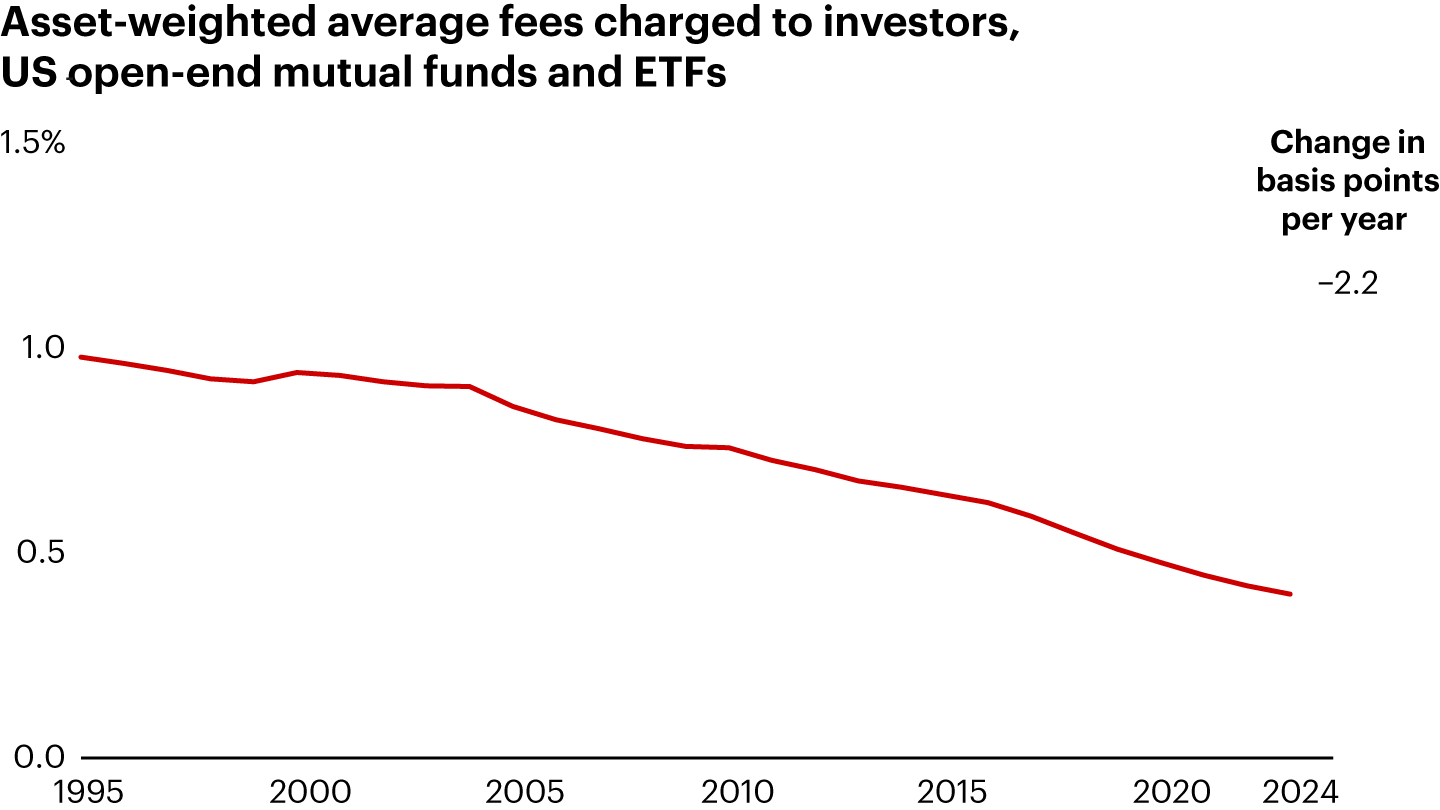

What we know right now is that pressure on fees is coming at a time when PE firms can least afford it. Without the benefit of low interest rates and rising valuations, generating returns comes down to actually improving the performance of portfolio companies. That can involve significant capability investments at both the fund level and within each portfolio company. Adding talent, beefing up data and analytics competencies, getting up to speed on generative AI—all of that is expensive. Firms that aren’t planning for a future of tighter economics risk being caught out as the pressure increases.
Fund-raising is hard and getting harder
While the current environment for private equity fund-raising is difficult, conditions will doubtless improve somewhat as dealmaking recovers and cash starts flowing back to investors. But as we discuss more fully in the first section of our annual report, fund-raising is turning into a game of haves and have-nots, with the preponderance of capital flowing to the largest, most established funds or those with the strongest track records.
Winning in this environment demands both a clearly articulated value proposition and a means to communicate it. Among other things, that requires a professionalized investor relations capability that looks more like a first-class B2B sales organization than the “lunch and a handshake” approach of years gone by.
At the same time, sources of new capital are very much in flux. While private equity’s traditional capital base (anchored by large institutions) will continue to expand over the next decade, two large sources will significantly outpace others: private wealth and sovereign wealth funds (SWFs). Bain estimates that these deep pools of capital will together account for approximately 60% of growth in alternative assets under management (AUM) over the next decade (see Figure 2). The requirements to tap that growth will likely look very different from what most GPs are doing today.
Figure 2
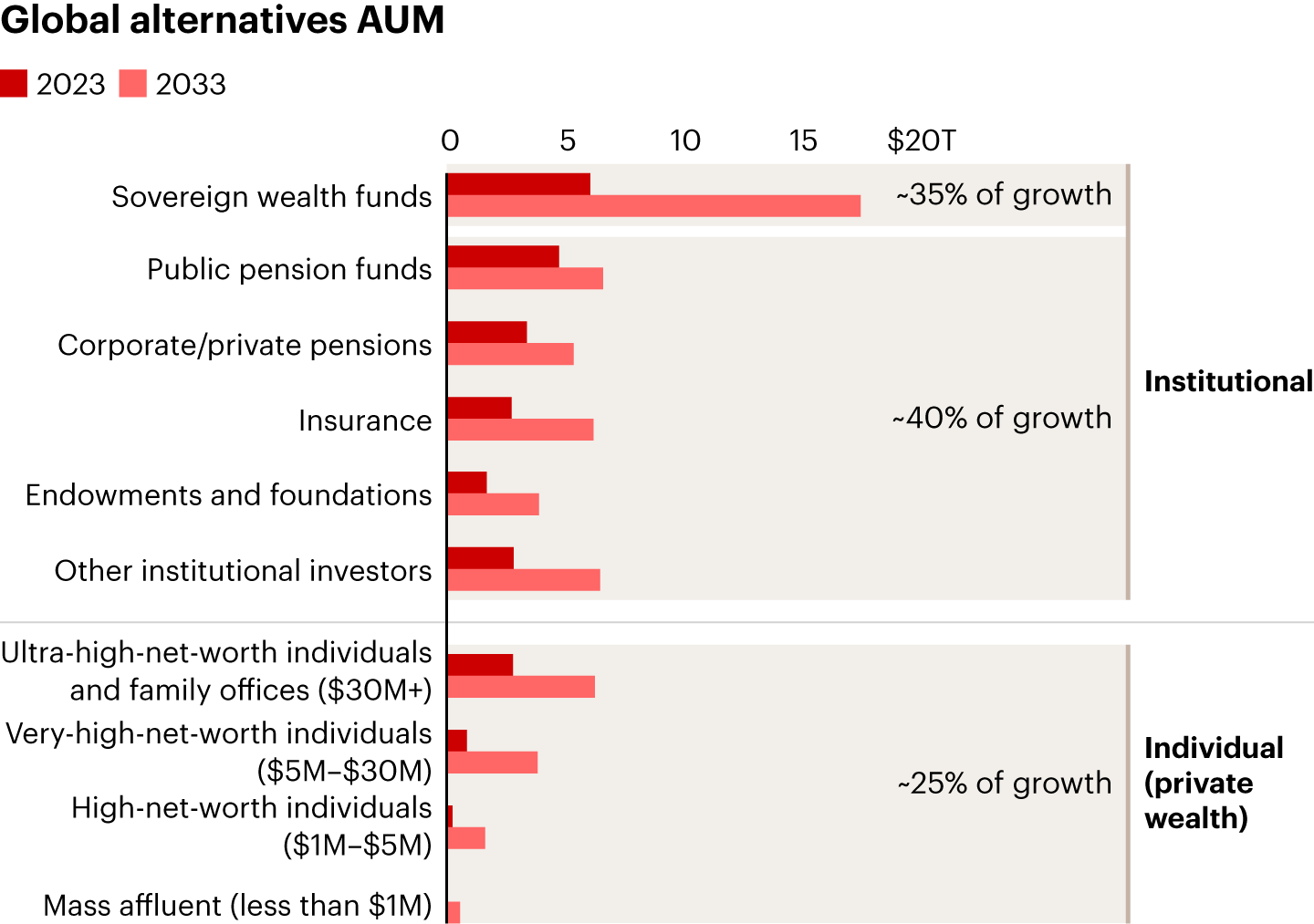

Note: Other institutional investors include investment banks and various small investor groups (private equity, real assets, hedge funds, infrastructure, etc.)
Fonte: Bain analysisThe appeal of private wealth is simple. Individual investors hold roughly 50% of global capital. Yet those same investors represent just 16% of AUM in alternative investment funds.
Alternatives firms seeking to boost that percentage are in a race to get their products on the shelves of channel partners like private banks, wirehouses, and registered investment advisers. Real estate and private credit funds have led the charge with retail-oriented products, but private equity is catching up fast with semiliquid products that have lower minimums and are aimed at investors who need more liquidity than institutional investors (see Figure 3). In 2024, Blackstone alone saw $23 billion flow into its set of semiliquid products aimed at retail investors.
Figure 3
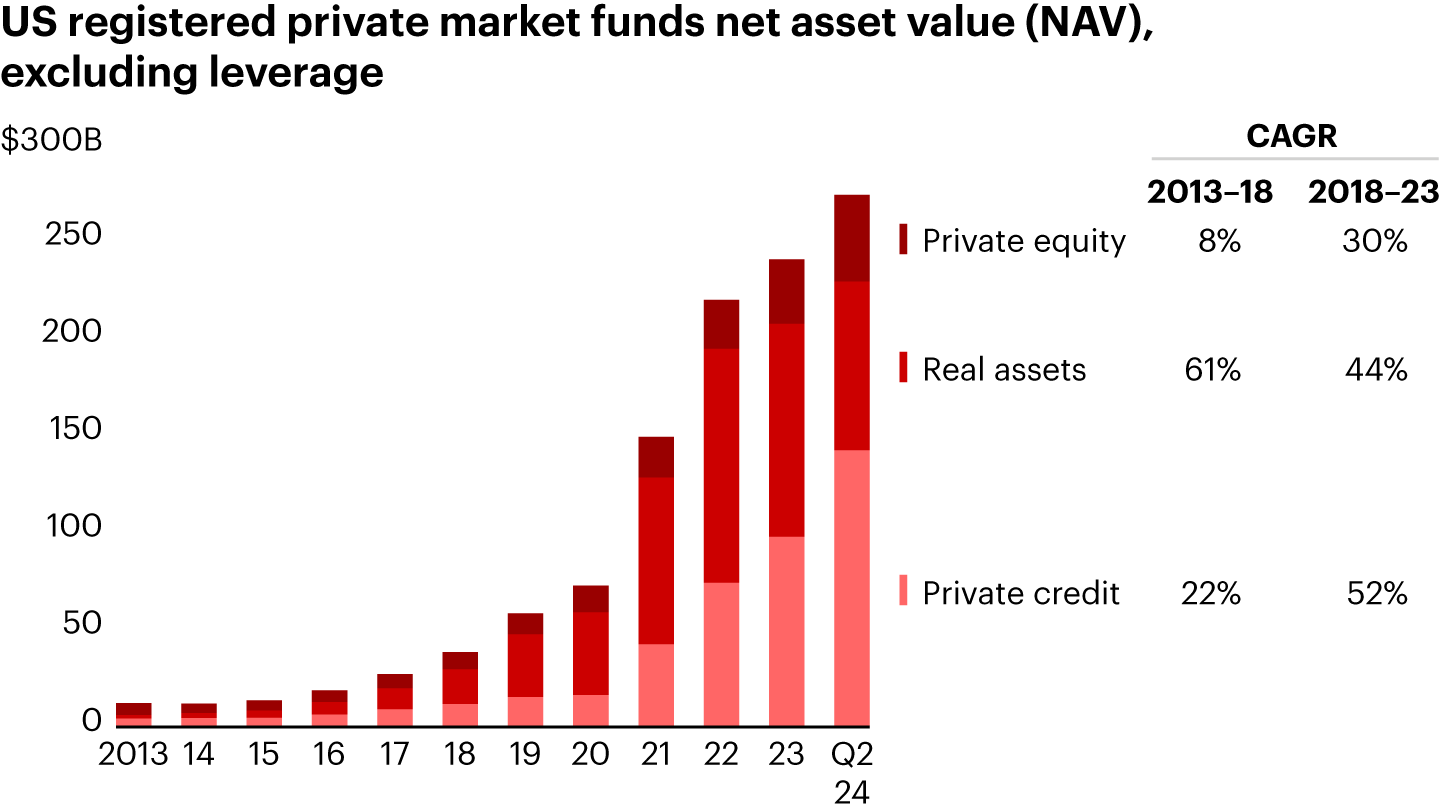

Appunti: Excludes private and finite nontraded BDCs and finite nontraded REITs; NAV for BXPE and K-PEC as of Q3 2024; NAV for nontraded REITs calculated by multiplying shareholders’ equity (SE) by a NAV/SE ratio of 1.35; ratio calculated using the average fraction of SE relative to NAV for two representative funds (BREIT and Starwood REIT)
Sources: Company websites; Internal Fund Tracker; Tender Offer Funds; Bain analysisFirms also are investing heavily in private wealth teams to provide frontline coverage, sales support, and investor services, which is creating a war for talent. At the same time, they have struck partnerships with, or been acquired by, large traditional asset managers offering vast distribution. Alliances between firms like KKR and Capital Group, Apollo and State Street, or Partners Group and BlackRock are aimed at giving wealthy individuals ready access to the diversification and superior returns generated by alternative capital.
Sovereign wealth funds, meanwhile, are transforming private capital’s supply side. SWFs in aggregate already control investment capital worth $6 trillion, and Bain projects that total will grow 11% annually over the next decade to $17 trillion. State-based institutions ADIA in Abu Dhabi and GIC in Singapore have each grown their exposure to alternatives by more than 10% annually over the past decade and have seen their alternatives programs grow to over $360 billion and nearly $250 billion, respectively.
These are massive pools of capital, which means that if SWFs want to move the needle, they necessarily have to focus on partnering and coinvesting with the largest funds in the market. It’s impossible to predict how the growth of SWFs will ultimately reshape the industry’s capital flows. But as these giants grow in sophistication and build new capabilities, they are becoming much more than the passive investors of the past. This will present threats and opportunities across the alternatives landscape that every fund will need to think through.
Scale is only becoming more important
For many years in private equity, a well-run, smallish firm could be just as effective as a big one at raising capital and using it to generate strong returns. Everybody could earn substantial fees; margins were strong for funds of all sizes. Today, however, that balance is shifting. As the industry matures, it is moving to a place where larger firms have measurable advantages.
We’ve already discussed how capital formation is turning into a scale game. But size can also offer firms advantages in how efficiently they operate, how they make investment decisions, and how they build firm assets.
Back-office functions like accounting, finance, tax, IT, and HR all benefit from scale. Bigger firms also have more resources to build investment capabilities and deploy them across portfolios. They can assemble deeper teams of sector specialists or those devoted to creating value from AI and other new technologies. They can invest more in the data and analytics capabilities that are becoming increasingly valuable in underwriting value and gaining differentiated insights.
At the same time, size can offer something less tangible—institutional stability. Larger firms are less reliant on just one fund series, they have less key person risk, and they can more easily build a brand and reputation that resonates broadly. That attracts the best talent and builds the most staying power.
None of this is to say that scale is the be all, end all. In fact, the evidence is mixed at best that increased size translates directly into stronger returns or more efficient operations. Simply spending on AI or data science is no substitute for rigorous due diligence, for instance. Actually capturing cost benefits requires skill at streamlining processes and rationalizing the organization. It depends on proactively managing business complexity, which tends to grow exponentially with firm size and scope. The firms that get it right start with a clearly differentiated model for creating value, which in turn guides where it pays to cut costs. Then it’s essential to use those savings to invest in finding and diligencing great investment opportunities and converting them into winning deals.
The myriad challenges of managing growth, in fact, are why many firms will never aspire to true scale. And indeed, there will always be room in private equity for smaller, differentiated firms that can reliably generate alpha. Capital used to be the scarcest commodity; now it’s ideas. Today’s winners are the firms that know where to find value that others miss and mitigate risks that others cannot, and do it in a repeatable way.
The best of these firms, however, recognize that staying smaller carries its own set of demands. It requires drawing an even sharper definition of what makes the firm stand out and doing whatever it takes at every step of the private equity value chain to generate market-beating returns. Targeted investment in the right capabilities is even more critical. So is pulling every lever, every time to ensure your funds are exceptional, since one or two average vintages will render your firm invisible next time you hit the road to raise capital.
True differentiation is a nonnegotiable for firms of any size and can make a smaller firm loom larger in the eyes of LPs. But as the industry expands beyond its roots, one thing is certain: Competing without scale benefits has never been harder.
Strategic M&A has arrived
As scale becomes more and more important, so does the prospect of growing inorganically.
Merger and acquisition activity has been largely a nonstarter in private equity over the years. Most firms lacked the balance sheet to fund acquisitions that would expand their geographical footprint or add a new asset class. Those that did very often foundered on the integration complexity that arises when private partnerships try to combine.
But that’s changing fast. M&A within the alternatives industry has accelerated meaningfully in recent years, with over 180 transactions since 2021 (see Figure 4).
Figure 4
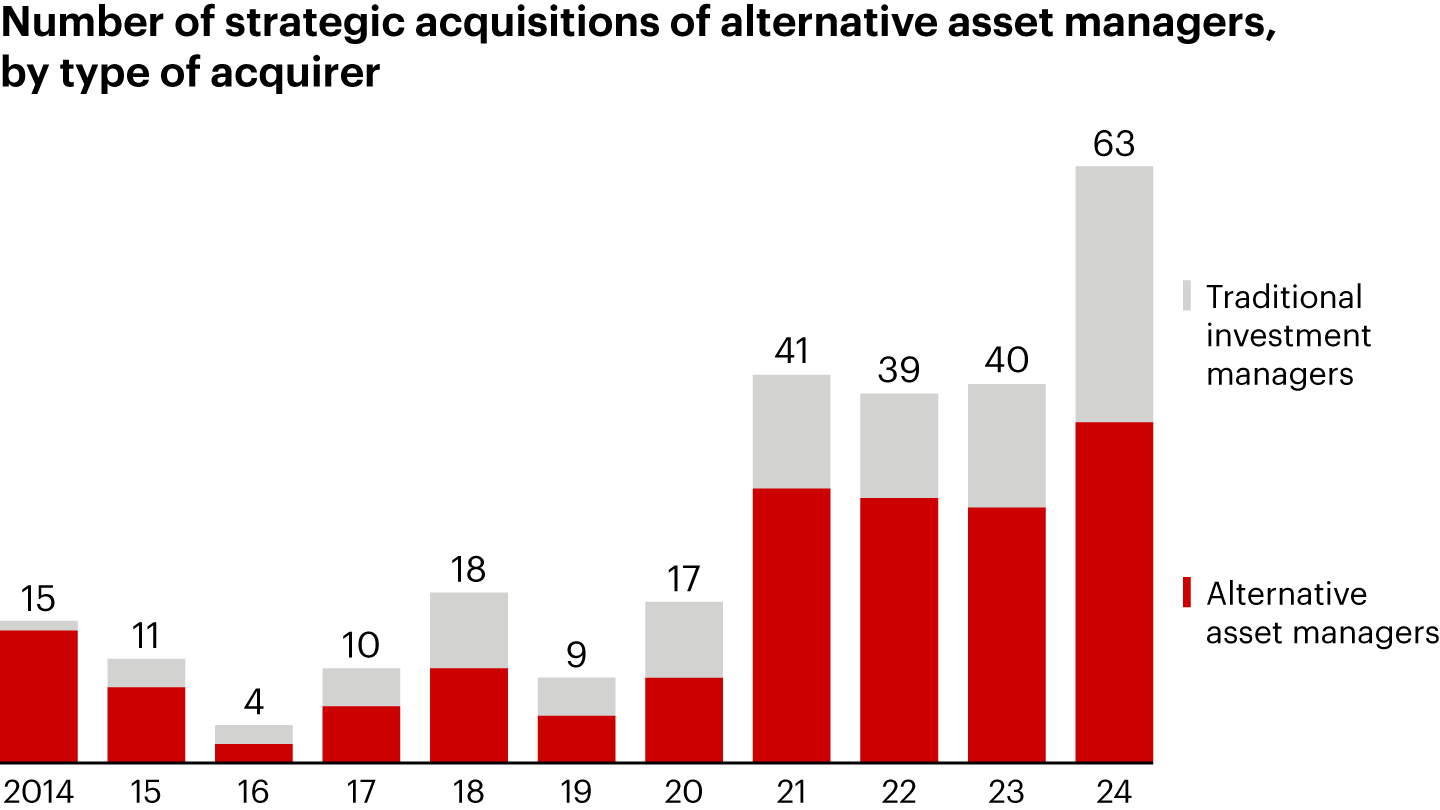

Appunti: Includes publicly announced deals only; traditional investment managers include banks, insurers, sovereign wealth funds, and family offices; alternative asset managers include private equity, hedge funds, venture capital, real asset managers, and other alternative asset managers
Fonte: Bain Strategic M&A in Alternatives DatabaseIt’s worth noting that M&A (at least M&A that works) isn’t a thing in itself; it’s a means to an end strategically. Scale has been the objective driving most of the deals shown in the chart. But geographic expansion and commercial objectives like adding new customers or securing strategic distribution also have inspired combinations.
At the same time, traditional asset managers like T. Rowe Price, Franklin Templeton, and BlackRock have been actively chasing the outsize growth of private capital through acquisition. These firms see a vibrant opportunity in providing access to private capital through their extensive distribution networks.
Beyond the increase in deal count, the sheer scale of the acquisitions taking place in recent years is stunning. EQT’s $7.5 billion combination with Baring Private Equity Asia (BPEA) to boost its presence in that region, BlackRock’s $12 billion acquisition of HPS Investment Partners to expand in private credit and its $12.5 billion absorption of Global Infrastructure Partners to expand in that burgeoning sector—these are all examples of truly transformative M&A for both the acquirers and anyone competing with them.
As in any maturing industry, M&A in alternatives ultimately will touch everybody in one way or another. At a minimum, it raises the risk of getting caught flat-footed or watching from the sidelines as the most successful firms “pair up” sooner rather than later. With that in mind, every firm should be asking itself several key questions: Can we stand on our own, and, if so, what would it take to be successful? Do we need to be a buyer to keep pace with the competition, find new growth vectors, or burnish our capabilities? Or do we have a target on our back and would joining with another firm be the best path forward for all of our stakeholders?
Strategy has never been more critical
It would be a mistake to assume that the impact of these potentially tectonic shifts won’t be broad based. At the end of the day, the private equity industry is like any other: Firms compete for opportunities and resources—in this case, quality investments, capital, and talent. And as the industry matures, so does the intensity of this competition.
Higher asset prices. Eroding fees. Blurred lines between traditional and alternative asset managers. The race to tap new sources of capital. Increasing costs for technology and everything else. All of these factors are pressuring private equity firms to decide how they want to define themselves in the years ahead and what will make them stand out against others.
Strategy is about making choices, starting with articulating your firm’s ambition (see Figure 5). This sounds easy, but it’s not. Done right, it is only a few crisp sentences that capture the firm’s distinctive mission in a way that is bold and inspiring, but also specific. You may think you are all on the same page, but getting alignment from the leadership team isn’t trivial. Ask 10 different senior people from a firm to state the firm’s ambition and it’s not uncommon to get 10 different answers.
Figure 5
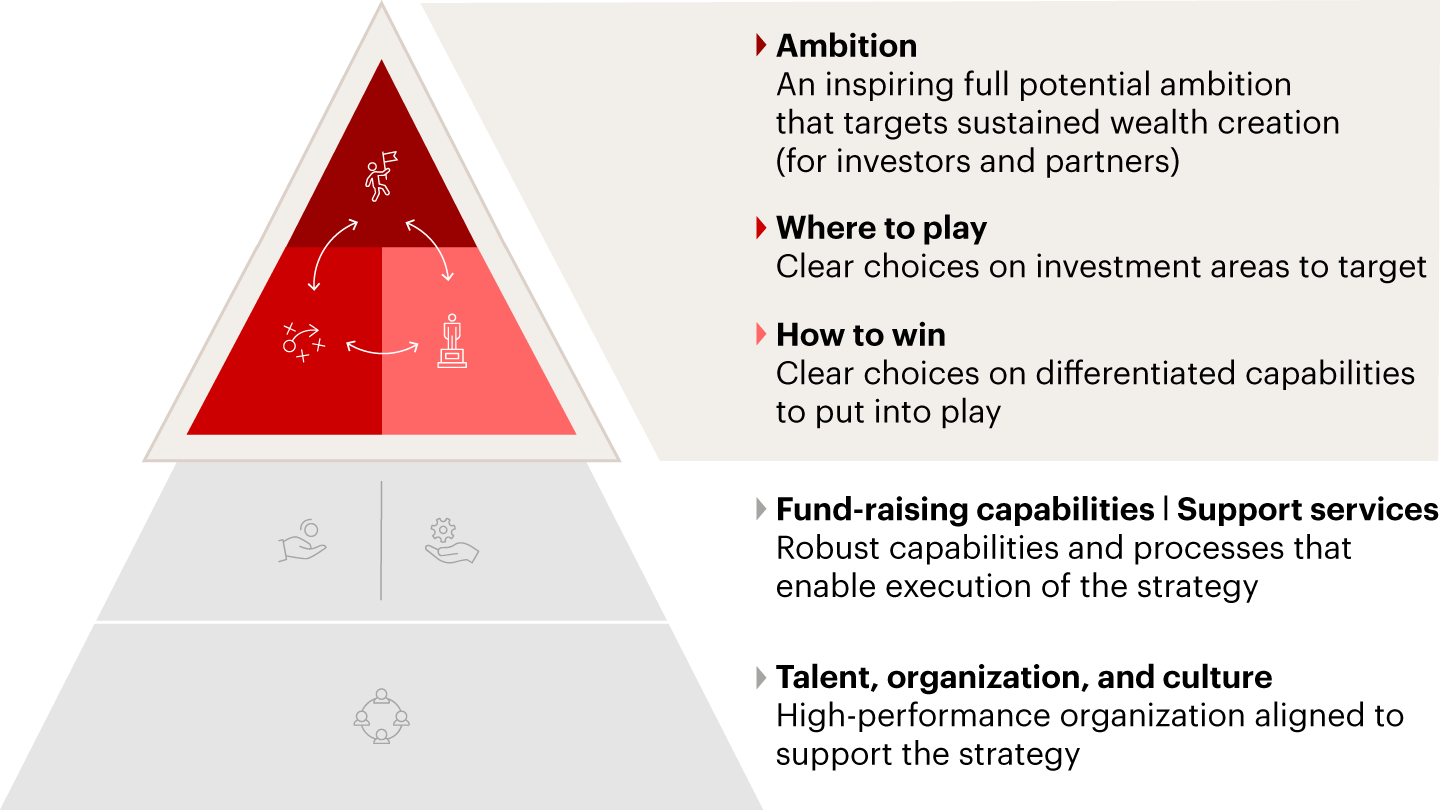

While scale confers advantages, achieving maximum scale is not the ambition for many firms, as we’ve discussed. Size can be a powerful advantage, but smaller firms always can compete—and win—by doing what they do best in a way that reliably generates alpha.
Growth itself, however, is nonnegotiable. Firms that aren’t growing aren’t expanding the pie. They aren’t creating the opportunities or generating the wealth that attracts and retains the lifeblood of the firm—the next generation of talent.
Therefore, some measure of growth is almost always a part of a firm’s ambition. This might show up as a specific AUM target or an aspiration to be a top five firm in a particular space. Yet setting out to gather assets absent differentiation is a losing proposition. Investors want to know that a GP has a reliable model for outperforming in a competitive market.
Establishing what does or can differentiate your firm, then, is table stakes when it comes to setting a strategy. The trap is to think the market views you as different simply because you’ve had success in the past. What’s often missing is a clear-eyed assessment of what makes the firm stand out or not and how that profile is resonating in the eyes of LPs, intermediates, business owners, and prospective hires.
Once you establish an ambition and know confidently what differentiates (or will differentiate) your firm from others, the challenge is to build a strategy around that—one that gets you to full potential in your core investment strategy while selectively pursuing new avenues of growth. It’s never about simply being biggest or best. The right strategy will have elements of both, and the way forward will be a specific, nuanced plan that is actionable and easy to communicate.
A precise measure of what you are getting into, however, is critical. Raising bigger funds and pursuing new products, by definition, requires change. Doing bigger deals, expanding into new subsectors or geographies, or moving into new asset classes all can accelerate growth. But setting off in new directions while trying to manage complexity and sustain differentiated performance is inevitably a high-wire act. The industry is littered with examples of firms that took on too much, too fast and lost their way. It is essential to pursue adjacencies with clear synergies and to preserve what is special about the firm.
Evolving a firm is also expensive. As complexity rises, so does cost. The investment required to generate alpha is only going up, which means PE firms need to link their ambitions to a clear plan to sustain attractive margins by doing things better and faster. In private equity, words like “cost out” and “efficiency” are typically heard in portfolio company boardrooms, not firm-level leadership meetings. As competition continues to pressure fees, those issues are now squarely on the agenda.
The firms that take planning seriously are always asking the same questions: Do we really know where we are today competitively and what makes us stand out in the crowd? Are we clear on where we want to be in 5 to 10 years and what we need to do to get there? Private equity is in a state of change, one that may reorder winners and losers across the industry. The surest way to land in the winner’s circle is to articulate your ambition clearly and develop a practical strategy for how you plan to compete in the years ahead.