
Skip to Content
  • Uffici

    Uffici

    Nord e Sud America
    • Atlanta
    • Austin
    • Bogota
    • Boston
    • Buenos Aires
    • Chicago
    • Dallas
    • Denver
    • Houston
    • Los Angeles
    • Mexico City
    • Minneapolis
    • Monterrey
    • Montreal
    • New York
    • Rio de Janeiro
    • San Francisco
    • Santiago
    • São Paulo
    • Seattle
    • Silicon Valley
    • Toronto
    • Washington, DC
    Europa, Medio Oriente e Africa
    • Amsterdam
    • Athens
    • Berlin
    • Brussels
    • Copenhagen
    • Doha
    • Dubai
    • Dusseldorf
    • Frankfurt
    • Helsinki
    • Istanbul
    • Johannesburg
    • Kyiv
    • Lisbon
    • London
    • Madrid
    • Milan
    • Munich
    • Oslo
    • Paris
    • Riyadh
    • Rome
    • Stockholm
    • Vienna
    • Warsaw
    • Zurich
    Asia e Australia
    • Bangkok
    • Beijing
    • Bengaluru
    • Brisbane
    • Ho Chi Minh City
    • Hong Kong
    • Jakarta
    • Kuala Lumpur
    • Manila
    • Melbourne
    • Mumbai
    • New Delhi
    • Perth
    • Seoul
    • Shanghai
    • Singapore
    • Sydney
    • Tokyo
    Guarda tutti gli uffici
  • Alumni
  • Media Center
  • Iscriviti
  • Contattaci
  • Italy | Italiano

    Seleziona il tuo Paese e la tua lingua

    Global
    • Global (English)
    Nord e Sud America
    • Brazil (Português)
    • Argentina (Español)
    • Canada (Français)
    • Chile (Español)
    • Colombia (Español)
    Europa, Medio Oriente e Africa
    • France (Français)
    • DACH Region (Deutsch)
    • Italy (Italiano)
    • Spain (Español)
    • Greece (Elliniká)
    Asia e Australia
    • China (中文版)
    • Korea (한국어)
    • Japan (日本語)
  • Saved items (0)
    Saved items (0)

    You have no saved items.

    Contrassegna il contenuto che ti interessa e verrà salvato qui. Potrai leggerlo o condividerlo in seguito.

    Explore Bain Insights
  • Settori
    Menu principale

    Settori

    • Aerospazio e Difesa
    • Agribusiness
    • Chimica
    • Infrastrutture e Costruzioni
    • Beni di Largo Consumo
    • Servizi Finanziari
    • Sanità
    • Macchinari Industriali
    • Media & Intrattenimento
    • Industria Metallurgica
    • Industria Mineraria
    • Petrolio e Gas
    • Industria Cartaria e Packaging
    • Private Equity
    • Settore Sociale & Pubblico
    • Retail
    • Tecnologia
    • Telecomunicazioni
    • Compagnie Aeree & Trasporti
    • Viaggi e Svago
    • Utility e Rinnovabili
  • Servizi di Consulenza
    Menu principale

    Servizi di Consulenza

    • Customer Experience
    • ESG
    • Innovation
    • M&A and Divestitures
    • Operation
    • People & Organization
    • Private Equity
    • Sales & Marketing
    • Strategia
    • IA, Approfondimenti e Soluzioni
    • Tecnologia
    • Trasformazione
  • Digital
  • Tematiche
  • Informazioni su Bain
    Menu principale

    Informazioni su Bain

    • Che Cosa Facciamo
    • Quello in Cui Crediamo
    • Le Nostre Persone e la Leadership
    • Risultati
    • Premi e Riconoscimenti
    • Organizzazioni Globali
    Further: Our global responsibility
    • Diversità e Inclusione
    • Social Impact
    • Sustainability
    • World Economic Forum
    Learn more about Further
  • Careers
    Menu principale

    Careers

    • Work with Us
      Careers
      Work with Us
      • Find Your Place
      • Our Work Areas
      • Integrated Teams
      • Students
      • Internships & Programs
      • Recruiting Events
    • Life at Bain
      Careers
      Life at Bain
      • Blog: Inside Bain
      • Career Stories
      • Our People
      • Where We Work
      • Supporting Your Growth
      • Affinity Groups
      • Benefits
    • Impact Stories
    • Hiring Process
      Careers
      Hiring Process
      • What to Expect
      • Interviewing
    FIND JOBS
  • Uffici
    Menu principale

    Uffici

    • Nord e Sud America
      Uffici
      Nord e Sud America
      • Atlanta
      • Austin
      • Bogota
      • Boston
      • Buenos Aires
      • Chicago
      • Dallas
      • Denver
      • Houston
      • Los Angeles
      • Mexico City
      • Minneapolis
      • Monterrey
      • Montreal
      • New York
      • Rio de Janeiro
      • San Francisco
      • Santiago
      • São Paulo
      • Seattle
      • Silicon Valley
      • Toronto
      • Washington, DC
    • Europa, Medio Oriente e Africa
      Uffici
      Europa, Medio Oriente e Africa
      • Amsterdam
      • Athens
      • Berlin
      • Brussels
      • Copenhagen
      • Doha
      • Dubai
      • Dusseldorf
      • Frankfurt
      • Helsinki
      • Istanbul
      • Johannesburg
      • Kyiv
      • Lisbon
      • London
      • Madrid
      • Milan
      • Munich
      • Oslo
      • Paris
      • Riyadh
      • Rome
      • Stockholm
      • Vienna
      • Warsaw
      • Zurich
    • Asia e Australia
      Uffici
      Asia e Australia
      • Bangkok
      • Beijing
      • Bengaluru
      • Brisbane
      • Ho Chi Minh City
      • Hong Kong
      • Jakarta
      • Kuala Lumpur
      • Manila
      • Melbourne
      • Mumbai
      • New Delhi
      • Perth
      • Seoul
      • Shanghai
      • Singapore
      • Sydney
      • Tokyo
    Guarda tutti gli uffici
  • Alumni
  • Media Center
  • Iscriviti
  • Contattaci
  • Italy | Italiano
    Menu principale

    Seleziona il tuo Paese e la tua lingua

    • Global
      Seleziona il tuo Paese e la tua lingua
      Global
      • Global (English)
    • Nord e Sud America
      Seleziona il tuo Paese e la tua lingua
      Nord e Sud America
      • Brazil (Português)
      • Argentina (Español)
      • Canada (Français)
      • Chile (Español)
      • Colombia (Español)
    • Europa, Medio Oriente e Africa
      Seleziona il tuo Paese e la tua lingua
      Europa, Medio Oriente e Africa
      • France (Français)
      • DACH Region (Deutsch)
      • Italy (Italiano)
      • Spain (Español)
      • Greece (Elliniká)
    • Asia e Australia
      Seleziona il tuo Paese e la tua lingua
      Asia e Australia
      • China (中文版)
      • Korea (한국어)
      • Japan (日本語)
  • Saved items  (0)
    Menu principale
    Saved items (0)

    You have no saved items.

    Contrassegna il contenuto che ti interessa e verrà salvato qui. Potrai leggerlo o condividerlo in seguito.

    Explore Bain Insights
  • Settori
    • Settori

      • Aerospazio e Difesa
      • Agribusiness
      • Chimica
      • Infrastrutture e Costruzioni
      • Beni di Largo Consumo
      • Servizi Finanziari
      • Sanità
      • Macchinari Industriali
      • Media & Intrattenimento
      • Industria Metallurgica
      • Industria Mineraria
      • Petrolio e Gas
      • Industria Cartaria e Packaging
      • Private Equity
      • Settore Sociale & Pubblico
      • Retail
      • Tecnologia
      • Telecomunicazioni
      • Compagnie Aeree & Trasporti
      • Viaggi e Svago
      • Utility e Rinnovabili
  • Servizi di Consulenza
    • Servizi di Consulenza

      • Customer Experience
      • ESG
      • Innovation
      • M&A and Divestitures
      • Operation
      • People & Organization
      • Private Equity
      • Sales & Marketing
      • Strategia
      • IA, Approfondimenti e Soluzioni
      • Tecnologia
      • Trasformazione
  • Digital
  • Tematiche
  • Informazioni su Bain
    • Informazioni su Bain

      • Che Cosa Facciamo
      • Quello in Cui Crediamo
      • Le Nostre Persone e la Leadership
      • Risultati
      • Premi e Riconoscimenti
      • Organizzazioni Globali
      Further: Our global responsibility
      • Diversità e Inclusione
      • Social Impact
      • Sustainability
      • World Economic Forum
      Learn more about Further
  • Careers
    Ricerche più popolari
    • Agile
    • Digitale
    • Strategia
    La tue ricerche precedenti
      Pagine visitate

      Content added to saved items

      Saved items (0)

      Removed from saved items

      Saved items (0)

      Forbes.com

      The future of banks hangs in their balance sheets

      The future of banks hangs in their balance sheets

      Leading banks are improving balance sheet management capabilities throughout the organization.

      Di Mike Baxter and Thomas Olsen

      • Tempo di lettura min.

      Article

      The future of banks hangs in their balance sheets
      en

      This article originally appeared on Forbes.com

      Since the global financial crash, banks have traveled a hard road of bad debt, volatile funding markets and an uncertain economy. Now, as tough new rules under Basel III and a host of local regulations require banks to increase capital and threaten to put a big dent in their returns on equity, it’s clear that many banks will need a new roadmap.

      To navigate the difficult journey ahead, industry leading banks are implanting better balance sheet management capabilities throughout the organization. A comprehensive analysis by Bain & Company of approximately 200 banks around the world and interviews with more than 50 senior executives revealed that the leaders recognize that the ability to fully account for risk, capital and liquidity in their strategic and daily business decisions will be a source of competitive advantage. 

      Our investigation suggests that views are coalescing around new ways to think about running the bank with greater heed to the consequences of decisions on the balance sheet. They are best captured in a comprehensive approach for incorporating risk and capital in critical decisions. Called RaCADTM (for “risk and capital-adjusted decision making”), it translates the bank’s overall strategy into discrete objectives, governance and processes for managing risk, capital and liquidity in an integrated way at the level of each of its businesses (see figure).

      The new orientation marks a welcome shift in bankers’ strategic mindset from a drive to maximize short-term returns to a commitment to create sustainable, more valuable institutions. But as they wrestle with how best to implement these new competitive disciplines, bankers told us that they were struggling to reconcile four fundamental dilemmas. 
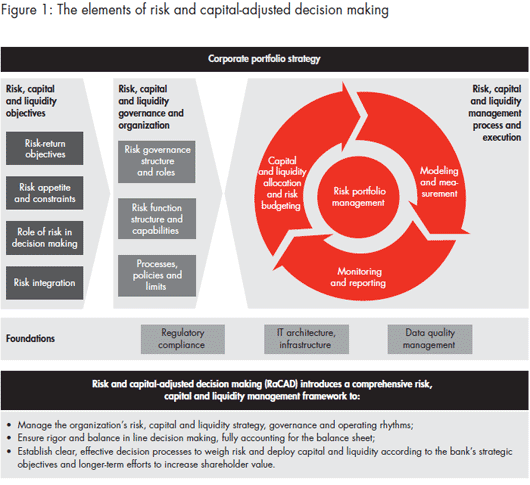

      managing-risk-and-capital-fig-01_embed

      What is the “right” level of capital? Bank leaders recognize that more capital is required, of course, but the critical point of debate going on around boardroom tables centers on what level of capital is consistent with the bank’s risk appetite and commercial objectives. The ultimate choice is to target the level of risk-adjusted capital the bank needs to hold in order to maintain market, regulatory and political confidence in the institution’s ability to withstand stress robustly and to pay dividends over time.

      Once the bank has settled on the target capital level, it needs to communicate its rationale clearly, and often, to all stakeholders. Internally, business unit managers need to understand how the amount of capital they are allocated reflects the risk of their business. Shareholders, debt holders and regulators need to be able to size up the amount of capital the bank is targeting, how this compares to the minimum and how much capital is currently available on the balance sheet.

      Which metrics best support decision making? Banks have typically gauged their performance primarily by the easily understood yardstick of return on equity (ROE). But as a single-period measure, ROE falls short as a reliable indicator of returns across the ups and downs of the business cycle. Leading banks are responding by applying a suite of metrics to get a 360-degree view of the impact of competitive challenges on their balance sheet.

      The choice of a predominant measure of capital that best suits a bank’s needs depends on the type of bank it is and its risk-return objectives. As the metric that best captures how much capital is needed to support commercial planning and pricing decisions at the granular level of customer segments, products or accounts, economic capital remains an indispensable tool for most. Many of the bankers with whom we spoke reported that their banks are measuring and allocating both economic and regulatory capital across their businesses. They report that economic capital often becomes the basis for determining how to allocate regulatory capital (the real constraint) with finer attention to product and customer segments.

      How to make decisions that account for risk when competitors do not always do the same? Disciplines that put risk at the center of a bank’s decision-making process support better decisions. But if its rivals are not following a similar approach, the bank faces real commercial pressures to chase business that could lose money or market share.

      Leading banks recognize that they need to move away from thinking that is fixated on gaining market share, increasing revenues or building volume. Instead, their growth objectives concentrate on achieving sustainable competitive advantage and increasing the bank’s share of economic profits in the markets where it competes. The choice of whether to accept a lower return on risk in order to remain competitive is a strategic judgment about whether the bank can earn an appropriate risk- and capital-adjusted return in a given market, customer segment, product niche or area of expertise.

      What are the right investments to make in capital-management capabilities? Most banks we surveyed are shoring up their technical risk-management capabilities. However, banks also need to invest to deepen the awareness of risk, capital and liquidity disciplines in how operating managers think about their businesses. Nearly all of the senior bank executives we interviewed mentioned how important their people and culture were to their success. But only a few forward-thinking banks truly help their line managers to better understand the interactions between the balance sheet and their commercial goals and behaviors. These banks are reinforcing those essential capabilities through communication and training and by sharpening the effectiveness of their decision making.

      Banks that embrace this new way of thinking about risk and capital face major cultural and behavioral challenges. For some, it means rediscovering disciplines that were lost in the heady days of the past decade. For others, it requires starting afresh and building new muscles. How any individual bank tackles its capital management challenges depends on its business model, its strategic objectives and its unique starting point; but its future success will hinge on whether it is able to sustain these new disciplines once they have been developed.

      Mike Baxter is a partner with Bain & Company based in New York. Thomas Olsen is a partner in Bain’s Sao Paulo office. Both are members of the firm’s Global Financial Services practice.

      Autori
      • Headshot of Mike Baxter
        Mike Baxter
        Advisory Partner, New York
      Contattaci
      Industry collegate
      • Servizi Finanziari
      Servizi Finanziari
      Managing Risk and Capital

      Banks’ future hangs in the balance sheet.

      Leggi di più
      Servizi Finanziari
      Beyond Payments, the Real Prize in SME Commerce Is Ecosystem Control

      Choices on integration are reshaping how European commerce platforms and payments providers will thrive.

      Leggi di più
      Servizi Finanziari
      Six Threats Demand a New Playbook for Banks in Wealth and Asset Management

      AI, direct-to-consumer models, and the return of local priorities are redrawing industry lines.

      Leggi di più
      Servizi Finanziari
      Stay Relevant, Spark Energy: Pedro Arnt, CEO dLocal

      How can a hyperscaler grow at lightning speed without losing its soul? 

      Leggi di più
      Servizi Finanziari
      Rethinking Transformation: Lawrence Lam on Leading Change at Prudential

      Frankie Leung speaks with Lawrence Lam, CEO of Prudential Hong Kong, about organizational transformation and sustaining change through a people-led approach.

      Leggi di più
      First published in maggio 2012
      Tags
      • Servizi Finanziari

      Come abbiamo aiutato i nostri clienti

      Sostenibilità e Corporate Responsibility Voluntary Carbon Markets: A Bank Moves Early to Seize the Opportunity

      Leggi un caso di studio

      Lean Six Sigma solves a commercial bank's growth problem

      Leggi un caso di studio

      Bridging the Gap Between Business and Technology

      Leggi un caso di studio

      Vuoi continuare la conversazione?

      Aiutiamo i leader globali e le loro aziende ad affrontare problemi e a cogliere le opportunità. Sosteniamo cambiamenti e otteniamo risultati duraturi.

      Bain Insights. Le nostre idee e punti di vista sulle tematiche che le aziende globali affrontano ogni giorno, arrivano nella tua email tutti i mesi.

      *Ho letto l'Informativa sulla Privacy e accetto i termini e le condizioni.

      Si prega di leggere e accettare l’Informativa sulla Privacy
      Bain & Company
      Contattaci Sustainability Accessibility Condizioni d’uso Privacy Cookie Policy Sitemap Log In

      © 1996-2026 Bain & Company, Inc.

      Contatta Bain

      Come posso aiutarti?

      • Business inquiry
      • Career information
      • Press relations
      • Partnership request
      • Speaker request
      Guarda tutti gli uffici