
Skip to Content
  • Uffici

    Uffici

    Nord e Sud America
    • Atlanta
    • Austin
    • Bogota
    • Boston
    • Buenos Aires
    • Chicago
    • Dallas
    • Denver
    • Houston
    • Los Angeles
    • Mexico City
    • Minneapolis
    • Monterrey
    • Montreal
    • New York
    • Rio de Janeiro
    • San Francisco
    • Santiago
    • São Paulo
    • Seattle
    • Silicon Valley
    • Toronto
    • Washington, DC
    Europa, Medio Oriente e Africa
    • Amsterdam
    • Athens
    • Berlin
    • Brussels
    • Copenhagen
    • Doha
    • Dubai
    • Dusseldorf
    • Frankfurt
    • Helsinki
    • Istanbul
    • Johannesburg
    • Kyiv
    • Lisbon
    • London
    • Madrid
    • Milan
    • Munich
    • Oslo
    • Paris
    • Riyadh
    • Rome
    • Stockholm
    • Vienna
    • Warsaw
    • Zurich
    Asia e Australia
    • Bangkok
    • Beijing
    • Bengaluru
    • Brisbane
    • Ho Chi Minh City
    • Hong Kong
    • Jakarta
    • Kuala Lumpur
    • Manila
    • Melbourne
    • Mumbai
    • New Delhi
    • Perth
    • Seoul
    • Shanghai
    • Singapore
    • Sydney
    • Tokyo
    Guarda tutti gli uffici
  • Alumni
  • Media Center
  • Iscriviti
  • Contattaci
  • Italy | Italiano

    Seleziona il tuo Paese e la tua lingua

    Global
    • Global (English)
    Nord e Sud America
    • Brazil (Português)
    • Argentina (Español)
    • Canada (Français)
    • Chile (Español)
    • Colombia (Español)
    Europa, Medio Oriente e Africa
    • France (Français)
    • DACH Region (Deutsch)
    • Italy (Italiano)
    • Spain (Español)
    • Greece (Elliniká)
    Asia e Australia
    • China (中文版)
    • Korea (한국어)
    • Japan (日本語)
  • Saved items (0)
    Saved items (0)

    You have no saved items.

    Contrassegna il contenuto che ti interessa e verrà salvato qui. Potrai leggerlo o condividerlo in seguito.

    Explore Bain Insights
  • Settori
    Menu principale

    Settori

    • Aerospazio e Difesa
    • Agribusiness
    • Chimica
    • Infrastrutture e Costruzioni
    • Beni di Largo Consumo
    • Servizi Finanziari
    • Sanità
    • Macchinari Industriali
    • Media & Intrattenimento
    • Industria Metallurgica
    • Industria Mineraria
    • Petrolio e Gas
    • Industria Cartaria e Packaging
    • Private Equity
    • Settore Sociale & Pubblico
    • Retail
    • Tecnologia
    • Telecomunicazioni
    • Compagnie Aeree & Trasporti
    • Viaggi e Svago
    • Utility e Rinnovabili
  • Servizi di Consulenza
    Menu principale

    Servizi di Consulenza

    • Customer Experience
    • ESG
    • Innovation
    • M&A and Divestitures
    • Operation
    • People & Organization
    • Private Equity
    • Sales & Marketing
    • Strategia
    • IA, Approfondimenti e Soluzioni
    • Tecnologia
    • Trasformazione
  • Digital
  • Tematiche
  • Informazioni su Bain
    Menu principale

    Informazioni su Bain

    • Che Cosa Facciamo
    • Quello in Cui Crediamo
    • Le Nostre Persone e la Leadership
    • Risultati
    • Premi e Riconoscimenti
    • Organizzazioni Globali
    Further: Our global responsibility
    • Diversità e Inclusione
    • Social Impact
    • Sustainability
    • World Economic Forum
    Learn more about Further
  • Careers
    Menu principale

    Careers

    • Work with Us
      Careers
      Work with Us
      • Find Your Place
      • Our Work Areas
      • Integrated Teams
      • Students
      • Internships & Programs
      • Recruiting Events
    • Life at Bain
      Careers
      Life at Bain
      • Blog: Inside Bain
      • Career Stories
      • Our People
      • Where We Work
      • Supporting Your Growth
      • Affinity Groups
      • Benefits
    • Impact Stories
    • Hiring Process
      Careers
      Hiring Process
      • What to Expect
      • Interviewing
    FIND JOBS
  • Uffici
    Menu principale

    Uffici

    • Nord e Sud America
      Uffici
      Nord e Sud America
      • Atlanta
      • Austin
      • Bogota
      • Boston
      • Buenos Aires
      • Chicago
      • Dallas
      • Denver
      • Houston
      • Los Angeles
      • Mexico City
      • Minneapolis
      • Monterrey
      • Montreal
      • New York
      • Rio de Janeiro
      • San Francisco
      • Santiago
      • São Paulo
      • Seattle
      • Silicon Valley
      • Toronto
      • Washington, DC
    • Europa, Medio Oriente e Africa
      Uffici
      Europa, Medio Oriente e Africa
      • Amsterdam
      • Athens
      • Berlin
      • Brussels
      • Copenhagen
      • Doha
      • Dubai
      • Dusseldorf
      • Frankfurt
      • Helsinki
      • Istanbul
      • Johannesburg
      • Kyiv
      • Lisbon
      • London
      • Madrid
      • Milan
      • Munich
      • Oslo
      • Paris
      • Riyadh
      • Rome
      • Stockholm
      • Vienna
      • Warsaw
      • Zurich
    • Asia e Australia
      Uffici
      Asia e Australia
      • Bangkok
      • Beijing
      • Bengaluru
      • Brisbane
      • Ho Chi Minh City
      • Hong Kong
      • Jakarta
      • Kuala Lumpur
      • Manila
      • Melbourne
      • Mumbai
      • New Delhi
      • Perth
      • Seoul
      • Shanghai
      • Singapore
      • Sydney
      • Tokyo
    Guarda tutti gli uffici
  • Alumni
  • Media Center
  • Iscriviti
  • Contattaci
  • Italy | Italiano
    Menu principale

    Seleziona il tuo Paese e la tua lingua

    • Global
      Seleziona il tuo Paese e la tua lingua
      Global
      • Global (English)
    • Nord e Sud America
      Seleziona il tuo Paese e la tua lingua
      Nord e Sud America
      • Brazil (Português)
      • Argentina (Español)
      • Canada (Français)
      • Chile (Español)
      • Colombia (Español)
    • Europa, Medio Oriente e Africa
      Seleziona il tuo Paese e la tua lingua
      Europa, Medio Oriente e Africa
      • France (Français)
      • DACH Region (Deutsch)
      • Italy (Italiano)
      • Spain (Español)
      • Greece (Elliniká)
    • Asia e Australia
      Seleziona il tuo Paese e la tua lingua
      Asia e Australia
      • China (中文版)
      • Korea (한국어)
      • Japan (日本語)
  • Saved items  (0)
    Menu principale
    Saved items (0)

    You have no saved items.

    Contrassegna il contenuto che ti interessa e verrà salvato qui. Potrai leggerlo o condividerlo in seguito.

    Explore Bain Insights
  • Settori
    • Settori

      • Aerospazio e Difesa
      • Agribusiness
      • Chimica
      • Infrastrutture e Costruzioni
      • Beni di Largo Consumo
      • Servizi Finanziari
      • Sanità
      • Macchinari Industriali
      • Media & Intrattenimento
      • Industria Metallurgica
      • Industria Mineraria
      • Petrolio e Gas
      • Industria Cartaria e Packaging
      • Private Equity
      • Settore Sociale & Pubblico
      • Retail
      • Tecnologia
      • Telecomunicazioni
      • Compagnie Aeree & Trasporti
      • Viaggi e Svago
      • Utility e Rinnovabili
  • Servizi di Consulenza
    • Servizi di Consulenza

      • Customer Experience
      • ESG
      • Innovation
      • M&A and Divestitures
      • Operation
      • People & Organization
      • Private Equity
      • Sales & Marketing
      • Strategia
      • IA, Approfondimenti e Soluzioni
      • Tecnologia
      • Trasformazione
  • Digital
  • Tematiche
  • Informazioni su Bain
    • Informazioni su Bain

      • Che Cosa Facciamo
      • Quello in Cui Crediamo
      • Le Nostre Persone e la Leadership
      • Risultati
      • Premi e Riconoscimenti
      • Organizzazioni Globali
      Further: Our global responsibility
      • Diversità e Inclusione
      • Social Impact
      • Sustainability
      • World Economic Forum
      Learn more about Further
  • Careers
    Ricerche più popolari
    • Agile
    • Digitale
    • Strategia
    La tue ricerche precedenti
      Pagine visitate

      Content added to saved items

      Saved items (0)

      Removed from saved items

      Saved items (0)

      Brief

      Why Asset Class Expansion Is Harder Than It Seems

      Why Asset Class Expansion Is Harder Than It Seems

      Moving into a new private equity asset class can’t be that difficult, right? Think again.

      Di Hugh MacArthur, Or Skolnik, Brenda Rainey, Graham Rose, e Alexander De Mol

      • Tempo di lettura min.
      }

      Brief

      Why Asset Class Expansion Is Harder Than It Seems
      en

      The vast majority of private equity firms have a growth imperative.

      Steady expansion of assets under management (AUM) is the best way for any firm to generate a predictable stream of fees. For single-focus firms, diversification into strategies that are less cyclical, or countercyclical, can increase stability. Striking out in a new direction may be the key to expanding share of wallet with limited partners (LPs) looking for exposure elsewhere on the risk/reward spectrum. For maturing firms, expansion is often about talent; it can be critical for retaining or attracting the best people.

      The number and variety of growth strategies have exploded in recent years as firms look for alternatives beyond their core (see Figure 1). One of the most popular, however, is also among the riskiest: asset class expansion. In practice, too many of these asset class adjacency moves end up as small side businesses that aren’t particularly strategic or profitable. In the worst cases, firms cut their losses and exit the business altogether. A Bain & Company analysis shows that over 60% of the firms that pursue asset class expansion will retrench from at least one of those pursuits over time.

      Figure 1
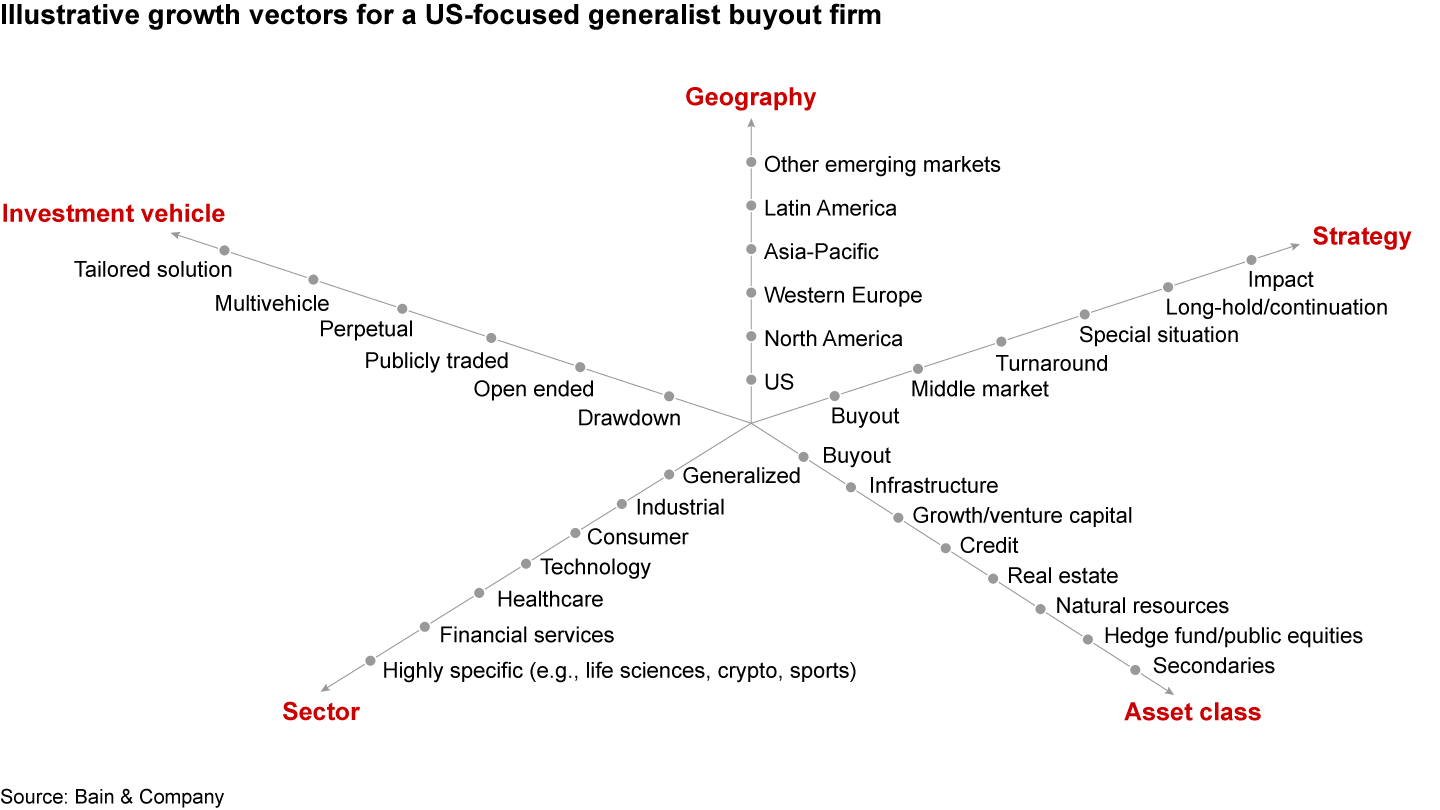
      New approaches and products have proliferated as private equity firms seek additional ways to grow

      What goes wrong?

      While many firms assume that success in the buyout world will translate smoothly to, say, credit investing or infrastructure, that’s often not the case. Despite the common umbrella of “private capital,” synergies across most asset classes are relatively minor. Different asset classes often require sharply different capabilities across the investment value chain—from sourcing and underwriting to deal structuring, value creation, and exit. Each class has a unique ecosystem requiring a distinct set of relationships. And though there may be some overlap among sources of capital across funds, the decision makers responsible for each class tend not to be the same.

      The basis of competition also varies widely across asset classes. While a small to midsize buyout firm can thrive in a lucrative niche, asset classes like liquid credit or core real estate are driven by massive scale. Expanding into these areas demands a clear-eyed assessment of what sort of investment it would take to establish critical mass and, importantly, whether the firm is prepared to make that kind of commitment. Asset classes like growth equity and venture capital may share more with buyout in terms of capabilities and business model, but, increasingly, they require deep, specialized expertise in technology and the ability to make deals at a much faster pace. Success in underwriting infrastructure risk, meanwhile, may turn on how well the firm understands specific government regulations or local political realities.  

      If the firm lacks the requisite capabilities, networks, or experience to break into a new business, it will have to add new talent. That raises the buy or build dilemma and sparks tricky questions at the operating level about how to set up the new team for success. Private equity is a people business, and integrating new talent always presents risks that have to be managed carefully. Transforming what amounts to a single-line business into a multiline organization means allocating resources and economics in ways that may be unfamiliar or disruptive.

      A strong buyout fund, for instance, generates strong economics for the firm. By nature, that’s less true of other asset classes like infrastructure or natural resources. When adding one to the other, how do you share firmwide economics in a way that feels good to everybody? And how do you allocate resources: Does the fund-raising organization cover both businesses, or do you need to build a new one?

      While the tendency is to assume these details are easily solvable, they aren’t. In fact, they can have major consequences for the firm; the complexity of integration can easily overwhelm the organization.

      None of this is to say that asset class expansion is a bad idea. But the firms getting it right work hard to confirm that it is a good idea for their firm and investors. That involves a thorough two-part analysis: Is the asset class really as attractive as it might seem? And if it is, do we actually have a right to win based on our talent, resources, and appetite for taking on a new business (see Figure 2)?

      Figure 2
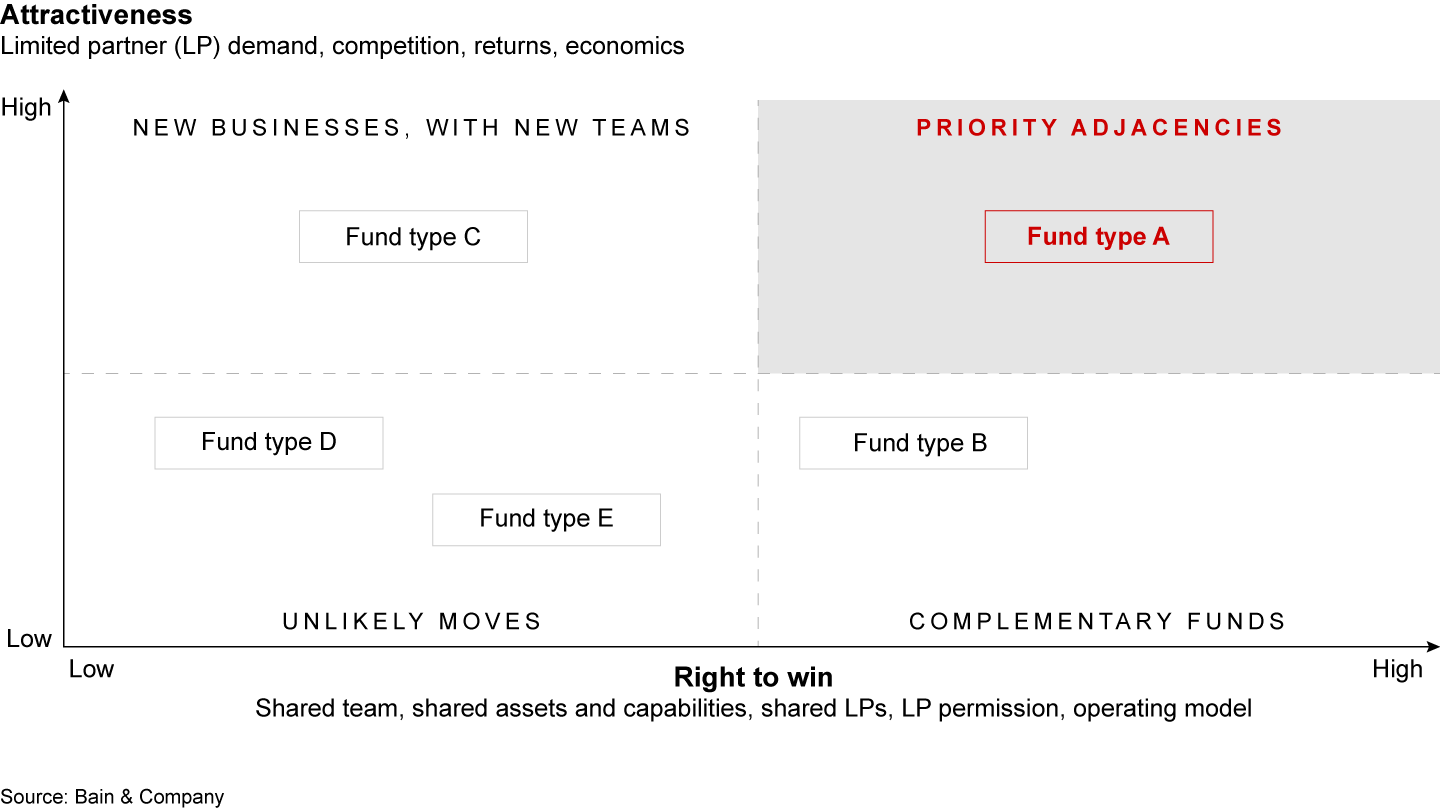
      Successful asset class expansion starts with two questions: Is the class attractive, and do we have a right to win?

      These questions lead to several practical considerations that can help frame the issues.

      Attractiveness

      • LP demand: Is this an area that has attracted the interest of a large number of investors and significant capital?
      • Competition: Who is competing in the space now? How good are they, and is there room for new entrants?
      • Returns: How high are typical returns for this asset class? Are returns similar to or better than what we offer our investors today?
      • Economics: What is the typical fee structure for this asset class? What is a realistic size for Fund I, and what scale is required to compete? Can we achieve that size in a reasonable time frame with a workable investment?

      Right to win

      • Shared team: Can our existing team (investment professionals and others) succeed within this new adjacency? If not, how much new talent will we need to add, and are attractive candidates or acquisition targets available? What will it take to integrate the new team with our unique culture?
      • Shared assets and capabilities: To what extent will our differentiated assets and capabilities help us win in this adjacency (sourcing networks, operational expertise, sector knowledge, etc.)? How much capability building (or buying) is required?
      • Shared LPs: Will our existing LPs invest with us in this strategy, and are they enthusiastic about placing capital there?
      • LP permission: How will LPs perceive our expansion? Will they see it as complementary or as a distraction? Could this perception harm future fund-raising?
      • Operating model: Will this move take advantage of our existing infrastructure and operations, or will it involve some level of transformation? Is it culturally aligned with the current team and style of investing? Will the economics work to everyone’s advantage?

      The most important message here is that a growth imperative isn’t enough. It has to be matched with a differentiation imperative that gets just as much attention from leadership. More than anything else, LPs want to know that a general partner can reliably outperform the average in whatever asset class its funds invest in. Growth in AUM comes from demonstrating a clear, competitive advantage and the ability to deliver results.

      This has never been more true than in today’s fund-raising environment, where new capital is suddenly harder to come by. Growth for growth’s sake won’t play. The imperative is to demonstrate how your firm is going to win.

      Autori
      • Headshot of Hugh MacArthur
        Hugh MacArthur
        Partner, Boston
      • Headshot of Or Skolnik
        Or Skolnik
        Partner, New York
      • Headshot of Brenda Rainey
        Brenda Rainey
        Executive Vice President, Boston
      • Headshot of Graham Rose
        Graham Rose
        Partner, Boston
      • Headshot of Alexander De Mol
        Alexander De Mol
        Partner, London
      Contattaci
      Industry collegate
      • Private Equity
      Come possiamo aiutarti
      • Firm Strategy & Operations
      Private Equity
      This Time It’s Different: The Strategic Imperative in Private Equity

      Structural changes are already altering the competitive landscape in alternatives. Do you have a plan to stay ahead over the coming decade?

      Leggi di più
      Private Equity
      What Kind of AI Cycle Are We Actually In?

      The question for investors is not whether AI will boom or bust, but who may be unwittingly subsidizing the buildout.

      Leggi di più
      Private Equity
      Macro Update: What Could Derail 2026?

      Bain’s leading macroeconomic expert examines the cracks beneath the surface of the US market and how investors should prepare for post-globalization realities.

      Leggi di più
      Firm Strategy & Operations
      Sustainable Aviation Fuel: The Supply Race Is On

      European production is projected to fall nearly 20% short of mandate-driven demand by 2030, a big opportunity for global feedstock suppliers and refiners that invest now.

      Leggi di più
      Private Equity
      New Models of Value Creation for Physician Groups

      Investors are retooling their physician group approach, building performance-driven platforms for the long term and positioning assets for strategic exits.

      Leggi di più
      First published in agosto 2022
      Tags
      • Firm Strategy & Operations
      • Private Equity

      Come abbiamo aiutato i nostri clienti

      A Strategic Vision Inspires a Strategic Acquisition

      Leggi un caso di studio

      Rapid Tech Due Diligence Helped a Private Equity Firm Invest with Confidence

      Leggi un caso di studio

      An Asian Sovereign Wealth Fund Expands Its Tech Investing

      Leggi un caso di studio

      Vuoi continuare la conversazione?

      Aiutiamo i leader globali e le loro aziende ad affrontare problemi e a cogliere le opportunità. Sosteniamo cambiamenti e otteniamo risultati duraturi.

      Bain Insights. Le nostre idee e punti di vista sulle tematiche che le aziende globali affrontano ogni giorno, arrivano nella tua email tutti i mesi.

      *Ho letto l'Informativa sulla Privacy e accetto i termini e le condizioni.

      Si prega di leggere e accettare l’Informativa sulla Privacy
      Bain & Company
      Contattaci Sustainability Accessibility Condizioni d’uso Privacy Cookie Policy Sitemap Log In

      © 1996-2026 Bain & Company, Inc.

      Contatta Bain

      Come posso aiutarti?

      • Business inquiry
      • Career information
      • Press relations
      • Partnership request
      • Speaker request
      Guarda tutti gli uffici