

Founder's Mentality Blog

We described in earlier blog posts the Bain Micro-Battles System℠ and the skills and behaviors needed to run the system. Now we’ll look at the micro-battle mission. Here’s what to consider.
The micro-battle mission is a one-pager that lives throughout the micro-battle
Micro-battles are designed to avoid excessive reporting (or second-guessing), so there’s not a lot of paper. An exception is a single sheet called the micro-battle mission, which lays out in very short order what each micro-battle is intended to accomplish (see Figure 1).
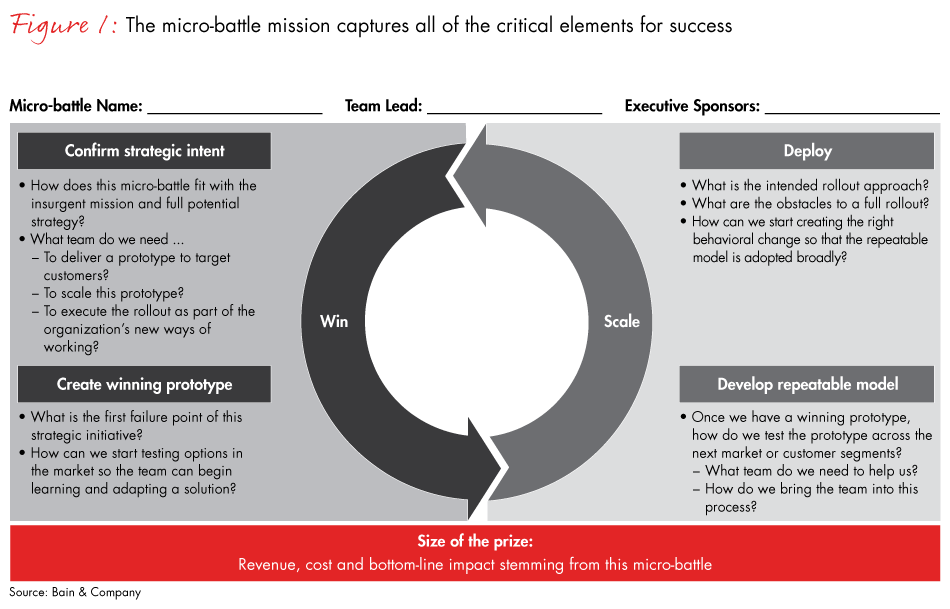
The Leadership team gets its hands dirty first. Team members write the first draft of a mission for each micro-battle in the portfolio. This requires presenting hypotheses for each of the four key phases of the micro-battle life cycle.
- Confirm strategic intent: What are you trying to do strategically here? How does this initiative link to your insurgent mission and your full-potential strategy? From the outset, this ties micro-battles to the revolution you are pursuing in your industry and your quest to maximize the company’s long-term value.
- Create winning prototype: What’s the first failure point of this strategic initiative and how can you launch a prototype to begin failing fast, adapting and learning your way to a solution? Getting this right requires tapping the accumulated expertise of your leaders by asking, “Folks, you’ve been in the business a long time—give some guidance here. What’s the most important thing that can go wrong and how should we address it?’’
- Develop repeatable model: How should you turn the successful prototype into a repeatable model? A micro-battle is not a quick, one-off victory. You’re trying to win locally, so you can scale that victory globally. The Leadership team must provide a hypothesis on how the initiative might scale across the organization.
- Deploy: What is the most effective way to roll out the solution to the broader organization? What obstacles might lie in the way? What are the behaviors and habits that might hamper adoption and how can you mitigate them? Senior leaders aren’t babes in the woods. They’ve seen too many global initiatives fail in the rollout phase. Feeble initiatives were often at fault, but many times, a good initiative failed when leaders underestimated how much behavioral change would be required of the organization. So leaders need to think about this up front.

Micro-battles
Want to learn more about the journey to scale insurgency? Explore the Bain Micro-battles System℠, step by step.
The Leadership team then hands off the mission statement to the leaders of the micro-battle team, whose job is to test these hypotheses in the market and adjust as necessary. The micro-battle team uses the first four-week cycle to assemble a team that can deliver on the mission. Micro-battle leaders must consider:
- Who can deliver a prototype that both addresses specific customer needs and can be developed into a repeatable model that can be scaled? This requires skills of intimacy that can deliver the benefits of difference and skills of scale that can deliver the benefits of sameness.
- How do we test the prototype for transferability across the next market or customer segment? How do we recruit early input from the leaders of these transfer markets?
- Who is best able to help us translate the prototype into a repeatable model that others can adopt? How do we create peer-to-peer learning across the teams?
- Who can help us create the right scaling model and think through the behavioral changes required?
The first time the micro-battle team meets with the Leadership team, it presents a revised version of the mission and their recommended team. Every four weeks thereafter, the team presents its latest hypothesis on the mission. The template doesn’t change, but the hypotheses get revised as team members test, fail and adjust their way to success.
Every quadrant matters as you move around the wheel
We talk about micro-battles in terms of “moving around the wheel.” The wheel has four quadrants—strategy, prototype, repeatable model and rollout—each of which is equally important.
Micro-battles differ from pilots, quick wins or Agile development projects. A micro-battle isn’t a pilot, as most people define pilots, because the whole goal is to translate the early prototype into a repeatable model. It’s not a quick win, because winning involves long-term behavior change. Micro-battles adopt the principles of Agile, but they recognize that it’s not enough to just translate the strategy into the minimal viable product and test it; you must also consider from the outset how you’ll scale the solution across the organization.
The best leaders keep their teams in balance, and the evolving micro-battle mission should reflect progress in all four quadrants as the team works around the wheel. Team members will begin prototyping and do multiple tests until they fail their way to a solution. Next, they’ll test for transferability and repeatability by working out the routines and determining what behaviors must change. Then they will determine the rollout model and resources required. Finally, they work to remove obstacles to rollout, which creates pull for the initiative. The process is highly iterative, and your teams will constantly be updating their missions. But team activities are a steady march around the wheel, and progress on this march is what guides the leadership discussion.
Insights occur when rounding corners
The fascinating thing about the micro-battle mission is that true strategic insight most often emerges when rounding the corners—that is, moving from an answer in one quadrant of the wheel and suddenly realizing that the next quadrant challenges that answer to its core. We tend to see three main pivot points.
- Prototype to repeatable model: The first round of prototypes are narrowly defined because you’re addressing a specific customer. You’re making the problem as small as possible and solving it in a differentiated way. But insights emerge as you begin to ask, “What’s repeatable here? What’s transferable to other customers or markets?” This raises questions about all the routines and behaviors that determine how you work with customers to deliver the solution on an ongoing basis. There’s an element of dumbing down at this stage, or designing for delivery. You’re trying to reduce the complexity of the offer so it can be delivered perfectly every time. Pilots often fail because they involve complex, bespoke solutions that work only because everyone is focused on success. Repeatability demands a sustained rollout to a large organization with many competing priorities, and micro-battles need to address this challenge up-front. The team doesn’t have a solution unless it passes the twin tests of transferability and repeatability.
- Repeatable model to rollout model and behavior change: Even if you have a strong repeatable model, your initiative can still fail if behaviors elsewhere in the organization cripple the rollout. The best leaders ask their teams to think of these obstacles while they’re designing the repeatable model. In some cases, the team will ask the Leadership team to eliminate obstacles. At other times, the behavioral change is too big, too intertwined with positive aspects of the firm’s culture. Then the question becomes: “What changes can we make to the repeatable model to make it go with the grain of the organization as we roll it out?”
- Behavioral change to strategic intent: The issue of behavioral change is so important that it sometimes forces the team to revisit the strategic intent and start over. It might be that organizational habits will simply prevent the team from getting to an answer that meets customer needs and can scale wide enough to have a real material impact. The problem may be that you’ve framed the strategic question in the wrong way, leading to the wrong solution. But it may also be that the organization is “genetically incapable” of rolling out the right solution for its customers. These are tough issues to address, but your goal here is to think about them before a bad solution settles and while you still have time to pivot to a better answer (or question). The key is to raise these issues early so you can adapt toward an integrated solution.
The micro-battle mission is a surprisingly effective tool for diagnosing yield loss
Now for something completely different: Once you understand the idea of marching around the wheel, you can begin to think about the micro-battle mission as a tool to diagnose yield loss from previous strategic initiatives. We know that leaders are frustrated. They roll out initiative after initiative, and very few hit their targets. Most start with great fanfare, achieve some early traction, but then gradually lose momentum and die. Well, no, they don’t die exactly, because corporations never like to kill off anything. Instead, moribund initiatives hover around the edges like some mutant zombie army. The micro-battle mission is a great lens for diagnosing how lively, energy-giving initiatives transformed into ugly, flesh-eating abominations. You may discover that failure happened:
- Between strategy and prototype. Did you focus on the really hard things that needed to be tested and adapted before the initiative was rolled out?
- Between prototype and repeatable model. Did you have initial success with the prototype, but fail to test for transferability? Did you invest the time and energy in defining a strong repeatable model?
- Between repeatable model and rollout. Did you develop a strong repeatable model only to watch it fail because you chose a mismatched rollout strategy? Maybe you relied on playbooks, for instance, instead of engaging the stars in your business to champion a more viral rollout.
- As a result of old behaviors. Did you develop a strong prototype and roll out the right repeatable model only to watch the organization attack it with so many cultural antibodies that it never had a chance of wide adoption?
Your best leaders will become very good at understanding these root causes of failure and avoiding them by balancing winning with scaling in future micro-battles.
Your micro-battle masters will become your leaders of the future: Use the mission to develop them
There are three critical skill sets your team will develop over time as they pursue micro-battles:
- The skills to break a strategic initiative into winnable subcomponents and then scale a solution across the company.
- The skills to diagnose how and where an initiative failed—whether it was in the prototype phase, because the solution wasn’t repeatable, because the team chose the wrong scaling model or because it failed to address behavioral change.
- The skills to help others turn strategy into results by keeping their teams in balance between winning and scaling.
These are the skills of the scale insurgent and, in our view, they are the skills that will determine tomorrow’s leaders. The micro-battle mission should keep both your micro-battle teams and your company dialed in on assessing and developing talent against these skills. Most large organizations suffer heavy yield loss because they aren’t focused on finding leaders who know how to develop and scale strategic initiatives. Becoming skilled at defining the right micro-battle missions and using them to transform your company’s behaviors will ultimately ensure your company avoids the same fate.

Micro-battles and Finding the First Failure Point
Identify the biggest problem that could derail the initiative and make it the focus of your micro-battle.
Bain Micro-battles System℠ is a service mark of Bain & Company, Inc.
First published in Juni 2017