

Brief
As commercial and national oil and gas companies begin their annual planning cycles in September, they will assess the macro business environment and make careful assumptions about the industry and their companies’ positions in it. These insights will define the coming year’s performance targets, confirm priorities and set board and shareholder expectations. Done well, they serve as a robust backdrop for establishing effective plans, budgets and rolling five-year operating plan updates.
As in previous years, Bain & Company offers a critical checklist of 10 key issues, to inform the 2014 oil and gas planning and budgeting cycle. The list covers macroeconomic trends, industry themes and specific tactical considerations. We recommend using this kind of structured framework to challenge thinking and ensure a highly effective 2014 planning process, contributing to high-quality, accurate results.
A. Macroeconomic trends
Global macroeconomic risks have shifted somewhat as the modest stabilization in the major advanced economies, including the US1 and Western Europe,2 has contrasted with the deteriorating conditions of the major developing economies. For the current planning horizon, we expect the volatility in China’s growth to continue, and it will be amplified through the many upstream trading partner countries that have relied on sustained China dynamism for their own growth. While the effect of a stabilizing West and a more uncertain East may net overall growth, higher volatility combined with a still-low cost of capital environment will likely make conditions ripe for large, short-term swings in the oil industry. Yet these notes of caution are a passing veil of uncertainty as midterm GDP growth and a sustained low cost of capital environment create a positive medium- to longer-term future for the oil and gas industry.
1. Low real interest rates. 2014 plans should take into account the likelihood that the business world will see a continued period of low-cost capital, driven by low real interest rates. The inevitable end of the Federal Reserve’s emergency measures does not alter the fundamentals driving the low real interest rate environment and should be factored in only for tactical considerations. Oil and gas companies generally continue to enjoy strong balance sheet positions with gearing below 30%, while low-cost capital offers additional investment and expansion opportunities. More ambitious investors and governments may also begin to progressively lower their investment hurdle rates, pushing oil companies’ capital spending levels even higher and increasing national oil companies’ (NOCs’) appetites for acquisition. For the oil majors with lagging profit-to-equity ratios, a growth push is one route to closing the gap between them and the pharmaceutical and technology sectors3 as priority shifts toward top-line revenue growth.
2. The new normal of political risk. The shifting political landscape is an aspect of the oil industry that has historically felt manageable. Tensions come and go. However, in 2014 the industry will have to contend with a new administration in Australia; energy reforms in Mexico and India; difficulties in Egypt, Nigeria and now Syria; and perhaps strengthening energy alliances among Russia, China, Brazil and the Caspian countries. The China Sea region continues to be an area of low-grade tension, which may be exacerbated by a more resurgent Japan combined with a potentially massive transition China may be facing.
Few companies have structured processes for embedding short-term disruptive political risk into their annual planning processes. Yet this level of sophistication is exactly what oil companies need in an uncertain environment. We are still likely to see some companies disadvantage themselves by planning to increase performance targets and investment hurdle rates in the face of unstable political settings, instead of creating plans that explicitly deal with a range of possible political developments.
B. Oil and gas industry themes
In 2013, we called out three significant oil industry planning themes: capabilities, inflation and price volatility. These are even more important to the 2014 planning cycles of oil majors, national oil companies, oil independents and the oilfield services sector. The first two, capabilities and inflation, dragged down results in the first half of 2013, suggesting they were underplayed in last year’s plans. Price volatility, while not dramatic,4 was cited by many as a surprise in the first- and second-quarter 2013 results.
These themes are joined in 2014 by generally weaker capital project inventories beyond 2017. Where will the next generation of step-change growth come from, as the industry delivers the current crop of major projects? The outlook is not great overall and offers opportunities for some to establish real differentiation in the quality of their next-generation growth projects.
3. Capabilities and capacity. Hiring and retaining the best people and filling capability shortages are paramount issues. Companies with clear staffing strategies will gain significant competitive advantage and greater confidence in their ability to deliver. We see too many companies that don’t know how many staff they have in key technical disciplines and don’t have a good-enough estimate of what is needed for the next five years.
Growth leaders are building detailed plans to strengthen their talent pools and improve their capabilities into their budget processes. Specialist skills are more valued today than at any other time in the past two decades. ExxonMobil, Shell and BP have all moved their upstream operating models to technically thematic organizations—a shift from functional organizations. Some US shale gas players, such as Hess and Chesapeake, are moving to focused asset-based models in an attempt to get a better handle on costs and build specific technical needs. This will allow the development of strong, differentiated core capabilities, which is a prerequisite for sustainable growth. We expect more companies to follow this trend in 2014.
4. Inflation. Growth areas like Brazil, Australia and the Middle East, as well as the unconventional activities in the US, are seeing annual energy industry cost inflation rates of 10% to 15% in some equipment and services. Planning budgets often assume that increased spending will generate more activity, but Bain’s analysis finds that many companies are spending more on operations without corresponding increases in activity and, more important, production volumes. Quite a few companies have structured productivity and cost improvement programs (Occidental), restructuring plans (Hess) or project cost reviews (Chevron’s review of its huge Gorgon LNG project in Western Australia) under way. Here, too, we anticipate that many more will need to do this in 2014.
5. Oil and gas price volatility. Price uncertainty continues to challenge energy companies as they estimate their net incomes and affordability of capital project budgets. Several companies, including ExxonMobil, Shell and ConocoPhillips, referenced this uncertainty in their 2013 second-quarter results. Lower price realization is a challenge when many companies are still running “marker” gas or crude price in their budgeting exercises.
6. Longer-term project pipeline quality. With so many large developments and expansion programs scheduled to complete by 2017, the industry must now define the next generation of projects. Gas export terminals in the US, complex East African gas, ultra-deepwater and Arctic drilling, along with a new round of refinery upgrades to meet new fuel specifications—it’s hard to see these all as high-return projects. We expect many companies will return to mature sites and look for the missed oil, tapping improved recovery techniques, including advanced seismic sensing, digital oilfield applications and the next generation of drilling technology advances. The industry could in 2014 start to signal a move away from mega-projects, to large reactivation and infill programs upstream as well as selective expansions around advantaged sites in the downstream.
C. Tactical specifics
The planning challenge specific to each company’s circumstances and portfolio will vary, but most will have exploration, gas, projects and operational performance on their planning priorities lists.
7. Exploration focus. Exploration is difficult at the best of times, as the license round schedule, drilling success rates, and the costs and availability of rigs all introduce uncertainty. For larger players, materiality and maturation speed are constant concerns, which is why we have seen many companies now quoting resource addition annual performance in addition to proven (P1) reserve additions. To grow 100,000 barrels of oil equivalent (BOE) per day, producers need to consistently find an extra 35 million to 45 million BOE per year. For the supermajors and large NOCs to sustain production, finding 1 billion to 1.5 billion BOE a year is the challenge.
The priority exploration themes for 2014 seem to be the following:
- Big gas (East Africa, Australia and the eastern Mediterranean);
- Re-exploration: Going back to mature provinces with improved seismic-while-drilling technology and knowledge (Norway, UK and the Gulf of Mexico);
- Deepwater oil (Brazil, West Africa and a full restart in the US’s Gulf of Mexico);
- Onshore oil (East Africa, India, California and Egypt);
- Unconventional oil and gas (US, Argentina and Australia).
The number of focus areas required by an oil company is largely a function of size. But with exploration budgets of $500 million per year for even the independents and as much as $5 billion per year or more for the supermajors, there seems to be no shortage of investment dollars targeting emerging trends and new opportunities.
8. Gas. Planning for one to five years in gas—once a stable, long-term part of the portfolio—has taken on a challenging degree of uncertainty. Unconventional gas in the US has caused major swings in market prices and the value of gas assets. The most recent of these include the write-downs by many companies that had built up big resource positions, such as Anadarko, BHP Billiton, Encana, Noble, Statoil, Shell and Total; cost escalation for mega offshore projects, as experienced by Chevron Australia; and large new discoveries in East Africa, India, Argentina, the eastern Mediterranean and Australia.
Gas remains a very strong part of the mix and will drive a large part of the volume growth for the international oil companies (IOCs) over the next decade. But project delivery is likely to be slow, with commercialization subject to greater gas-to-gas competition. The best projects will still yield solid returns and support growing demand. But it is more important than ever to hold “advantaged” assets to deliver strong results.
9. Major projects start up. Major conventional projects face two main performance challenges, in addition to meeting cost expectations, of course. First, will the project meet its start-up date? Second, will it perform to expectations? Recent history suggests that the larger the project, the more susceptible it is to slippage. Once up and running, there is a strong likelihood that the first six months will see lumpy performance rather than a smooth ramp-up, as the facility transfers from project to operations.
Unconventional projects are quite different in nature, more akin to a long-running manufacturing program that has a constantly moving work site. For planning effectiveness, the measure is how many wells can we complete and hook up, how quickly and at what unit cost. For the 2014 plan, it will be vital to know if these criteria are escalating, steady or declining.
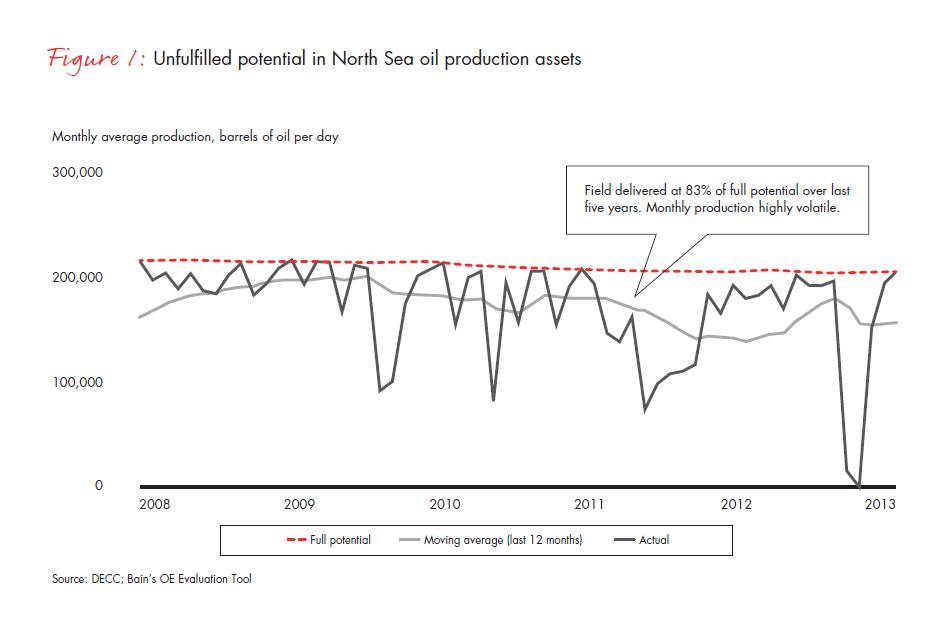
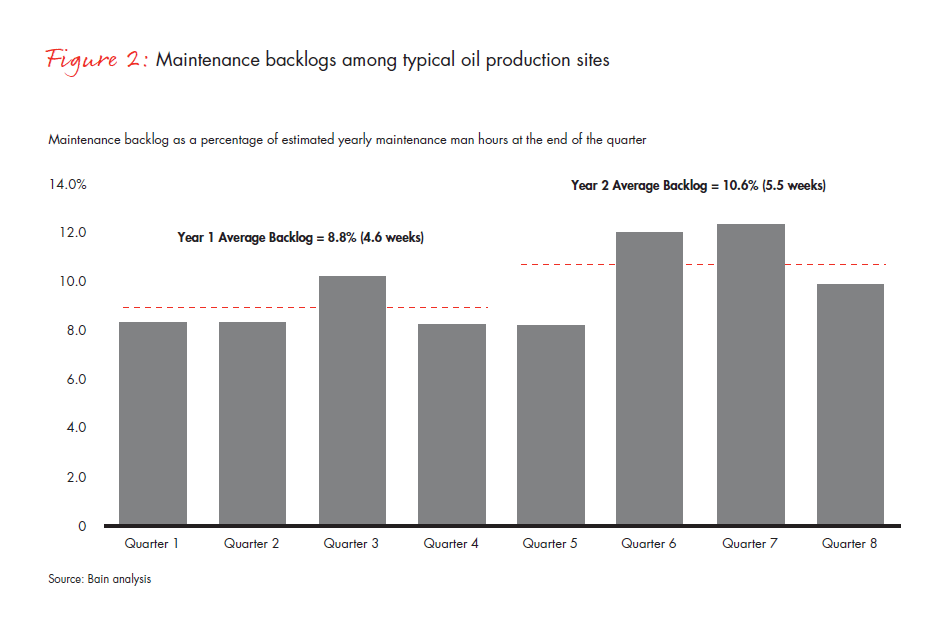
10. Realistic operational delivery. The operational reliability of the oil and gas industry continues to be a major challenge and a huge opportunity to realize value. For example, in the North Sea the average oil production asset performs well below its theoretical potential and has a large backlog of maintenance work (see Figures 1 and 2). From a planning perspective, it is critical to have a clear view of historical performance, as well as reasons to expect stronger or weaker future delivery and the extent to which planned programs and interventions will increase operational performance.
Summary: Getting 2014 right
At Bain, we see a greater premium than ever in getting forecasts and guidance right, not only for internal performance management but also for IOCs to meet stock market requirements and for NOCs to contribute to national budgets. The lower profit-to-equity ratios in oil and gas indicate a performance gap between this sector and other major commercial sectors—which has as much to do with planning as with delivery.
Whenever possible, the approach to planning should focus on the quality of information and sensitivity analysis around what are often P50 numbers—that is, those with at least a 50% confidence level of being commercially recoverable. It is also important to have a realistic view on timing for new projects as well as the upside to be found in mature assets. With a good checklist as a prompt, 2014 planning could be the best yet.
Peter J. Parry is a partner with Bain & Company in its London office. He is a vice president and leads the firm’s Global Oil & Gas practice.
The 2014 planning and budgeting cycle checklist
Oil and gas companies should address the following macroeconomic trends, industry themes and tactical considerations as they plan for the coming year.
What are the macroeconomic trends we must plan for?
- Low real interest rates. What will a period of sustained low-cost capital enable us to do?
- The new normal of political risk. How can we plan better for short-term disruptive political risk?
Which industry themes will be most critical in the coming year?
- Capabilities and capacities. How can we strengthen our talent pool and organize more effectively?
- Inflation. How should we account for sector inflation?
- Oil and gas price volatility. How can we plan effectively, given the volatility in prices?
- Longer-term project pipeline quality. What plans should we make to extend growth beyond thecompletion of major projects beyond 2017?
What tactical considerations are most important in our plans for 2014?
- Exploration focus. Where will we focus, and how will we ensure adequate reserves?
- Gas. What role will gas play in our portfolio?
- Major projects start-up. How can we ensure that projects complete on time and deliver on their expected performance goals?
- Realistic operational delivery. What effect will operational improvement programs have on our performance?
1 US GDP in Q2 2013 was 2.5% compared with that of Q2 2012, which was 2.0%.
2 GDPs for Germany, UK and France in Q2 2013 were between 2% and 3%, up from negative numbers in Q2 2012.
3 Source: Datastream, 2013 profit-to-equity ratios for the pharmaceutical (18.9), technology (18.6) and oil and gas production (10.1) sectors worldwide.
4 Source: Datastream; The price of crude oil has fluctuated between $86 and $108 to date in 2013; gas prices have generally improved.
First published in settembre 2013