

Brief
It’s hard to escape the fact that legal environments are getting more complex—and often more punitive. One sign of this trend is the sharp uptick in enforcement: At least two-thirds of the companies in the insurance, energy, financial services and healthcare industries faced some type of regulatory investigation in 2013, and 52% reported spending more time addressing regulatory requests or enforcement proceedings, up from 43% the previous year, according to a recent survey of in-house legal executives. Across industries, new business practices like electronic data storage and mobile computing are fueling new work for legal, as more than 40% of companies encountered trouble with privacy or data protection during 2013. Not only is the volume of work increasing, the stakes are rising, too. One-third of companies face at least one lawsuit involving $20 million or more; only 18% report no lawsuits.
While the external pressure on corporate legal departments mounts, the internal pressure to reduce costs is also intensifying. Nearly 80% of companies faced this challenge in 2013, according to a recent survey by Sandpiper Partners, up from 66% the prior year.
Legal departments may understandably feel they need more resources, not less. What they may need most, however, is the right emphasis. Given limited resources and competing goals, is the legal department managing the complexity as efficiently and effectively as possible? To put it another way, are legal’s priorities the same as the business’s priorities?
For many corporate legal departments, the answer too often is no.
The financial crisis and its aftereffects prompted many companies to take a hard look at major support functions, such as IT, finance and HR, and optimize them to focus on the activities that add the most value to the organization while jettisoning (or dramatically reducing) non-core activities. One indication of this more discriminating approach: US companies cut, on average, 18% of their general and administrative (G&A) costs between 2010 and 2012, according to a recent Bain survey of US companies.
Transforming corporate legal departments can increase their effectiveness and add more value to the company. Jason Heinrich, a partner in Bain's Performance Improvement practice, explains how in this short video.
Legal has been part of these efforts, and most chief legal officers (CLOs) have attempted to reduce their costs and better focus their activities in some ways. But few companies have gone far enough in getting the most for their money by connecting their legal strategy with their business strategy. Rather than proactively agreeing on what legal should prioritize, management often leaves legal departments to juggle an ever-growing list of demands and make the necessary trade-offs on their own. As a result, the activities that could unlock the most value for the company—say, licensing to enable a new-product launch—can get crowded out by seemingly urgent demands, such as re-architecting nondisclosure agreements or chasing trademark requests for unvetted ideas that neither add significant value nor seek to manage material risks for the business. Without a governing framework linked to the business strategy, legal departments can underinvest in those areas most critical to the business.
Our research and experience show that the best—and most efficient—support functions are relentlessly focused on enabling the organization’s core mission while leveraging a high-performing and scalable delivery model to nimbly tackle new challenges. For example, the role of finance is changing from one that simply reports historical facts and transactions to one that looks forward at the broader landscape, with a greater emphasis on decision support. Similarly, the role of legal is not only compliance or contract management. It is to support the company’s strategy and growth in a way that balances opportunities with risks.
The catch is that legal can’t become a more strategic resource entirely on its own. For a legal department to strategically add value, other departments must recognize it as a high-value but also expensive resource. In our experience working with companies around the world, though, there’s a wide perception gap between CLOs and CEOs on what legal teams add to business results. A 2010 study documented this gap: Though almost 40% of CLOs gave their team top marks for contributing to the commercial value of the company, only 14% of CEOs did so. These numbers suggest two things: Even the majority of CLOs are not fully satisfied with their contributions, and CLOs can take their rightful place as trusted business advisers only when their CEOs and boards believe they are highly effective at delivering value to the business. Here, we look at how companies can meet these challenges, with the end result that legal fully supports top business priorities and avoids investing significant time and money on lesser tasks.
The roadmap to business results
So how do the best companies ensure that their legal departments marry legal savvy with business acumen at an effective cost? For many, it begins with the legal department investing the time to better understand the company’s business strategy and objectives. From there, CLOs can determine where and how they can add the most value and which delivery model makes the most sense. The next step with a clean sheet of paper is to develop a roadmap to achieve the desired state, creating the right milestones and metrics (see Figure 1).
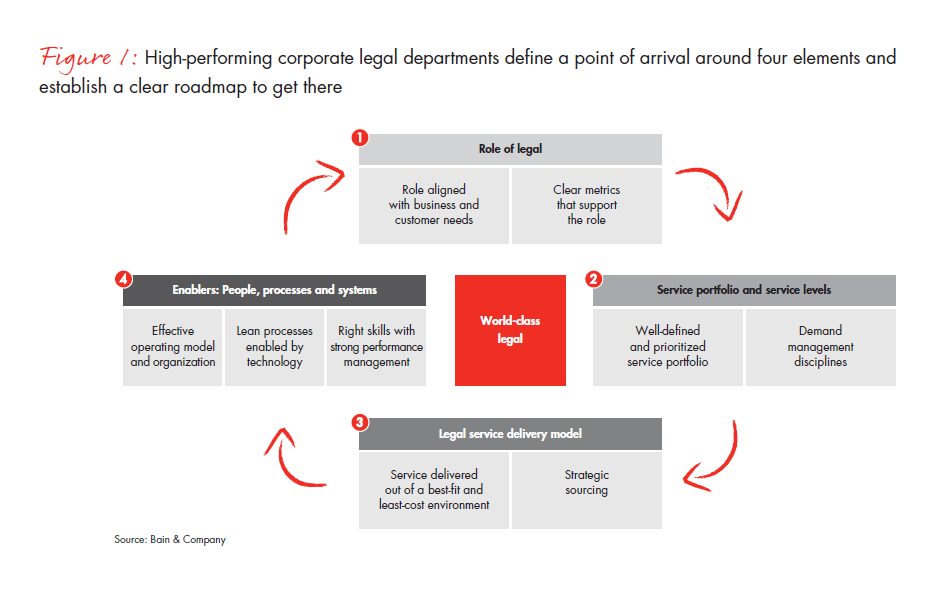
Transforming a legal department requires CLOs to start with “first principles.” Broadly speaking, CLOs need input from the board, CEO, senior management and other stakeholders to establish the right role and fundamental tenets to guide the department. For example, what is the role of the legal department in helping to achieve the company’s business strategy and outcomes? How should the legal department think about managing risk, given the unique demands of its industry and business? Where is the legal department expected to play offense, and where is defense preferable? Proactively agreeing upon a set of basic criteria or a short list of principles allows CLOs to make smart trade-offs with limited resources more explicitly, rather than reactively making trade-offs that may not always align with the business strategy and outcomes the business is trying to achieve (see below, “Six critical questions every CLO [and CEO] should ask”).
Becoming a business adviser
A key measure of success for any legal department should be its level of influence among the key constituents within the business. The best legal departments are valued advisers. While business leaders won’t follow all guidance, world-class legal departments work hard to improve and hone their ability to influence behavior. The most trusted legal departments do three things particularly well:
Build trust. Top legal departments make an effort to create connections across the organization, regularly checking in with business unit leaders to learn how legal can better support operations. With a strong commitment to the business strategy and priorities, they add value by being responsive and offering creative solutions to problems. The best legal departments are in the “say yes” business and find ways to do what the business needs to get done. And trust cuts both ways. The best legal departments also train the businesses on how to handle most matters themselves and trust them to do the right thing, so that legal doesn’t have to opine on everything and can focus only on responding to exceptions and high-value-added matters.
Focus on business outcomes. The best CLOs measure their department’s success based on business outcomes, such as revenue, profit and adherence to risk policies and processes. They use leading and lagging indicators of performance, such as responsiveness, number and timeliness of matters closed, results achieved and settlement dollars, to manage their departments.
The business outcomes, and therefore supporting key performance indicators, will differ by industry and by company. As a result, it’s important that legal departments do not take a “one size fits all” approach to metrics.
- For frequent acquirers: Metrics might focus on how repeatable and streamlined the diligence process is. Does legal provide effective toolkits to streamline diligence, for example? And does legal make potential deals easier for the board to review with presentation templates?
- For companies operating in highly regulated industries: Metrics might include the ability to influence favorable legislation or time required to obtain regulatory approvals or certifications.
- For companies with a heavy compliance focus: Metrics might include training sessions completed, reductions in fines and violations, and qualitative assessments of how well compliance requirements are understood and followed across the organization.
- For companies with a robust litigation pipeline: Metrics might include win rates, cycle time between opening and closing a case, and the cost of litigation—including not only settlements but also outside legal fees.
Armed with this focus on business outcomes, legal departments are well positioned to influence strategy when it comes to advising management on emerging compliance and regulatory requirements that could impact investments and priorities. They also take a more proactive role in seeking commercial opportunities and managing risks. Some CLOs have helped their companies accelerate revenue growth by eliminating work through simplifying and automating processes. They make their contracts more customer friendly, streamline the sales process, reduce corporate entities and standardize forms to reduce complexity and the time needed for legal review.
Focus on improving how the legal function works. It’s not enough for legal departments to commit to aligning with business outcomes. They also need to back up this promise by delivering high-quality services efficiently. CLOs who have a crisp sense of strategic priorities bring those back to the legal department as guideposts for where to focus resources. They then leverage the other three elements of the framework seen in Figure 1 to improve legal’s efficiency and effectiveness in tandem, rather than one at the price of the other.
Tuning the dials on legal service levels
High-performing support functions have long known that putting the right demand management disciplines in place is critical to satisfying their customers and managing costs. Legal departments won’t succeed as order takers; rather, they will thrive as order makers, actively helping to identify customer needs and prioritize requests. Part of this prioritization process means triaging the nonstrategic and low-value work that often creeps into organizations.
Properly tuning the service levels, of course, requires that the legal department has a well-honed understanding of the company’s strategic objectives and investment areas. CLOs at leading companies work closely with business leaders to make the right trade-offs between which legal services can be “good enough” and which ones should be best in class to support the business.
To set the stage, CLOs need to articulate the acceptable risk profile to the broader organization, establish expectations for service levels and inform legal and business leaders about where potential service trade-offs should be made. For example, should the company aim to win litigation at all cost? File for patents as often as possible? Maintain granularly detailed employee policies? Or would the company be better served by staying out of court, pruning the patent portfolio and creating user-friendly policies that promote better employee relations? These are questions that can only be answered in the context of each company’s broader corporate objectives, but getting explicit buy-in from the board of directors and management team gives CLOs the proper framework for making the inevitable trade-offs between cost and quality that legal will face (see Figure 2).
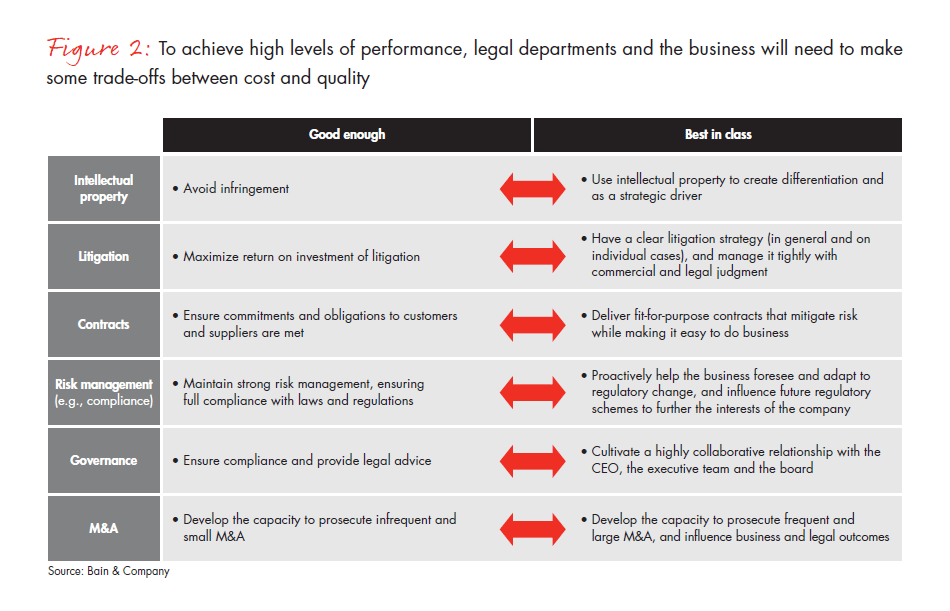
These are examples of policy issues that are as much business as legal in nature and offer CLOs an opportunity to take a leadership role. As part of the dialogue, though, CLOs might consider educating (or re-educating) the business on what drives legal or regulatory risk and how they can mitigate it. This not only helps refine the trade-off decisions, but also builds and reinforces a culture of compliance and risk management.
Service delivery model
Most companies today have moved well beyond the traditional model, where legal work was outsourced only to top-tier law firms, with little to no consideration of lower-tier or non–law firm alternatives (see Figure 3). Today, leaders are more focused on dissecting and dis-aggregating legal processes to a heightened degree of granularity, finding new layers of subprocesses to contract out to lower-cost providers.
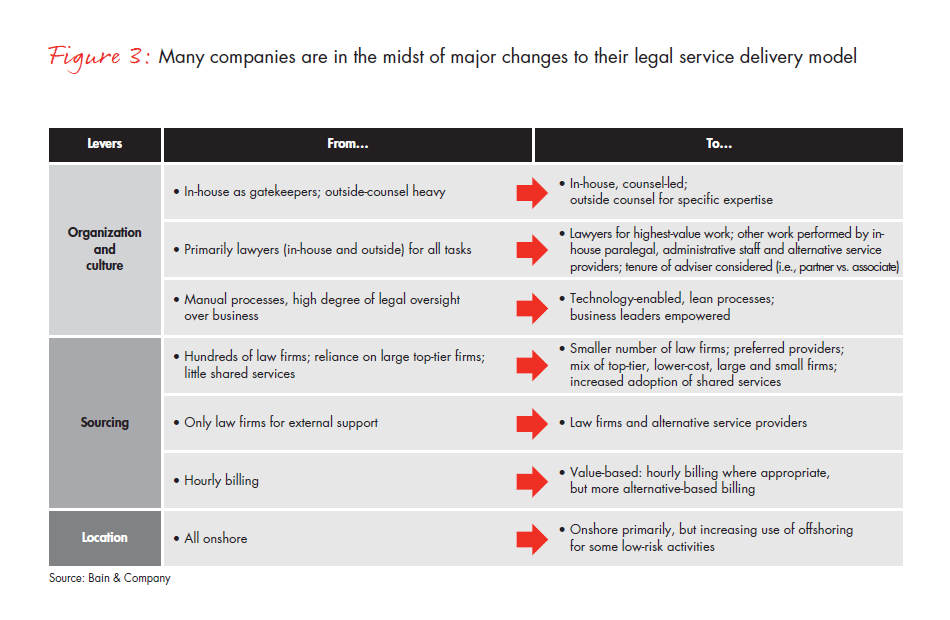
In our experience, three key levers can help create a more efficient service delivery model:
Organization and culture. There are many different models for structuring corporate legal departments. Some departments are highly centralized with legal specialists at the center, working across business units. Others are more decentralized, embedding a legal team within each business unit. Still others have a more mixed model, having both legal specialists at the center for some services and dedicated legal teams embedded across the business.
In some support functions, such as IT, the trend is toward greater centralization regardless of the company’s organization structure and culture. There is no one right answer for legal departments. As a general rule, the organization structure and culture for legal departments often follow the structure and culture of the company. Any of the three organizational models can still allow legal departments to help achieve the desired business outcomes while driving high levels of departmental efficiency and effectiveness.
The way in which legal departments achieve their desired outcomes, though, will be different depending on the organization they choose. A decentralized model with legal teams embedded across the organization means the CLO will need to drive greater levels of standardization and involvement from the business leaders, as it is too costly and risky to build up large legal teams in every corner of the business doing highly customized work. Conversely, a highly centralized model with legal specialists at the center means the CLO will need to ensure that there is sufficient expertise and tailoring of the services to meet the unique needs of business units.
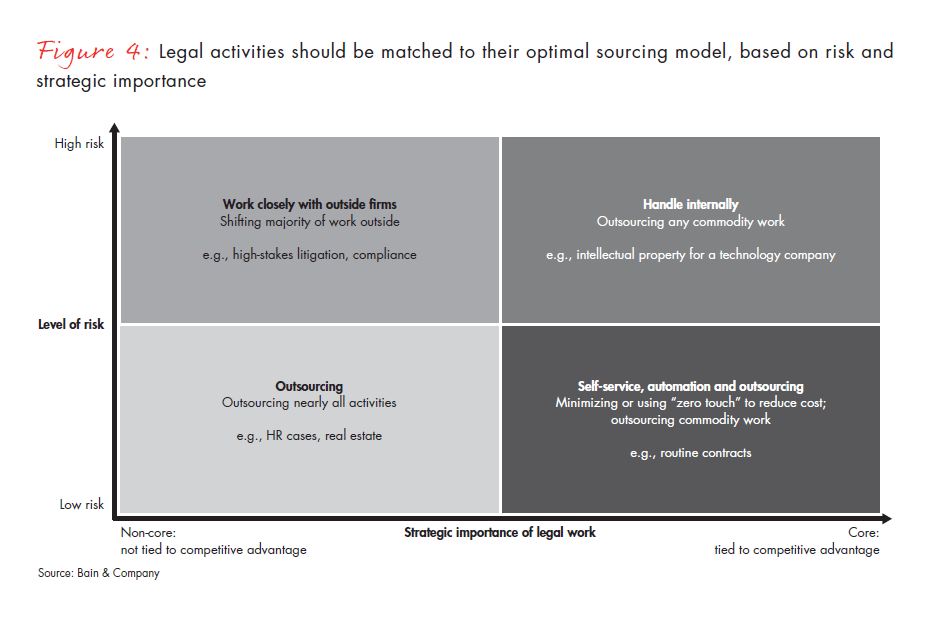
Sourcing. Unlike other support functions, such as finance or HR, legal departments have always embraced outsourcing. According to Bain analysis, legal departments spent, on average, 56% of their budget on outsourcing in 2012. However, unlike most support functions, traditional outsourcing of legal services has been significantly more expensive than insourcing. The question for legal departments going forward is not whether to outsource, but how to strike the right balance between outsourcing and insourcing and determine the right mix of outside resources (see Figure 4).
Location. Offshoring is a relatively new concept to the legal profession, and it can represent significant opportunities to reduce cost. Our client experience indicates that 20% to 30% of total legal spending can be offshored, with subprocesses in areas such as intellectual property, litigation and contracts carrying the highest potential for such treatment.
Another opportunity is taking advantage of lower-cost regions. Corporate law departments in high-cost cities could experiment with models to hire staff and contractors in lower-cost cities. Several major law firms have already implemented two-tiered, nonpartner-track systems in such areas.
Making these shifts requires leaping over a number of hurdles, both real and psychological. It is difficult, for example, to trust that legal process outsourcing (LPO) could perform as well as a law firm. Similarly, the concept of seeking out low-cost locations still seems risky, but it represents a significant opportunity. CLOs who are willing to take on some of these risks and effectively manage them will demonstrate that they can handle risk—not just avoid it—and that they are the type of change agents CEOs look for.
People, processes and systems
Aligning legal work with business outcomes is an important first step, but the strategy will not succeed unless employees have the right skills and resources to implement it. On the skills side, corporate legal departments typically focus on making sure they have the right mix of legal experts in such key areas as litigation, IP and M&A. Infusing the legal department with talented business people, however, can be a great opportunity to improve operational performance and also reduce some of the administrative burden on CLOs.
To that end, CLOs should look to create (or amplify) three key roles:
- An operations officer whom the CLO trusts can play a meaningful role in driving transformational change and making it stick. Good candidates for this role could either come from within legal or outside of it; the main criteria is that the person understands both legal perspectives and the overall strategy of the company.
- Embedded finance (or other analytical) personnel can also play a large part in illuminating spending visibility, managing scorecards and metrics, and implementing audit processes for third-party vendors—all of which should come with clear returns. Dedicated finance resources should also enable better procurement of outside counsel and improved billing practices, which are significant opportunities in most legal organizations.
- A dedicated IT liaison, generally someone within the IT department who has familiarity and experience with legal issues and processes, can help the legal function identify opportunities to better leverage technology. This type of resource can also help the legal function prioritize and sequence existing technology requests, and evaluate specific solutions for purchase.
On the resources side, the right combination of technology, policies and processes can also magnify the effectiveness of the department. New e-discovery tools can bring down the cost of discovery quite a bit, for example, and new record retention policies can reduce costs even further by dramatically cutting down on the volume of documents lawyers must examine. Overall, automating and minimizing some basic legal tasks will free up more time for lawyers to focus on higher-value activities, furthering the goal of business partnership.
Many paths to optimization
Just as no two companies have the same strategy, there is no cookie-cutter approach to transforming a legal department to support that strategy. But companies that make the greatest strides in realigning their legal departments and realizing the efficiency gains that result do follow a set of similar steps to legal transformation. It begins with a vision, shared by the CEO and the CLO, that includes both an understanding of how the role of CLOs is changing and what CLOs can do to align their departments more tightly with the business. The next step is to assess the potential gaps and opportunities around each element of the framework—and then set priorities for change.
Structural change, of course, is hard—it involves making choices about risk, organization and culture, and then taking the right steps to ensure that the resulting changes stick. But aligning with the corporate strategy and the needs of the business, along with increasing the business effectiveness of the legal department, can help enormously in the transition—it ensures the support of business units and helps guarantee that efficiency gains aren’t later overturned because they cut into vital support functions. The result: a fundamental change in the way the legal department works, both internally and within the overall business.
Six critical questions every CLO (and CEO) should ask
To strengthen their business partnerships and influence within the organization, CLOs should be asking themselves the following questions:
- Is there clarity and alignment between the business priorities and the legal team’ s activities?
- Is there agreement on the role that legal should play to support success?
- Have external market and internal business conditions changed, requiring legal to reevaluate its future priorities?
- Is there strong alignment between the business and the legal team on the efficiency and effectiveness of current legal services?
- Is legal moving far enough and fast enough to meet the needs of the business?
- Do we have the right people, skills, expertise and organization across the areas that matter most to achieve our objectives?
Jason Heinrich is a partner in Bain & Company’s Chicago office and a leader in the firm’s Performance Improvement practice. Michael Heric is a Bain partner based in New York and leads the G&A Optimization and Organizational Design practice for the Americas. Neal Goldman is a legal management adviser to Bain & Company. Paul Cichocki is a partner in Bain’s Boston office and leads the firm’s Performance Improvement practice in the Americas.
First published in ottobre 2014