
Skip to Content
  • Uffici

    Uffici

    Nord e Sud America
    • Atlanta
    • Austin
    • Bogota
    • Boston
    • Buenos Aires
    • Chicago
    • Dallas
    • Denver
    • Houston
    • Los Angeles
    • Mexico City
    • Minneapolis
    • Monterrey
    • Montreal
    • New York
    • Rio de Janeiro
    • San Francisco
    • Santiago
    • São Paulo
    • Seattle
    • Silicon Valley
    • Toronto
    • Washington, DC
    Europa, Medio Oriente e Africa
    • Amsterdam
    • Athens
    • Berlin
    • Brussels
    • Copenhagen
    • Doha
    • Dubai
    • Dusseldorf
    • Frankfurt
    • Helsinki
    • Istanbul
    • Johannesburg
    • Kyiv
    • Lisbon
    • London
    • Madrid
    • Milan
    • Munich
    • Oslo
    • Paris
    • Riyadh
    • Rome
    • Stockholm
    • Vienna
    • Warsaw
    • Zurich
    Asia e Australia
    • Bangkok
    • Beijing
    • Bengaluru
    • Brisbane
    • Ho Chi Minh City
    • Hong Kong
    • Jakarta
    • Kuala Lumpur
    • Manila
    • Melbourne
    • Mumbai
    • New Delhi
    • Perth
    • Seoul
    • Shanghai
    • Singapore
    • Sydney
    • Tokyo
    Guarda tutti gli uffici
  • Alumni
  • Media Center
  • Iscriviti
  • Contattaci
  • Italy | Italiano

    Seleziona il tuo Paese e la tua lingua

    Global
    • Global (English)
    Nord e Sud America
    • Brazil (Português)
    • Argentina (Español)
    • Canada (Français)
    • Chile (Español)
    • Colombia (Español)
    Europa, Medio Oriente e Africa
    • France (Français)
    • DACH Region (Deutsch)
    • Italy (Italiano)
    • Spain (Español)
    • Greece (Elliniká)
    Asia e Australia
    • China (中文版)
    • Korea (한국어)
    • Japan (日本語)
  • Saved items (0)
    Saved items (0)

    You have no saved items.

    Contrassegna il contenuto che ti interessa e verrà salvato qui. Potrai leggerlo o condividerlo in seguito.

    Explore Bain Insights
  • Settori
    Menu principale

    Settori

    • Aerospazio e Difesa
    • Agribusiness
    • Chimica
    • Infrastrutture e Costruzioni
    • Beni di Largo Consumo
    • Servizi Finanziari
    • Sanità
    • Macchinari Industriali
    • Media & Intrattenimento
    • Industria Metallurgica
    • Industria Mineraria
    • Petrolio e Gas
    • Industria Cartaria e Packaging
    • Private Equity
    • Settore Sociale & Pubblico
    • Retail
    • Tecnologia
    • Telecomunicazioni
    • Compagnie Aeree & Trasporti
    • Viaggi e Svago
    • Utility e Rinnovabili
  • Servizi di Consulenza
    Menu principale

    Servizi di Consulenza

    • Customer Experience
    • ESG
    • Innovation
    • M&A and Divestitures
    • Operation
    • People & Organization
    • Private Equity
    • Sales & Marketing
    • Strategia
    • IA, Approfondimenti e Soluzioni
    • Tecnologia
    • Trasformazione
  • Digital
  • Tematiche
  • Informazioni su Bain
    Menu principale

    Informazioni su Bain

    • Che Cosa Facciamo
    • Quello in Cui Crediamo
    • Le Nostre Persone e la Leadership
    • Risultati
    • Premi e Riconoscimenti
    • Organizzazioni Globali
    Further: Our global responsibility
    • Diversità e Inclusione
    • Social Impact
    • Sustainability
    • World Economic Forum
    Learn more about Further
  • Careers
    Menu principale

    Careers

    • Work with Us
      Careers
      Work with Us
      • Find Your Place
      • Our Work Areas
      • Integrated Teams
      • Students
      • Internships & Programs
      • Recruiting Events
    • Life at Bain
      Careers
      Life at Bain
      • Blog: Inside Bain
      • Career Stories
      • Our People
      • Where We Work
      • Supporting Your Growth
      • Affinity Groups
      • Benefits
    • Impact Stories
    • Hiring Process
      Careers
      Hiring Process
      • What to Expect
      • Interviewing
    FIND JOBS
  • Uffici
    Menu principale

    Uffici

    • Nord e Sud America
      Uffici
      Nord e Sud America
      • Atlanta
      • Austin
      • Bogota
      • Boston
      • Buenos Aires
      • Chicago
      • Dallas
      • Denver
      • Houston
      • Los Angeles
      • Mexico City
      • Minneapolis
      • Monterrey
      • Montreal
      • New York
      • Rio de Janeiro
      • San Francisco
      • Santiago
      • São Paulo
      • Seattle
      • Silicon Valley
      • Toronto
      • Washington, DC
    • Europa, Medio Oriente e Africa
      Uffici
      Europa, Medio Oriente e Africa
      • Amsterdam
      • Athens
      • Berlin
      • Brussels
      • Copenhagen
      • Doha
      • Dubai
      • Dusseldorf
      • Frankfurt
      • Helsinki
      • Istanbul
      • Johannesburg
      • Kyiv
      • Lisbon
      • London
      • Madrid
      • Milan
      • Munich
      • Oslo
      • Paris
      • Riyadh
      • Rome
      • Stockholm
      • Vienna
      • Warsaw
      • Zurich
    • Asia e Australia
      Uffici
      Asia e Australia
      • Bangkok
      • Beijing
      • Bengaluru
      • Brisbane
      • Ho Chi Minh City
      • Hong Kong
      • Jakarta
      • Kuala Lumpur
      • Manila
      • Melbourne
      • Mumbai
      • New Delhi
      • Perth
      • Seoul
      • Shanghai
      • Singapore
      • Sydney
      • Tokyo
    Guarda tutti gli uffici
  • Alumni
  • Media Center
  • Iscriviti
  • Contattaci
  • Italy | Italiano
    Menu principale

    Seleziona il tuo Paese e la tua lingua

    • Global
      Seleziona il tuo Paese e la tua lingua
      Global
      • Global (English)
    • Nord e Sud America
      Seleziona il tuo Paese e la tua lingua
      Nord e Sud America
      • Brazil (Português)
      • Argentina (Español)
      • Canada (Français)
      • Chile (Español)
      • Colombia (Español)
    • Europa, Medio Oriente e Africa
      Seleziona il tuo Paese e la tua lingua
      Europa, Medio Oriente e Africa
      • France (Français)
      • DACH Region (Deutsch)
      • Italy (Italiano)
      • Spain (Español)
      • Greece (Elliniká)
    • Asia e Australia
      Seleziona il tuo Paese e la tua lingua
      Asia e Australia
      • China (中文版)
      • Korea (한국어)
      • Japan (日本語)
  • Saved items  (0)
    Menu principale
    Saved items (0)

    You have no saved items.

    Contrassegna il contenuto che ti interessa e verrà salvato qui. Potrai leggerlo o condividerlo in seguito.

    Explore Bain Insights
  • Settori
    • Settori

      • Aerospazio e Difesa
      • Agribusiness
      • Chimica
      • Infrastrutture e Costruzioni
      • Beni di Largo Consumo
      • Servizi Finanziari
      • Sanità
      • Macchinari Industriali
      • Media & Intrattenimento
      • Industria Metallurgica
      • Industria Mineraria
      • Petrolio e Gas
      • Industria Cartaria e Packaging
      • Private Equity
      • Settore Sociale & Pubblico
      • Retail
      • Tecnologia
      • Telecomunicazioni
      • Compagnie Aeree & Trasporti
      • Viaggi e Svago
      • Utility e Rinnovabili
  • Servizi di Consulenza
    • Servizi di Consulenza

      • Customer Experience
      • ESG
      • Innovation
      • M&A and Divestitures
      • Operation
      • People & Organization
      • Private Equity
      • Sales & Marketing
      • Strategia
      • IA, Approfondimenti e Soluzioni
      • Tecnologia
      • Trasformazione
  • Digital
  • Tematiche
  • Informazioni su Bain
    • Informazioni su Bain

      • Che Cosa Facciamo
      • Quello in Cui Crediamo
      • Le Nostre Persone e la Leadership
      • Risultati
      • Premi e Riconoscimenti
      • Organizzazioni Globali
      Further: Our global responsibility
      • Diversità e Inclusione
      • Social Impact
      • Sustainability
      • World Economic Forum
      Learn more about Further
  • Careers
    Ricerche più popolari
    • Agile
    • Digitale
    • Strategia
    La tue ricerche precedenti
      Pagine visitate

      Content added to saved items

      Saved items (0)

      Removed from saved items

      Saved items (0)

      Brief

      “A Uniquely Portable Magic”: Why Book Publishing Has Hope

      “A Uniquely Portable Magic”: Why Book Publishing Has Hope

      People are reading less, but those who read focus more and are willing to pay for the good stuff—if you give it to them.

      Di Nicole Magoon, Laurent Colombani, e Daniel Hong

      • Tempo di lettura min.
      }

      Brief

      “A Uniquely Portable Magic”: Why Book Publishing Has Hope
      en
      In evidenza
      • Book publishing is in crisis: People read less in our more online world, and legacy business models aren’t fit for the future.
      • Despite this, reading is highly valued and not easily substituted by other media formats.
      • Readers are passionate and want human-created books; talent can help companies differentiate themselves in the AI flood.
      • To thrive, the industry should market itself as an offline alternative while modernizing operations and monetization.

      Media is everywhere these days, and ever-present screens haven’t done great things for reading. Kids no longer read full-length books in many US schools. Bain’s latest Media Consumption Survey data shows that just over a third of US consumers read books and e-books at least annually (slightly more than 15% listen to audiobooks, if you were hoping that was better), which translates to slightly more than 5% of US consumers’ media time spent with books and audiobooks.

      Benefits of a literate society notwithstanding,* a smaller market is not necessarily problematic. If this were supported by a healthy, appropriately salaried publishing industry with efficient processes and commensurate labor for the market size, one could argue it’s a sustainable, slow-growth model. Unfortunately, industry gossip account xoxopublishinggg regularly posts publishing woes to its more than 30,000 Instagram followers for a reason. Publishing needs fixing.

      And yet, if publishing can develop sustainable operating rhythms, it has more potential than everyone thinks. Books have something going for them that no “newer” media experience has. Despite all our talk of immersive online worlds and all-consuming entertainment, books remain the most immersive entertainment there is.

      (*We’re definitely advocates of a literate society; we just aren’t the right people to write that article.)

      Books are the objective best

      Before you scoff and whip out Minecraft, this is based on data. When we look at how much people say they focus on their media, books are the only media format a majority of US consumers say they pay full attention to while consuming it, according to Bain’s survey (see Figure 1).

      Figure 1
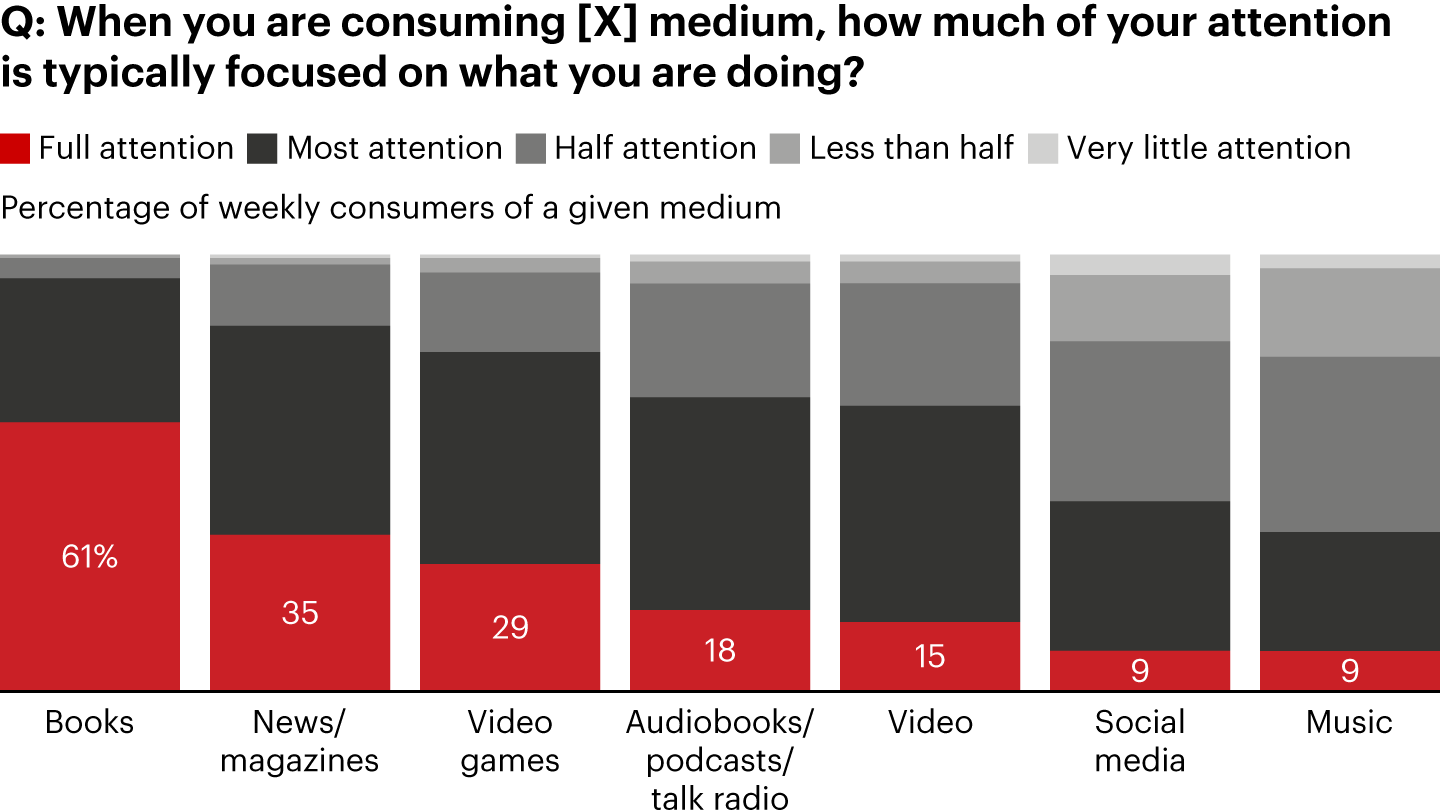
      Books command the highest attention among all media types, with more than 60% of US readers giving their full attention

      Appunti: Only qualified US respondents are considered; video includes consumers of traditional TV, streaming video, or both; music includes streaming and radio listeners

      Fonte: Bain Media Consumption Survey, May 2025 (US n=5,089)

      All that simultaneous Discord chatting, TikTok scrolling, and background Netflix viewing that plagues other media formats happens much less with books (and a bit less with news and magazines, too). We don’t like to multitask the written word. Audiobooks do get multitasked, but their growth is still a good thing; audiobooks can expand the publishing market as they tap into multitasking behavior that physical books don’t, and they can offer accessibility to populations with reading difficulties.

      In a screen-fatigued world, that ability to disconnect and focus is only going to matter more. Furthermore, reading books is seen as “virtuous” in a way that other types of media engagement aren’t. It’s the only media activity that a majority of consumers say they wish they did more of; attending live events, the other major “escape the screen” activity, was just shy of 50% in our survey (see Figure 2).

      Figure 2
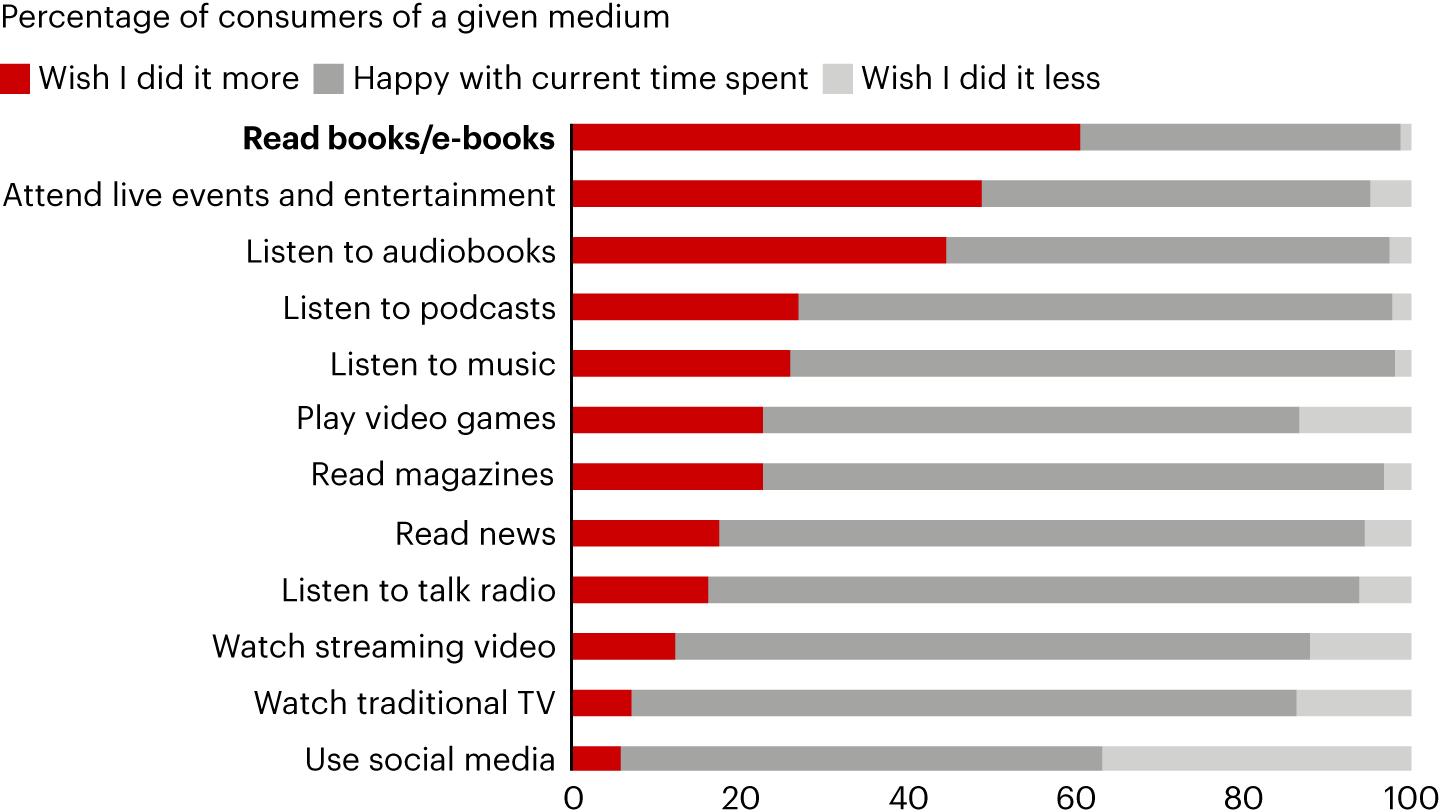
      Around 60% of US consumers wish they read books more

      Appunti: Only qualified US respondents are considered; includes responses from people who said they consume each medium at least monthly, except for live events and entertainment, which includes all respondents

      Fonte: Bain Media Consumption Survey, May 2025 (US n=5,089)

      Lastly, people value the human creativity that goes into books. While consumers are already quite willing to play AI-generated video games, more than 70% say they’re less interested in or simply wouldn’t read books generated in part or in whole by AI (see Figure 3).

      Figure 3
      Across media, US consumers have the lowest tolerance for AI-generated content in books
      visualization
      Source: Bain Media Consumption Survey, May 2025 (US n=5,089)

      There are some genres where this isn’t as true. Poetry, short stories, and children’s literature—though not young adult literature—were the genres/formats where less than half of consumers were “less interested” in AI-generated work. This is also distinctly different when teasing apart consumers’ response to using AI to “fully generate the entire book” (more than 70% of people said they would be less interested in reading it) vs. perform tasks like “edit spelling and grammar” (our apologies to copyeditors everywhere, but only a quarter of consumers said they would be less interested in reading a book copyedited by AI). The authorial voice from a flesh-and-blood writer, however, remains a differentiator,** and that’s something the onslaught of AI Kindle uploads doesn’t have—publishers’ years of honing creative instincts and cultivating talent pipelines matter even more in a flood of content.

      Unfortunately, none of the nice facts above put global book publishing revenue above a low-single-digit growth trajectory, if it continues as it currently is. What they do offer is a chance for publishing to change its narrative based on advantages from its history, while adopting new tech, strategies, and operating rhythms to win in the future.

      (**We practice what we preach—real humans wrote and edited this article, which goes for the rest of Bain’s articles, too.)

      Make more money, make more books

      Let’s break down the things publishing can do into three areas: Get more readers in the door, encourage existing readers to read more, and capture a higher share of wallet from the readers you have.

      Get more readers in the door. This is where the data above matters most—it’s about playing up the advantages that books already have. Books offer a respite from screens, and getting off screens has real grassroots momentum right now. But as publishers scramble to figure out BookTok, there’s been less room to figure out how to show that reading offers something unique. (This is not to say the industry should ignore BookTok—definitely keep paying attention to that one.)

      Years of studies show reading is good for you, backed by the fact that consumers wish they did more of it. But there’s no “got milk” campaign for books, and there’s no reading tracker partnership with the health app on your smartwatch—yet. These kinds of things require collaboration between competitors and beyond publishing, which might seem like a distraction in an industry focused on protecting revenues. Nevertheless, the whole industry has a better chance of thriving if leading voices work together. Continuing to expand formats such as audiobooks and graphic novels, which have enjoyed high growth recently, can help bring in new readers as well.

      Get people to read more. We could repeat the two paragraphs above when we talk about enticing existing readers to read more, and the industry can further those tactics by doubling down on community engagement and proactively working with social forums and reader communities. (Here, BookTok comes back, but also Goodreads and book clubs—celebrity-led and grassroots ones alike).

      These communities build excitement around reading and create a sense of connection, which can leverage the best of the online world to pull readers into the offline one more frequently. While our survey respondents say genre and author are the most important reasons for picking a book, “recommended by family, friends, or community” is important for over a third of readers—and that community is now global.

      Get the $. Speaking of community, books have some of the most powerful fan bases around, and that brings us to the third growth area—how to make more money from the stories you have. Other media sectors are growing savvier about franchising intellectual property (IP) across consumer formats (movies, TV shows, games, merch, live events) and partnering with companies that have similar consumer bases (think of all those Barbie brand activations). In contrast, publishing rarely monetizes content beyond the book until a studio with film or TV rights does it.

      Publishing should stop waiting. Fourth Wing is still in the “video rights sold” stage, but that hasn’t stopped fans from turning up en masse in cosplay at author events. Redbubble and Etsy have countless unlicensed book slogan T-shirts and tote bags, and no author or publishing house is seeing a dime from the use of their IP in those marketplaces. Sprayed-edge special editions of books and book boxes with unnecessary-yet-delightful goodies are doing well for a reason: Fans like buying themed stuff, and they like it when book content stretches to new domains. But publishers have to offer it to them.

      Giving superfans what they want is the most straightforward part of making more money. The other part comes back to the industry marketing itself better. AI is here, whether you win those copyright infringement lawsuits or not, so get ahead of it: Reinforce why your human-created stories have value, label your books as such, and double down on the fact that you’ve built pipelines of the talented authors, illustrators, and editors that consumers reach for when picking a book. There’s pricing power in quality, and in a world flooded with AI content, the publishing industry must reinforce what it has.

      New era, new operating model

      Evolving for the future will also require publishers to redesign their operating model and—we’re just going to duck from the incoming tomatoes—embrace new tech, including AI, to automate processes outside the creative core. These new tools can free up money and time to nurture and compensate creative talent, and those talent pipelines are what will differentiate you in the future media landscape.

      Today’s consumers don’t want AI writing their books, but they really aren’t opposed to it automating publishers’ data analytics. That kind of back-end automation will soon become the norm across media and entertainment industries. Furthermore, emerging competitors will use AI to make rapid, hyper-targeted content, and some of them will even understand how to craft a plot arc. Publishers must prepare for that new landscape while ensuring they have a competitive cost base and operating model.

      Not The End

      We don’t want to underestimate how hard any of this is—it’s a huge change to the way publishing has historically operated. But it’s necessary to change the industry’s trajectory, and it can be done. People value books; they are, as Stephen King once said, “a uniquely portable magic,” and they still draw people in like no other media format can.

      Book publishing has the chance to stand out from the screens, not shrink behind them. It should take it.

      Brief

      Not Yet, Robots: How to Win in Media’s Flooded Era

      As AI floods the market with cheap content, human creativity will stand out—and new tech tools might even help.

      Autori
      • Headshot of Nicole Magoon
        Nicole Magoon
        Partner, London
      • Headshot of Laurent Colombani
        Laurent Colombani
        Partner, Paris
      • Headshot of Daniel Hong
        Daniel Hong
        Partner, New York
      Contattaci
      Industry collegate
      • Media & Entertainment
      Media & Entertainment
      Shift to Vertical: David Haines, Group CEO, Flora Food Group

      What does it take to stay connected to your customers when scale and complexity threaten to pull you away? 

      Leggi di più
      Media & Entertainment
      Media M&A

      AI and other tech tools can boost bidding confidence in this highly competitive environment.

      Leggi di più
      Media & Entertainment
      In an AI Age, People Still Want the Radio Star

      Listeners are open to music artists using AI as a creative tool, but don’t expect an AI band to top the charts anytime soon.

      Leggi di più
      Media & Entertainment
      Music Discovery: More Channels, More Problems

      Consumers find new music via more sources than ever, requiring artists and their record labels to meet them where they are with targeted messages.

      Leggi di più
      Media & Entertainment
      Reimagining Cinema: How Movie Theaters Can Fill Seats Again

      Audiences haven’t abandoned theaters; they need a more compelling reason to go.

      Leggi di più
      First published in ottobre 2025
      Tags
      • Media & Entertainment

      Come abbiamo aiutato i nostri clienti

      Organizzazione A Video Game Company Levels Up With a New Operating Model

      Leggi un caso di studio

      Organizzazione Building a winning media salesforce

      Leggi un caso di studio

      A full-potential business bumps up the bidding

      Leggi un caso di studio

      Vuoi continuare la conversazione?

      Aiutiamo i leader globali e le loro aziende ad affrontare problemi e a cogliere le opportunità. Sosteniamo cambiamenti e otteniamo risultati duraturi.

      Bain Insights. Le nostre idee e punti di vista sulle tematiche che le aziende globali affrontano ogni giorno, arrivano nella tua email tutti i mesi.

      *Ho letto l'Informativa sulla Privacy e accetto i termini e le condizioni.

      Si prega di leggere e accettare l’Informativa sulla Privacy
      Bain & Company
      Contattaci Sustainability Accessibility Condizioni d’uso Privacy Cookie Policy Sitemap Log In

      © 1996-2026 Bain & Company, Inc.

      Contatta Bain

      Come posso aiutarti?

      • Business inquiry
      • Career information
      • Press relations
      • Partnership request
      • Speaker request
      Guarda tutti gli uffici