
Skip to Content
  • Uffici

    Uffici

    Nord e Sud America
    • Atlanta
    • Austin
    • Bogota
    • Boston
    • Buenos Aires
    • Chicago
    • Dallas
    • Denver
    • Houston
    • Los Angeles
    • Mexico City
    • Minneapolis
    • Monterrey
    • Montreal
    • New York
    • Rio de Janeiro
    • San Francisco
    • Santiago
    • São Paulo
    • Seattle
    • Silicon Valley
    • Toronto
    • Washington, DC
    Europa, Medio Oriente e Africa
    • Amsterdam
    • Athens
    • Berlin
    • Brussels
    • Copenhagen
    • Doha
    • Dubai
    • Dusseldorf
    • Frankfurt
    • Helsinki
    • Istanbul
    • Johannesburg
    • Kyiv
    • Lisbon
    • London
    • Madrid
    • Milan
    • Munich
    • Oslo
    • Paris
    • Riyadh
    • Rome
    • Stockholm
    • Vienna
    • Warsaw
    • Zurich
    Asia e Australia
    • Bangkok
    • Beijing
    • Bengaluru
    • Brisbane
    • Ho Chi Minh City
    • Hong Kong
    • Jakarta
    • Kuala Lumpur
    • Manila
    • Melbourne
    • Mumbai
    • New Delhi
    • Perth
    • Seoul
    • Shanghai
    • Singapore
    • Sydney
    • Tokyo
    Guarda tutti gli uffici
  • Alumni
  • Media Center
  • Iscriviti
  • Contattaci
  • Italy | Italiano

    Seleziona il tuo Paese e la tua lingua

    Global
    • Global (English)
    Nord e Sud America
    • Brazil (Português)
    • Argentina (Español)
    • Canada (Français)
    • Chile (Español)
    • Colombia (Español)
    Europa, Medio Oriente e Africa
    • France (Français)
    • DACH Region (Deutsch)
    • Italy (Italiano)
    • Spain (Español)
    • Greece (Elliniká)
    Asia e Australia
    • China (中文版)
    • Korea (한국어)
    • Japan (日本語)
  • Saved items (0)
    Saved items (0)

    You have no saved items.

    Contrassegna il contenuto che ti interessa e verrà salvato qui. Potrai leggerlo o condividerlo in seguito.

    Explore Bain Insights
  • Settori
    Menu principale

    Settori

    • Aerospazio e Difesa
    • Agribusiness
    • Chimica
    • Infrastrutture e Costruzioni
    • Beni di Largo Consumo
    • Servizi Finanziari
    • Sanità
    • Macchinari Industriali
    • Media & Intrattenimento
    • Industria Metallurgica
    • Industria Mineraria
    • Petrolio e Gas
    • Industria Cartaria e Packaging
    • Private Equity
    • Settore Sociale & Pubblico
    • Retail
    • Tecnologia
    • Telecomunicazioni
    • Compagnie Aeree & Trasporti
    • Viaggi e Svago
    • Utility e Rinnovabili
  • Servizi di Consulenza
    Menu principale

    Servizi di Consulenza

    • Customer Experience
    • ESG
    • Innovation
    • M&A and Divestitures
    • Operation
    • People & Organization
    • Private Equity
    • Sales & Marketing
    • Strategia
    • IA, Approfondimenti e Soluzioni
    • Tecnologia
    • Trasformazione
  • Digital
  • Tematiche
  • Informazioni su Bain
    Menu principale

    Informazioni su Bain

    • Che Cosa Facciamo
    • Quello in Cui Crediamo
    • Le Nostre Persone e la Leadership
    • Risultati
    • Premi e Riconoscimenti
    • Organizzazioni Globali
    Further: Our global responsibility
    • Diversità e Inclusione
    • Social Impact
    • Sustainability
    • World Economic Forum
    Learn more about Further
  • Careers
    Menu principale

    Careers

    • Work with Us
      Careers
      Work with Us
      • Find Your Place
      • Our Work Areas
      • Integrated Teams
      • Students
      • Internships & Programs
      • Recruiting Events
    • Life at Bain
      Careers
      Life at Bain
      • Blog: Inside Bain
      • Career Stories
      • Our People
      • Where We Work
      • Supporting Your Growth
      • Affinity Groups
      • Benefits
    • Impact Stories
    • Hiring Process
      Careers
      Hiring Process
      • What to Expect
      • Interviewing
    FIND JOBS
  • Uffici
    Menu principale

    Uffici

    • Nord e Sud America
      Uffici
      Nord e Sud America
      • Atlanta
      • Austin
      • Bogota
      • Boston
      • Buenos Aires
      • Chicago
      • Dallas
      • Denver
      • Houston
      • Los Angeles
      • Mexico City
      • Minneapolis
      • Monterrey
      • Montreal
      • New York
      • Rio de Janeiro
      • San Francisco
      • Santiago
      • São Paulo
      • Seattle
      • Silicon Valley
      • Toronto
      • Washington, DC
    • Europa, Medio Oriente e Africa
      Uffici
      Europa, Medio Oriente e Africa
      • Amsterdam
      • Athens
      • Berlin
      • Brussels
      • Copenhagen
      • Doha
      • Dubai
      • Dusseldorf
      • Frankfurt
      • Helsinki
      • Istanbul
      • Johannesburg
      • Kyiv
      • Lisbon
      • London
      • Madrid
      • Milan
      • Munich
      • Oslo
      • Paris
      • Riyadh
      • Rome
      • Stockholm
      • Vienna
      • Warsaw
      • Zurich
    • Asia e Australia
      Uffici
      Asia e Australia
      • Bangkok
      • Beijing
      • Bengaluru
      • Brisbane
      • Ho Chi Minh City
      • Hong Kong
      • Jakarta
      • Kuala Lumpur
      • Manila
      • Melbourne
      • Mumbai
      • New Delhi
      • Perth
      • Seoul
      • Shanghai
      • Singapore
      • Sydney
      • Tokyo
    Guarda tutti gli uffici
  • Alumni
  • Media Center
  • Iscriviti
  • Contattaci
  • Italy | Italiano
    Menu principale

    Seleziona il tuo Paese e la tua lingua

    • Global
      Seleziona il tuo Paese e la tua lingua
      Global
      • Global (English)
    • Nord e Sud America
      Seleziona il tuo Paese e la tua lingua
      Nord e Sud America
      • Brazil (Português)
      • Argentina (Español)
      • Canada (Français)
      • Chile (Español)
      • Colombia (Español)
    • Europa, Medio Oriente e Africa
      Seleziona il tuo Paese e la tua lingua
      Europa, Medio Oriente e Africa
      • France (Français)
      • DACH Region (Deutsch)
      • Italy (Italiano)
      • Spain (Español)
      • Greece (Elliniká)
    • Asia e Australia
      Seleziona il tuo Paese e la tua lingua
      Asia e Australia
      • China (中文版)
      • Korea (한국어)
      • Japan (日本語)
  • Saved items  (0)
    Menu principale
    Saved items (0)

    You have no saved items.

    Contrassegna il contenuto che ti interessa e verrà salvato qui. Potrai leggerlo o condividerlo in seguito.

    Explore Bain Insights
  • Settori
    • Settori

      • Aerospazio e Difesa
      • Agribusiness
      • Chimica
      • Infrastrutture e Costruzioni
      • Beni di Largo Consumo
      • Servizi Finanziari
      • Sanità
      • Macchinari Industriali
      • Media & Intrattenimento
      • Industria Metallurgica
      • Industria Mineraria
      • Petrolio e Gas
      • Industria Cartaria e Packaging
      • Private Equity
      • Settore Sociale & Pubblico
      • Retail
      • Tecnologia
      • Telecomunicazioni
      • Compagnie Aeree & Trasporti
      • Viaggi e Svago
      • Utility e Rinnovabili
  • Servizi di Consulenza
    • Servizi di Consulenza

      • Customer Experience
      • ESG
      • Innovation
      • M&A and Divestitures
      • Operation
      • People & Organization
      • Private Equity
      • Sales & Marketing
      • Strategia
      • IA, Approfondimenti e Soluzioni
      • Tecnologia
      • Trasformazione
  • Digital
  • Tematiche
  • Informazioni su Bain
    • Informazioni su Bain

      • Che Cosa Facciamo
      • Quello in Cui Crediamo
      • Le Nostre Persone e la Leadership
      • Risultati
      • Premi e Riconoscimenti
      • Organizzazioni Globali
      Further: Our global responsibility
      • Diversità e Inclusione
      • Social Impact
      • Sustainability
      • World Economic Forum
      Learn more about Further
  • Careers
    Ricerche più popolari
    • Agile
    • Digitale
    • Strategia
    La tue ricerche precedenti
      Pagine visitate

      Content added to saved items

      Saved items (0)

      Removed from saved items

      Saved items (0)

      Brief

      Digital Attacker Banks’ Time Has Come

      Digital Attacker Banks’ Time Has Come

      Digital attackers are lower cost, faster to innovate and can transform their traditional parents.

      Di Fabrice Franzen, Vitor D'Agnoluzzo, e Bernardo Sebastião

      • Tempo di lettura min.
      }

      Brief

      Digital Attacker Banks’ Time Has Come
      en
      In evidenza
      • Digital attacker banks have demonstrated that they can delight customers, scale up quickly and expand into new products, geographies and customer segments.
      • Attackers’ cloud-native, cutting-edge technology platforms allow them to have much lower operating costs than most traditional incumbent banks.
      • As an alternative to embarking on a multiyear, hugely expensive systems transformation, some incumbent banks have launched attackers with the aim of transforming the core business.

      Digital attackers—that is, digital-only banks using a cloud-native, low-cost platform—historically were secondary banks for consumers. Many attackers garnered smaller deposits and more limited lending than traditional banks.

      Yet digital attackers have gained ground among consumers, and they hold more promise than initially meets the eye. Traditional banks risk losing market share if they don’t respond to these new models. An inflection point in adoption is near, as some attackers have shown that they can please customers and achieve a large scale. They are expanding from retail to small business accounts, from deposits and basic transactions to lending. As a result, venture capitalists and other investors have heavily funded digital attacker banks in recent years (see Figure 1).

      Figure 1
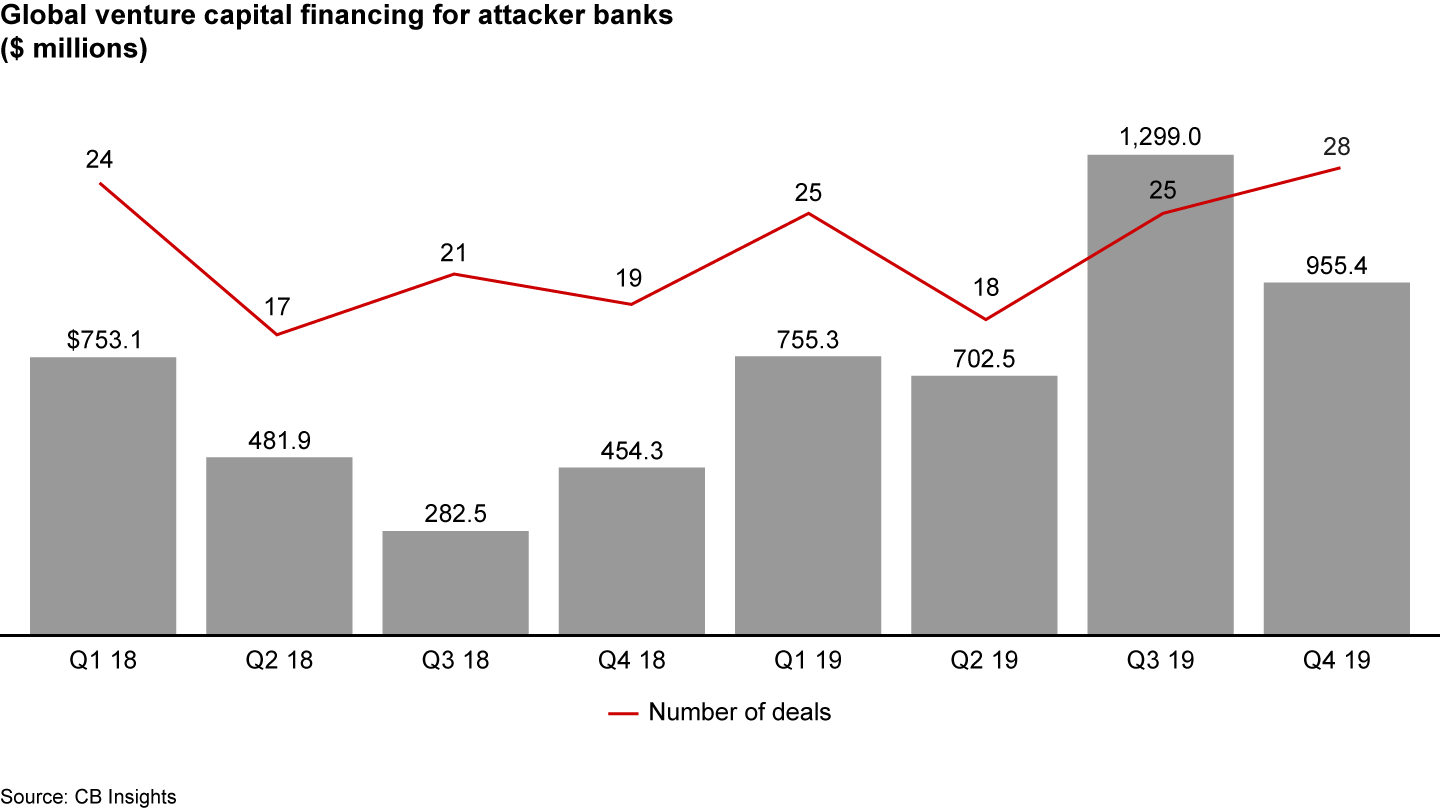
      Digital attacker banks are attracting heavy funding

      For instance, Nubank in Brazil has more than 25 million customers, making it one of the world’s largest digital banks. Nubank has put the smartphone at the heart of its strategy, and it has earned the region’s highest NPS Prism® score (a key metric of loyalty) for banks. Similarly, Kakao Bank attracted 10 million customers in just two years, and in 2019, it also had a customer loyalty score far above traditional banks in Korea, largely on the strength of its customer experience.

      In parallel, the ranks of traditional banks launching their own digital attackers has grown. Mettle, launched by NatWest, targets small UK businesses. Bradesco’s digital offering, Next, started by targeting underserved millennials in Brazil, and it has broadened its appeal to other underserved segments.

      Incumbent banks have realized the compelling logic of having a separate digital bank. Regulatory changes (such as open banking initiatives and the Revised Payment Services Directive, or PSD2, in the European Union) that are designed to promote innovation, better prices and a better experience have primed the field for more competition. Customer expectations have been redefined by technology firms offering personalized, easy, convenient services. To open a current checking account, for instance, takes an average of 81 clicks for 11 major incumbents analyzed in Europe, but it only takes 36 clicks on average for 5 attacker banks in Europe, according to the Centre for Finance, Technology and Entrepreneurship.

      Digital’s cost advantage

      On the revenue side, incumbents strategically can use an attacker bank to enter a new country or to improve their position within a customer segment such as millennials.

      Moreover, lower operating costs flow from having a modern, cloud-native technology platform. Analysis by Bain and Thought Machine finds that a digital attacker launched on such a platform could have a cost base that is 60% to 70% lower than a mid-tier legacy bank (see Figure 2). Bain’s comparison of four attackers with four major incumbents shows that attackers serve two to three times as many customers per employee.

      Figure 2
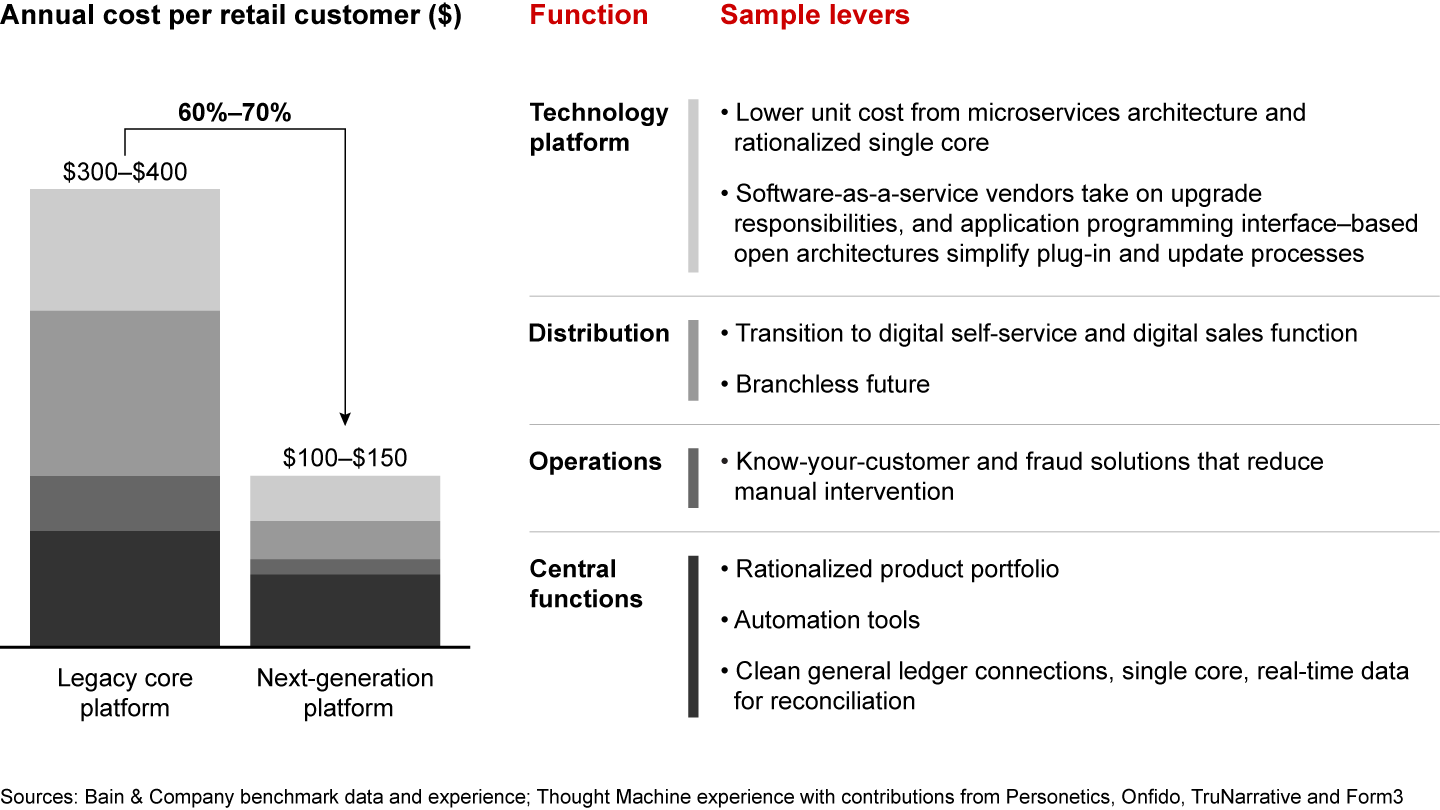
      A digital attacker bank on a cutting-edge technology platform could have a cost base 60%–70% lower than a mid-tier traditional bank

      Digital banks launched by incumbents have varying levels of integration with the parent company. Some incumbents treat their digital attacker as a separate entity with which to energize revenue growth by reaching underserved customer segments and quickly launching new products. They may also enjoy synergies with the existing business—for instance, by sharing fast, low-cost innovation.

      The child could transform the parent

      Other incumbents take a longer view, aiming to use the new bank to transform the core business by building very low-cost operations and more resilient technology. For example, Swedish bank SEB set up SEBx, a cloud-native technology platform, creating an in-house fintech to break with the traditional bank’s own legacy that will serve the broader SEB Group over time. This option holds perhaps the greatest promise as an alternative to embarking on a five-year, hugely expensive core banking transformation that risks causing a big-bang, all-at-once migration of customers.

      Whatever the motivation, success with an attacker bank hinges on several dimensions.

      • Monetization: From the outset, there should be a clear and realistic path to monetizing the strategy. Digital attackers have demonstrated that they can monetize by focusing on a specific customer segment with a narrow value proposition that addresses that segment’s needs.
      • A customer-centered proposition: The offering must align with customers’ needs and expectations. That’s why Marcus from Goldman Sachs has made inroads with affluent US millennials with its high-yield-interest savings product.
      • Speed of scaling: The ability to scale up quickly allows insurgents to penetrate their target segment. Bradesco’s Next reached 3.2 million customers in three years. By contrast, Chase shut down finn, its digital-only mobile banking platform, after only 47,000 customers had joined in a year.
      • Lean operations: The best bank platforms run low-cost operations by leveraging next-generation technology, as Revolut has demonstrated with its cloud-based core systems.
      • An ecosystem of partners: Many customers have begun to see value in obtaining related services through a single platform using open architecture for better integration. Starling’s third-party marketplace is one example, offering insurance, wealth management and tax tools.

      As with any new business, not all attackers will survive, much less thrive. Yet many have resonated with customers; digital attacker banks typically earn higher loyalty scores than regional and national incumbents. Digital attackers might start with less profitable parts of a market, but as they become the primary bank for more customers, they will grow and continue to take share from traditional banks. Younger customers are particularly open to using digital attackers, meaning that the pool of potential customers is bound to grow.

      So incumbents that embrace the scale insurgent mentality stand a better chance of defending their current business while also targeting new customer segments and new markets. It pays to act soon, however, as the window of time to build a strong attacker brand that will attract high-value customers is closing.


      NPS Prism® is a registered trademark of Bain & Company, Inc.

      Autori
      • Headshot of Fabrice Franzen
        Fabrice Franzen
        Partner, Middle East
      • Headshot of Vitor D'Agnoluzzo
        Vitor D'Agnoluzzo
        Partner, London
      • Headshot of Bernardo Sebastião
        Bernardo Sebastião
        Alumni, São Paulo
      Contattaci
      Industry collegate
      • Banking
      • Fintech
      • Servizi Finanziari
      Servizi di consulenza collegati
      • Digital
      • Enterprise Technology
      Servizi Finanziari
      What Makes Digital Attacker Banks So Efficient?

      Digital-only banks have gained ground with consumers, and have lower operating costs than incumbent banks. Here’s why.

      Leggi di più
      Servizi Finanziari
      Can US Banks Protect Their Card-Issuing Business?

      Consumer payments have been gravitating to neobanks and technology firms.

      Leggi di più
      Enterprise Technology
      Reimagining Merchandising in the Era of Agentic AI

      The future of merchandising is not better analysis, but faster, smarter execution—and agentic AI is what makes that possible.

      Leggi di più
      Servizi Finanziari
      The Fragmentation of Wholesale Payments Calls for Banks to Remake Their Approach

      Banks have a dominant position, but competitors look set to take market share.

      Leggi di più
      Enterprise Technology
      Beyond AI Efficiency: A Conversation with Intuit’s Ivan Lazarov

      “Ultimately, we must be audacious enough to envision the impossible and bold enough to build it.”

      Leggi di più
      First published in dicembre 2020
      Tags
      • Banking
      • Digital
      • Enterprise Technology
      • Fintech
      • Servizi Finanziari

      Come abbiamo aiutato i nostri clienti

      Blockchain-enabled Payment Flows: A Payments Company Reviews its Strategy

      Leggi un caso di studio

      A Digital-First Bank Finds a Customer-Driven Path to Profitability

      Leggi un caso di studio

      The change process unlocks potential and profits

      Leggi un caso di studio

      Vuoi continuare la conversazione?

      Aiutiamo i leader globali e le loro aziende ad affrontare problemi e a cogliere le opportunità. Sosteniamo cambiamenti e otteniamo risultati duraturi.

      Bain Insights. Le nostre idee e punti di vista sulle tematiche che le aziende globali affrontano ogni giorno, arrivano nella tua email tutti i mesi.

      *Ho letto l'Informativa sulla Privacy e accetto i termini e le condizioni.

      Si prega di leggere e accettare l’Informativa sulla Privacy
      Bain & Company
      Contattaci Sustainability Accessibility Condizioni d’uso Privacy Cookie Policy Sitemap Log In

      © 1996-2026 Bain & Company, Inc.

      Contatta Bain

      Come posso aiutarti?

      • Business inquiry
      • Career information
      • Press relations
      • Partnership request
      • Speaker request
      Guarda tutti gli uffici