
Skip to Content
  • Uffici

    Uffici

    Nord e Sud America
    • Atlanta
    • Austin
    • Bogota
    • Boston
    • Buenos Aires
    • Chicago
    • Dallas
    • Denver
    • Houston
    • Los Angeles
    • Mexico City
    • Minneapolis
    • Monterrey
    • Montreal
    • New York
    • Rio de Janeiro
    • San Francisco
    • Santiago
    • São Paulo
    • Seattle
    • Silicon Valley
    • Toronto
    • Washington, DC
    Europa, Medio Oriente e Africa
    • Amsterdam
    • Athens
    • Berlin
    • Brussels
    • Copenhagen
    • Doha
    • Dubai
    • Dusseldorf
    • Frankfurt
    • Helsinki
    • Istanbul
    • Johannesburg
    • Kyiv
    • Lisbon
    • London
    • Madrid
    • Milan
    • Munich
    • Oslo
    • Paris
    • Riyadh
    • Rome
    • Stockholm
    • Vienna
    • Warsaw
    • Zurich
    Asia e Australia
    • Bangkok
    • Beijing
    • Bengaluru
    • Brisbane
    • Ho Chi Minh City
    • Hong Kong
    • Jakarta
    • Kuala Lumpur
    • Manila
    • Melbourne
    • Mumbai
    • New Delhi
    • Perth
    • Seoul
    • Shanghai
    • Singapore
    • Sydney
    • Tokyo
    Guarda tutti gli uffici
  • Alumni
  • Media Center
  • Iscriviti
  • Contattaci
  • Italy | Italiano

    Seleziona il tuo Paese e la tua lingua

    Global
    • Global (English)
    Nord e Sud America
    • Brazil (Português)
    • Argentina (Español)
    • Canada (Français)
    • Chile (Español)
    • Colombia (Español)
    Europa, Medio Oriente e Africa
    • France (Français)
    • DACH Region (Deutsch)
    • Italy (Italiano)
    • Spain (Español)
    • Greece (Elliniká)
    Asia e Australia
    • China (中文版)
    • Korea (한국어)
    • Japan (日本語)
  • Saved items (0)
    Saved items (0)

    You have no saved items.

    Contrassegna il contenuto che ti interessa e verrà salvato qui. Potrai leggerlo o condividerlo in seguito.

    Explore Bain Insights
  • Settori
    Menu principale

    Settori

    • Aerospazio e Difesa
    • Agribusiness
    • Chimica
    • Infrastrutture e Costruzioni
    • Beni di Largo Consumo
    • Servizi Finanziari
    • Sanità
    • Macchinari Industriali
    • Media & Intrattenimento
    • Industria Metallurgica
    • Industria Mineraria
    • Petrolio e Gas
    • Industria Cartaria e Packaging
    • Private Equity
    • Settore Sociale & Pubblico
    • Retail
    • Tecnologia
    • Telecomunicazioni
    • Compagnie Aeree & Trasporti
    • Viaggi e Svago
    • Utility e Rinnovabili
  • Servizi di Consulenza
    Menu principale

    Servizi di Consulenza

    • Customer Experience
    • ESG
    • Innovation
    • M&A and Divestitures
    • Operation
    • People & Organization
    • Private Equity
    • Sales & Marketing
    • Strategia
    • IA, Approfondimenti e Soluzioni
    • Tecnologia
    • Trasformazione
  • Digital
  • Tematiche
  • Informazioni su Bain
    Menu principale

    Informazioni su Bain

    • Che Cosa Facciamo
    • Quello in Cui Crediamo
    • Le Nostre Persone e la Leadership
    • Risultati
    • Premi e Riconoscimenti
    • Organizzazioni Globali
    Further: Our global responsibility
    • Diversità e Inclusione
    • Social Impact
    • Sustainability
    • World Economic Forum
    Learn more about Further
  • Careers
    Menu principale

    Careers

    • Work with Us
      Careers
      Work with Us
      • Find Your Place
      • Our Work Areas
      • Integrated Teams
      • Students
      • Internships & Programs
      • Recruiting Events
    • Life at Bain
      Careers
      Life at Bain
      • Blog: Inside Bain
      • Career Stories
      • Our People
      • Where We Work
      • Supporting Your Growth
      • Affinity Groups
      • Benefits
    • Impact Stories
    • Hiring Process
      Careers
      Hiring Process
      • What to Expect
      • Interviewing
    FIND JOBS
  • Uffici
    Menu principale

    Uffici

    • Nord e Sud America
      Uffici
      Nord e Sud America
      • Atlanta
      • Austin
      • Bogota
      • Boston
      • Buenos Aires
      • Chicago
      • Dallas
      • Denver
      • Houston
      • Los Angeles
      • Mexico City
      • Minneapolis
      • Monterrey
      • Montreal
      • New York
      • Rio de Janeiro
      • San Francisco
      • Santiago
      • São Paulo
      • Seattle
      • Silicon Valley
      • Toronto
      • Washington, DC
    • Europa, Medio Oriente e Africa
      Uffici
      Europa, Medio Oriente e Africa
      • Amsterdam
      • Athens
      • Berlin
      • Brussels
      • Copenhagen
      • Doha
      • Dubai
      • Dusseldorf
      • Frankfurt
      • Helsinki
      • Istanbul
      • Johannesburg
      • Kyiv
      • Lisbon
      • London
      • Madrid
      • Milan
      • Munich
      • Oslo
      • Paris
      • Riyadh
      • Rome
      • Stockholm
      • Vienna
      • Warsaw
      • Zurich
    • Asia e Australia
      Uffici
      Asia e Australia
      • Bangkok
      • Beijing
      • Bengaluru
      • Brisbane
      • Ho Chi Minh City
      • Hong Kong
      • Jakarta
      • Kuala Lumpur
      • Manila
      • Melbourne
      • Mumbai
      • New Delhi
      • Perth
      • Seoul
      • Shanghai
      • Singapore
      • Sydney
      • Tokyo
    Guarda tutti gli uffici
  • Alumni
  • Media Center
  • Iscriviti
  • Contattaci
  • Italy | Italiano
    Menu principale

    Seleziona il tuo Paese e la tua lingua

    • Global
      Seleziona il tuo Paese e la tua lingua
      Global
      • Global (English)
    • Nord e Sud America
      Seleziona il tuo Paese e la tua lingua
      Nord e Sud America
      • Brazil (Português)
      • Argentina (Español)
      • Canada (Français)
      • Chile (Español)
      • Colombia (Español)
    • Europa, Medio Oriente e Africa
      Seleziona il tuo Paese e la tua lingua
      Europa, Medio Oriente e Africa
      • France (Français)
      • DACH Region (Deutsch)
      • Italy (Italiano)
      • Spain (Español)
      • Greece (Elliniká)
    • Asia e Australia
      Seleziona il tuo Paese e la tua lingua
      Asia e Australia
      • China (中文版)
      • Korea (한국어)
      • Japan (日本語)
  • Saved items  (0)
    Menu principale
    Saved items (0)

    You have no saved items.

    Contrassegna il contenuto che ti interessa e verrà salvato qui. Potrai leggerlo o condividerlo in seguito.

    Explore Bain Insights
  • Settori
    • Settori

      • Aerospazio e Difesa
      • Agribusiness
      • Chimica
      • Infrastrutture e Costruzioni
      • Beni di Largo Consumo
      • Servizi Finanziari
      • Sanità
      • Macchinari Industriali
      • Media & Intrattenimento
      • Industria Metallurgica
      • Industria Mineraria
      • Petrolio e Gas
      • Industria Cartaria e Packaging
      • Private Equity
      • Settore Sociale & Pubblico
      • Retail
      • Tecnologia
      • Telecomunicazioni
      • Compagnie Aeree & Trasporti
      • Viaggi e Svago
      • Utility e Rinnovabili
  • Servizi di Consulenza
    • Servizi di Consulenza

      • Customer Experience
      • ESG
      • Innovation
      • M&A and Divestitures
      • Operation
      • People & Organization
      • Private Equity
      • Sales & Marketing
      • Strategia
      • IA, Approfondimenti e Soluzioni
      • Tecnologia
      • Trasformazione
  • Digital
  • Tematiche
  • Informazioni su Bain
    • Informazioni su Bain

      • Che Cosa Facciamo
      • Quello in Cui Crediamo
      • Le Nostre Persone e la Leadership
      • Risultati
      • Premi e Riconoscimenti
      • Organizzazioni Globali
      Further: Our global responsibility
      • Diversità e Inclusione
      • Social Impact
      • Sustainability
      • World Economic Forum
      Learn more about Further
  • Careers
    Ricerche più popolari
    • Agile
    • Digitale
    • Strategia
    La tue ricerche precedenti
      Pagine visitate

      Content added to saved items

      Saved items (0)

      Removed from saved items

      Saved items (0)

      Article

      How to make IT spending more effective

      How to make IT spending more effective

      Four skills can help companies reap the hoped-for benefits of their IT spending and ensure that new IT investments target the highest-impact projects.

      Di Donie Lochan

      • Tempo di lettura min.

      Article

      How to make IT spending more effective
      en

      In a time of economic fragility, rapid technological change and ferocious competition, what company is not trying to stretch its capital and operating budgets and do more with less? In no area is the mandate for intelligent frugality more important than spending on information technology.

      Not only is IT among the biggest and fastest-growing outlays for most companies, but executives also view IT as one of the most important enablers of business expansion. In Bain & Company’s survey of senior managers at more than 350 companies, 70 percent of respondents agreed that IT spending was highly relevant to their organization’s future growth.

      But too few companies are reaping the hoped-for benefits from their IT spending. More than 80 percent of the executives we surveyed believe that their IT is out of step with their most important business strategies. In most industries, outlays—simply to keep the lights on in the organization’s installed base—typically consume four out of every five dollars in the IT budget. And because the IT organization does not fully understand what the business wants and needs, it ends up squandering resources on services that fail to meet the business’s true requirements. We calculate that the imbalance between IT supply and business demand leads companies to spend, on average, 20 percent more on IT than they need to.

      Organizations that are best able to ensure that their everyday IT spending is efficient and their new IT investments target the highest-impact projects master these four skills:

      1. Finding strategic alignment: Create headroom for the most important priorities

      The tussle over how to allocate scarce resources leaves the IT organization and its business clients out of step with each other. IT typically is cast in the subordinate role of a master-servant relationship, with the businesses calling the shots. IT ends up running fast to keep up with job orders but lack insight into whether the tasks they are assigned best serve the business’s needs. The businesses also feel constrained by IT, whose resources are absorbed tending to many small projects while the business’s highest-priority initiatives are left unattended.

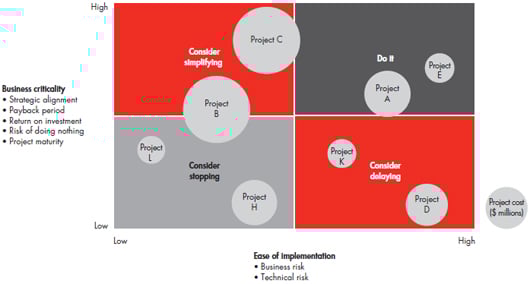
      The experience of a leading bank in the Asia-Pacific region shows that achieving true strategic alignment requires business-IT collaboration to articulate the business’s goals, to identify the unique capabilities needed to attain them and to decide which IT projects can best deliver them. To focus resources on the right initiatives, the bank’s managers took a zero-based approach to IT demand. They subjected each current and planned project in the IT portfolio to an assessment of its value or necessity to the business, the risks involved, the time needed to complete it and, of course, the cost. In the process, the team discovered that more than one-third of the bank’s IT project portfolio was not aligned with its business priorities. Projects deemed strategically critical to the business, as well as those that had an attractive return on investment and posed little business or technical risk, were moved to the top of the list and were accelerated.

      how-to-make-it-spending-more-effective-fig-01.jpg


      As they whittled down the list, the team separated the projects that were “must do,” either because regulators mandated them or because strategic objectives made them essential, from those that were “nice to have” and “not worth the trouble.” By realigning IT projects to business goals, the bank was able to reduce its IT outlays by 35 percent, overall. More important, the percentage of total spending that flowed to top-priority projects increased from 60 percent to 90 percent.

      Key questions to ask about strategic alignment in your organization:

      • Is there a clear IT strategy in place that is explicitly linked to the business strategy?
      • Are all IT projects readily mapped to the parts of the IT and business strategies that each project delivers on?

      2. Managing volume: Pinpoint where the organization is overconsuming IT resources

      Businesses are voracious consumers of IT. Whether IT services are performed in-house or outsourced, overconsumption of everything—from too many servers and laptops to underutilized storage capacity and software licenses—drives up IT costs.

      Paradoxically, inflated demand for IT services and their resulting high cost has its origins in business buyers’ preoccupation with negotiating the lowest unit price for the IT they purchase—whether it’s millions of minutes of mobile phone service or terabytes of processing capacity. The inclination to buy in bulk often turns businesses into indiscriminate consumers and makes them blind to the total cost of their IT use. A classic example of false economy, businesses often justify their bulk-purchase decisions with the rationale that locking in low rates for their hardware or service contracts will guarantee that they will have capacity in reserve to manage peak workloads. Few organizations track the hidden costs of excess capacity, which can be prodigious when organizations ratchet up use of IT they do not need or pay for idle capacity they rarely use.

      Businesses can take four steps to curb IT volume proliferation:

      • First, develop robust tracking tools to monitor IT usage, identify the factors that most affect it and make IT spending more transparent;
      • Second, reinforce budgetary controls by tightening the purchasing approval process and clarifying who has authority to release funds;
      • Third, use actual usage data to rebase the volume assumptions written into outsourcing contracts or agreements with internal IT; and
      • Finally, centralize the procurement of basic IT services that are not strategic to the business.

      Key questions to ask about volume management in your organization:

      • Does the business know which IT costs they are consuming and what is driving these costs?
      • Are there adequate policies and controls in place for IT purchases?

      3. Rooting out complexity: Eliminate redundancy of IT resources across the organization

      The complexity of maintaining, retrofitting and upgrading the organization’s installed base of IT assets is the biggest barrier to aligning business demand and IT supply. Complexity gets in the way whenever a business requests IT resources to tackle an urgent priority or provide an additional capability.

      Delays and the added effort that is needed to tackle this complexity can impose a 50 percent cost premium on a project and significantly limit what IT can actually deliver to the business in the end. When a major financial services firm turned to IT to revamp its product pricing, for example, the complexity in synching incompatible systems resulted in a year-long delay in bringing the basic project to completion.

      Squeezing complexity out of IT often begins by first stripping it out of the business. Subjecting the business’s product portfolio to a rigorous cost-benefit analysis reveals big potential savings. Leaders take what we call a “Model T” approach to simplifying their offerings and harmonizing them across businesses. For example, when executives at a major business services company applied a Model T lens to the company’s product portfolio, they discovered that its branches were actively selling no more than a quarter of the products it offered. Paring back to the most basic offering that best served the needs of their most important customers, the organization’s marketers added back only those features that increased their ability to profitably differentiate themselves from their competitors. Streamlining the portfolio vastly simplified the business’s underlying demand for IT. The product rationalization resulted in a 60 percent reduction in offerings, enabling IT to consolidate platforms and redirect spending to get more out of the smaller IT footprint.

      The savings to be gained by reducing IT complexity can be huge. For example, a global financial services company calculated that reducing its application count by just 1 percent would enable the businesses to bank approximately $20 million in savings.

      Key questions to ask about complexity management in your organization:

      • Are IT changes or new IT systems or infrastructure easy and efficient to implement?
      • Is there typically reuse of IT solutions and a limited number of one-off work-arounds?

      4. Keeping supply and demand in balance: Develop processes and governance rules that enable IT to match its resources with customers’ most important needs

      Unless the master-servant relationship is fundamentally transformed into a partnership of equals, supply-demand imbalances will quickly regenerate. To prevent the problems of misalignment, overconsumption and complexity from recurring, businesses need to learn to value IT as a strategic partner and a trusted adviser.

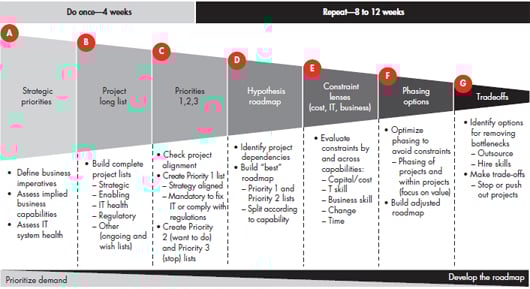
      The partnership needs to be grounded in shared accountability, with senior IT and business executives jointly collaborating in a year-round process to identify the organization’s most important business imperatives and monitor a detailed roadmap to achieve them. In an initial monthlong planning phase with business leaders in charge, the team decides which capabilities the business needs to meet its strategic goals, develops a complete list of priority IT projects and sets a global budget.

      how-to-make-it-spending-more-effective-fig-02.jpg


      Every two to three months, the leadership team reconvenes to flesh out the IT implementation plan. The team homes in on the most urgent priorities from the master list and charts how each can best be done. The team also identifies the constraints that will need to be overcome, considers how they affect the phasing of work and weighs the trade-offs that will need to be made to conserve resources and ensure that the work will be on time and within budget. To monitor demand for IT resources on a day-to-day basis, the leadership team also tasks a working group with ensuring that financial controls are adhered to, that consumption is transparent and that stakeholders have end-to-end visibility into IT spending. When a leading Southeast Asian business services company replaced its once-haphazard IT budgeting process with a tightly controlled IT roadmap, it cut its IT spending on unaligned projects, resulting in a savings of between 10 percent and 15 percent.

      Key questions to ask about demand management processes and governance in your organization:

      • Are there clear procedures and systems in place to govern IT spending, and are they being followed and enforced?
      • Do organizational and decision accountabilities for IT and the businesses encourage efficient IT use and spending?
      Servizi di consulenza collegati
      • Enterprise Technology
      Tecnologia
      How to Keep Control of an IT System That's Outsourced to Multiple Suppliers

      To master increasingly complex IT, companies are turning to multiple suppliers. But that strategy creates another risk: loss of control over mission-critical functions.

      Leggi di più
      Enterprise Technology
      How Businesses Can Prepare for Post-Quantum Cybersecurity Threats

      Your company will soon face attackers armed with quantum technology. Will you be ready?

      Leggi di più
      Enterprise Technology
      Reimagining Merchandising in the Era of Agentic AI

      The future of merchandising is not better analysis, but faster, smarter execution—and agentic AI is what makes that possible.

      Leggi di più
      Enterprise Technology
      Transforming Maintenance with Artificial Intelligence

      With little to no capex, companies can turn maintenance into an engine of cash flow.

      Leggi di più
      Enterprise Technology
      Beyond AI Efficiency: A Conversation with Intuit’s Ivan Lazarov

      “Ultimately, we must be audacious enough to envision the impossible and bold enough to build it.”

      Leggi di più
      First published in ottobre 2011
      Tags
      • Enterprise Technology

      Come abbiamo aiutato i nostri clienti

      A European Banking Giant Rises to the Fintech Challenge

      Leggi un caso di studio

      Salvaging a Technology Outsourcing Deal Gone Bad

      Leggi un caso di studio

      Bridging the Gap Between Business and Technology

      Leggi un caso di studio

      Vuoi continuare la conversazione?

      Aiutiamo i leader globali e le loro aziende ad affrontare problemi e a cogliere le opportunità. Sosteniamo cambiamenti e otteniamo risultati duraturi.

      Bain Insights. Le nostre idee e punti di vista sulle tematiche che le aziende globali affrontano ogni giorno, arrivano nella tua email tutti i mesi.

      *Ho letto l'Informativa sulla Privacy e accetto i termini e le condizioni.

      Si prega di leggere e accettare l’Informativa sulla Privacy
      Bain & Company
      Contattaci Sustainability Accessibility Condizioni d’uso Privacy Cookie Policy Sitemap Log In

      © 1996-2026 Bain & Company, Inc.

      Contatta Bain

      Come posso aiutarti?

      • Business inquiry
      • Career information
      • Press relations
      • Partnership request
      • Speaker request
      Guarda tutti gli uffici