
Skip to Content
  • Uffici

    Uffici

    Nord e Sud America
    • Atlanta
    • Austin
    • Bogota
    • Boston
    • Buenos Aires
    • Chicago
    • Dallas
    • Denver
    • Houston
    • Los Angeles
    • Mexico City
    • Minneapolis
    • Monterrey
    • Montreal
    • New York
    • Rio de Janeiro
    • San Francisco
    • Santiago
    • São Paulo
    • Seattle
    • Silicon Valley
    • Toronto
    • Washington, DC
    Europa, Medio Oriente e Africa
    • Amsterdam
    • Athens
    • Berlin
    • Brussels
    • Copenhagen
    • Doha
    • Dubai
    • Dusseldorf
    • Frankfurt
    • Helsinki
    • Istanbul
    • Johannesburg
    • Kyiv
    • Lisbon
    • London
    • Madrid
    • Milan
    • Munich
    • Oslo
    • Paris
    • Riyadh
    • Rome
    • Stockholm
    • Vienna
    • Warsaw
    • Zurich
    Asia e Australia
    • Bangkok
    • Beijing
    • Bengaluru
    • Brisbane
    • Ho Chi Minh City
    • Hong Kong
    • Jakarta
    • Kuala Lumpur
    • Manila
    • Melbourne
    • Mumbai
    • New Delhi
    • Perth
    • Seoul
    • Shanghai
    • Singapore
    • Sydney
    • Tokyo
    Guarda tutti gli uffici
  • Alumni
  • Media Center
  • Iscriviti
  • Contattaci
  • Italy | Italiano

    Seleziona il tuo Paese e la tua lingua

    Global
    • Global (English)
    Nord e Sud America
    • Brazil (Português)
    • Argentina (Español)
    • Canada (Français)
    • Chile (Español)
    • Colombia (Español)
    Europa, Medio Oriente e Africa
    • France (Français)
    • DACH Region (Deutsch)
    • Italy (Italiano)
    • Spain (Español)
    • Greece (Elliniká)
    Asia e Australia
    • China (中文版)
    • Korea (한국어)
    • Japan (日本語)
  • Saved items (0)
    Saved items (0)

    You have no saved items.

    Contrassegna il contenuto che ti interessa e verrà salvato qui. Potrai leggerlo o condividerlo in seguito.

    Explore Bain Insights
  • Settori
    Menu principale

    Settori

    • Aerospazio e Difesa
    • Agribusiness
    • Chimica
    • Infrastrutture e Costruzioni
    • Beni di Largo Consumo
    • Servizi Finanziari
    • Sanità
    • Macchinari Industriali
    • Media & Intrattenimento
    • Industria Metallurgica
    • Industria Mineraria
    • Petrolio e Gas
    • Industria Cartaria e Packaging
    • Private Equity
    • Settore Sociale & Pubblico
    • Retail
    • Tecnologia
    • Telecomunicazioni
    • Compagnie Aeree & Trasporti
    • Viaggi e Svago
    • Utility e Rinnovabili
  • Servizi di Consulenza
    Menu principale

    Servizi di Consulenza

    • Customer Experience
    • ESG
    • Innovation
    • M&A and Divestitures
    • Operation
    • People & Organization
    • Private Equity
    • Sales & Marketing
    • Strategia
    • IA, Approfondimenti e Soluzioni
    • Tecnologia
    • Trasformazione
  • Digital
  • Tematiche
  • Informazioni su Bain
    Menu principale

    Informazioni su Bain

    • Che Cosa Facciamo
    • Quello in Cui Crediamo
    • Le Nostre Persone e la Leadership
    • Risultati
    • Premi e Riconoscimenti
    • Organizzazioni Globali
    Further: Our global responsibility
    • Diversità e Inclusione
    • Social Impact
    • Sustainability
    • World Economic Forum
    Learn more about Further
  • Careers
    Menu principale

    Careers

    • Work with Us
      Careers
      Work with Us
      • Find Your Place
      • Our Work Areas
      • Integrated Teams
      • Students
      • Internships & Programs
      • Recruiting Events
    • Life at Bain
      Careers
      Life at Bain
      • Blog: Inside Bain
      • Career Stories
      • Our People
      • Where We Work
      • Supporting Your Growth
      • Affinity Groups
      • Benefits
    • Impact Stories
    • Hiring Process
      Careers
      Hiring Process
      • What to Expect
      • Interviewing
    FIND JOBS
  • Uffici
    Menu principale

    Uffici

    • Nord e Sud America
      Uffici
      Nord e Sud America
      • Atlanta
      • Austin
      • Bogota
      • Boston
      • Buenos Aires
      • Chicago
      • Dallas
      • Denver
      • Houston
      • Los Angeles
      • Mexico City
      • Minneapolis
      • Monterrey
      • Montreal
      • New York
      • Rio de Janeiro
      • San Francisco
      • Santiago
      • São Paulo
      • Seattle
      • Silicon Valley
      • Toronto
      • Washington, DC
    • Europa, Medio Oriente e Africa
      Uffici
      Europa, Medio Oriente e Africa
      • Amsterdam
      • Athens
      • Berlin
      • Brussels
      • Copenhagen
      • Doha
      • Dubai
      • Dusseldorf
      • Frankfurt
      • Helsinki
      • Istanbul
      • Johannesburg
      • Kyiv
      • Lisbon
      • London
      • Madrid
      • Milan
      • Munich
      • Oslo
      • Paris
      • Riyadh
      • Rome
      • Stockholm
      • Vienna
      • Warsaw
      • Zurich
    • Asia e Australia
      Uffici
      Asia e Australia
      • Bangkok
      • Beijing
      • Bengaluru
      • Brisbane
      • Ho Chi Minh City
      • Hong Kong
      • Jakarta
      • Kuala Lumpur
      • Manila
      • Melbourne
      • Mumbai
      • New Delhi
      • Perth
      • Seoul
      • Shanghai
      • Singapore
      • Sydney
      • Tokyo
    Guarda tutti gli uffici
  • Alumni
  • Media Center
  • Iscriviti
  • Contattaci
  • Italy | Italiano
    Menu principale

    Seleziona il tuo Paese e la tua lingua

    • Global
      Seleziona il tuo Paese e la tua lingua
      Global
      • Global (English)
    • Nord e Sud America
      Seleziona il tuo Paese e la tua lingua
      Nord e Sud America
      • Brazil (Português)
      • Argentina (Español)
      • Canada (Français)
      • Chile (Español)
      • Colombia (Español)
    • Europa, Medio Oriente e Africa
      Seleziona il tuo Paese e la tua lingua
      Europa, Medio Oriente e Africa
      • France (Français)
      • DACH Region (Deutsch)
      • Italy (Italiano)
      • Spain (Español)
      • Greece (Elliniká)
    • Asia e Australia
      Seleziona il tuo Paese e la tua lingua
      Asia e Australia
      • China (中文版)
      • Korea (한국어)
      • Japan (日本語)
  • Saved items  (0)
    Menu principale
    Saved items (0)

    You have no saved items.

    Contrassegna il contenuto che ti interessa e verrà salvato qui. Potrai leggerlo o condividerlo in seguito.

    Explore Bain Insights
  • Settori
    • Settori

      • Aerospazio e Difesa
      • Agribusiness
      • Chimica
      • Infrastrutture e Costruzioni
      • Beni di Largo Consumo
      • Servizi Finanziari
      • Sanità
      • Macchinari Industriali
      • Media & Intrattenimento
      • Industria Metallurgica
      • Industria Mineraria
      • Petrolio e Gas
      • Industria Cartaria e Packaging
      • Private Equity
      • Settore Sociale & Pubblico
      • Retail
      • Tecnologia
      • Telecomunicazioni
      • Compagnie Aeree & Trasporti
      • Viaggi e Svago
      • Utility e Rinnovabili
  • Servizi di Consulenza
    • Servizi di Consulenza

      • Customer Experience
      • ESG
      • Innovation
      • M&A and Divestitures
      • Operation
      • People & Organization
      • Private Equity
      • Sales & Marketing
      • Strategia
      • IA, Approfondimenti e Soluzioni
      • Tecnologia
      • Trasformazione
  • Digital
  • Tematiche
  • Informazioni su Bain
    • Informazioni su Bain

      • Che Cosa Facciamo
      • Quello in Cui Crediamo
      • Le Nostre Persone e la Leadership
      • Risultati
      • Premi e Riconoscimenti
      • Organizzazioni Globali
      Further: Our global responsibility
      • Diversità e Inclusione
      • Social Impact
      • Sustainability
      • World Economic Forum
      Learn more about Further
  • Careers
    Ricerche più popolari
    • Agile
    • Digitale
    • Strategia
    La tue ricerche precedenti
      Pagine visitate

      Content added to saved items

      Saved items (0)

      Removed from saved items

      Saved items (0)

      Brief

      How Utilities Can Regain Control of Their Technology Roadmap

      How Utilities Can Regain Control of Their Technology Roadmap

      Utilities must find innovative ways to update their IT to keep up with a rapidly evolving electricity sector.

      Di Arnaud Leroi e Alex Martynov

      • Tempo di lettura min.
      }

      Brief

      How Utilities Can Regain Control of Their Technology Roadmap
      en
      In evidenza
      • The electricity sector is changing rapidly, with decarbonization policies, more renewable generation and new competitors.
      • Utilities often face these challenges with outdated IT systems. Transforming IT is difficult in any sector, but regulated utilities also face unique constraints.
      • To avoid being edged out by digital attackers, utilities will need to find innovative ways to invest in IT transformation where it matters.
      • Three principles help leaders make effective technology transformations: align IT priorities with business needs, take advantage of new market opportunities and help IT develop agility.


      Power utilities around the world are confronting an unprecedented level of change in their sector, including decarbonization policies, decentralization of the power grid, electrification of large parts of the economy and an increasingly competitive retail market that offers consumers greater choice over who they buy power from. Customers and regulators are demanding more from utilities than ever before, and investors aren’t lowering their expectations either, with most still looking for earnings growth of 6% or better (see the Bain Brief “New Strategies for Utility Growth”).

      Faced with rising expectations and aggressive new competitors, utilities are working to become more cost efficient to create headroom for innovation, while also improving their abilities to respond quickly and nimbly to technological changes in their sector. However, like companies in many industries, utilities face these challenges with legacy IT systems that are poorly equipped to support the digital demands of the rapidly evolving electricity business. These old IT systems are the result of decades of accretive, patchwork fixes, and many utilities are severely limited in their ability to invest in modernization, due to low margins and regulatory constraints on salaries and operating expenses.

      Sitting still isn’t an option. Across markets, new competitors are entering the sector with greenfield advantages—that is, they can develop new ways of doing business without the burden of legacy systems. In the UK, for example, green energy supplier Bulb offers a mobile app that makes signing up for service as simple as clicking a few buttons and submitting—much simpler and more engaging than navigating lengthy voicemail systems that some legacy providers still use to manage new customer sign-ups (see Figure 1.)

      Figure 1
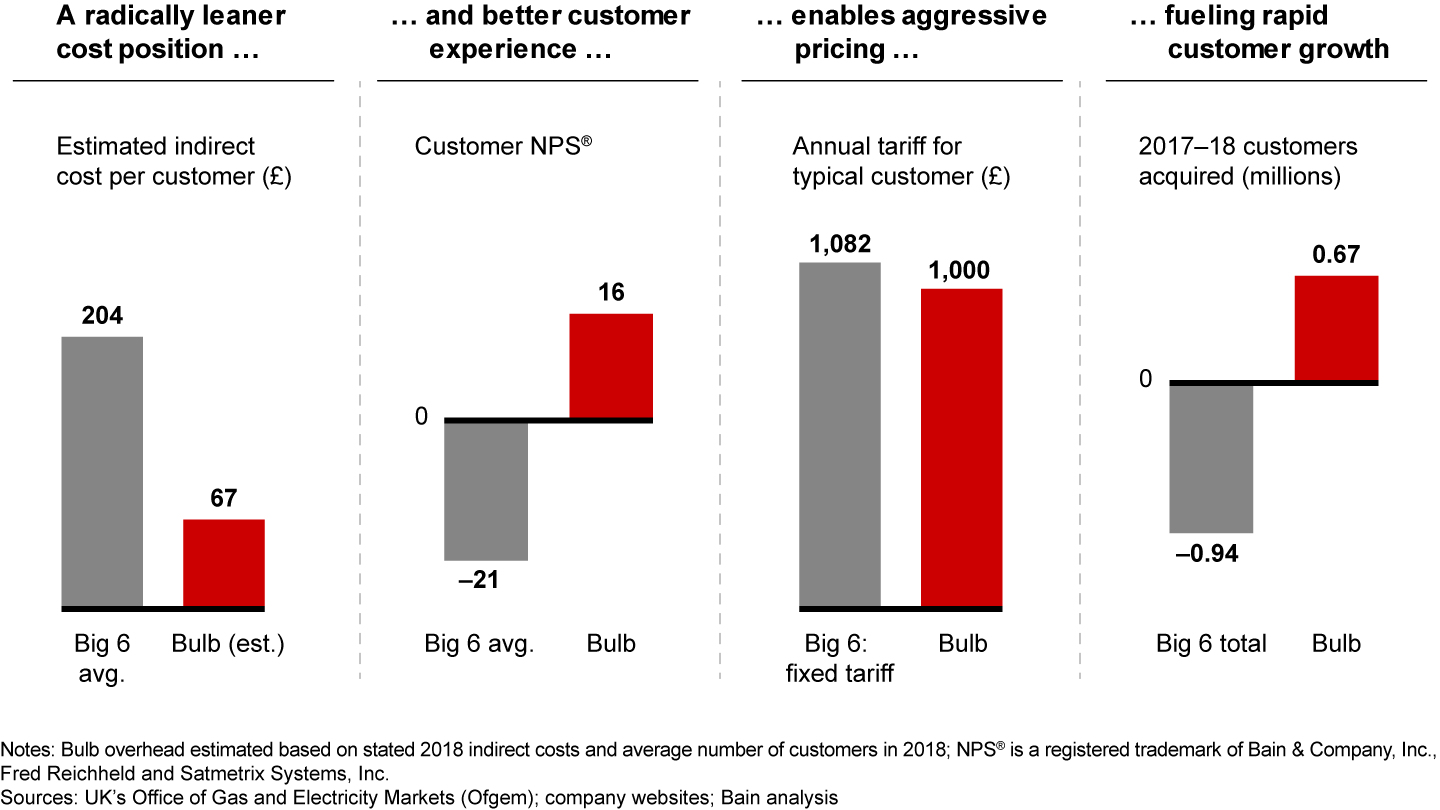
      New entrants like Bulb have a lower cost position combined with better customer experience, allowing them to aggressively acquire customers with lower tariffs
      New entrants like Bulb have a lower cost position combined with better customer experience, allowing them to aggressively acquire customers with a lower tariffs
      New entrants like Bulb have a lower cost position combined with better customer experience, allowing them to aggressively acquire customers with a lower tariffs

      The IT challenge may be different but similarly acute in other parts of the utility value chain. For example, transmission and distribution units may find it difficult to deploy smart grid technologies (like smart meters) or integrate electricity from intermittent, renewable sources if shackled by outdated, monolithic technology systems (see Figure 2).

      Figure 2
      An increasingly complex and interconnected electricity system demands a more sophisticated technological infrastructure

      To develop more flexible technology and avoid being edged out by digital attackers, utilities need to invest in technology transformations that address real business needs, avoiding overly broad and costly initiatives (see the Bain Brief “Digital Transformation for Utilities: More Tortoise, Less Hare”). Successful transformations focus directly on opportunities to improve core processes and customer experiences, like making payments or signing up for new service. They shouldn’t be led solely by IT; the utility’s business owners must be in the driver’s seat, to make sure these investments align with the organization’s strategic priorities.

      Some industry leaders are showing how to work successfully within these constraints and gain momentum in their technology transformations, whether by adopting software-as-a-service (SaaS) solutions for some of their processes, launching digital hubs with greater flexibility to tackle new digital challenges or setting up focused agile teams that can tackle the most promising opportunities as they arise. By understanding where and how they’ve made progress, it’s possible to see a path forward to regain control over a utility’s technology roadmap.

      In our work with utilities, we have identified three aspects of a technology transformation that are particularly important to success: aligning with the business, identifying the funding and becoming more agile.

      Align IT priorities with business needs

      Many industries struggle with poor communication between IT and business executives, and it remains particularly acute in utilities. IT leaders may be too focused on internal issues and may fail to engage closely with business leaders to understand and support strategic goals. As a result, business leaders may not trust IT’s vision or its ability to transform itself.

      Utility executives wrestle with this challenge, with some success. One European utility found that its IT function had the lowest internal customer satisfaction rating (measured by Net Promoter Score®) of any department in the company, a sign that business executives were unhappy with their interactions. The utility changed the way it created new technology initiatives, enlisting business and technology teams to cocreate initiatives. This not only raised the level of confidence in the IT team, but also produced technology programs that did a better job addressing business opportunities.

      Increasingly, IT and business teams will have to work closely together to identify the trade-offs that are necessary to balance budgets, particularly as they relate to choices between customization and simplicity in technology projects. Some of these trade-offs will extend beyond individual business units, and investments will have to be prioritized across the entire organization. Decisions should be guided by strong governance procedures, with oversight from the executive committee and other senior leaders.

      Internal customers who have long been accustomed to bespoke work that meets every last preference will need to become more comfortable with cloud-based and off-the-shelf solutions that deliver the critical functionality at more affordable costs. Some utilities have considered customization the best way to differentiate their services from those of competitors, but there are more effective (and less expensive) ways to improve customer experience, such as simple welcome calls to new customers.

      Align IT funding with evolving market opportunities

      One of the most promising features of change on the technology landscape across industries has been migration to the cloud and the rise of software-as-a-service solutions. SaaS services have proved essential for new energy competitors that lack legacy IT environments and can orient their growth strategies around these services. New competitors recognize that in an industry with margins so thin, they are unlikely to see any profit margins until their customer base reaches scale. So the strategy for early years has been to acquire as many customers as possible, and adopting SaaS solutions that make it easy for customers to sign up helps them do that. Now, larger utilities are experimenting with similar strategies. In March 2018, E.ON contracted with Gentrack to adopt its Velocity billing solution in the UK and Romania. The hope is that by adopting SaaS services that automate the most common interactions, the utility can focus more attention on developing its unique customer experience on top of that critical functionality. 

      At least, that’s the plan in Europe. The situation is more complicated in North America, where regulated utilities have traditionally made money based on capital investment. Invest in upgrading your transmission infrastructure, and regulators may allow you to adjust rates to recoup that investment. Investing capex in a large software app is similarly easy to identify and manage. But migrating applications to the cloud turns capex to opex: that hefty license fee goes away, while monthly subscription fees raise operating expenses.

      Specifics vary from one regulated region to another, but it’s generally more difficult to explain an increase in operating expenses to stakeholders—although some capital asset structures are emerging that would allow subscription pricing to fit better in the regulated utility model.

      Align IT capabilities to develop agility

      As utilities try to transform themselves, many are constrained by their own salary bands that effectively prevent them from hiring the talent they need. This has led some utilities to outsource much of their technology activity, some as much as 85% of their IT function. With all that expertise outside their walls, many utilities have let their own technological skills atrophy, limiting their ability to tackle the IT projects that could move the business forward. Some are not even able to spend the capex they have budgeted for IT because they don’t have enough staff to perform the work. For most, rebuilding the technology function in ways that allow the company to become more strategically agile is likely to be a cornerstone of transformation.

      Some utilities have decided that the best way to develop those capabilities is with a digital acceleration hub, a place where new models can be tested in an incubator environment. These hubs can be an effective way to attract new talent and bring in-house talent up to speed while transitioning to a more agile way of working. One North American utility developed a digital hub that piloted programs making better use of data about field service productivity and outage duration. The unit developed methodologies for more accurate prediction and reporting, which were eventually rolled out to the larger organization.

      Of course, some capabilities may remain unaffordable to develop and maintain in house, given budget limitations and the scarcity of talent in some tech specialties. IT departments will find it important to maintain the capabilities to manage outsourced elements of the stack, as it may be the only way to ensure the best capabilities in areas of high demand, like cybersecurity.

      Digital accelerator hubs and greenfield units develop new programs, but they’re usually tightly focused on one part of the business, rather than the whole. The real challenge comes as utilities try to expand these pilot programs from their test bed to the larger organization. Scaling up tends to expose the shortcomings of legacy IT systems, which were never designed to support new digital customer experiences.

      Some utilities are looking beyond their technology functions and beginning to move the entire organization into an agile mode in order to meet competitive challenges. In Europe, deregulated markets and retail competition are accelerating this transition. Most North American utilities appear to be moving more cautiously. In transmission and distribution, agile methods and “test and learn” processes are more difficult to adopt, given investment patterns and industry regulations. However, with the right incentives, the modernization of capex treatment and a commitment by operations teams to work differently with IT, more utilities are likely to make investments that will position their organizations as technology leaders.

      Net Promoter Score® and NPS® are registered trademarks of Bain & Company, Inc., Fred Reichheld and Satmetrix Systems, Inc.

      Arnaud Leroi is a leader in Bain & Company’s Global Energy & Natural Resources practice. He is based in Paris. Keith Romero and Alex Martynov are affiliated with Bain’s Global Energy & Natural Resources practice and the Global Enterprise Technology practice. Keith is based in San Francisco, and Alex in London. 

      Autori
      • Headshot of Arnaud Leroi
        Arnaud Leroi
        Partner, Paris
      • Headshot of Alex Martynov
        Alex Martynov
        Partner, London
      Contattaci
      Industry collegate
      • Energia e Risorse Naturali
      • Utility e Rinnovabili
      Servizi di consulenza collegati
      • AI, Insights, and Solutions
      • Digital
      • Enterprise Technology
      Come possiamo aiutarti
      • Systems & Architecture
      Enterprise Technology
      Top Digital Use Cases by Industry

      Bain’s research identifies the most useful digital applications, including those that offer the best opportunities for competitive advantage.

      Leggi di più
      Energia e Risorse Naturali
      Utilities Can Power Growth Through a Better Customer Experience

      Top performers turn everyday interactions into loyalty, lower costs, greater revenue streams, and stronger reputations.

      Leggi di più
      Systems & Architecture
      Tech Execs Lack Confidence in System Integrators

      Only 6% said that they would recommend their system integrators for an enterprise resource planning (ERP) transformation.

      Leggi di più
      Enterprise Technology
      Reimagining Merchandising in the Era of Agentic AI

      The future of merchandising is not better analysis, but faster, smarter execution—and agentic AI is what makes that possible.

      Leggi di più
      Energia e Risorse Naturali
      Can the US Energy Grid Keep Up with AI Data Centers?

      Our latest forecast projects data centers will consume 9% of US electricity by 2030, straining the grid without new solutions.

      Leggi di più
      First published in gennaio 2020
      Tags
      • AI, Insights, and Solutions
      • Digital
      • Energia e Risorse Naturali
      • Enterprise Technology
      • Systems & Architecture
      • Utility e Rinnovabili

      Come abbiamo aiutato i nostri clienti

      An Environmental Services Company Captures Massive Savings from a Merger

      Leggi un caso di studio

      Boosting a utility's workforce productivity

      Leggi un caso di studio

      Revitalizing a utility's market position with customer loyalty

      Leggi un caso di studio

      Vuoi continuare la conversazione?

      Aiutiamo i leader globali e le loro aziende ad affrontare problemi e a cogliere le opportunità. Sosteniamo cambiamenti e otteniamo risultati duraturi.

      Bain Insights. Le nostre idee e punti di vista sulle tematiche che le aziende globali affrontano ogni giorno, arrivano nella tua email tutti i mesi.

      *Ho letto l'Informativa sulla Privacy e accetto i termini e le condizioni.

      Si prega di leggere e accettare l’Informativa sulla Privacy
      Bain & Company
      Contattaci Sustainability Accessibility Condizioni d’uso Privacy Cookie Policy Sitemap Log In

      © 1996-2026 Bain & Company, Inc.

      Contatta Bain

      Come posso aiutarti?

      • Business inquiry
      • Career information
      • Press relations
      • Partnership request
      • Speaker request
      Guarda tutti gli uffici