

Brief

In evidenza
- The most innovative companies have rapidly increased their market value relative to innovation laggards, according to Bain’s recent research.
- Highly innovative companies take an ambitious portfolio approach, combining internal programs that cultivate new ideas with external ecosystems of partners and sources of innovation.
- These companies consistently reward innovation and risk-taking, and they look for certain key characteristics in leadership, including risk tolerance and an explorer’s mindset.
Innovation is an imperative for every company today. Given the dynamic and global nature of business, with technology disrupting everything from operating models to supply chains, innovation is now the nexus of strategy. Many well-established companies know that innovation is critical but have only just begun to test the waters. Others have set sail and are learning to navigate. The most advanced are mid-voyage, adventurers deep into a quest. The characteristics of the most advanced companies and the benefits accruing to those leaders are now becoming clear.
Wherever they are on their journey, companies that are especially good at cultivating innovation don’t view it as a task, a project with a set goal. Instead, they envision a permanent state of evolution and exploration.
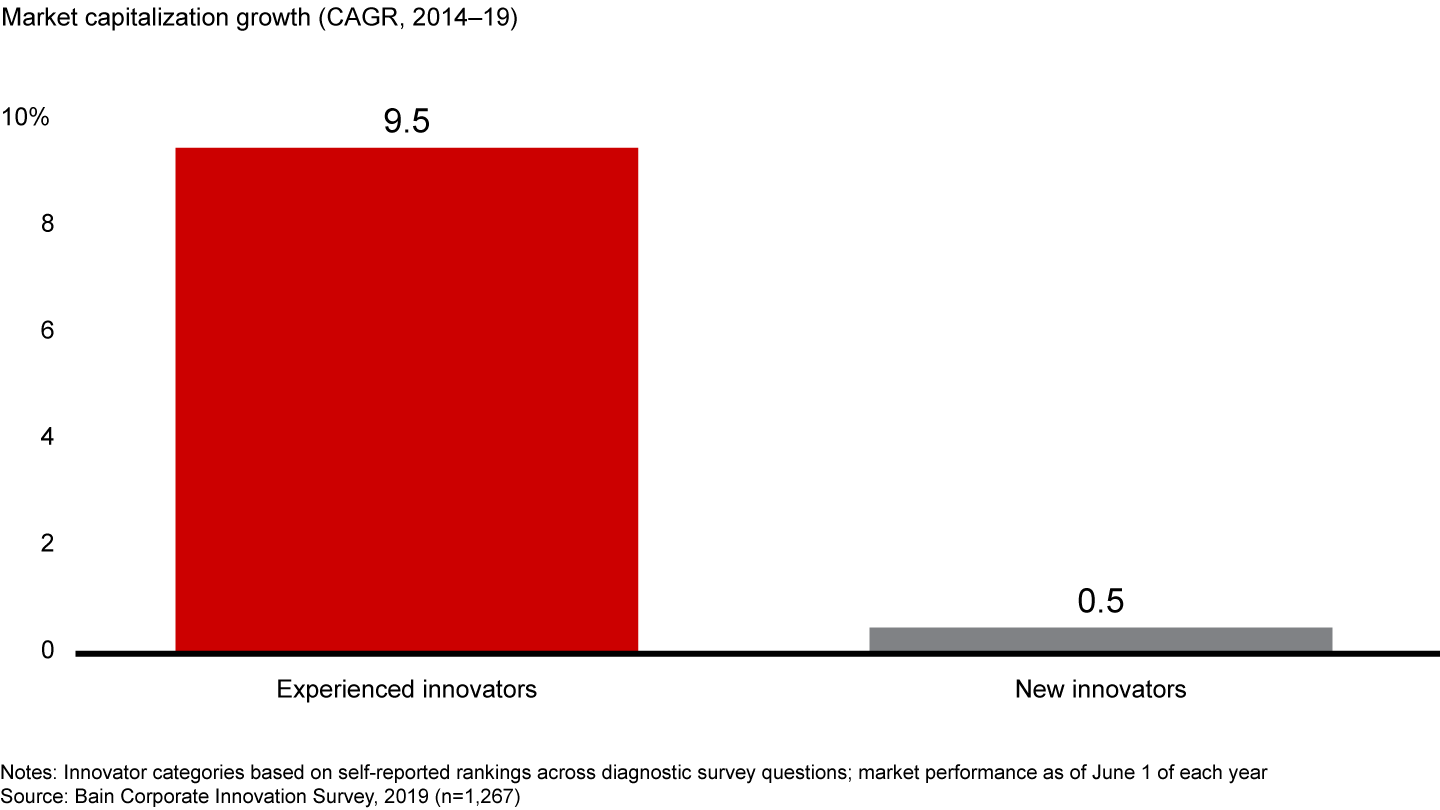
Exploration can be difficult and uncomfortable, but the payoff is well worth the challenge, Bain & Company research has found. Working with Dynata, a leading data provider, we recently surveyed more than 1,200 executives actively engaged in innovation. We found that experienced innovators grew their market capitalization at a five-year compound annual rate of 9.5%, compared with just 0.5% for those with the least experience (see Figure 1).
Figure 1

Setting sail: Many approaches and even more ideas
One of the survey’s most striking findings was the clear value of pursuing a variety of approaches to innovation. While corporate strategy often benefits from focus, the process of innovation requires making multiple bets. This may feel counterintuitive, and could require changes in corporate behavior and culture, but the data shows that the most innovative companies have already embraced this approach. Experienced innovators in our survey employ a variety of approaches to generate innovation, averaging 4.4 different tactics each, compared with 2.8 tactics for the companies least experienced at innovation.

Why Leading Innovators Think Like Explorers
The best companies view innovation as a permanent state of exploration, not a set path with a predefined goal.
The portfolio of approaches successful innovators use can include corporate venture capital, business accelerators, incubators and partnerships with the broader ecosystem. Some, like hackathons and dedicated time for experimentation, are internal programs. Others, such as corporate venture capital funds, help the company reach outside itself and expand its access to fresh ideas. By laying bets in many different ways, companies create more angles into innovation and improve the odds of finding a truly important new idea. Building the portfolio helps develop the muscles to innovate and spreads out the inevitable risk of failure. Pursuing varied approaches also signals the strong commitment of an organization’s leaders to exploration and its central role in sustaining the enterprise.
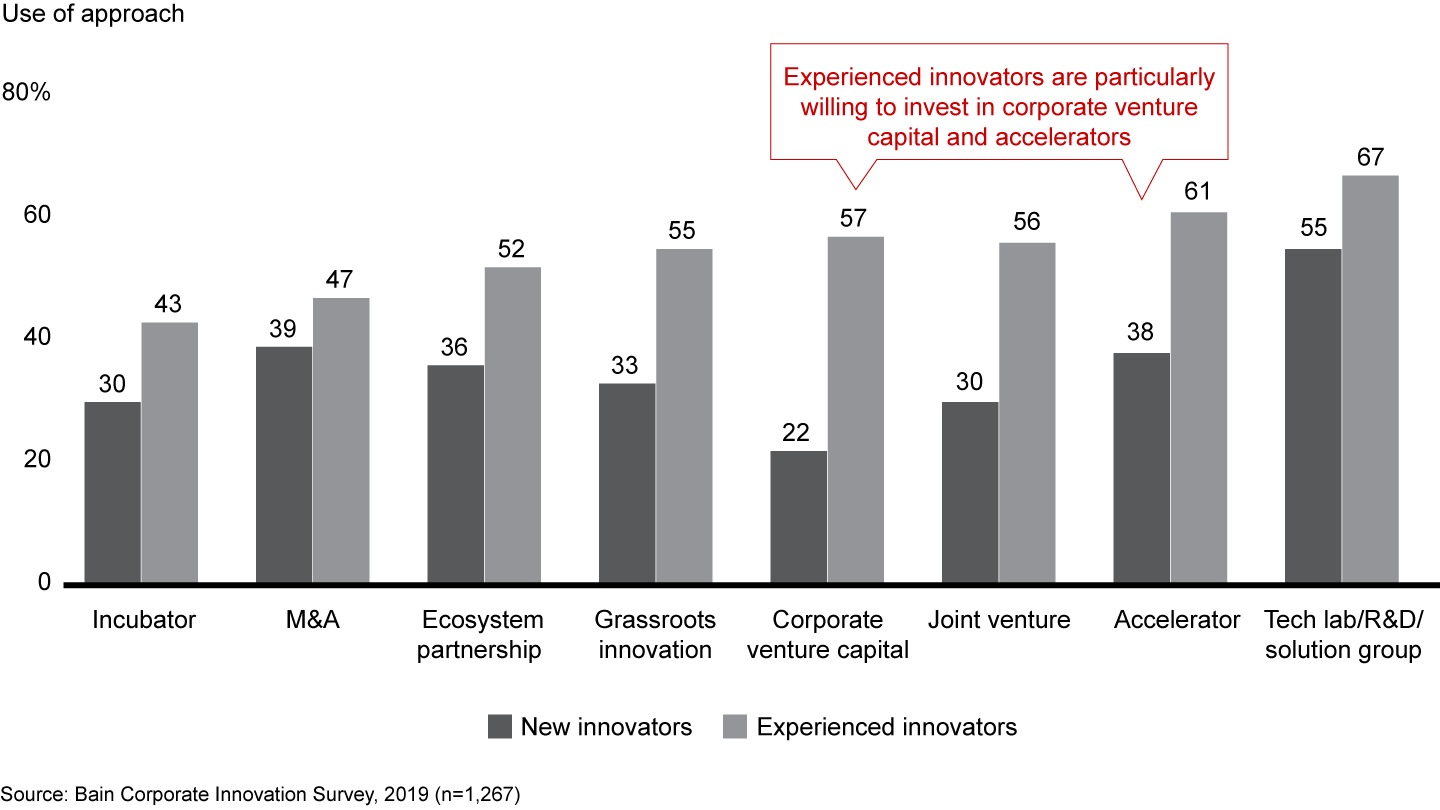
Among the most popular approaches are corporate venture capital, which 57% of experienced innovators in our survey report using, and accelerators, used by 61% of those in the top quartile (see Figure 2). Less experienced companies are far less likely to use either. Only 22% of the companies in the bottom quartile of innovation have a corporate venture capital fund, and only 38% of them have utilized accelerators.
Figure 2

Innovation approaches should complement, strengthen and harmonize with one another, so it’s important that companies are deliberate and thoughtful about how they construct and operate their portfolios. There is no point in hosting a hackathon or idea challenge if it doesn’t smoothly connect to an early-stage incubator or accelerator program, for example. Why incubate a new business venture if there is no way of scaling it through a corporate venture capital arm or via the external ecosystem? Each innovation approach serves a different purpose, and companies must be clear about what they hope to achieve with each. Don’t expect a hackathon to yield a unicorn—it won’t—but it can be a great symbol of leadership and a beacon of the explorer’s mindset. A venture capital arm, on the other hand, might indeed aim to fund a start-up with billion-dollar potential.
A portfolio of approaches makes uncertainty easier to accept. It’s okay that some things will fail, because others will succeed. Some bets may have a quick near-term payoff; others will take longer. Dividing the risks across these different dimensions helps companies become more tolerant of risk. Over time, this builds institutional learning and fosters the kind of corporate courage that innovation requires.
An explorer’s mindset: Mapping the path to greater innovation
One of the best-known examples of portfolio innovation is the approach of Google’s parent company, Alphabet. Like many of the experienced innovators in our survey (some with far fewer resources at their disposal), Alphabet is outgrowing its peer group by launching a fleet of ships, each on its own voyage. Every day, it’s putting more speedboats in the water—agile efforts focused on exploration and learning that can rapidly change direction, permitting its core supertanker of a business to remain on a steady course.
Alphabet’s corporate venture capital arm invests in life sciences, artificial intelligence, transportation and cybersecurity. Its mobile, machine learning and applications businesses run more than 2,000 open-source projects, including the Android operating system and TensorFlow. Google Developers Launchpad is a six-month accelerator focused on machine learning and AI for start-ups in developing markets. The company has both a traditional R&D lab—for moonshots and tackling megatrends in transportation and urban infrastructure—and an in-house incubator that gives employees the opportunity to pursue their ideas. By exploring far and wide, Alphabet has registered nearly 9,000 US patents in the past three years alone, and new ideas have contributed to a doubling of corporate revenue over the past five years.
In a very different industry, agricultural equipment maker John Deere is broadening its ecosystem through acquisition and partnership. Since purchasing California-based Blue River Technology, Deere has left the maker of farm robotics largely independent. Blue River’s tools can recognize plants, diagnose issues, and execute actions such as spraying weeds with herbicide or thinning the crop, which can reduce herbicide use in some parts of the process. Alexey Rostapshov, head of digital innovation at John Deere Labs, believes that combining Deere’s internal capability development with partnerships across the agritech industry is the best way to accelerate innovation and create competitive advantage. “The acquisition of Blue River Technology and the data insights team we are building at John Deere Labs are just two examples of how we strengthen and complement the John Deere precision ag technology group,” he says. “On the partnership front, our formal collaborator program strengthens how we work with start-ups, and our open digital platform includes over 100 software partners with whom our growers can share data if they elect to do so.”
In our research on innovation, Bain has collaborated closely with Perry Klebahn and Jeremy Utley, directors at Stanford’s Hasso Plattner Institute of Design (the d.school). Their work underscores the importance of pursuing many approaches to generate new ideas. “Commissioning many exploratory missions simultaneously does pay off,” says Utley. “It is the best way to foster discovery.”
Utley points to Stanford professor Bob Sutton’s research showing that, for an organization to deliver two or three commercial successes, it must first start with 4,000 raw ideas. That’s an order of magnitude larger than what most CEOs think they need, Utley notes. “Leveraging a portfolio approach to any innovation effort can drastically improve the effort’s likelihood of ultimate success,” he says. The approach makes possible the speed, agility and iteration that positive disruption requires.
Some slack in the system is needed for this to work, however. When an employee comes up with a new opportunity, does he or she have to work on it on the weekend? If employees who identify an opportunity can’t be relieved of their everyday responsibilities, new ideas may suffer. Of course, some parts of the business should be lean, but in areas where exploration is important, companies must be able to accommodate the time new discoveries will demand. Build in slack strategically, Utley says, because “if every time we have a new opportunity we have to hire new people, that doesn’t work.”
Hackathons and innovation summits, as well as protecting employee time to experiment, can encourage in-house talent to pursue their fresh ideas more freely. The Facebook “like” button developed out of one of the company’s many internal hackathons. And long before Google established its 20% policy, 3M encouraged employees to dedicate 15% of their time to pursuing innovative ideas.
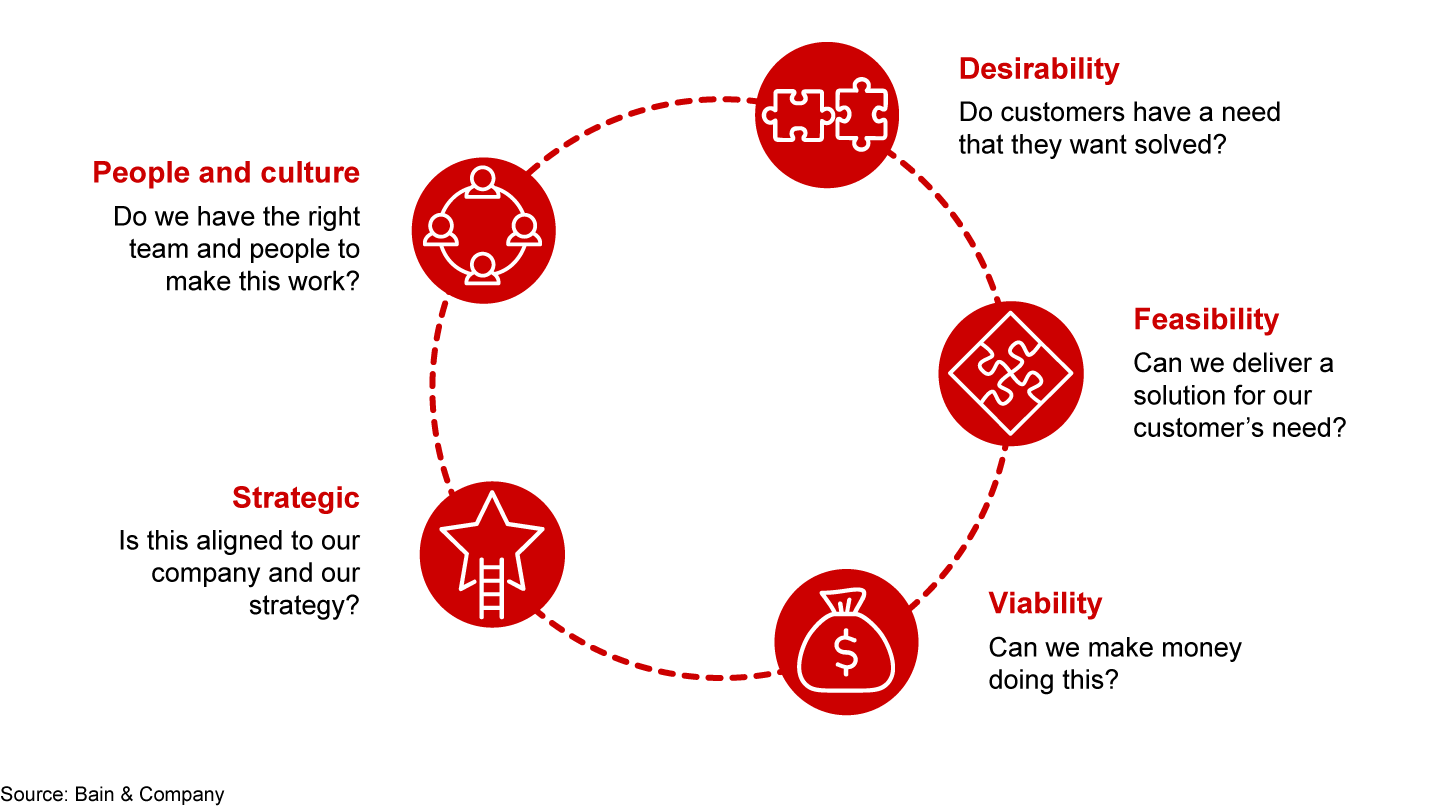
Generating sufficient ideas is the first challenge. Paring them down and then managing that portfolio is the next. Utley and Klebahn propose that managers apply three filters sequentially: first, what is desirable for the user; second, what is feasible technically; and finally, what is economically viable. To those, we would add two more tests: strategy (whether an idea aligns with the company’s long-term strategic plan) and people (who on the executive team will sponsor the idea and who will staff the teams) (see Figure 3).
Figure 3

Charting your course
Our survey finds that companies need three things for a successful innovation journey. First, when setting strategic goals, they must be open to many sources of new ideas and engaged with a broader ecosystem. Second, companies must rewire their culture and norms to tolerate and value risk, challenging any bias toward efficiency and incremental improvement. The third critical piece is to embrace an explorer’s mindset, marked by a constant search for new ideas and a passion to solve fundamental problems for the company’s customers and employees. Combined, these three factors support a portfolio approach to innovation and the incubation of new ideas.
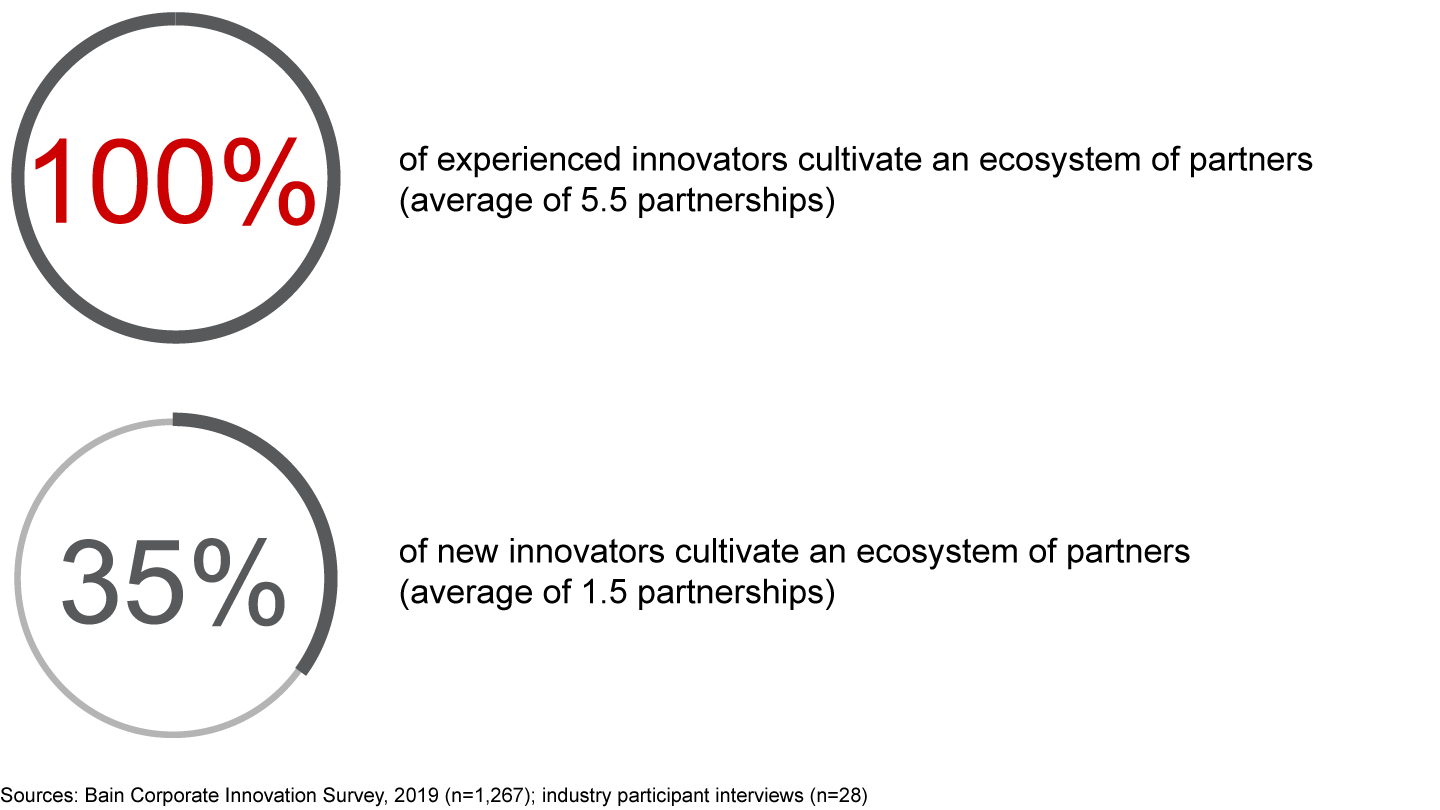
Open up your strategy. Use not just the boat, but also the wind, current, crew and all the assets of your ecosystem to speed and improve innovation. Highly innovative companies collaborate with an ecosystem of external organizations. The most experienced innovators in our study have more than three-and-a-half times the number of partners as the least experienced group (see Figure 4).
Figure 4

Benefits of partnership include the chance to tap into specialized expertise and broader talent pools, to build tools and solutions without bearing the full cost and to gain exposure to new ideas and business models.
Rewire company culture and norms. Exploration can be scary. It’s not only uncharted waters that employees need to worry about. Sometimes a new direction requires more radical change, even a whole new vessel. Unless a company can overcome its institutional fear of failure, it stands little chance of effectively reorienting toward innovation.
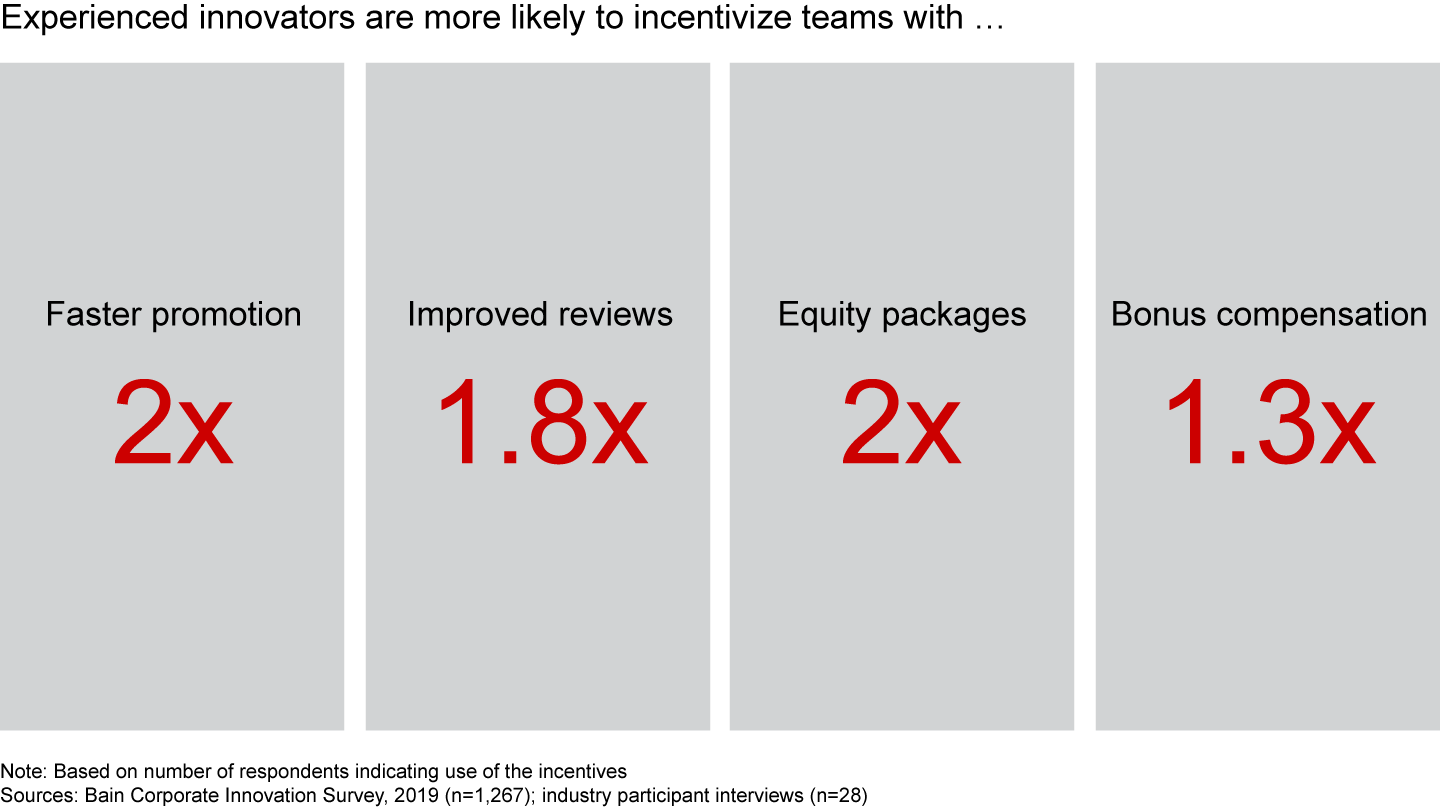
Our study found that experienced innovators are much more likely to reward employees for trying new things and to acknowledge their efforts even when their work doesn’t pan out. Risk-takers in these organizations are rewarded with faster promotion, greater equity and bonus compensation, and improved performance reviews (see Figure 5). Such rewards are a means to an end. They nurture teams of people who deeply and passionately care about the problem they are solving, a kind of engagement and dedication that is simply priceless.
Figure 5

Because innovation requires starting with many ideas and then whittling them down, it is important to reward making those tough choices. One option is to calculate the dollars saved by not continuing a faltering project. Another is to track the percentage of ideas cut.
It’s also important to develop a formal structure for what to do with failed projects and the people who work on them, including clear guidelines for reassignment, incentives and other details.
Develop an explorer’s mindset. Great leaders catalyze innovation in an organization—they supply the oxygen for new ideas and help protect them from the traditional company’s tendency to reject them. We call them EPIC leaders because they are Enthusiastic (espousing a relentless passion for the problems they are solving), Prominent (senior enough to be heard, ideally reporting to the CEO or CIO), Influential (able to secure buy-in and resources and to help incorporate completed projects into the broader organization) and Consistent (acting as stable project champions and upping the chances that innovation will succeed).
Such leaders need some appetite for risk, says Stanford’s Klebahn: “Too many organizations end up picking people to run innovation work who are proven contributors—they create results. Usually these people are the most intolerant of risk and uncertainty. You need to take an explorer’s mind frame from the beginning.”
To lead innovation efforts, it’s helpful to select people who can handle uncertainty. They may not only need to learn new skills, but also to overcome the instincts developed over years of work in traditional operations. “The process of innovation is easy to understand, just like riding a bike backwards or writing with your other hand. The most difficult part is rewiring all of the learned instinct, reflexes and muscle memory inside your organization that has been established over decades,” says Tien-Ti Mak, who was the innovation partner and chief technology officer at Australia Post before joining Bain as a senior advisor in 2018.
In addition to cultivating this behavior, it’s crucial that companies connect leaders to one another and integrate them across the organization. Michael Arena, vice president of talent and development at Amazon Web Services and former chief talent officer for General Motors, stresses the significance of these kinds of connections to innovation. “It’s important to weave together the social fabric of a company so that different groups can meet each other. This might happen naturally for some organizations, but for others we have to thoughtfully manufacture these scenarios,” he says.
Stay Two Steps Ahead of Disruption
Disruption is everywhere. Forge Retail keeps you updated on the latest in retail innovation. Sign up to receive our curated newsletter, Pulse, and invitations to our live Showcases featuring disruptors and industry luminaries.
Moving forward
Where is your company on its innovation journey? Are you just testing the waters or have you set sail? Perhaps you are well into your exploration of the wide sea. An online diagnostic tool can help assess your company’s starting position, providing a scorecard across a number of critical enablers of innovation and pointing where to go next.
The following questions offer a practical starting point for many executives and boards:
- Are we encouraging employees to pursue new ideas and opportunities?
- What are the best approaches—from corporate venture capital to accelerators—to propel our innovation strategy?
- Do we employ enough approaches to constitute a diverse portfolio? Are those approaches aligned with clear objectives?
- Are we enabling and supporting failure in our organization?
- Who are our EPIC leaders?
Knowing where you are today helps you set the course and prioritize what needs to happen next.
Elizabeth Spaulding, a Bain & Company partner in San Francisco, leads the Bain Innovation Exchange and is a coleader of the firm’s Digital practice. Also based in San Francisco, Greg Caimi leads Bain’s Digital practice in the Americas.
First published in ottobre 2019