
Skip to Content
  • Uffici

    Uffici

    Nord e Sud America
    • Atlanta
    • Austin
    • Bogota
    • Boston
    • Buenos Aires
    • Chicago
    • Dallas
    • Denver
    • Houston
    • Los Angeles
    • Mexico City
    • Minneapolis
    • Monterrey
    • Montreal
    • New York
    • Rio de Janeiro
    • San Francisco
    • Santiago
    • São Paulo
    • Seattle
    • Silicon Valley
    • Toronto
    • Washington, DC
    Europa, Medio Oriente e Africa
    • Amsterdam
    • Athens
    • Berlin
    • Brussels
    • Copenhagen
    • Doha
    • Dubai
    • Dusseldorf
    • Frankfurt
    • Helsinki
    • Istanbul
    • Johannesburg
    • Kyiv
    • Lisbon
    • London
    • Madrid
    • Milan
    • Munich
    • Oslo
    • Paris
    • Riyadh
    • Rome
    • Stockholm
    • Vienna
    • Warsaw
    • Zurich
    Asia e Australia
    • Bangkok
    • Beijing
    • Bengaluru
    • Brisbane
    • Ho Chi Minh City
    • Hong Kong
    • Jakarta
    • Kuala Lumpur
    • Manila
    • Melbourne
    • Mumbai
    • New Delhi
    • Perth
    • Seoul
    • Shanghai
    • Singapore
    • Sydney
    • Tokyo
    Guarda tutti gli uffici
  • Alumni
  • Media Center
  • Iscriviti
  • Contattaci
  • Italy | Italiano

    Seleziona il tuo Paese e la tua lingua

    Global
    • Global (English)
    Nord e Sud America
    • Brazil (Português)
    • Argentina (Español)
    • Canada (Français)
    • Chile (Español)
    • Colombia (Español)
    Europa, Medio Oriente e Africa
    • France (Français)
    • DACH Region (Deutsch)
    • Italy (Italiano)
    • Spain (Español)
    • Greece (Elliniká)
    Asia e Australia
    • China (中文版)
    • Korea (한국어)
    • Japan (日本語)
  • Saved items (0)
    Saved items (0)

    You have no saved items.

    Contrassegna il contenuto che ti interessa e verrà salvato qui. Potrai leggerlo o condividerlo in seguito.

    Explore Bain Insights
  • Settori
    Menu principale

    Settori

    • Aerospazio e Difesa
    • Agribusiness
    • Chimica
    • Infrastrutture e Costruzioni
    • Beni di Largo Consumo
    • Servizi Finanziari
    • Sanità
    • Macchinari Industriali
    • Media & Intrattenimento
    • Industria Metallurgica
    • Industria Mineraria
    • Petrolio e Gas
    • Industria Cartaria e Packaging
    • Private Equity
    • Settore Sociale & Pubblico
    • Retail
    • Tecnologia
    • Telecomunicazioni
    • Compagnie Aeree & Trasporti
    • Viaggi e Svago
    • Utility e Rinnovabili
  • Servizi di Consulenza
    Menu principale

    Servizi di Consulenza

    • Customer Experience
    • ESG
    • Innovation
    • M&A and Divestitures
    • Operation
    • People & Organization
    • Private Equity
    • Sales & Marketing
    • Strategia
    • IA, Approfondimenti e Soluzioni
    • Tecnologia
    • Trasformazione
  • Digital
  • Tematiche
  • Informazioni su Bain
    Menu principale

    Informazioni su Bain

    • Che Cosa Facciamo
    • Quello in Cui Crediamo
    • Le Nostre Persone e la Leadership
    • Risultati
    • Premi e Riconoscimenti
    • Organizzazioni Globali
    Further: Our global responsibility
    • Diversità e Inclusione
    • Social Impact
    • Sustainability
    • World Economic Forum
    Learn more about Further
  • Careers
    Menu principale

    Careers

    • Work with Us
      Careers
      Work with Us
      • Find Your Place
      • Our Work Areas
      • Integrated Teams
      • Students
      • Internships & Programs
      • Recruiting Events
    • Life at Bain
      Careers
      Life at Bain
      • Blog: Inside Bain
      • Career Stories
      • Our People
      • Where We Work
      • Supporting Your Growth
      • Affinity Groups
      • Benefits
    • Impact Stories
    • Hiring Process
      Careers
      Hiring Process
      • What to Expect
      • Interviewing
    FIND JOBS
  • Uffici
    Menu principale

    Uffici

    • Nord e Sud America
      Uffici
      Nord e Sud America
      • Atlanta
      • Austin
      • Bogota
      • Boston
      • Buenos Aires
      • Chicago
      • Dallas
      • Denver
      • Houston
      • Los Angeles
      • Mexico City
      • Minneapolis
      • Monterrey
      • Montreal
      • New York
      • Rio de Janeiro
      • San Francisco
      • Santiago
      • São Paulo
      • Seattle
      • Silicon Valley
      • Toronto
      • Washington, DC
    • Europa, Medio Oriente e Africa
      Uffici
      Europa, Medio Oriente e Africa
      • Amsterdam
      • Athens
      • Berlin
      • Brussels
      • Copenhagen
      • Doha
      • Dubai
      • Dusseldorf
      • Frankfurt
      • Helsinki
      • Istanbul
      • Johannesburg
      • Kyiv
      • Lisbon
      • London
      • Madrid
      • Milan
      • Munich
      • Oslo
      • Paris
      • Riyadh
      • Rome
      • Stockholm
      • Vienna
      • Warsaw
      • Zurich
    • Asia e Australia
      Uffici
      Asia e Australia
      • Bangkok
      • Beijing
      • Bengaluru
      • Brisbane
      • Ho Chi Minh City
      • Hong Kong
      • Jakarta
      • Kuala Lumpur
      • Manila
      • Melbourne
      • Mumbai
      • New Delhi
      • Perth
      • Seoul
      • Shanghai
      • Singapore
      • Sydney
      • Tokyo
    Guarda tutti gli uffici
  • Alumni
  • Media Center
  • Iscriviti
  • Contattaci
  • Italy | Italiano
    Menu principale

    Seleziona il tuo Paese e la tua lingua

    • Global
      Seleziona il tuo Paese e la tua lingua
      Global
      • Global (English)
    • Nord e Sud America
      Seleziona il tuo Paese e la tua lingua
      Nord e Sud America
      • Brazil (Português)
      • Argentina (Español)
      • Canada (Français)
      • Chile (Español)
      • Colombia (Español)
    • Europa, Medio Oriente e Africa
      Seleziona il tuo Paese e la tua lingua
      Europa, Medio Oriente e Africa
      • France (Français)
      • DACH Region (Deutsch)
      • Italy (Italiano)
      • Spain (Español)
      • Greece (Elliniká)
    • Asia e Australia
      Seleziona il tuo Paese e la tua lingua
      Asia e Australia
      • China (中文版)
      • Korea (한국어)
      • Japan (日本語)
  • Saved items  (0)
    Menu principale
    Saved items (0)

    You have no saved items.

    Contrassegna il contenuto che ti interessa e verrà salvato qui. Potrai leggerlo o condividerlo in seguito.

    Explore Bain Insights
  • Settori
    • Settori

      • Aerospazio e Difesa
      • Agribusiness
      • Chimica
      • Infrastrutture e Costruzioni
      • Beni di Largo Consumo
      • Servizi Finanziari
      • Sanità
      • Macchinari Industriali
      • Media & Intrattenimento
      • Industria Metallurgica
      • Industria Mineraria
      • Petrolio e Gas
      • Industria Cartaria e Packaging
      • Private Equity
      • Settore Sociale & Pubblico
      • Retail
      • Tecnologia
      • Telecomunicazioni
      • Compagnie Aeree & Trasporti
      • Viaggi e Svago
      • Utility e Rinnovabili
  • Servizi di Consulenza
    • Servizi di Consulenza

      • Customer Experience
      • ESG
      • Innovation
      • M&A and Divestitures
      • Operation
      • People & Organization
      • Private Equity
      • Sales & Marketing
      • Strategia
      • IA, Approfondimenti e Soluzioni
      • Tecnologia
      • Trasformazione
  • Digital
  • Tematiche
  • Informazioni su Bain
    • Informazioni su Bain

      • Che Cosa Facciamo
      • Quello in Cui Crediamo
      • Le Nostre Persone e la Leadership
      • Risultati
      • Premi e Riconoscimenti
      • Organizzazioni Globali
      Further: Our global responsibility
      • Diversità e Inclusione
      • Social Impact
      • Sustainability
      • World Economic Forum
      Learn more about Further
  • Careers
    Ricerche più popolari
    • Agile
    • Digitale
    • Strategia
    La tue ricerche precedenti
      Pagine visitate

      Content added to saved items

      Saved items (0)

      Removed from saved items

      Saved items (0)

      Global Machinery & Equipment Report

      The Factory of the Future Could Boost Productivity by 30% or More

      The Factory of the Future Could Boost Productivity by 30% or More

      The key is integrating lean, digital, artificial intelligence, and sustainability measures.

      Di Thomas Frost, Jörg Gnamm, Stefan Silberstein, Mike Duvall, and Lisa Kabus

      • Tempo di lettura min.
      }

      Report

      The Factory of the Future Could Boost Productivity by 30% or More
      en
      At a Glance
      • Most machinery companies could improve productivity by 30% to 50% with a “factory of the future” approach.
      • Approximately 60% of machinery companies have started implementing their “factory of the future” strategy.
      • Successful companies integrate digital tools, sustainability, and lean operations into their future roadmap.

      This article is part of Bain's Global Machinery & Equipment Report 2024

      Explore the report

      Machinery chief operating officers (COOs) are under increasing pressure from all sides, including customers, markets, and competition, to deliver additional value. Some are using digital tools or Industry 4.0 technologies such as artificial intelligence (AI), robotics, and additive manufacturing to counter these pressures and deliver significant value. Others are using traditional operational excellence approaches.

      The most recent Bain research, however, shows that most machinery companies fail to truly capitalize on these levers, leaving 30% to 50% of productivity value on the table as they bring their factory of the future to life.

      Why? Machinery and equipment manufacturers still rely heavily on traditional lean manufacturing approaches. They may be exploring how to incorporate digital tools or Industry 4.0 and sustainability measures, but they still do so in separate organizational silos.

      Top performers, however, are incorporating an integrated approach in which digital technologies enable an upgraded state across the board and address real pain points.

      Successful companies also define the standards and interfaces that work across their information technology (IT) and operational technology (OT) infrastructure as well as the operating model. In this way, they can extend scaled impact beyond pilot projects and create a “factory of the future” roadmap for their existing and future plants that clearly identifies the short-term and long-term steps they need to take to mature and unlock value.

      Pain points

      Machinery and equipment firms struggle to future-proof their factories for various reasons. Challenge No. 1 is siloed thinking. Many companies use traditional operational excellence approaches, and in parallel, they implement digital for digital’s sake or Industry 4.0 use cases that are fully separate. Instead, they need to integrate the new Industry 4.0 technologies with their existing operational excellence approach and standards.

      Companies also often fail to integrate OT and IT from an operational and systems aspect. In fact, the top pain point with scaling the production system was feeling overwhelmed when selecting IT and OT vendors, according to a recent Bain survey. Part of this stems from the fact that COOs and chief information officers do not always work hand in hand as much as they could. As a result, they lack a transparent overarching vision, and they do not adequately communicate the case for change.

      Finally, companies do not connect sustainability and circularity with broader business objectives and implement them throughout the production system.

      Designing the factory of the future

      In order to achieve results at scale, leading companies are going beyond just applying selected technologies or operating in functional silos. Instead, they are adopting an integrated approach, challenging the legacy status quo means of operation, and considering a new setup of their entire production system. In short, they are paving the way toward the factory of the future through the following four steps (see Figure 1).

      • Clarify the future strategy: The factory of the future cannot simply be a bolt-on project; it needs to be integrated in the overarching business strategy. Consequently, the future strategy should incorporate current operations; market; customer; economic; and environmental, social, and corporate governance requirements. It should also define a specific path toward developing the factory of the future, identifying the short-term and long-term goals along the way.
      • Build the production system of the future: The new production system defines the new ways of working and standards needed to progress toward an integrated factory of the future. This approach moves beyond traditional operational excellence approaches and interconnects these existing approaches with sustainability and digital tools or Industry 4.0 technologies.
      • Identify the technological enablers: The IT/OT systems need to support the production system and include the appropriate reference structure, data architecture, databases, and interfaces so that they are cross-functional today and flexible to adapt to future requirements. This technology foundation should also enable interfacing throughout the supply chain with customers and suppliers.
      • Make employees the backbone: The organizational structure places employees at the center, supercharged by technology and with sustainability embedded throughout the organization. Upskilling existing employees and recruiting employees with the appropriate new skills will be key.
      Figure 1
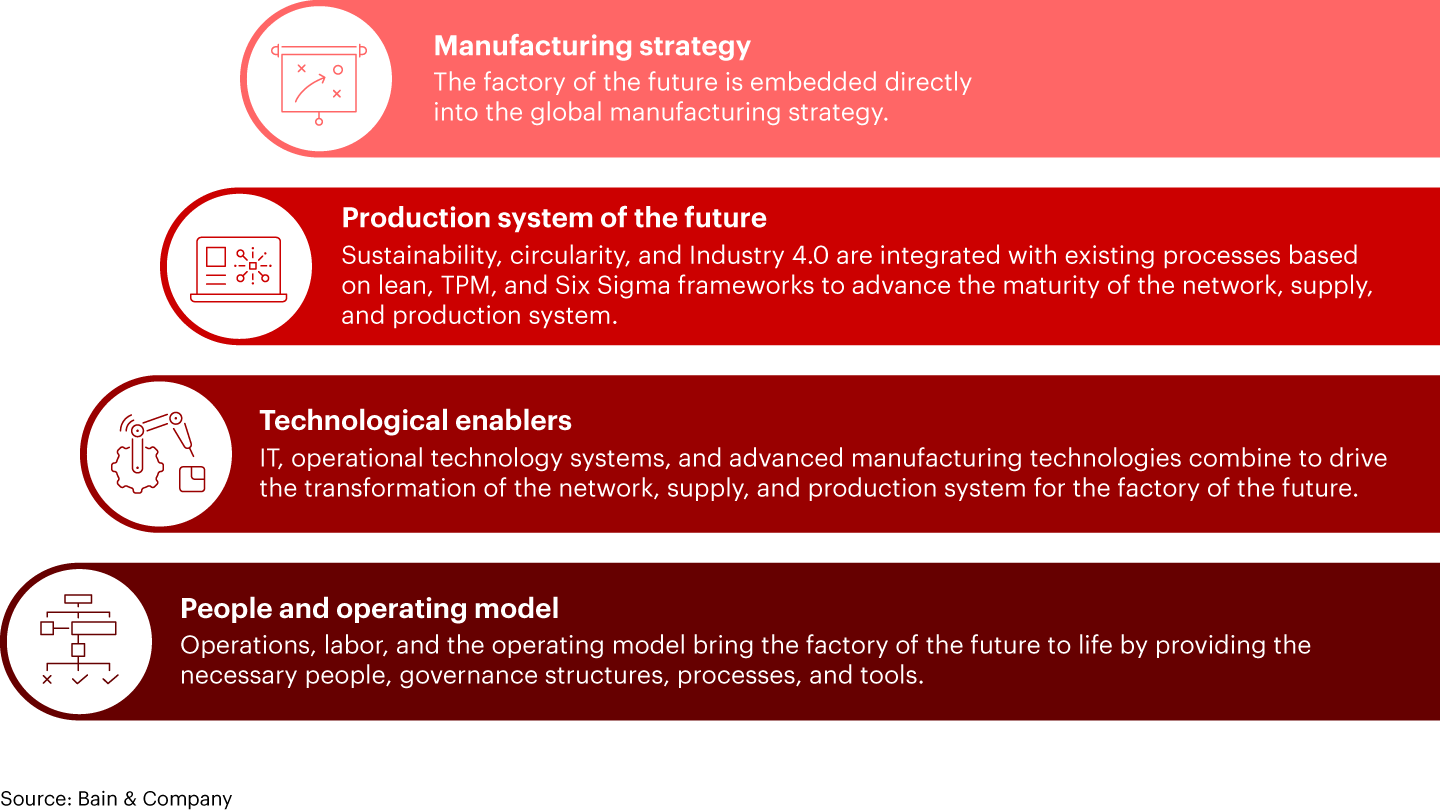
      Four steps toward the factory of the future

      Unlocking value regardless of your starting point

      While nearly 60% of the machinery and equipment companies that Bain surveyed have started their journey toward an integrated factory of the future, none have fully optimized efficiency. There are, however, tangible business benefits no matter what maturity level a machinery or equipment supplier starts at. An average machinery factory in Germany, for example, is currently at a level of circa 2.5 on a six-level maturity scale (see Figure 2).

      Establishing a transparent starting point and ambition is key to identifying the relevant and applicable technologies that enable this step-change ascension through the maturity levels.

      Figure 2
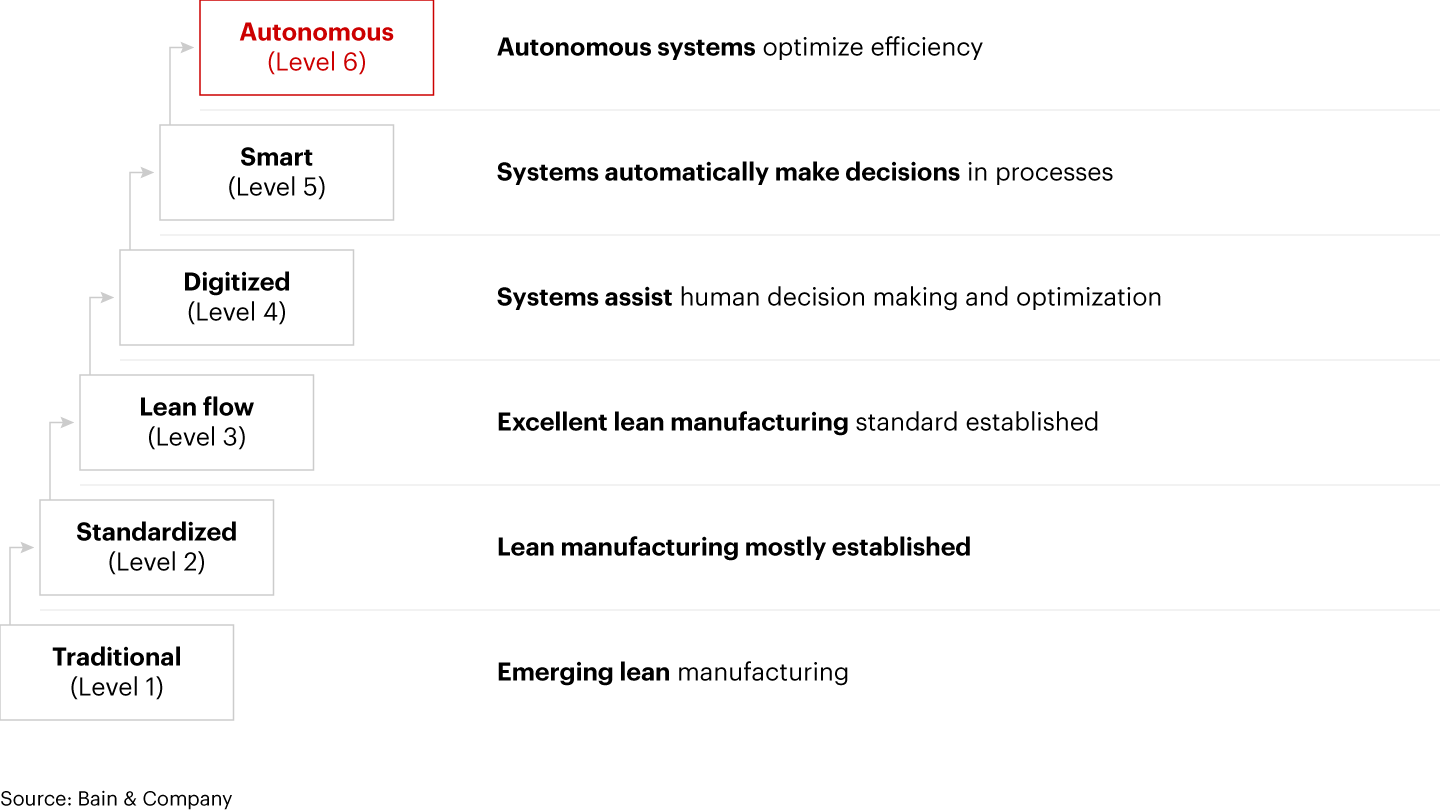
      Maturity-level scale

      For example, a low-maturity utility equipment supplier used the logic and framework of the factory of the future to move from maturity level 1 to 2. The team implemented end-to-end traceability for every SKU and optimized warehouse operations for more efficient organization, location tracking, and stock updates. As a result, they were able to reduce inventory by 50% and decrease lead time by 40%, which led to an additional 7% in sales. They also implemented inventory management and systematic performance management systems. All of these moves contributed to delivering more than 95% of products and services on time and in full.

      Moving higher

      Even relatively high-maturity companies still stand to benefit. For example, a global manufacturer started around level 3.5 maturity. It had excellent lean manufacturing standards, and systems were in place to assist human decision making and optimization. In an environment of more than 1,000 SKUs and 350 changeovers a day, however, it was increasingly inefficient for employees to manually develop flexible production schedules.

      The company decided to use AI in situations in which traditional analysis and optimization were falling short. These tools included engaging digital twin simulation to help de-bottleneck the overall system, deploying smart scheduling solutions, and installing live process analytics to reduce inspection requirements. These solutions all contributed to achieving a 40% increase in overall output.

      Beyond its focus on productivity improvement, the company has gone a step further. It also uses self-learning AI tools to continually monitor and adjust production parameters to assure quality. This has enabled the elimination of inspection requirements and is able to provide an early warning of up to 36 hours ahead of potential equipment failure.

      To move up completely to a level 5 (or smart) state, this company will need to scale this lighthouse project across all factories and apply the lessons learned from this work across the entire production system.

      Getting started

      Each transition to the factory of the future will vary by company, by plant, and even by specific value stream within a plant, depending on the maturity level and the short- and long-term ambitions. No one size fits all. Most important is to start now by defining true business goals and the future vision.

      For example, a move from level 3 to level 5 in smart maintenance could address and evolve maintenance process companies. In this way, the company could move from traditional lean elements—such as process failure mode effects analyses and defining maintenance plans, including inspections and preventative elements—toward predictive models and live-condition monitoring and notification. Finally, they could strive for automated intervention protocols, autonomous operations, and live interactions with original equipment manufacturers for spares and services.

      Or consider a company moving from level 3 to level 5 in factory performance management. Its plants would move from daily data downloads and reviews of hidden black-box data to having more live data feeds and being tracked against dynamic targets based on current conditions. Then, it could move further toward live intervention suggestions or autonomous rescheduling and prioritization across key work orders and assignments, while providing root cause analysis and longer-term suggestions for optimization.

      With a system-wide, end-to-end perspective, it is possible to move beyond functional silos and create a step-change ascension through maturity levels. Machinery and equipment manufacturers acting now to implement a “factory of the future” strategy will reap the benefits in productivity gains and increased savings. These leaders are already starting to shape their market and industry, remaining agile to adapt to future conditions.

      The authors would like to express thanks to Christian Ruehl, Frank Lesmeister, Thomas Kwasniok, Brian Kiefer, and Lokesh Payik for their contributions to this article.

      Read our Machinery & Equipment Report 2024

      Explore the full report Download the PDF

      More from the report

      • An Overlooked Ace: Finding Value in Your Installed Base

      • Digital Solutions in Machinery: Don’t Be Left Behind

      • Machinery and Equipment: The Circular Path to Value

      • The Feedback Machine: The Magic of Closed-Loop Product Life Cycle Management

      • Artificial Intelligence Rockets to the Top of the Manufacturing Priority List

      • The Factory of the Future Could Boost Productivity by 30% or More

      Autori
      • Headshot of Thomas Frost
        Thomas Frost
        Partner, Berlin
      • Headshot of Jörg Gnamm
        Jörg Gnamm
        Partner, Munich
      • Headshot of Michael DuVall
        Michael DuVall
        Alumni, Chicago
      Contattaci
      Industry collegate
      • Industria 4.0 e Servizi
      • Macchinari Industriali
      Servizi di consulenza collegati
      • Automation
      • Digital
      • Enterprise Technology
      • Manufacturing
      • Operations
      Machinery & Equipment Report
      An Overlooked Ace: Finding Value in Your Installed Base

      Digital models of installed machinery can improve product performance and predict necessary maintenance.

      Leggi di più
      Industria 4.0 e Servizi
      Machinery & Equipment M&A

      As more companies discover software’s value as a growth engine, more will need to hone their M&A skills.

      Leggi di più
      Enterprise Technology
      How to Trace a Path to Resilient, Sustainable Supply Chains

      The ability to view and track your entire supply chain will make it stronger. But no company can do that alone.

      Leggi di più
      Machinery & Equipment Report
      Digital Solutions in Machinery: Don’t Be Left Behind

      The industry has reached a turning point in the shift from products to solutions.

      Leggi di più
      Industria 4.0 e Servizi
      How Sustainability Is Creating B2B Growth

      Our survey of B2B buyers and sellers finds growth leaders using sustainability to create commercial value while laggards focus on compliance.

      Leggi di più
      First published in aprile 2024
      Tags
      • Automation
      • Digital
      • Enterprise Technology
      • Industria 4.0 e Servizi
      • Macchinari Industriali
      • Machinery & Equipment Report
      • Manufacturing
      • Operations

      Come abbiamo aiutato i nostri clienti

      Strategia A Steel Company Seeks to Regain Market Leadership

      Leggi un caso di studio

      Strategia A Conglomerate Charts a New Global Strategy

      Leggi un caso di studio

      Strategia Transforming Service Into a Source of Competitive Advantage

      Leggi un caso di studio

      Vuoi continuare la conversazione?

      Aiutiamo i leader globali e le loro aziende ad affrontare problemi e a cogliere le opportunità. Sosteniamo cambiamenti e otteniamo risultati duraturi.

      Bain Insights. Le nostre idee e punti di vista sulle tematiche che le aziende globali affrontano ogni giorno, arrivano nella tua email tutti i mesi.

      *Ho letto l'Informativa sulla Privacy e accetto i termini e le condizioni.

      Si prega di leggere e accettare l’Informativa sulla Privacy
      Bain & Company
      Contattaci Sustainability Accessibility Condizioni d’uso Privacy Cookie Policy Sitemap Log In

      © 1996-2026 Bain & Company, Inc.

      Contatta Bain

      Come posso aiutarti?

      • Business inquiry
      • Career information
      • Press relations
      • Partnership request
      • Speaker request
      Guarda tutti gli uffici