
Skip to Content
  • Uffici

    Uffici

    Nord e Sud America
    • Atlanta
    • Austin
    • Bogota
    • Boston
    • Buenos Aires
    • Chicago
    • Dallas
    • Denver
    • Houston
    • Los Angeles
    • Mexico City
    • Minneapolis
    • Monterrey
    • Montreal
    • New York
    • Rio de Janeiro
    • San Francisco
    • Santiago
    • São Paulo
    • Seattle
    • Silicon Valley
    • Toronto
    • Washington, DC
    Europa, Medio Oriente e Africa
    • Amsterdam
    • Athens
    • Berlin
    • Brussels
    • Copenhagen
    • Doha
    • Dubai
    • Dusseldorf
    • Frankfurt
    • Helsinki
    • Istanbul
    • Johannesburg
    • Kyiv
    • Lisbon
    • London
    • Madrid
    • Milan
    • Munich
    • Oslo
    • Paris
    • Riyadh
    • Rome
    • Stockholm
    • Vienna
    • Warsaw
    • Zurich
    Asia e Australia
    • Bangkok
    • Beijing
    • Bengaluru
    • Brisbane
    • Ho Chi Minh City
    • Hong Kong
    • Jakarta
    • Kuala Lumpur
    • Manila
    • Melbourne
    • Mumbai
    • New Delhi
    • Perth
    • Seoul
    • Shanghai
    • Singapore
    • Sydney
    • Tokyo
    Guarda tutti gli uffici
  • Alumni
  • Media Center
  • Iscriviti
  • Contattaci
  • Italy | Italiano

    Seleziona il tuo Paese e la tua lingua

    Global
    • Global (English)
    Nord e Sud America
    • Brazil (Português)
    • Argentina (Español)
    • Canada (Français)
    • Chile (Español)
    • Colombia (Español)
    Europa, Medio Oriente e Africa
    • France (Français)
    • DACH Region (Deutsch)
    • Italy (Italiano)
    • Spain (Español)
    • Greece (Elliniká)
    Asia e Australia
    • China (中文版)
    • Korea (한국어)
    • Japan (日本語)
  • Saved items (0)
    Saved items (0)

    You have no saved items.

    Contrassegna il contenuto che ti interessa e verrà salvato qui. Potrai leggerlo o condividerlo in seguito.

    Explore Bain Insights
  • Settori
    Menu principale

    Settori

    • Aerospazio e Difesa
    • Agribusiness
    • Chimica
    • Infrastrutture e Costruzioni
    • Beni di Largo Consumo
    • Servizi Finanziari
    • Sanità
    • Macchinari Industriali
    • Media & Intrattenimento
    • Industria Metallurgica
    • Industria Mineraria
    • Petrolio e Gas
    • Industria Cartaria e Packaging
    • Private Equity
    • Settore Sociale & Pubblico
    • Retail
    • Tecnologia
    • Telecomunicazioni
    • Compagnie Aeree & Trasporti
    • Viaggi e Svago
    • Utility e Rinnovabili
  • Servizi di Consulenza
    Menu principale

    Servizi di Consulenza

    • Customer Experience
    • ESG
    • Innovation
    • M&A and Divestitures
    • Operation
    • People & Organization
    • Private Equity
    • Sales & Marketing
    • Strategia
    • IA, Approfondimenti e Soluzioni
    • Tecnologia
    • Trasformazione
  • Digital
  • Tematiche
  • Informazioni su Bain
    Menu principale

    Informazioni su Bain

    • Che Cosa Facciamo
    • Quello in Cui Crediamo
    • Le Nostre Persone e la Leadership
    • Risultati
    • Premi e Riconoscimenti
    • Organizzazioni Globali
    Further: Our global responsibility
    • Diversità e Inclusione
    • Social Impact
    • Sustainability
    • World Economic Forum
    Learn more about Further
  • Careers
    Menu principale

    Careers

    • Work with Us
      Careers
      Work with Us
      • Find Your Place
      • Our Work Areas
      • Integrated Teams
      • Students
      • Internships & Programs
      • Recruiting Events
    • Life at Bain
      Careers
      Life at Bain
      • Blog: Inside Bain
      • Career Stories
      • Our People
      • Where We Work
      • Supporting Your Growth
      • Affinity Groups
      • Benefits
    • Impact Stories
    • Hiring Process
      Careers
      Hiring Process
      • What to Expect
      • Interviewing
    FIND JOBS
  • Uffici
    Menu principale

    Uffici

    • Nord e Sud America
      Uffici
      Nord e Sud America
      • Atlanta
      • Austin
      • Bogota
      • Boston
      • Buenos Aires
      • Chicago
      • Dallas
      • Denver
      • Houston
      • Los Angeles
      • Mexico City
      • Minneapolis
      • Monterrey
      • Montreal
      • New York
      • Rio de Janeiro
      • San Francisco
      • Santiago
      • São Paulo
      • Seattle
      • Silicon Valley
      • Toronto
      • Washington, DC
    • Europa, Medio Oriente e Africa
      Uffici
      Europa, Medio Oriente e Africa
      • Amsterdam
      • Athens
      • Berlin
      • Brussels
      • Copenhagen
      • Doha
      • Dubai
      • Dusseldorf
      • Frankfurt
      • Helsinki
      • Istanbul
      • Johannesburg
      • Kyiv
      • Lisbon
      • London
      • Madrid
      • Milan
      • Munich
      • Oslo
      • Paris
      • Riyadh
      • Rome
      • Stockholm
      • Vienna
      • Warsaw
      • Zurich
    • Asia e Australia
      Uffici
      Asia e Australia
      • Bangkok
      • Beijing
      • Bengaluru
      • Brisbane
      • Ho Chi Minh City
      • Hong Kong
      • Jakarta
      • Kuala Lumpur
      • Manila
      • Melbourne
      • Mumbai
      • New Delhi
      • Perth
      • Seoul
      • Shanghai
      • Singapore
      • Sydney
      • Tokyo
    Guarda tutti gli uffici
  • Alumni
  • Media Center
  • Iscriviti
  • Contattaci
  • Italy | Italiano
    Menu principale

    Seleziona il tuo Paese e la tua lingua

    • Global
      Seleziona il tuo Paese e la tua lingua
      Global
      • Global (English)
    • Nord e Sud America
      Seleziona il tuo Paese e la tua lingua
      Nord e Sud America
      • Brazil (Português)
      • Argentina (Español)
      • Canada (Français)
      • Chile (Español)
      • Colombia (Español)
    • Europa, Medio Oriente e Africa
      Seleziona il tuo Paese e la tua lingua
      Europa, Medio Oriente e Africa
      • France (Français)
      • DACH Region (Deutsch)
      • Italy (Italiano)
      • Spain (Español)
      • Greece (Elliniká)
    • Asia e Australia
      Seleziona il tuo Paese e la tua lingua
      Asia e Australia
      • China (中文版)
      • Korea (한국어)
      • Japan (日本語)
  • Saved items  (0)
    Menu principale
    Saved items (0)

    You have no saved items.

    Contrassegna il contenuto che ti interessa e verrà salvato qui. Potrai leggerlo o condividerlo in seguito.

    Explore Bain Insights
  • Settori
    • Settori

      • Aerospazio e Difesa
      • Agribusiness
      • Chimica
      • Infrastrutture e Costruzioni
      • Beni di Largo Consumo
      • Servizi Finanziari
      • Sanità
      • Macchinari Industriali
      • Media & Intrattenimento
      • Industria Metallurgica
      • Industria Mineraria
      • Petrolio e Gas
      • Industria Cartaria e Packaging
      • Private Equity
      • Settore Sociale & Pubblico
      • Retail
      • Tecnologia
      • Telecomunicazioni
      • Compagnie Aeree & Trasporti
      • Viaggi e Svago
      • Utility e Rinnovabili
  • Servizi di Consulenza
    • Servizi di Consulenza

      • Customer Experience
      • ESG
      • Innovation
      • M&A and Divestitures
      • Operation
      • People & Organization
      • Private Equity
      • Sales & Marketing
      • Strategia
      • IA, Approfondimenti e Soluzioni
      • Tecnologia
      • Trasformazione
  • Digital
  • Tematiche
  • Informazioni su Bain
    • Informazioni su Bain

      • Che Cosa Facciamo
      • Quello in Cui Crediamo
      • Le Nostre Persone e la Leadership
      • Risultati
      • Premi e Riconoscimenti
      • Organizzazioni Globali
      Further: Our global responsibility
      • Diversità e Inclusione
      • Social Impact
      • Sustainability
      • World Economic Forum
      Learn more about Further
  • Careers
    Ricerche più popolari
    • Agile
    • Digitale
    • Strategia
    La tue ricerche precedenti
      Pagine visitate

      Content added to saved items

      Saved items (0)

      Removed from saved items

      Saved items (0)

      M&A Report

      The Unsurprising Boom in Technology M&A

      The Unsurprising Boom in Technology M&A

      Why deal activity now is at a level not seen in two decades.

      Di Adam Haller

      • Tempo di lettura min.
      }

      Report

      The Unsurprising Boom in Technology M&A
      en
      In evidenza
      • Technology M&A roared back from an almost standstill in the second quarter of 2020 to hit record activity in deal volumes and value in the second half of the year.
      • Tech M&A continued to trend toward more growth- and capability-oriented scope deals, representing 81% of industry deals in 2020. And scope deals will be even more relevant post–Covid-19.
      • More nontechnology acquirers, including massive private equity interest, are looking to purchase technology assets as they respond to digital disruptions.
      • At the same time, regulators are increasing their scrutiny of technology deals for multiple reasons, including antitrust, data privacy, and national security.
      • Technology and nontechnology acquirers need to adapt their M&A approach to stay competitive, including how they source deals, conduct diligence, and integrate the new assets they acquire.


      Technology acquirers resume deal activity in the second half of 2020

      After pressing the pause button in the first half of 2020, technology M&A came surging back in the second half as companies positioned themselves for a post–Covid-19 digital economy. In semiconductors, AMD acquired Xilinx in a $35 billion all-stock deal. In software, Salesforce bought workplace communication company Slack for $27.7 billion in stock and cash. All told, deal value for corporate acquisitions of tech companies crossed $200 billion in each of the last two quarters of 2020, a level last seen more than two decades ago.

      Infographic

      Competition Heats Up in Technology M&A

      As Covid-19 gave a preview of the virtual future, acquirers in all industries rush to buy tech assets to thrive in the digital economy.

      In many ways, it is not surprising. Covid-19 gave businesses in all industries a preview of their virtual futures, and both tech and nontech companies alike rushed to buy and build their way into the opportunity. Across industries, companies are preparing for the post–Covid-19 world by (among other moves) augmenting collaboration tools in areas such as videoconferencing and chat while also reinforcing cybersecurity. Companies with the means are using the opportunity to add these and other new capabilities to reposition their organizations for the future. For example, Verizon announced a timely April acquisition of BlueJeans, a cloud-based videoconferencing and events platform, to extend its portfolio offerings for businesses. As Zoom’s usage grew exponentially and security concerns emerged, Zoom acquired Keybase for its end-to-end encryption expertise to beef up its security credibility.

      There are other forces propping up technology M&A. In general, large tech companies—namely, those valued at more than $10 billion—have the benefit of strong cash positions, they have proven themselves relatively resilient during the downturn, and they continued to acquire throughout 2020. Meanwhile, premiums have dropped for many of the small tech companies that hold valuable capabilities and that are potential targets for larger tech acquirers.

      Regulatory roadblocks

      One force, however, is working against deal volumes. While regulatory scrutiny has increased in most industries, it has had a particularly heavy impact on technology as regulators take a heightened interest in technology deals.

      Regulators are reviewing deals aggressively for antitrust concerns. Antitrust was at the heart of the suits launched in December against Facebook by the US Federal Trade Commission and 46 states. The suits allege that the company is maintaining its personal social networking monopoly illegally through a yearslong course of anticompetitive conduct, and they ask the company to divest Instagram and WhatsApp. As antitrust concerns mount, regulators in the US and elsewhere are investigating new approaches to evaluate and manage antitrust issues in technology, where traditional measures to assess competitiveness (primarily revenue) are difficult and where start-ups often maintain high valuations before the company even has revenue, banking on future potential to monetize daily active users down the road.

      Regulators are reviewing deals aggressively for antitrust concerns.

      Also, as we’ve examined in previous M&A reports, regulators are intensifying their efforts to scrutinize cross-border tech deals as a matter of national security. This is most dramatically reflected in the rising actions by the Committee on Foreign Investment in the United States, an interagency panel that reviews foreign investments for potential national security risks, which has heightened its scrutiny of Chinese ownership. Another unprecedented move on national security in 2020 was the Trump administration mandate that TikTok’s US operations be sold to a US buyer on grounds of national interest, with concerns that user data could be compromised.

      Data privacy is another growing area of concern among regulators. Questions of who owns the data and what companies are going to do with the data surface in many proposed tech deals. It became an issue in Google’s $2.1 billion bid for Fitbit, a wearable tech company, for example. All of this increases the need to prepare for consultations with regulators and broader stakeholder communications during the deal’s diligence and negotiation phases.

      Scope deals rise inside and outside tech

      Deal activity in 2020 continues a trend that has been steadily building over the past five years. Scope deals, which are usually designed to help a buyer enter faster-growing business segments or to acquire new capabilities, intellectual property, or talent, have grown from representing 44% of large tech deals in 2015 to 81% in 2020 (year-to-date in September), far outnumbering traditional scale deals that generate cost synergies. Compare that with the average of 56% scope M&A among all industries (see Figure 1).

      Figure 1
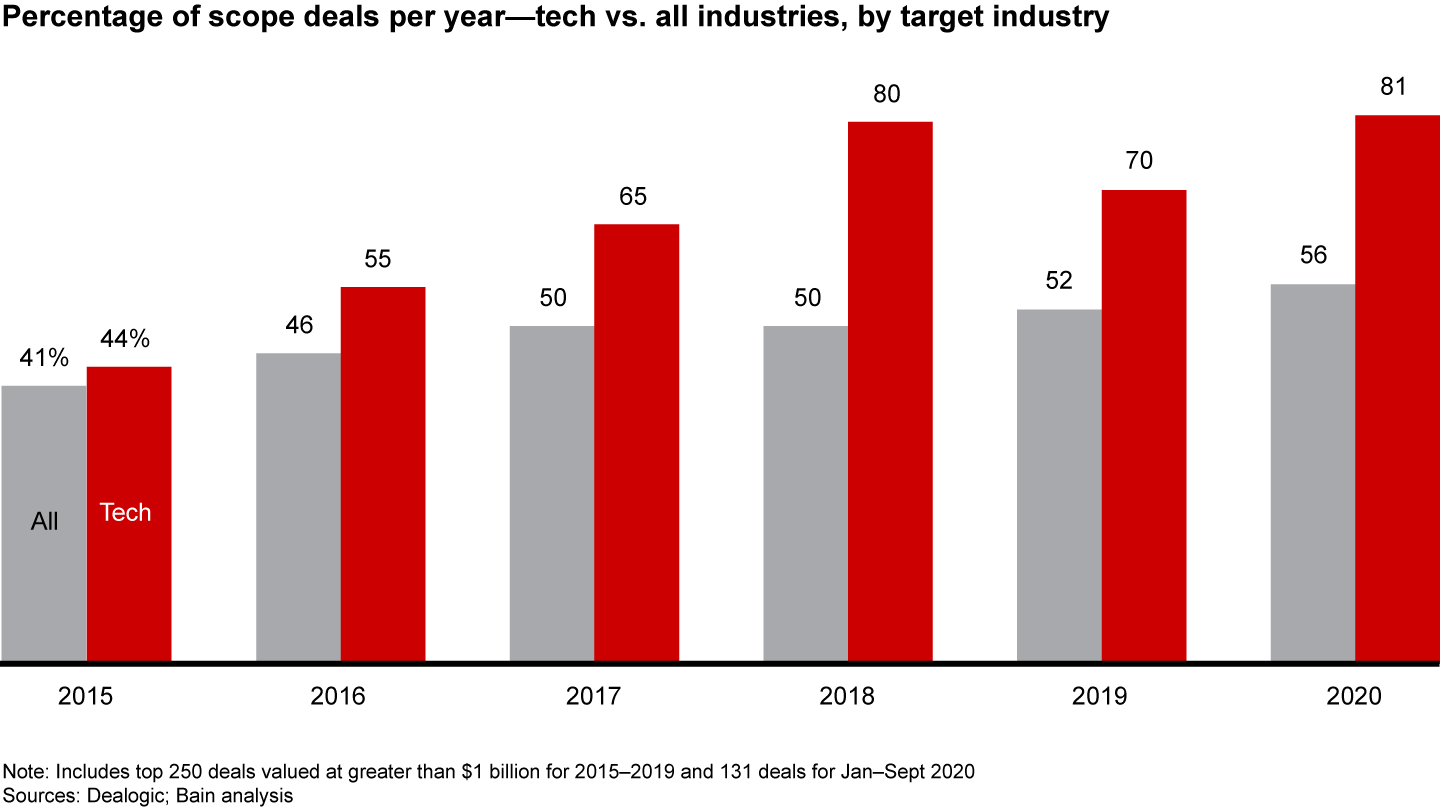
      Scope deals accounted for more than 80% of all technology M&A, far more than other industries
      Scope deals accounted for more than 80% of all technology M&A, far more than other industries
      Scope deals accounted for more than 80% of all technology M&A, far more than other industries

      The scope activity takes two forms: technology companies buying within tech; and companies from other industries buying tech companies to get out ahead of digital disruption. Companies in automotive are acquiring capabilities for autonomous driving and electric vehicles, for example. Industrial companies are buying assets to deliver integrated Internet of Things solutions and products for Industry 4.0 and robotics—that was the impetus behind Aveva’s purchase of OSIsoft. Financial services companies are buying their way into peer-to-peer payments, e-commerce payments, and blockchain. Most significant is the rising interest of private equity investors in the tech space. Together acquirers from other industries and private equity now account for nearly three-quarters of deals in the technology sector, up from about 60% a decade ago (see Figure 2).

      Figure 2
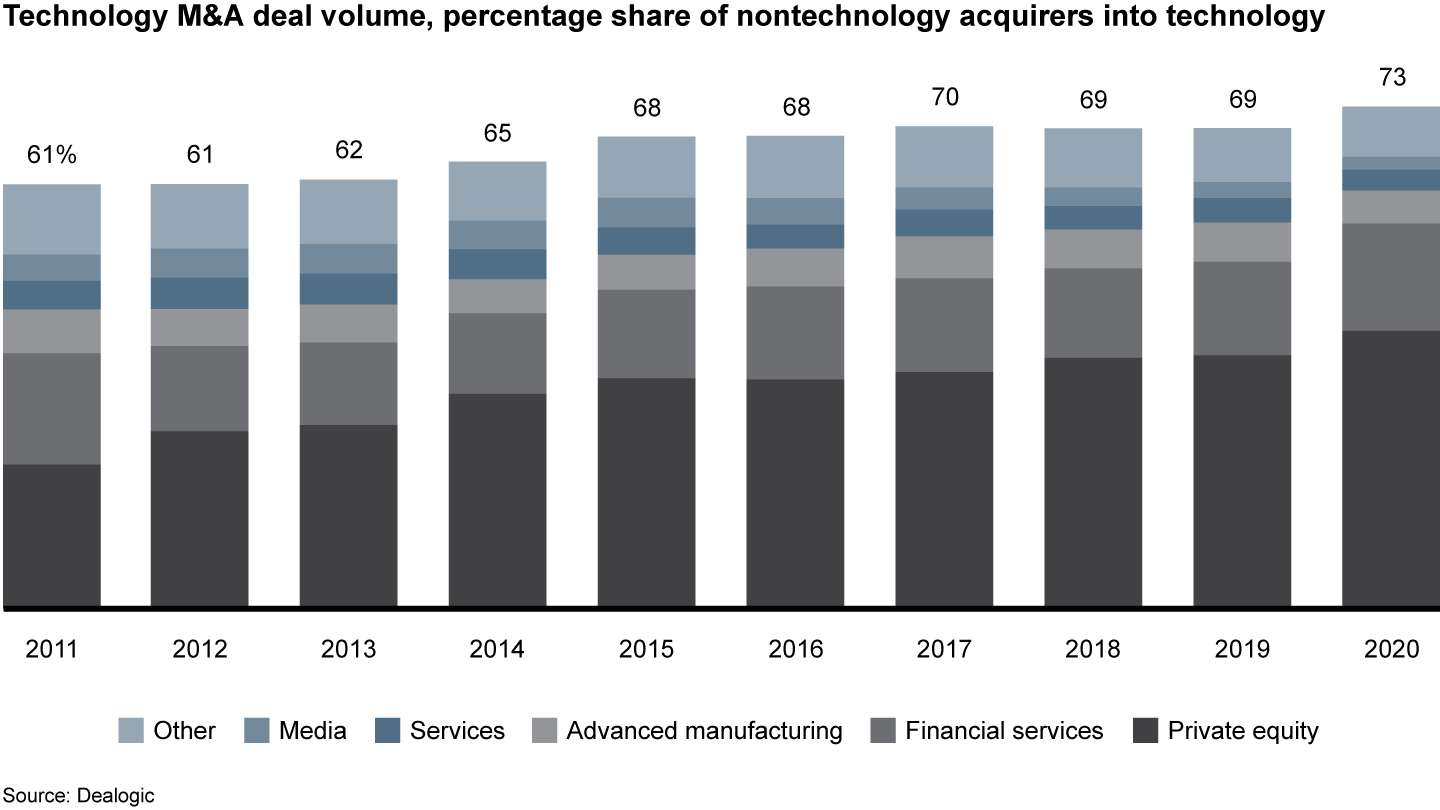
      Nontech acquirers are increasingly active in the technology sector
      Nontech acquirers are increasingly active in the technology sector
      Nontech acquirers are increasingly active in the technology sector

      For technology industry acquirers, this interest from other industries and financial sponsors means more competition and higher deal premiums. The mounting competition requires tech companies to be more rigorous in what they bid on, with clear plans for realizing synergies.

      Technology acquisitions require a different approach

      Nontech companies buying tech assets have a new set of rules to follow. In many ways, technology companies are different from those in any other industry, and there are meaningful risks that need to be anticipated and mitigated.

      Acquirers need to take a different approach to sourcing the right assets. Those more accustomed to purchasing large public companies need to plug into venture capital networks to track opportunities and court founder-led businesses. Some companies are doing this by investing in corporate venture capital, placing smaller investments to foster relationships that can lead to a future acquisition and integration of the assets.

      In diligence, it may be necessary to anticipate a more forward-looking financial assessment. In traditional due diligence, much of the effort involves evaluating a target’s past business performance and current competitive position. In digital M&A, acquirers need to become more forward looking, possibly through approaches that evaluate the potential success of the business model under different scenarios as well as through a rigorous understanding of the customers and their evolving needs.

      Then, there is the matter of financing. Tech assets typically are expensive compared with those in other industries, often selling at discouragingly high multiples. To mitigate the risk linked with the target’s high multiples, acquirers need to evaluate all potential financing solutions and consider adapted payment terms such as earn-outs or other deferred payment mechanisms. For many, the right answer will be alternative participation models such as partnerships (with or without equity) and not outright ownership.

      Given the high premiums and risk of acquiring tech assets, it is more important than ever to have a clear integration thesis and a clear understanding of the critical few decisions that will make or break the success of the deal. The integration thesis needs to translate the deal thesis into a roadmap of what needs to be integrated (or not integrated), when to integrate, and how to go about the integration.

      Acquirers must avoid the common mistake of forcing the legacy culture, policies, and approaches onto the new acquisition—it is a recipe for talent defection.

      In technology deals, talent and culture retention are particularly important for deal success. That is why Amazon offered $100 million in stock awards to retain the more than 900 employees of Zoox, the self-driving car start-up it bought last year. The deal was conditional on acceptance of this retention incentive by a majority of employees. Acquirers must avoid the common mistake of forcing the legacy culture, policies, and approaches onto the new acquisition—it is a recipe for talent defection.

      Finally, acquirers need to ensure that the operating model for both companies is designed to integrate enough to enable the new asset to add value to the acquirer’s existing business without stifling the acquired company and killing the operating mechanisms that allowed it to be so innovative in the first place.

      As technology deal activity maintains its healthy pace, learning to play by new rules will make the difference between those companies that guide the digital future and those that are written out of it.

      Explore the full report
      Autori
      • Headshot of Adam Haller
        Adam Haller
        Partner, San Francisco
      Contattaci
      Industry collegate
      • Tecnologia
      Servizi di consulenza collegati
      • Divestitures and Spin-offs
      • M&A Due Diligence
      • Mergers and Acquisitions
      Sanità
      Getting Ready for the Recovery in Healthcare M&A

      Companies willing to invest shrewdly in the downturn will emerge from it stronger.

      Leggi di più
      M&A Report
      Consumer Products M&A

      In their quest for profitable growth, more companies are divesting brands or buying insurgents.

      Leggi di più
      M&A Report
      Media M&A

      AI and other tech tools can boost bidding confidence in this highly competitive environment.

      Leggi di più
      M&A Report
      Software M&A

      The good news: Most deal best practices still apply to AI acquisitions.

      Leggi di più
      M&A Report
      Banking M&A

      As conditions shift, leading banks are fusing scale with scope to create future-ready organizations.

      Leggi di più
      First published in febbraio 2021
      Tags
      • Divestitures and Spin-offs
      • M&A Due Diligence
      • M&A Report
      • Mergers and Acquisitions
      • Tecnologia

      Come abbiamo aiutato i nostri clienti

      Helping a Midsize ERP Player Compete against the Giants

      Leggi un caso di studio

      Aggressively growing an IT service provider with a high-performance culture

      Leggi un caso di studio

      When the price is right, customers respond

      Leggi un caso di studio

      Vuoi continuare la conversazione?

      Aiutiamo i leader globali e le loro aziende ad affrontare problemi e a cogliere le opportunità. Sosteniamo cambiamenti e otteniamo risultati duraturi.

      Bain Insights. Le nostre idee e punti di vista sulle tematiche che le aziende globali affrontano ogni giorno, arrivano nella tua email tutti i mesi.

      *Ho letto l'Informativa sulla Privacy e accetto i termini e le condizioni.

      Si prega di leggere e accettare l’Informativa sulla Privacy
      Bain & Company
      Contattaci Sustainability Accessibility Condizioni d’uso Privacy Cookie Policy Sitemap Log In

      © 1996-2026 Bain & Company, Inc.

      Contatta Bain

      Come posso aiutarti?

      • Business inquiry
      • Career information
      • Press relations
      • Partnership request
      • Speaker request
      Guarda tutti gli uffici