
Skip to Content
  • Standorte

    Standorte

    North & Latin America
    • Atlanta
    • Austin
    • Bogota
    • Boston
    • Buenos Aires
    • Chicago
    • Dallas
    • Denver
    • Houston
    • Lisbon
    • Los Angeles
    • Mexico City
    • Minneapolis
    • Monterrey
    • Montreal
    • New York
    • Rio de Janeiro
    • San Francisco
    • Santiago
    • São Paulo
    • Seattle
    • Silicon Valley
    • Toronto
    • Washington, DC
    Europe & Africa
    • Amsterdam
    • Athens
    • Berlin
    • Brussels
    • Copenhagen
    • Düsseldorf
    • Frankfurt
    • Helsinki
    • Istanbul
    • Johannesburg
    • Kyiv
    • Lisbon
    • London
    • Madrid
    • Milan
    • München
    • Oslo
    • Paris
    • Rome
    • Stockholm
    • Warsaw
    • Wien
    • Zürich
    Middle East
    • Doha
    • Dubai
    • Riyadh
    Asia & Australia
    • Bangkok
    • Beijing
    • Bengaluru
    • Brisbane
    • Ho Chi Minh City
    • Hong Kong
    • Jakarta
    • Kuala Lumpur
    • Manila
    • Melbourne
    • Mumbai
    • New Delhi
    • Perth
    • Seoul
    • Shanghai
    • Singapore
    • Sydney
    • Tokyo
    Alle Standorte Anzeigen
  • Alumni
  • Presse
  • Newsletter
  • Kontakt
  • DACH-Region | Deutsch

    Wählen Sie Ihre Region und Sprache

    Global
    • Global (English)
    North & Latin America
    • Brazil (Português)
    • Argentina (Español)
    • Canada (Français)
    • Chile (Español)
    • Colombia (Español)
    Europe, Middle East, & Africa
    • France (Français)
    • DACH-Region (Deutsch)
    • Italy (Italiano)
    • Spain (Español)
    • Greece (Elliniká)
    Asia & Australia
    • China (中文版)
    • Korea (한국어)
    • Japan (日本語)
  • Saved items (0)
    Saved items (0)

    You have no saved items.

    Inhalte, für die Sie sich interessieren, werden hier gespeichert und können später gelesen oder weitergeleitet werden.

    Explore Bain Insights
  • Branchenkompetenzen
    Hauptmenü

    Branchenkompetenzen

    • Luft- und Raumfahrt, Verteidigung
    • Agrarwirtschaft
    • Chemieindustrie
    • Infrastruktur und Bauwirtschaft
    • Konsumgüter
    • Finanzdienstleistungen
    • Gesundheitswesen
    • Maschinen- und Anlagenbau
    • Medienwirtschaft
    • Metallindustrie
    • Bergbau
    • Öl und Gas
    • Papier- und Verpackungsindustrie
    • Private Equity
      Branchenkompetenzen
      Private Equity
      • Due Diligence
      • Exit Planning
      • Firm Strategy & Operations
      • Portfolio Value Creation
    • Öffentlicher Sektor und Sozialwesen
    • Einzelhandel
    • Technologie
    • Telekommunikation
    • Transportwesen
    • Reise- und Freizeitbranche
    • Versorgung und erneuerbare Energien
  • Managementkompetenzen
    Hauptmenü

    Managementkompetenzen

    • Customer Experience
    • ESG
    • Innovation
    • M&A
    • Operations
    • People & Organization
    • Private Equity
    • Sales & Marketing
    • Strategie
    • KI, Einblicke und Lösungen
    • Technologie
    • Transformation
  • Digital
  • Publikationen
    Hauptmenü

    Publikationen

    • Branchenthemen
    • Managementthemen
    • Bain-Bücher
    Alle Publikationen
    Ausgewählte Themen
    • Resilienz in der globalen Krise
    • M&A Report
    • Private Equity Podcast
    • Midyear Private Equity Report
    • Agile
    • Engineering Report
    • Digital Transformation
    • Elements of Value®
    • Firm of the Future
    • Nachhaltigkeitsstudie
    • Macro Trends
    • Future of Consumption
    • Weltwirtschaftsforum (WEF)
  • Über uns
    Hauptmenü

    Über uns

    • Was wir bieten
    • Unser Ansatz
    • Unser Team
    • Game Changer Award
    • Female Allstar Board
    • Messbare Ergebnisse (EN)
    • Auszeichnungen
    • Globale Partnerschaften
    • The Mission
    Further: Our global responsibility
    • Vielfalt & Chancengleichheit
    • Soziale Verantwortung
    • Sustainability
    Erfahren Sie mehr zu "Further"
  • Karriere
    Hauptmenü

    Karriere

    • Dein Einstieg
      Karriere
      Dein Einstieg
      • Find Your Place
      • Unsere Arbeitsbereiche
      • Unsere Teams
      • Angebote für Studierende
      • Praktika & Programme
      • Recruiting-Events
    • Arbeiten bei Bain
      Karriere
      Arbeiten bei Bain
      • Blog: Inside Bain
      • Karriere Stories
      • Unsere Bainies
      • Office-Standorte
      • Weiterentwicklung
      • Affinity Groups
      • Deine Benefits
    • Impact Stories
    • Deine Bewerbung
      Karriere
      Deine Bewerbung
      • Das erwartet dich
      • Der Interviewprozess
    FIND JOBS
  • Standorte
    Hauptmenü

    Standorte

    • North & Latin America
      Standorte
      North & Latin America
      • Atlanta
      • Austin
      • Bogota
      • Boston
      • Buenos Aires
      • Chicago
      • Dallas
      • Denver
      • Houston
      • Lisbon
      • Los Angeles
      • Mexico City
      • Minneapolis
      • Monterrey
      • Montreal
      • New York
      • Rio de Janeiro
      • San Francisco
      • Santiago
      • São Paulo
      • Seattle
      • Silicon Valley
      • Toronto
      • Washington, DC
    • Europe & Africa
      Standorte
      Europe & Africa
      • Amsterdam
      • Athens
      • Berlin
      • Brussels
      • Copenhagen
      • Düsseldorf
      • Frankfurt
      • Helsinki
      • Istanbul
      • Johannesburg
      • Kyiv
      • Lisbon
      • London
      • Madrid
      • Milan
      • München
      • Oslo
      • Paris
      • Rome
      • Stockholm
      • Warsaw
      • Wien
      • Zürich
    • Middle East
      Standorte
      Middle East
      • Doha
      • Dubai
      • Riyadh
    • Asia & Australia
      Standorte
      Asia & Australia
      • Bangkok
      • Beijing
      • Bengaluru
      • Brisbane
      • Ho Chi Minh City
      • Hong Kong
      • Jakarta
      • Kuala Lumpur
      • Manila
      • Melbourne
      • Mumbai
      • New Delhi
      • Perth
      • Seoul
      • Shanghai
      • Singapore
      • Sydney
      • Tokyo
    Alle Standorte Anzeigen
  • Alumni
  • Presse
  • Newsletter
  • Kontakt
  • DACH-Region | Deutsch
    Hauptmenü

    Wählen Sie Ihre Region und Sprache

    • Global
      Wählen Sie Ihre Region und Sprache
      Global
      • Global (English)
    • North & Latin America
      Wählen Sie Ihre Region und Sprache
      North & Latin America
      • Brazil (Português)
      • Argentina (Español)
      • Canada (Français)
      • Chile (Español)
      • Colombia (Español)
    • Europe, Middle East, & Africa
      Wählen Sie Ihre Region und Sprache
      Europe, Middle East, & Africa
      • France (Français)
      • DACH-Region (Deutsch)
      • Italy (Italiano)
      • Spain (Español)
      • Greece (Elliniká)
    • Asia & Australia
      Wählen Sie Ihre Region und Sprache
      Asia & Australia
      • China (中文版)
      • Korea (한국어)
      • Japan (日本語)
  • Saved items  (0)
    Hauptmenü
    Saved items (0)

    You have no saved items.

    Inhalte, für die Sie sich interessieren, werden hier gespeichert und können später gelesen oder weitergeleitet werden.

    Explore Bain Insights
  • Branchenkompetenzen
    • Branchenkompetenzen

      • Luft- und Raumfahrt, Verteidigung
      • Agrarwirtschaft
      • Chemieindustrie
      • Infrastruktur und Bauwirtschaft
      • Konsumgüter
      • Finanzdienstleistungen
      • Gesundheitswesen
      • Maschinen- und Anlagenbau
      • Medienwirtschaft
      • Metallindustrie
      • Bergbau
      • Öl und Gas
      • Papier- und Verpackungsindustrie
      • Private Equity
      • Öffentlicher Sektor und Sozialwesen
      • Einzelhandel
      • Technologie
      • Telekommunikation
      • Transportwesen
      • Reise- und Freizeitbranche
      • Versorgung und erneuerbare Energien
  • Managementkompetenzen
    • Managementkompetenzen

      • Customer Experience
      • ESG
      • Innovation
      • M&A
      • Operations
      • People & Organization
      • Private Equity
      • Sales & Marketing
      • Strategie
      • KI, Einblicke und Lösungen
      • Technologie
      • Transformation
  • Digital
  • Publikationen
    • Publikationen

      • Branchenthemen
      • Managementthemen
      • Bain-Bücher
      Alle Publikationen
      Ausgewählte Themen
      • Resilienz in der globalen Krise
      • M&A Report
      • Private Equity Podcast
      • Midyear Private Equity Report
      • Agile
      • Engineering Report
      • Digital Transformation
      • Elements of Value®
      • Firm of the Future
      • Nachhaltigkeitsstudie
      • Macro Trends
      • Future of Consumption
      • Weltwirtschaftsforum (WEF)
  • Über uns
    • Über uns

      • Was wir bieten
      • Unser Ansatz
      • Unser Team
      • Game Changer Award
      • Female Allstar Board
      • Messbare Ergebnisse (EN)
      • Auszeichnungen
      • Globale Partnerschaften
      • The Mission
      Further: Our global responsibility
      • Vielfalt & Chancengleichheit
      • Soziale Verantwortung
      • Sustainability
      Erfahren Sie mehr zu "Further"
  • Karriere
    Häufige Suchanfragen
    • Agil
    • Digital
    • Strategie
    Vorherige Suchanfragen
      Zuletzt besuchte Seiten

      Content added to saved items

      Saved items (0)

      Removed from saved items

      Saved items (0)

      Brief

      Beyond Scale: A Winning Portfolio Strategy for Semiconductor Players

      Beyond Scale: A Winning Portfolio Strategy for Semiconductor Players

      The shift from products to systems changes the game for chipmakers.

      Von Hans Joachim Heider, Daniel Suter, Josef Ming, und Michael Schallehn

      • Min. Lesezeit
      }

      Brief

      Beyond Scale: A Winning Portfolio Strategy for Semiconductor Players
      en
      Auf einen Blick
      • In some semiconductor segments, the time is over for strategies that focus purely on products.
      • A clear understanding of business boundaries has become a critical success factor for semiconductor companies.
      • Some businesses require pure scale, while others require scope across applications. Strategies need to address both.
      • Proactive portfolio strategies create substantial shareholder returns. 

      A decade’s worth of merger and acquisition activity has left many chipmakers with sprawling portfolios that include businesses outside their main areas of focus. Ideally, waves of M&A are accompanied by periods of rationalization, as companies move to divest less valuable segments of their portfolio so they can concentrate on those closer to their core. This continuous refocusing is particularly important in semiconductors, as it allows executives to focus time, talent, energy and capital on segments where they can achieve leadership and higher returns.

      However, the nature of leadership is changing rapidly, and not all executives have adjusted their portfolio strategies accordingly. Companies in the semiconductor industry, like those elsewhere in the technology sector, have tended to view their portfolios primarily from a product point of view—for example, power semiconductors, sensors, microcontroller units (MCUs) or connectivity. Their M&A playbooks have reflected this, aiming to build scale within product segments they want to lead by consolidating fragmented niches to gain product leadership.

      While this logic still holds true for some standard products, for others it’s no longer enough just to have scale. Increasingly, it’s important to build on product scale with expertise in the systems and applications of which the product is a part. This is particularly effective when the product sits at a control point of the system, enabling the company to build a complete reference design around it. Application-centric technology trends such as autonomous and electric cars, the Internet of Things, greater energy efficiency and renewable energy are creating new, high-growth semiconductor segments, while others like fixed and mobile communication are reaching their plateaus and commoditizing. In those application-centric segments, customers increasingly look for solutions that combine functionalities of multiple IP blocks or chips, software, reference design and ecosystem support. For example, many premium automobiles today have more than 100 electronic control units directing everything from tire pressure to electrical steering control units. Newer auto architectures tend to be based on more centralized domain controllers that steer integrated solutions of multiple chips (such as advanced driver assistance systems combining radar, lidar, vision sensors and associated logic). For these kinds of architectures, it becomes more critical for semiconductor vendors to take a full-system view that includes relevant ecosystems, rather than focusing only on individual products.

      As customers' needs evolve, chipmakers must revisit their portfolio strategies and their M&A and divesture plans that support them. Previously, it was enough to gain a leading position in a product category—and for some general purpose segments, gaining scale will still be enough. But increasingly, winners are likely to be those firms that continuously refine and streamline their portfolios to complement their core positions with the capabilities necessary to deliver leading solutions, while divesting other parts of their business no longer necessary for success. Capital markets tend to favor players who take an active portfolio management approach. Unless companies fully understand the business boundaries of their portfolio and where they have the highest commercial potential, they risk misjudging their market position and the areas where they should be focusing. They may wind up investing in segments that the company cannot win or, alternatively, failing to capitalize where it has definitive strengths.

      Business boundaries in the semiconductor industry have shifted

      This shift in focus from products to systems has been evolving for several years, but some chipmakers still struggle to find the right approach. Executives need to invest in a new understanding of business segments in order to define their corresponding portfolio strategy, building the right scope and necessary scale to succeed in the medium and long term—not always an easy combination. With the right portfolio strategy, they can gain synergies in cost and revenue, based on overlapping customer segments, capabilities and operations.

      A strategic approach to portfolio strategy begins by clearly defining the business ambition. What are the boundaries of the current business segments, where does it aspire to be and what are the odds of winning? At a detailed level, this includes identifying segment-related core competencies in customer and value chain relationships, go-to-market capabilities, supply chain management, application design and other capabilities. From there, it becomes easier to identify the synergies across competencies that are required to succeed within subsegments (see Figure 1). 

      Figure 1
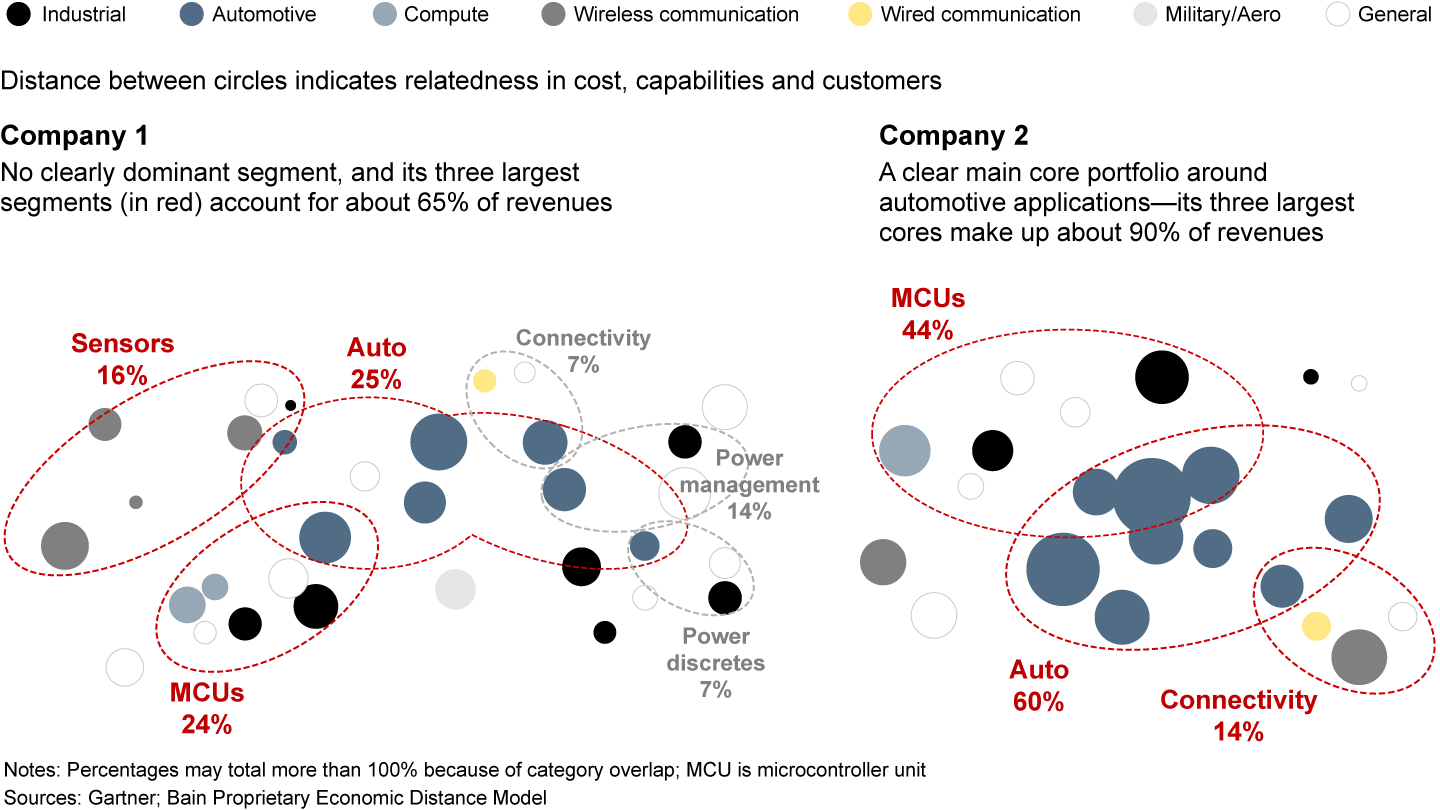
      An analysis of economic distance shows whether portfolios are coherent or fragmented
      An analysis of economic distance shows whether portfolios are coherent or fragmented
      An analysis of economic distance shows whether portfolios are coherent or fragmented

      Based on identified synergies across segments and capabilities, executives can begin to define boundaries and regroup businesses into market clusters—some that are specific to applications, others that are more general. For each new market cluster, executives must decide which products to include or exclude based on identified synergies. 

      • Cost and operational overlaps. Are there production or supply chain synergies that can be brought to bear to improve efficiency?
      • Technology capabilities. Are key, differentiating R&D capabilities, intellectual property and technologies shared across product lines and market segments?
      • Customer sharing. Are there customers shared among the businesses by end-market, region or size, which would allow a more effective go-to-market approach or differentiated positioning or branding?

      The results of a successful portfolio transformation can be significant. One semiconductor manufacturer outperformed its peers’ total shareholder return by a factor of two on share price over a 10-year period after going through a portfolio rationalization and a cost transformation at the same time.

      Building practical portfolio strategies

      It’s important to keep in mind that companies rarely find acquisition targets that perfectly match their strategic needs. Acquired targets often come with their own complex portfolios, particularly in a consolidating market. Acquirers have to assess early on which parts of a target company to keep and which to divest—and streamlining should occur in parallel or soon after the acquisition. Few semiconductor players do this systematically.

      Building a strategy for a complex semiconductor portfolio can be overwhelming. Breaking the problem down into six steps makes the challenge more manageable.

      • Define the overall business ambition, including strategic goals and financial and growth ambitions.
      • Determine core businesses based on economic business boundaries and the overlaps of costs, capabilities and customers.
      • Assess the portfolio by evaluating the attractiveness (market size, growth, profitability) and ability to gain and maintain a leading position for each segment.
      • Determine the full potential for each core based on current market position, as well as organic and inorganic growth opportunities.
      • Build portfolio scenarios and model expected shareholder returns of various portfolio and M&A scenarios, including changes in multiples due to arbitrage, reduced portfolio risk and more attractive equity stories.
      • Build multiyear roadmaps, which allow chipmakers to put in motion a proactive plan of acquisition and divestment, while assessing upcoming opportunities more quickly than competitors.

      As customer preferences continue to evolve and as products become increasingly complex and multifunctional, the opportunity for chipmakers to stay competitive will depend more and more on their ability to demonstrate their mastery of complex systems and solutions. Since this requires broader capabilities than merely building scale in individual products, most chipmakers will need to make more acquisitions and divestitures in order to maintain a streamlined portfolio that delivers against their business ambitions. A more strategic approach to portfolio management can help guide their progress.

      Hans Joachim Heider, Daniel Suter and Michael Schallehn are partners in Bain & Company’s Global Technology practice, and Josef Ming is a partner in the Advanced Manufacturing & Services practice. Hans Joachim is based in Munich, Daniel and Josef in Zurich, and Michael in Silicon Valley.

      Autoren
      • Headshot of Hans Joachim Heider
        Hans Joachim Heider
        Partner, München
      • Headshot of Daniel Suter
        Daniel Suter
        Partner, Zürich
      • Headshot of Josef Ming
        Josef Ming
        Advisory Partner, Zürich
      • Headshot of Michael Schallehn
        Michael Schallehn
        Partner, Silicon Valley
      Kontaktieren Sie uns
      Verwandte Branchen
      • Technologie
      Ähnliche Beratungsangebote
      • Business Strategy
      • Strategie
      Wie wir Sie unterstützen können
      • Portfolio Value Creation
      Technologie
      Mapping Synergies to Shape a Semiconductor Portfolio

      The shift from products to systems raises the importance of a detailed economic analysis of how cost, capabilities and customers overlap among segments.

      Mehr erfahren
      Technologie
      Why SaaS Stocks Have Dropped—and What It Signals for Software’s Next Chapter

      A sharp reset in valuations reflects AI-driven disruption, slowing retention, and a growing divide between incumbents and future winners.

      Mehr erfahren
      Portfolio Value Creation
      A Private Equity Fund Just Bought Your Company … Now What?

      Private equity ownership can be tricky, but it doesn’t have to be fatal for the incumbent CEO.

      Mehr erfahren
      Strategie
      Lean Strategy: Make Smarter Moves, Faster

      Bain's Michael Mankins and Thomas Sweet, former CFO of Dell Technologies, share how a lean strategy framework accelerates smarter decision-making and enhances performance.

      Mehr erfahren
      Technologie
      Software M&A

      The good news: Most deal best practices still apply to AI acquisitions.

      Mehr erfahren
      First published in Januar 2020
      Markierungen
      • Business Strategy
      • Portfolio Value Creation
      • Strategie
      • Technologie

      Wie wir unsere Kunden unterstützt haben

      Smart Pricing Helped a Private Equity Firm Unlock More Value

      Kundenbeispiel lesen

      Helping a Midsize ERP Player Compete against the Giants

      Kundenbeispiel lesen

      Performance Improvement Finding profit potential in a struggling private equity portfolio company

      Kundenbeispiel lesen

      Möchten Sie mit uns in Kontakt bleiben?

      Wir unterstützen Führungskräfte weltweit, die kritischen Themen in ihrem Unternehmen zu adressieren. Gemeinsam schaffen wir nachhaltige Veränderungen und Ergebnisse.

      Bain Insights. Unsere Perspektive auf die kritischen Themen, mit denen sich international agierende Unternehmen konfrontiert sehen, finden Sie monatlich in Ihrem Postfach.

      *Ich habe die Datenschutzerklärung gelesen und akzeptiere sie.
      Bitte lesen Sie die Datenschutzerklärung und akzeptieren Sie diese.
      Bain & Company
      Contact us Sustainability Accessibility Rechtliche Hinweise Impressum Datenschutz Cookie-Richtlinie Sitemap Log In

      © 1996-2026 Bain & Company, Inc.

      Kontaktieren Sie Bain

      Wie können wir Ihnen helfen?

      • Business inquiry
      • Career information
      • Press relations
      • Partnership request
      • Speaker request
      Alle weltweiten Büros