

Brief

Sustained business success requires a high-performance organization. For most executives, the challenge in building such an organization is determining where to start.
Should a company begin by setting clearer priorities? Or would it get better returns from hiring new talent, creating new incentives or changing decision-making processes? Any one of these efforts might work, but each would consume time and other scarce resources.
In our view, the starting point depends on three factors: the organization’s current performance, its long-term objectives and its competitive situation. In the price-sensitive agricultural commodities industry, for instance, success requires that an organization be tuned to keeping costs low. In computer software and services, on the other hand, customers care less about low prices and more about customization and ease of integration with their other systems. A software organization that consistently delivers innovative and distinctive products will generate higher levels of profitability and growth.
To raise the odds of business success, executives must identify and focus on the specific organizational outcomes they would like to achieve. They can use an approach that we call the Organizational Navigator to set a practical course for better results. The Organizational Navigator helps senior executives determine where their organization is strong, where it is weak and, critically, which outcomes matter most for generating superior business performance.
Over the past 15 years, Bain & Company has studied hundreds of companies in virtually every industry around the world, and our research has uncovered what great organizations look like. Recently, we surveyed 665 companies world-wide and found that six organizational outcomes are key to high performance. High-performing organizations are:
- aligned with the company’s strategy
- capable of executing strategy with the right talent, processes and tools
- effective at making and executing critical decisions
- adaptable in the face of rapid change
- efficient in realizing the benefits of scale and scope
- engaged to go the extra mile
The first three outcomes (being aligned, capable and effective) serve as the foundation of strong business performance. In our survey, very few companies that weren’t above average or better along these dimensions demonstrated consistent business performance leadership. The last three (being adaptable, efficient and engaged) serve as accelerators, giving companies a true competitive edge, provided they put in place a solid foundation.
How organization is linked to business performance
The better a company’s performance along these six dimensions, the higher the odds that it will be a business performance leader—that is, a company performing in the top quintile relative to industry peers along revenue growth, profitability and total shareholder returns, over a five-year period. Only one in six companies consistently achieve top-quintile performance on all three measures.
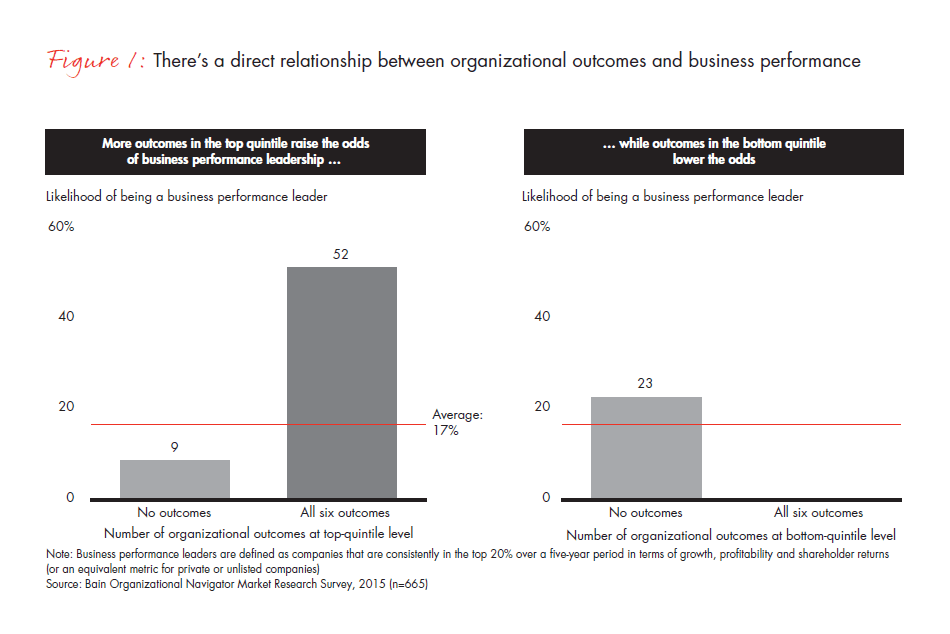
Our analysis of 665 companies shows a direct relationship between an organization’s performance across outcomes and the odds of achieving strong business performance. A company that performs in the top quintile on all six outcomes is more than five times more likely to be a business performance leader than a company that has zero outcomes in the top quintile. Similarly, a company that has no outcomes in the bottom quintile has a significantly higher chance of being a business performance leader than a company with some outcomes in the bottom quintile (see Figure 1).
The relative importance of each outcome may change over time for a company if it alters its strategy or builds new capabilities. Let’s take a closer look at how each of the outcomes contributes to business success.
Aligned with strategic priorities
Even with a great strategy, a company won’t succeed unless it executes well. An organization has to align closely with its strategy, and this is particularly important when the strategy changes.
To bring about Ford Motor Company’s remarkable turnaround starting in 2006, the senior management team under new CEO Alan Mulally set a strategic path that included divesting or shedding noncore brands, such as Aston Martin, Jaguar, Volvo and Mercury, and accelerating development of common vehicle platforms for global markets. Mulally realized he would need to realign Ford’s organization to execute the new strategy.
Ford moved from a structure based on regional business units to one based on global functions, which would enable the company to reduce the number of vehicle platforms from roughly 40 to 10. Mulally kept the focus on alignment through weekly business performance reviews, pushing executives for more open and honest debate about where problems were cropping up. He also distributed laminated “One Ford” cards that communicated new expected behaviors to all employees. Within just a few years, Ford returned to profitability without a bailout from American taxpayers, even after the financial crisis of 2008.
Capable where it matters
To achieve superior performance, a company must identify and excel at the few capabilities that are most essential to realizing its strategy—and be “good enough” at most others.
Capital One’s success in credit cards goes back to its longstanding strategy of defining microsegments of customers and tailoring offers accordingly. Founders Rich Fairbank and Nigel Morris decided to use mass customization to compete with financial giants such as American Express. Capital One has long used sophisticated statistical techniques, as well as thousands of test-and-learn experiments, to accomplish its strategy. The company also uses a data-intensive approach to identify hires with high potential and to determine the best staffing for assignments.
Effective at making and executing critical decisions
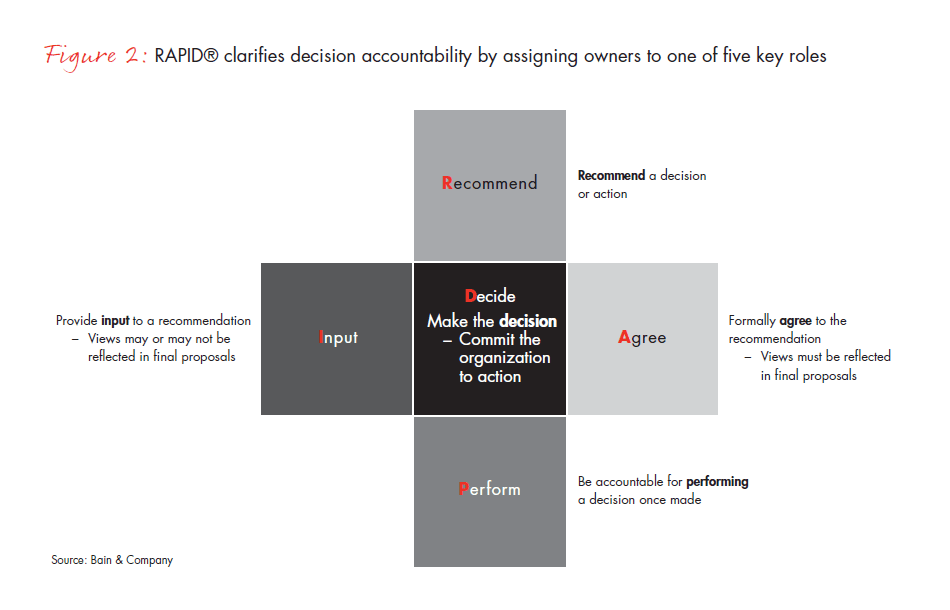
Companies that make better and faster decisions, and execute them consistently, outperform those that don’t. Decision effectiveness requires that everyone understands what decision is being made, who has the authority to make it, how the decision will be made and by when to deliver the best possible results. The decision-rights tool that Bain calls RAPID®—Recommend, Agree, Perform, Input and Decide—spells out who takes responsibility for every role in major decisions (see Figure 2).
Take the case of a group within Intel making semiconductor devices for a wide range of industrial, automotive and communications applications. A few years ago, the group struggled with decisions about what should go on its product-development roadmap. The general manager and marketing director for each of the three product areas wanted a say. So did the strategic planning manager who looked across all three areas. Because there was confusion around decision making, Intel was making decisions without including the right people. As a result decisions did not stick, and quality and speed suffered.
As part of a unit reorganization, Doug Davis, the general manager, used RAPID to explicitly define roles. For the roadmap, Intel gave the “D” (decision role) to the strategic planning manager, who was best placed to make trade-offs across the product areas. Some product general managers protested they just had an input role, and they would second-guess decisions. However, Davis and his team reinforced the new roles, and soon decisions were being made smoothly and more quickly.
Adaptable in the face of rapid change
To consistently grow, companies are often required to adjust their organization to a dynamic and competitive environment. The best organizations are able to adapt quickly.
Over the past two decades, Haier, the Chinese white goods manufacturer, has sustained an impressive average revenue growth rate of 24% per year, in part by evolving its organization to match the priorities of each phase of growth. In the 1980s and 1990s, when the company focused on achieving and sustaining high product quality, a functional structure helped it achieve excellent standards. In the late 1990s and 2000s, a matrix structure made it easier for the company to expand into numerous product lines and countries.
Since the late 2000s, Haier has dealt with creeping complexity. To address this problem and its desire to out-innovate competitors, the company shifted decision making to thousands of frontline units, empowering them to directly serve customers’ needs and collaborate with suppliers. These multifunctional teams of 10 to 20 people have their own revenue and P&L objectives, and manage their own budgets, expenses, hiring and firing.
Efficient to realize the benefits of scale and scope
Cost leaders understand how to streamline and minimize complexity in their organizations. They take steps to simplify the management structure where possible and streamline core processes, all with an eye to efficiency and productivity.
Spanish bank Santander took advantage of local scale to improve organizational efficiency. Its growth strategy included building a portfolio of leadership positions in retail banking throughout Spain, Latin America and the UK. Taking full advantage of its scale, Santander standardized processes to raise efficiency in IT and back-office operations, and has applied this standard of efficiency to the many banks it has acquired since 2000. This approach has enabled Santander to target underperforming retail banks for acquisition and make incremental performance improvements across its portfolio.
Engaged to go the extra mile
People will go the extra mile if they feel they have ownership of their work. Engaged employees invest more of their discretionary energy in the company’s success than merely satisfied employees. This can be vitally important in service-intensive sectors. Not surprisingly, then, organizations demonstrating high levels of engagement outperform those that don’t.
Consider DaVita, a market leader in providing dialysis treatments for kidney patients. Fifteen years ago, Total Renal Care (as it was then known) was unprofitable and short on cash, and half of its executives had quit or been fired earlier. New CEO Kent Thiry set about building a different kind of company.
Thiry began to speak of DaVita as a village and himself as mayor. He involved employees in changing DaVita’s culture and chose the company’s new name with a group of 800 representatives. Every year at DaVita’s spirited nationwide meetings, Thiry made a point of recognizing hundreds of employees who went the extra mile for patients. Fueled by this kind of engagement, the company has posted a remarkable performance over the past 15 years: Revenue has risen to $12.8 billion from $1.45 billion, and earnings to $723 million from a deficit of $147 million; patient outcomes have improved; and employee turnover has declined.
Setting the course to superior organizational performance
To assess where the organization currently stands on achieving each of the six outcomes, start with a survey of employees. Combining survey results with interviews and other diagnostics—such as how well a company makes and executes critical decisions—provides an assessment that accurately reflects the strengths and weaknesses of the organization’s current state (see Figure 3).
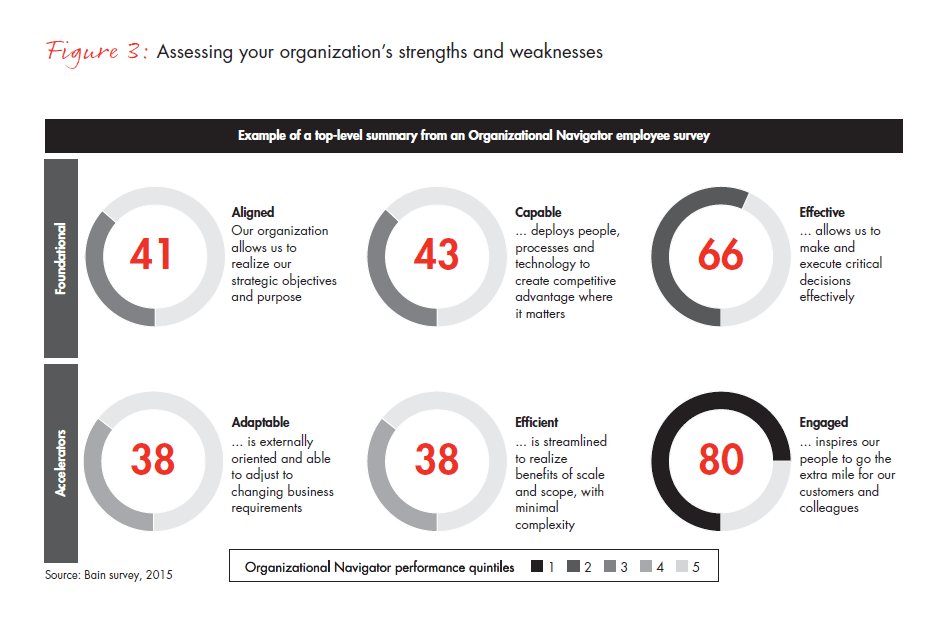
This rich assessment sets the scene for working sessions where executives can address three key questions:
- How do we close any gaps in our foundation? Sustained high performance entails securing a solid foundation. As we noted earlier, very few business performance leaders rank below average on the foundational elements of being aligned, capable and effective.
- How can we eliminate our liabilities? Ranking in the bottom quintile on even one or two of the dimensions more than halves a company’s odds of reaching top business performance. A service-intensive company like an airline might have strong alignment, but if flight attendants show weak engagement, it will be difficult to generate great performance.
- How can we build on our strengths? The more outcomes that rank in the top quintile, the higher the likelihood of superior business performance. Some organizations might even be able to use strength in one area, such as adaptability, to fix liabilities in another, such as poor alignment.
Taking these questions in order raises the odds of success. A multinational chemical company had seen costs rise for several years. Some efforts to make operations more efficient—cutting budgets, increasing management spans, reducing reporting layers—never took hold to produce sustainable cost reduction. Senior leaders realized the line-of-business boundaries did not align with how the company actually created value, causing confusion and dysfunctional behaviors, and resulting in duplication and excess overhead.
Once the company reorganized from asset-based business units to functional units (operations, sales and marketing, and so on) the functions could see more clearly their true costs and the effectiveness of their services. The company shrank the number of organizational entities by a third, creating lasting efficiencies. Only by solving the alignment problem first could the company fundamentally improve its efficiency.
Systemically changing an organization requires ruthless prioritization. Executives need to understand the specific outcomes at which they must excel to attain business success. The Organizational Navigator provides a clear view on the best use of scarce resources to generate superior performance.
Michael Mankins and Dan Schwartz are partners with Bain & Company’s Organization practice. They are based in San Francisco and Washington, DC, respectively.
First published in Februar 2016