
Skip to Content
  • Standorte

    Standorte

    North & Latin America
    • Atlanta
    • Austin
    • Bogota
    • Boston
    • Buenos Aires
    • Chicago
    • Dallas
    • Denver
    • Houston
    • Lisbon
    • Los Angeles
    • Mexico City
    • Minneapolis
    • Monterrey
    • Montreal
    • New York
    • Rio de Janeiro
    • San Francisco
    • Santiago
    • São Paulo
    • Seattle
    • Silicon Valley
    • Toronto
    • Washington, DC
    Europe & Africa
    • Amsterdam
    • Athens
    • Berlin
    • Brussels
    • Copenhagen
    • Düsseldorf
    • Frankfurt
    • Helsinki
    • Istanbul
    • Johannesburg
    • Kyiv
    • Lisbon
    • London
    • Madrid
    • Milan
    • München
    • Oslo
    • Paris
    • Rome
    • Stockholm
    • Warsaw
    • Wien
    • Zürich
    Middle East
    • Doha
    • Dubai
    • Riyadh
    Asia & Australia
    • Bangkok
    • Beijing
    • Bengaluru
    • Brisbane
    • Ho Chi Minh City
    • Hong Kong
    • Jakarta
    • Kuala Lumpur
    • Manila
    • Melbourne
    • Mumbai
    • New Delhi
    • Perth
    • Seoul
    • Shanghai
    • Singapore
    • Sydney
    • Tokyo
    Alle Standorte Anzeigen
  • Alumni
  • Presse
  • Newsletter
  • Kontakt
  • DACH-Region | Deutsch

    Wählen Sie Ihre Region und Sprache

    Global
    • Global (English)
    North & Latin America
    • Brazil (Português)
    • Argentina (Español)
    • Canada (Français)
    • Chile (Español)
    • Colombia (Español)
    Europe, Middle East, & Africa
    • France (Français)
    • DACH-Region (Deutsch)
    • Italy (Italiano)
    • Spain (Español)
    • Greece (Elliniká)
    Asia & Australia
    • China (中文版)
    • Korea (한국어)
    • Japan (日本語)
  • Saved items (0)
    Saved items (0)

    You have no saved items.

    Inhalte, für die Sie sich interessieren, werden hier gespeichert und können später gelesen oder weitergeleitet werden.

    Explore Bain Insights
  • Branchenkompetenzen
    Hauptmenü

    Branchenkompetenzen

    • Luft- und Raumfahrt, Verteidigung
    • Agrarwirtschaft
    • Chemieindustrie
    • Infrastruktur und Bauwirtschaft
    • Konsumgüter
    • Finanzdienstleistungen
    • Gesundheitswesen
    • Maschinen- und Anlagenbau
    • Medienwirtschaft
    • Metallindustrie
    • Bergbau
    • Öl und Gas
    • Papier- und Verpackungsindustrie
    • Private Equity
      Branchenkompetenzen
      Private Equity
      • Due Diligence
      • Exit Planning
      • Firm Strategy & Operations
      • Portfolio Value Creation
    • Öffentlicher Sektor und Sozialwesen
    • Einzelhandel
    • Technologie
    • Telekommunikation
    • Transportwesen
    • Reise- und Freizeitbranche
    • Versorgung und erneuerbare Energien
  • Managementkompetenzen
    Hauptmenü

    Managementkompetenzen

    • Customer Experience
    • ESG
    • Innovation
    • M&A
    • Operations
    • People & Organization
    • Private Equity
    • Sales & Marketing
    • Strategie
    • KI, Einblicke und Lösungen
    • Technologie
    • Transformation
  • Digital
  • Publikationen
    Hauptmenü

    Publikationen

    • Branchenthemen
    • Managementthemen
    • Bain-Bücher
    Alle Publikationen
    Ausgewählte Themen
    • Resilienz in der globalen Krise
    • M&A Report
    • Private Equity Podcast
    • Midyear Private Equity Report
    • Agile
    • Engineering Report
    • Digital Transformation
    • Elements of Value®
    • Firm of the Future
    • Nachhaltigkeitsstudie
    • Macro Trends
    • Future of Consumption
    • Weltwirtschaftsforum (WEF)
  • Über uns
    Hauptmenü

    Über uns

    • Was wir bieten
    • Unser Ansatz
    • Unser Team
    • Game Changer Award
    • Female Allstar Board
    • Messbare Ergebnisse (EN)
    • Auszeichnungen
    • Globale Partnerschaften
    • The Mission
    Further: Our global responsibility
    • Vielfalt & Chancengleichheit
    • Soziale Verantwortung
    • Sustainability
    Erfahren Sie mehr zu "Further"
  • Karriere
    Hauptmenü

    Karriere

    • Dein Einstieg
      Karriere
      Dein Einstieg
      • Find Your Place
      • Unsere Arbeitsbereiche
      • Unsere Teams
      • Angebote für Studierende
      • Praktika & Programme
      • Recruiting-Events
    • Arbeiten bei Bain
      Karriere
      Arbeiten bei Bain
      • Blog: Inside Bain
      • Karriere Stories
      • Unsere Bainies
      • Office-Standorte
      • Weiterentwicklung
      • Affinity Groups
      • Deine Benefits
    • Impact Stories
    • Deine Bewerbung
      Karriere
      Deine Bewerbung
      • Das erwartet dich
      • Der Interviewprozess
    FIND JOBS
  • Standorte
    Hauptmenü

    Standorte

    • North & Latin America
      Standorte
      North & Latin America
      • Atlanta
      • Austin
      • Bogota
      • Boston
      • Buenos Aires
      • Chicago
      • Dallas
      • Denver
      • Houston
      • Lisbon
      • Los Angeles
      • Mexico City
      • Minneapolis
      • Monterrey
      • Montreal
      • New York
      • Rio de Janeiro
      • San Francisco
      • Santiago
      • São Paulo
      • Seattle
      • Silicon Valley
      • Toronto
      • Washington, DC
    • Europe & Africa
      Standorte
      Europe & Africa
      • Amsterdam
      • Athens
      • Berlin
      • Brussels
      • Copenhagen
      • Düsseldorf
      • Frankfurt
      • Helsinki
      • Istanbul
      • Johannesburg
      • Kyiv
      • Lisbon
      • London
      • Madrid
      • Milan
      • München
      • Oslo
      • Paris
      • Rome
      • Stockholm
      • Warsaw
      • Wien
      • Zürich
    • Middle East
      Standorte
      Middle East
      • Doha
      • Dubai
      • Riyadh
    • Asia & Australia
      Standorte
      Asia & Australia
      • Bangkok
      • Beijing
      • Bengaluru
      • Brisbane
      • Ho Chi Minh City
      • Hong Kong
      • Jakarta
      • Kuala Lumpur
      • Manila
      • Melbourne
      • Mumbai
      • New Delhi
      • Perth
      • Seoul
      • Shanghai
      • Singapore
      • Sydney
      • Tokyo
    Alle Standorte Anzeigen
  • Alumni
  • Presse
  • Newsletter
  • Kontakt
  • DACH-Region | Deutsch
    Hauptmenü

    Wählen Sie Ihre Region und Sprache

    • Global
      Wählen Sie Ihre Region und Sprache
      Global
      • Global (English)
    • North & Latin America
      Wählen Sie Ihre Region und Sprache
      North & Latin America
      • Brazil (Português)
      • Argentina (Español)
      • Canada (Français)
      • Chile (Español)
      • Colombia (Español)
    • Europe, Middle East, & Africa
      Wählen Sie Ihre Region und Sprache
      Europe, Middle East, & Africa
      • France (Français)
      • DACH-Region (Deutsch)
      • Italy (Italiano)
      • Spain (Español)
      • Greece (Elliniká)
    • Asia & Australia
      Wählen Sie Ihre Region und Sprache
      Asia & Australia
      • China (中文版)
      • Korea (한국어)
      • Japan (日本語)
  • Saved items  (0)
    Hauptmenü
    Saved items (0)

    You have no saved items.

    Inhalte, für die Sie sich interessieren, werden hier gespeichert und können später gelesen oder weitergeleitet werden.

    Explore Bain Insights
  • Branchenkompetenzen
    • Branchenkompetenzen

      • Luft- und Raumfahrt, Verteidigung
      • Agrarwirtschaft
      • Chemieindustrie
      • Infrastruktur und Bauwirtschaft
      • Konsumgüter
      • Finanzdienstleistungen
      • Gesundheitswesen
      • Maschinen- und Anlagenbau
      • Medienwirtschaft
      • Metallindustrie
      • Bergbau
      • Öl und Gas
      • Papier- und Verpackungsindustrie
      • Private Equity
      • Öffentlicher Sektor und Sozialwesen
      • Einzelhandel
      • Technologie
      • Telekommunikation
      • Transportwesen
      • Reise- und Freizeitbranche
      • Versorgung und erneuerbare Energien
  • Managementkompetenzen
    • Managementkompetenzen

      • Customer Experience
      • ESG
      • Innovation
      • M&A
      • Operations
      • People & Organization
      • Private Equity
      • Sales & Marketing
      • Strategie
      • KI, Einblicke und Lösungen
      • Technologie
      • Transformation
  • Digital
  • Publikationen
    • Publikationen

      • Branchenthemen
      • Managementthemen
      • Bain-Bücher
      Alle Publikationen
      Ausgewählte Themen
      • Resilienz in der globalen Krise
      • M&A Report
      • Private Equity Podcast
      • Midyear Private Equity Report
      • Agile
      • Engineering Report
      • Digital Transformation
      • Elements of Value®
      • Firm of the Future
      • Nachhaltigkeitsstudie
      • Macro Trends
      • Future of Consumption
      • Weltwirtschaftsforum (WEF)
  • Über uns
    • Über uns

      • Was wir bieten
      • Unser Ansatz
      • Unser Team
      • Game Changer Award
      • Female Allstar Board
      • Messbare Ergebnisse (EN)
      • Auszeichnungen
      • Globale Partnerschaften
      • The Mission
      Further: Our global responsibility
      • Vielfalt & Chancengleichheit
      • Soziale Verantwortung
      • Sustainability
      Erfahren Sie mehr zu "Further"
  • Karriere
    Häufige Suchanfragen
    • Agil
    • Digital
    • Strategie
    Vorherige Suchanfragen
      Zuletzt besuchte Seiten

      Content added to saved items

      Saved items (0)

      Removed from saved items

      Saved items (0)

      Brief

      Capital Productivity for Oil and Gas in a Low-Price Environment

      Capital Productivity for Oil and Gas in a Low-Price Environment

      Reducing capital expenditure is a natural response to low oil prices, but the industry needs to continue to explore and develop to meet long-term demand, which continues to grow.

      Von Lodewijk de Graauw, John McCreery and Brian Murphy

      • Min. Lesezeit
      }

      Brief

      Capital Productivity for Oil and Gas in a Low-Price Environment
      en

      Reducing capital expenditure is a natural response to low oil prices, as demonstrated by the oil and gas industry deferring or canceling $200 billion worth of planned investments over the past two years. Another $1.5 trillion of future spending may be uneconomic at current oil prices.

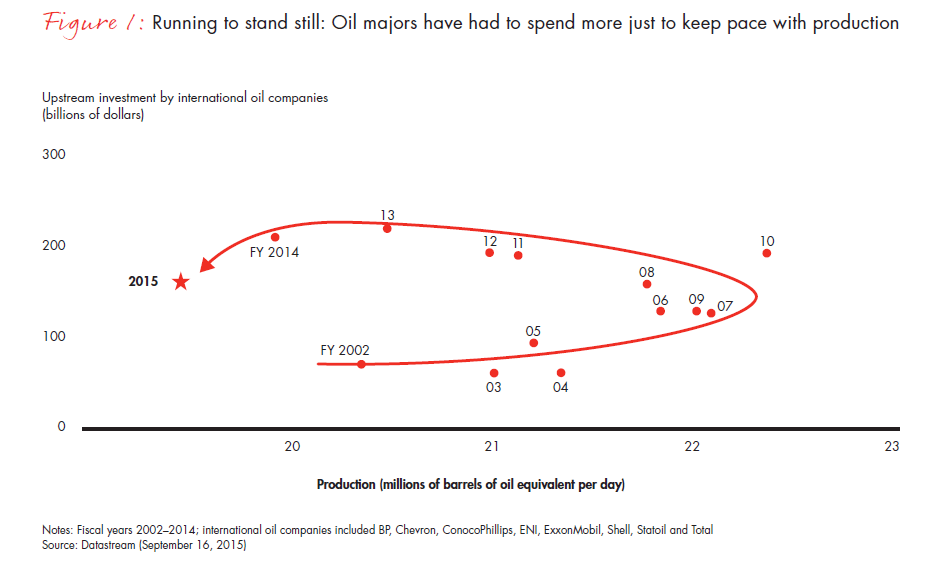
      At the same time, the industry needs to continue to explore and develop to meet long-term demand, which continues to grow, albeit more slowly than before. In fact, over the past decade, major oil companies have had to invest more capital just to maintain production levels, running harder to stand still (see Figure 1).

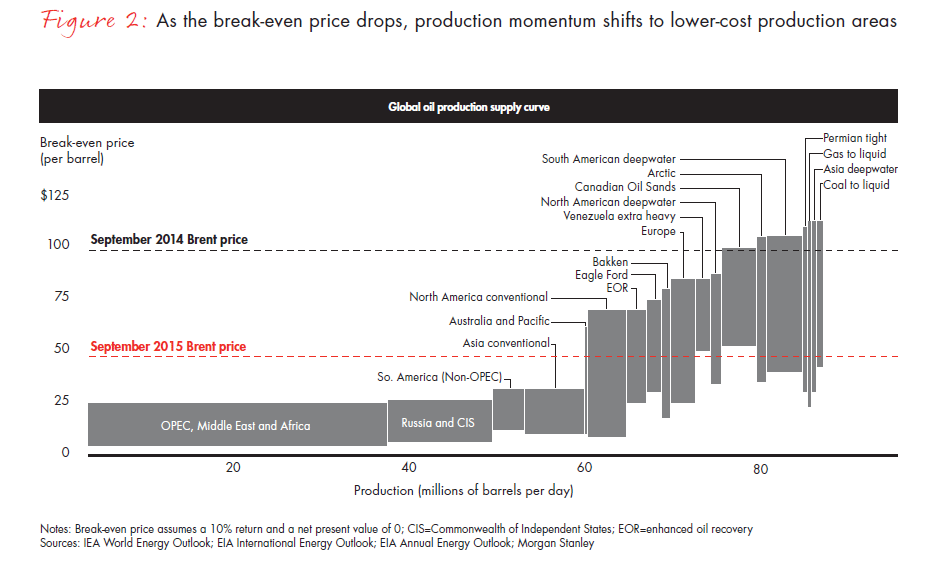
      As the industry establishes a new equilibrium between supply and demand, producers shift from high-cost plays (such as Arctic and ultra-deepwater) to more accessible, low-cost barrels (see Figure 2).

      In this low-cost world, it will be even more important to use capital as efficiently as possible. When oil was $100 per barrel, projects competed against each other for capital, but high returns meant that volume typically won over capital efficiency, resulting in a tripling of annual capex between 2003 and 2013. In the $50-per-barrel world, projects will increasingly struggle to return the cost of capital, so capital efficiency will be essential to get projects funded.
      capital-productivity-for-oil-and-gas-in-a-low-price-environment-fig-01-embed

      capital-productivity-for-oil-and-gas-in-a-low-price-environment-fig-02-embed

      Three fundamental trends to improve capital productivity

      Fortunately, oil and gas companies have room to raise their capital productivity, particularly for projects that are early in the life cycle. We see three broad trends that will fundamentally raise the productivity of capital over the coming decades: innovation, standardization and optionality.

      Innovation. Technology continues to evolve rapidly in oil and gas, improving capital productivity by delivering solutions that help producers deliver more efficiently. The technologies that helped make unconventional production economical over the past decade are the most obvious example. Floating liquefied natural gas (FLNG) platforms are another one. These structures will improve the economics of remote natural gas production as they begin to replace traditional onshore development projects. Advanced analytics will help, too, by improving the predictability of known drilling problems in well planning and execution. When oil prices are low, technology budgets come under severe pressure, so executives should take care not to damage their long-term capacity for innovation.

      Standardization. Industries such as automotive and manufacturing have worked to standardize their production processes, but that has not occurred in oil and gas. Consider subsea operators who still use 28 different shades of yellow to paint their equipment. Standardization improves capital productivity in several ways. First, simplifying and standardizing engineering designs helps prevent unnecessary customization and the urge to gold-plate solutions. One senior executive applies this test: If the new idea were to cost 10 times what the proponent says and the benefit were to be one-tenth of that claimed, would we still do it? Only changes passing the test are implemented.

      Second, the “design one, build many” concept has had some notable successes, with ExxonMobil’s deepwater developments in Angola often cited as the best example. The industry could do more under this concept—for example, in FLNG.

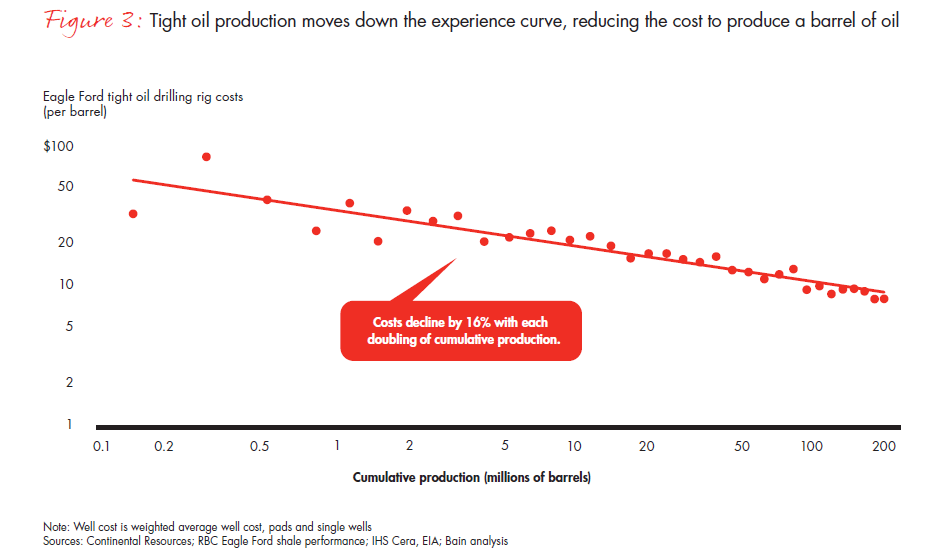
      Standardization also makes it easier for companies to collaborate and eliminate wasteful practices. This is especially true as most development over the next five years will be within known environments (since ultra-deepwater and the Arctic are mostly off the table at today’s oil prices), and companies can continue down the experience curve (see Figure 3).

      capital-productivity-for-oil-and-gas-in-a-low-price-environment-fig-03-embed

      Optionality. For almost 20 years, the industry has worked with decision review gates and a sequential, converging process for project development: a review of conceptual options followed by front-end engineering of one selected option before making a final investment decision and commencement of a detailed design. This approach has served the industry well and should continue to do so.

      Today’s environment places pressure on that process. Markets are volatile, and innovation is accelerating rapidly. Pressure on capital productivity leaves less tolerance for long rework cycles, and if a project fails to pass a stage gate, that may be the end of it.

      We see two implications from this, both of which may require the judgement of more senior project development executives.

      First, companies can learn to make decisions based on imperfect but sufficient information. Too often, they overinvest in defining conceptual designs to reach an outcome that could have been decided more easily. Instead, they can reverse the logic and start with what would be needed for the project to fly. If the cost is off by billions, there’s no need to examine smaller details. Instead, they can move on to alternative concepts.

      Second, they should keep more options open in the early stages, pursuing multiple concepts in competition with each other. Suboptimal options should receive less attention, but the project should maintain a clear understanding of the assumptions underpinning that outcome and monitor the external environment for changes.

      None of this advocates for looser or schedule-driven early-stage development, which can be a train wreck. Project developers still need to make decisions based on value creation and with all due technical and commercial consideration. But projects can proceed with explicit treatment of uncertainty, taking a “wider funnel for longer” at the start with a flexible stage gate system, guided by an appropriately senior gatekeeper.

      Brian Murphy, a partner in Bain's Oil & Gas practice, outlines five action areas for oil and gas companies to implement capital projects in the most productive way.

      Putting capital productivity into motion

      These trends are well documented, but industry leaders will have to focus their efforts to ensure that they contribute to capital productivity within their organizations. Five principles can guide executives as they make capital decisions.

      • Continue to invest. Current conditions represent an opportunity to invest in capital projects in a low-price environment, to make progress on projects while sector inflation takes a breather and people and equipment are less in demand. The opportunity applies to R&D, too, even though reduced revenue puts pressure on budgets. Companies need to prioritize carefully to ensure that they continue to fund technologies that could reduce costs and make challenging opportunities affordable.
      • Design to cost. Too many capital projects start with a cost estimate defined by the engineering and design teams. Taking the reverse approach—that is, understanding what investment is feasible and then deciding what can be done within those constraints—is more realistic in a low-oil-price environment. In fact, setting the cost below a reasonable level spurs creativity and preserves capital until oil prices recover.
      • Collaborate to drive standardization. Internally, companies should adopt best-in-class design objects and measure the uptake of reusable designs from standard catalogs. Externally, companies should be more open to (closely monitored) collaboration with vendors, engineering and procurement contractors, and owner teams to engage collectively in standard, productive solutions. Decision processes and tools that streamline partner interactions and approvals can also help.
      • Challenge the development process. The traditional stage gate process looks increasingly regimented and slow in an industry with volatile prices, shifting markets and accelerating innovation. More agile and iterative methods may be more effective in supporting design to cost, and some industry leaders are experimenting with shorter time periods, parallel processes and rapid development methodologies such as agile and scrum. Others worry that rushing forward without proper review could be disastrous for projects and organizations. Most are trying to get the balance right so that their organizations can be productive but also efficient.
      • Look for opportunities in every step of the process. Project teams have many ways to improve the productivity of capital, including scope reduction, construction excellence and more efficient procurement. Too often, they review these opportunities only before major decision gates, or after an unsuccessful visit to one. Instead, similar to an operating asset, the development project itself needs a constant improvement process. Opportunities to optimize value need to be managed throughout opportunity generation, prioritization, solution generation and implementation. Project leaders should resource and govern these to add value to, rather than slow down, the overall project process.

      Working across all these principles, companies can reduce capex significantly. One major integrated oil company was able to reduce the capital spending costs of a major platform in the Gulf of Mexico by 36% through reengineering work that suggested better productivity was possible from using a subsea platform. In another example, a national oil company cut the time necessary for drilling a well by more than 40%, from 146 days to 83 days, by avoiding side efforts and focusing on better planning and execution.

      As executives work to improve their capital productivity in this low-price environment, they need to remain nimble, pairing the engineering and commercial mindsets where they can, managing the organization toward simplicity and standardization, and maintaining a healthy appetite for investment rather than deferment. Few forecasts suggest a strong price recovery in the medium term, so the need for capital productivity is here to stay.

      Lodewijk de Graauw and Brian Murphy are partners with Bain & Company in Perth. John McCreery is a Bain partner in Houston. All three work with Bain’s Global Oil & Gas practice, and Brian leads the practice in the Asia- Pacific region.


      capital-productivity-for-oil-and-gas-in-a-low-price-environment-fig-01-embed

      capital-productivity-for-oil-and-gas-in-a-low-price-environment-fig-02-embed

      capital-productivity-for-oil-and-gas-in-a-low-price-environment-fig-03-embed
      Autoren
      • John McCreery
        Alumni, Houston
      • Headshot of Brian Murphy
        Brian Murphy
        Partner, Perth
      Kontaktieren Sie uns
      Verwandte Branchen
      • Energiewirtschaft
      • Öl und Gas
      Öl und Gas
      When a New Organizational Structure Isn’t Enough: How to Truly Live Your Operating Model

      The goal of any organizational redesign is for people to work differently, but that only happens if leaders invest in changing the work itself.

      Mehr erfahren
      Öl und Gas
      Oil & Gas M&A

      Why some companies are winning by a wider margin.

      Mehr erfahren
      Öl und Gas
      Fueling the Future: How Business, Finance, and Policy Can Accelerate the Clean Fuels Market

      Why global clean fuel ambitions are outpacing investment, and what leaders must do to unlock capital and scale viable projects.

      Mehr erfahren
      Öl und Gas
      Positioning Oil & Gas Companies for Today’s Capital Markets

      We interviewed senior investment professionals, and here’s what we heard.

      Mehr erfahren
      Öl und Gas
      Sustaining Capital: From Chaos to Discipline

      Fragmented budgets, poor visibility, and missed forecasts are fixable with the right approach.

      Mehr erfahren
      First published in November 2015
      Markierungen
      • Energiewirtschaft
      • Öl und Gas

      Wie wir unsere Kunden unterstützt haben

      Nachhaltigkeit An Oil and Gas Leader Creates a New Clean Energy Business

      Kundenbeispiel lesen

      Organisation Centralization boosts performance for an energy giant

      Kundenbeispiel lesen

      Mergers & Acquisitions Forecast backs a bet on shale services

      Kundenbeispiel lesen

      Möchten Sie mit uns in Kontakt bleiben?

      Wir unterstützen Führungskräfte weltweit, die kritischen Themen in ihrem Unternehmen zu adressieren. Gemeinsam schaffen wir nachhaltige Veränderungen und Ergebnisse.

      Bain Insights. Unsere Perspektive auf die kritischen Themen, mit denen sich international agierende Unternehmen konfrontiert sehen, finden Sie monatlich in Ihrem Postfach.

      *Ich habe die Datenschutzerklärung gelesen und akzeptiere sie.
      Bitte lesen Sie die Datenschutzerklärung und akzeptieren Sie diese.
      Bain & Company
      Contact us Sustainability Accessibility Rechtliche Hinweise Impressum Datenschutz Cookie-Richtlinie Sitemap Log In

      © 1996-2026 Bain & Company, Inc.

      Kontaktieren Sie Bain

      Wie können wir Ihnen helfen?

      • Business inquiry
      • Career information
      • Press relations
      • Partnership request
      • Speaker request
      Alle weltweiten Büros