
Skip to Content
  • Standorte

    Standorte

    North & Latin America
    • Atlanta
    • Austin
    • Bogota
    • Boston
    • Buenos Aires
    • Chicago
    • Dallas
    • Denver
    • Houston
    • Lisbon
    • Los Angeles
    • Mexico City
    • Minneapolis
    • Monterrey
    • Montreal
    • New York
    • Rio de Janeiro
    • San Francisco
    • Santiago
    • São Paulo
    • Seattle
    • Silicon Valley
    • Toronto
    • Washington, DC
    Europe & Africa
    • Amsterdam
    • Athens
    • Berlin
    • Brussels
    • Copenhagen
    • Düsseldorf
    • Frankfurt
    • Helsinki
    • Istanbul
    • Johannesburg
    • Kyiv
    • Lisbon
    • London
    • Madrid
    • Milan
    • München
    • Oslo
    • Paris
    • Rome
    • Stockholm
    • Warsaw
    • Wien
    • Zürich
    Middle East
    • Doha
    • Dubai
    • Riyadh
    Asia & Australia
    • Bangkok
    • Beijing
    • Bengaluru
    • Brisbane
    • Ho Chi Minh City
    • Hong Kong
    • Jakarta
    • Kuala Lumpur
    • Manila
    • Melbourne
    • Mumbai
    • New Delhi
    • Perth
    • Seoul
    • Shanghai
    • Singapore
    • Sydney
    • Tokyo
    Alle Standorte Anzeigen
  • Alumni
  • Presse
  • Newsletter
  • Kontakt
  • DACH-Region | Deutsch

    Wählen Sie Ihre Region und Sprache

    Global
    • Global (English)
    North & Latin America
    • Brazil (Português)
    • Argentina (Español)
    • Canada (Français)
    • Chile (Español)
    • Colombia (Español)
    Europe, Middle East, & Africa
    • France (Français)
    • DACH-Region (Deutsch)
    • Italy (Italiano)
    • Spain (Español)
    • Greece (Elliniká)
    Asia & Australia
    • China (中文版)
    • Korea (한국어)
    • Japan (日本語)
  • Saved items (0)
    Saved items (0)

    You have no saved items.

    Inhalte, für die Sie sich interessieren, werden hier gespeichert und können später gelesen oder weitergeleitet werden.

    Explore Bain Insights
  • Branchenkompetenzen
    Hauptmenü

    Branchenkompetenzen

    • Luft- und Raumfahrt, Verteidigung
    • Agrarwirtschaft
    • Chemieindustrie
    • Infrastruktur und Bauwirtschaft
    • Konsumgüter
    • Finanzdienstleistungen
    • Gesundheitswesen
    • Maschinen- und Anlagenbau
    • Medienwirtschaft
    • Metallindustrie
    • Bergbau
    • Öl und Gas
    • Papier- und Verpackungsindustrie
    • Private Equity
      Branchenkompetenzen
      Private Equity
      • Due Diligence
      • Exit Planning
      • Firm Strategy & Operations
      • Portfolio Value Creation
    • Öffentlicher Sektor und Sozialwesen
    • Einzelhandel
    • Technologie
    • Telekommunikation
    • Transportwesen
    • Reise- und Freizeitbranche
    • Versorgung und erneuerbare Energien
  • Managementkompetenzen
    Hauptmenü

    Managementkompetenzen

    • Customer Experience
    • ESG
    • Innovation
    • M&A
    • Operations
    • People & Organization
    • Private Equity
    • Sales & Marketing
    • Strategie
    • KI, Einblicke und Lösungen
    • Technologie
    • Transformation
  • Digital
  • Publikationen
    Hauptmenü

    Publikationen

    • Branchenthemen
    • Managementthemen
    • Bain-Bücher
    Alle Publikationen
    Ausgewählte Themen
    • Resilienz in der globalen Krise
    • M&A Report
    • Private Equity Podcast
    • Midyear Private Equity Report
    • Agile
    • Engineering Report
    • Digital Transformation
    • Elements of Value®
    • Firm of the Future
    • Nachhaltigkeitsstudie
    • Macro Trends
    • Future of Consumption
    • Weltwirtschaftsforum (WEF)
  • Über uns
    Hauptmenü

    Über uns

    • Was wir bieten
    • Unser Ansatz
    • Unser Team
    • Game Changer Award
    • Female Allstar Board
    • Messbare Ergebnisse (EN)
    • Auszeichnungen
    • Globale Partnerschaften
    • The Mission
    Further: Our global responsibility
    • Vielfalt & Chancengleichheit
    • Soziale Verantwortung
    • Sustainability
    Erfahren Sie mehr zu "Further"
  • Karriere
    Hauptmenü

    Karriere

    • Dein Einstieg
      Karriere
      Dein Einstieg
      • Find Your Place
      • Unsere Arbeitsbereiche
      • Unsere Teams
      • Angebote für Studierende
      • Praktika & Programme
      • Recruiting-Events
    • Arbeiten bei Bain
      Karriere
      Arbeiten bei Bain
      • Karriere Stories
      • Unsere Bainies
      • Office-Standorte
      • Weiterentwicklung
      • Affinity Groups
      • Deine Benefits
    • Impact Stories
    • Deine Bewerbung
      Karriere
      Deine Bewerbung
      • Das erwartet dich
      • Der Interviewprozess
    FIND JOBS
  • Standorte
    Hauptmenü

    Standorte

    • North & Latin America
      Standorte
      North & Latin America
      • Atlanta
      • Austin
      • Bogota
      • Boston
      • Buenos Aires
      • Chicago
      • Dallas
      • Denver
      • Houston
      • Lisbon
      • Los Angeles
      • Mexico City
      • Minneapolis
      • Monterrey
      • Montreal
      • New York
      • Rio de Janeiro
      • San Francisco
      • Santiago
      • São Paulo
      • Seattle
      • Silicon Valley
      • Toronto
      • Washington, DC
    • Europe & Africa
      Standorte
      Europe & Africa
      • Amsterdam
      • Athens
      • Berlin
      • Brussels
      • Copenhagen
      • Düsseldorf
      • Frankfurt
      • Helsinki
      • Istanbul
      • Johannesburg
      • Kyiv
      • Lisbon
      • London
      • Madrid
      • Milan
      • München
      • Oslo
      • Paris
      • Rome
      • Stockholm
      • Warsaw
      • Wien
      • Zürich
    • Middle East
      Standorte
      Middle East
      • Doha
      • Dubai
      • Riyadh
    • Asia & Australia
      Standorte
      Asia & Australia
      • Bangkok
      • Beijing
      • Bengaluru
      • Brisbane
      • Ho Chi Minh City
      • Hong Kong
      • Jakarta
      • Kuala Lumpur
      • Manila
      • Melbourne
      • Mumbai
      • New Delhi
      • Perth
      • Seoul
      • Shanghai
      • Singapore
      • Sydney
      • Tokyo
    Alle Standorte Anzeigen
  • Alumni
  • Presse
  • Newsletter
  • Kontakt
  • DACH-Region | Deutsch
    Hauptmenü

    Wählen Sie Ihre Region und Sprache

    • Global
      Wählen Sie Ihre Region und Sprache
      Global
      • Global (English)
    • North & Latin America
      Wählen Sie Ihre Region und Sprache
      North & Latin America
      • Brazil (Português)
      • Argentina (Español)
      • Canada (Français)
      • Chile (Español)
      • Colombia (Español)
    • Europe, Middle East, & Africa
      Wählen Sie Ihre Region und Sprache
      Europe, Middle East, & Africa
      • France (Français)
      • DACH-Region (Deutsch)
      • Italy (Italiano)
      • Spain (Español)
      • Greece (Elliniká)
    • Asia & Australia
      Wählen Sie Ihre Region und Sprache
      Asia & Australia
      • China (中文版)
      • Korea (한국어)
      • Japan (日本語)
  • Saved items  (0)
    Hauptmenü
    Saved items (0)

    You have no saved items.

    Inhalte, für die Sie sich interessieren, werden hier gespeichert und können später gelesen oder weitergeleitet werden.

    Explore Bain Insights
  • Branchenkompetenzen
    • Branchenkompetenzen

      • Luft- und Raumfahrt, Verteidigung
      • Agrarwirtschaft
      • Chemieindustrie
      • Infrastruktur und Bauwirtschaft
      • Konsumgüter
      • Finanzdienstleistungen
      • Gesundheitswesen
      • Maschinen- und Anlagenbau
      • Medienwirtschaft
      • Metallindustrie
      • Bergbau
      • Öl und Gas
      • Papier- und Verpackungsindustrie
      • Private Equity
      • Öffentlicher Sektor und Sozialwesen
      • Einzelhandel
      • Technologie
      • Telekommunikation
      • Transportwesen
      • Reise- und Freizeitbranche
      • Versorgung und erneuerbare Energien
  • Managementkompetenzen
    • Managementkompetenzen

      • Customer Experience
      • ESG
      • Innovation
      • M&A
      • Operations
      • People & Organization
      • Private Equity
      • Sales & Marketing
      • Strategie
      • KI, Einblicke und Lösungen
      • Technologie
      • Transformation
  • Digital
  • Publikationen
    • Publikationen

      • Branchenthemen
      • Managementthemen
      • Bain-Bücher
      Alle Publikationen
      Ausgewählte Themen
      • Resilienz in der globalen Krise
      • M&A Report
      • Private Equity Podcast
      • Midyear Private Equity Report
      • Agile
      • Engineering Report
      • Digital Transformation
      • Elements of Value®
      • Firm of the Future
      • Nachhaltigkeitsstudie
      • Macro Trends
      • Future of Consumption
      • Weltwirtschaftsforum (WEF)
  • Über uns
    • Über uns

      • Was wir bieten
      • Unser Ansatz
      • Unser Team
      • Game Changer Award
      • Female Allstar Board
      • Messbare Ergebnisse (EN)
      • Auszeichnungen
      • Globale Partnerschaften
      • The Mission
      Further: Our global responsibility
      • Vielfalt & Chancengleichheit
      • Soziale Verantwortung
      • Sustainability
      Erfahren Sie mehr zu "Further"
  • Karriere
    Häufige Suchanfragen
    • Agil
    • Digital
    • Strategie
    Vorherige Suchanfragen
      Zuletzt besuchte Seiten

      Content added to saved items

      Saved items (0)

      Removed from saved items

      Saved items (0)

      Brief

      Make decisions work

      Make decisions work

      How companies can reset the What, Who, How, and When of individual decisions so that they work smoothly and effectively.

      Von Marcia W. Blenko, Michael C. Mankins and Paul Rogers

      • Min. Lesezeit

      Brief

      Make decisions work
      en

      One of ECG’s key decisions wasn’t working right, and general manager Doug Davis knew it.

      The decision in question was what should go on the roadmap of products slated for development by ECG, Intel’s Embedded and Communications Group. The general manager and marketing director responsible for each of ECG’s three product areas wanted a say. So did the unit’s strategic-planning manager, who looked across all three areas—industrial, automotive and communications applications. Because of the confusion, said Davis, “We were making decisions without including the right people, so they didn’t stick. Someone who hadn’t been involved early on would bring a new piece of data, and we’d go back and revisit the decision.”


      Too many organizations struggle with their critical decisions. Some simply dither. Others make a decision and then, like ECG, revisit it. Still others make poor choices or cannot translate their decisions into action. For decisions with a great deal of value at stake, the cost of all these failings can be extraordinarily high.

      This article shows you how to attack your troubled decisions by resetting them—in effect, setting them up to succeed. A decision reset not only gets individual decisions working better, it also demonstrates to people in the organization that they can cut through bureaucratic logjams and get things decided and delivered.1

      A reset involves clarifying the answers to just four questions:

      • What decision needs to be made and executed?

      • Who will play the key roles that go into a decision?

      • How will people make and execute the decision?

      • When will they make and execute the decision?

      Let’s take a look at each one. Resets that bring you closer to best practice on all four will put you well along on the path to greater decision effectiveness.

      Define the what

      Is the decision at hand clear in everyone’s mind?

      If not, the first step is to state the decision explicitly. Intel, for example, asks its employees to begin every meeting with a single statement: “The purpose of this meeting is to inform you about X, to discuss Y and to decide on Z,” where Z is a specific, well-defined decision.

      Sometimes framing the decision right is essential. When the team at Ford Motor Company was deliberating whether to accept a bailout from US taxpayers, for example, CEO Alan Mulally framed the decision as “What strategy will maximize the long-term value of the company?” This forced the group to examine alternatives such as “fix the operations,” “merge with a competitor,” “seek Chapter 11 bankruptcy protection” and others, along with accepting government funding. By framing the decision this way—and not “Should we accept a bailout or not?”—Ford was able to make the best decision for all the company’s stakeholders.

      Determine the who: RAPID®2

      Even if the decision itself is clear and well framed, individuals may be uncertain about their own roles and responsibilities. In helping our clients reset decisions, we use a time-tested tool known as RAPID to cut through the uncertainty and to clarify who’s accountable for what. The words that form the acronym RAPID—Recommend, Agree, Input, Decide and Perform—reflect the primary roles in any decision, though we have taken liberties with the sequence to create a memorable acronym.

      • Recommend. The person in this role leads the process. He or she is responsible for obtaining and evaluating the relevant facts and other inputs and then proposing alternative courses of action.

      • Input. People with input responsibilities provide the data that is the basis of any good decision. They also offer their own judgments about the proposals. They have the right to provide input to a recommendation but not to veto it.

      • Agree. People who must agree to a recommendation are those who must sign off on it before it can move forward—executives with legal or regulatory compliance responsibilities, for instance.

      • Decide. Eventually, one person will decide. (Many RAPID users say that this person “has the D.”) Giving the D to one individual ensures single-point accountability.

      • Perform. The final role in the process involves the individual or group who will perform or execute the decision. It’s this party’s job to implement the decision promptly and effectively.

      Spelling out decision roles was one key to resetting product-roadmap decisions at Intel’s ECG. Doug Davis and his team gave the D to the strategic-planning manager within ECG, who was best placed to make trade-offs across the unit’s product areas. They assigned an input role to the product managers. Implementation wasn’t perfectly smooth. Some of the product general managers, for example, weren’t happy with just offering input and would second-guess the strategic-planning manager’s decisions. But Davis reinforced the new roles, and soon the decisions were going smoothly—and a lot more quickly. “We’re not thrashing around on these things as much,” he says.

      Clarify the how

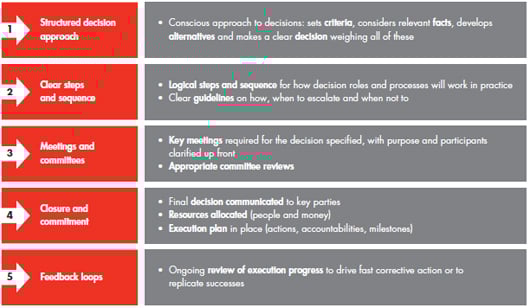
      Companies that are best at handling decisions use a consistent, well-defined process for every major decision, whether it is made in the C-suite or on the frontlines. They modify it only to take into account the value that is at stake—more care and attention for high-value decisions, less for lower-value ones. Like RAPID, a structured decision process has the great advantage that people eventually come to understand and expect it. If one person isn’t following the drill, someone else is likely to raise a red flag.

      The best practices, such as those listed in the figure below, are remarkably similar from one company to another. Any structured approach needs to incorporate the appropriate steps and sequencing. It needs to factor role assignments into the picture. ECG’s process specifies how people will play their roles, at what stage they will provide input, when a recommendation will be developed, how approval will be sought when necessary and how the final decision will be reached. Communications is also a key part of ECG’s decisions. Davis says, “We developed a regular cadence of ‘Here’s what we’ve done, here’s why we’ve done it’ to help people understand what’s being added to the roadmap and why. This has reduced the amount of revisiting we do by a lot.”

      di-set-up-your-most-important-decisions-fig-01.jpg

      Make the when explicit

      The best performers create schedules, timetables, milestones, deadlines. They ensure that decisions are quickly followed by action. Bob Walter, the CEO who led Cardinal Health from start-up to $100 billion in sales during his tenure, was a stickler for avoiding decision drift. He would say, “Delay is the worst form of denial.” When an issue hit the executive agenda at Cardinal, the clock began ticking. Every team had a certain length of time to come back with facts, alternatives and recommendations. Every executive had a strict timetable for making a decision and seeing that it was carried out. Timetables ensure that decisions get made at the right speed and that execution stays on track.

      Bain Book

      Decide & Deliver

      Learn more about the five steps that leading organizations use to make great decisions quickly and execute them effectively.

      Resetting a decision

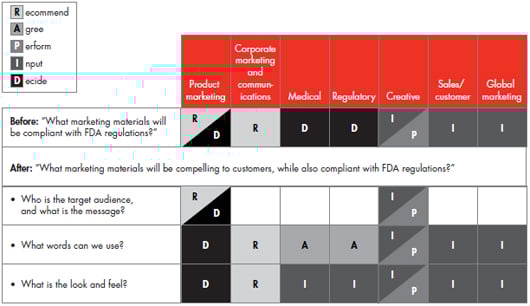
      In an earlier article we described the case of Hospira, a specialty pharmaceutical and medical device company that sought to increase its effectiveness on many critical decisions.3 Among the decisions that weren’t working well at Hospira were everyday operational matters such as producing marketing materials. That particular process seemed to take forever. Often it didn’t lead to effective sales aids. So a team attacked it in just the manner outlined here:

      What. Everybody knew that the US Food and Drug Administration (FDA) had strict regulatory restrictions on what a pharma sales aid could say. But discussions with the team suggested that while the employees were rightly concerned with FDA guidelines, they didn’t put enough emphasis on the benefits of the product. So Hospira agreed that the what of the decision was to develop effective, compelling brochures that were also FDA compliant.

      Who. The team also discovered that decision roles were less than clear. Marketing, regulatory and medical functions all believed they had the D on decisions regarding sales aids. Further discussion unbundled the decisions involved and resolved the issue. To ensure compliance with FDA rules, Regulatory got an A role on the words that could be used. Product marketing got the D on most subdecisions to ensure that they presented a compelling story to customers.

      How. In the existing process, colleagues jotted down comments on a draft and passed it around in a manila folder. Team members received the draft with no context for the critiques and had to interpret and make their own edits as best they could. Going forward, the team agreed to hold focused meetings to discuss specific issues on a brochure and thereby provide the person in the recommend role with more information and insight.

      When. Finally, the team outlined a timetable for decisions. Each step in the process—determining a promotional strategy, developing a brief, customizing the language and distributing a draft—had its own deadline. That way, everyone had clear guidelines about how long each step and the entire project should take.

      The Hospira team reset the what and the who of these decisions in a one-day workshop. Team members collaborated on the how and when over the following weeks. Finally, the entire group met to finalize the process. The results have been positive: while the teams used to take about four weeks to approve a sales aid, they are now churning through approvals much faster.

      Like Intel and Hospira, you can reset your organization’s key decisions and get them humming. The likely outcome? Better, faster decisions and improved performance—and a renewed sense of engagement and enthusiasm among the people involved.

      di-set-up-your-most-important-decisions-fig-02.jpg

      Marcia W. Blenko is a partner with Bain & Company and leads the firm’s Global Organization practice. Paul Rogers is the managing partner of Bain’s London office. Michael C. Mankins is a partner with Bain’s San Francisco office. He leads Bain’s Organization practice in the Americas and is a key member of the firm’s Strategy practice.


      1 See the book Decide & Deliver: 5 Steps to Breakthrough Performance in Your Organization (Harvard Business Review Press, 2010), from which this article is adapted.

      2 RAPID® is a registered trademark of Bain & Company, Inc.

      3 See the first article in this series, “Score your organization” (Bain & Company, 2010).

      Autoren
      • Headshot of Marcia Blenko
        Marcia Blenko
        Advisory Partner, Boston
      • Headshot of Michael Mankins
        Michael Mankins
        Partner, Austin
      • Paul Rogers
        Former Partner, Middle East
      Kontaktieren Sie uns
      Ähnliche Beratungsangebote
      • Organisation
      Wie wir Sie unterstützen können
      • Decision Effectiveness
      Organisation
      Focus on key decisions

      Don't overlook small, frequent decisions that generate a lot of value over time.

      Mehr erfahren
      Organisation
      Build an organization that decides and delivers

      Seemingly small operating choices made every day by people throughout the company can make a big difference in performance. Getting those decisions right requires that people at every level are equipped to decide and deliver.

      Mehr erfahren
      Decision Effectiveness
      RAPID® Decision Making

      When the roles involved in decisions are clearly delineated, teams and organizations make the right choices.

      Mehr erfahren
      Organisation
      When a New Organizational Structure Isn’t Enough: How to Truly Live Your Operating Model

      The goal of any organizational redesign is for people to work differently, but that only happens if leaders invest in changing the work itself.

      Mehr erfahren
      Decision Effectiveness
      At the Top, It’s All about Teamwork

      Exceptional leadership teams exhibit five collective behaviors. Here’s how to build them.

      Mehr erfahren
      First published in Dezember 2010
      Markierungen
      • Decision Effectiveness
      • Organisation

      Wie wir unsere Kunden unterstützt haben

      Organisation A Video Game Company Levels Up With a New Operating Model

      Kundenbeispiel lesen

      Organisation Building a winning media salesforce

      Kundenbeispiel lesen

      Organisation Powering a mining company's growth through cultural change

      Kundenbeispiel lesen

      Möchten Sie mit uns in Kontakt bleiben?

      Wir unterstützen Führungskräfte weltweit, die kritischen Themen in ihrem Unternehmen zu adressieren. Gemeinsam schaffen wir nachhaltige Veränderungen und Ergebnisse.

      Bain Insights. Unsere Perspektive auf die kritischen Themen, mit denen sich international agierende Unternehmen konfrontiert sehen, finden Sie monatlich in Ihrem Postfach.

      *Ich habe die Datenschutzerklärung gelesen und akzeptiere sie.
      Bitte lesen Sie die Datenschutzerklärung und akzeptieren Sie diese.
      Bain & Company
      Contact us Sustainability Accessibility Rechtliche Hinweise Impressum Datenschutz Cookie-Richtlinie Sitemap Log In

      © 1996-2026 Bain & Company, Inc.

      Kontaktieren Sie Bain

      Wie können wir Ihnen helfen?

      • Business inquiry
      • Career information
      • Press relations
      • Partnership request
      • Speaker request
      Alle weltweiten Büros