
Skip to Content
  • Standorte

    Standorte

    North & Latin America
    • Atlanta
    • Austin
    • Bogota
    • Boston
    • Buenos Aires
    • Chicago
    • Dallas
    • Denver
    • Houston
    • Lisbon
    • Los Angeles
    • Mexico City
    • Minneapolis
    • Monterrey
    • Montreal
    • New York
    • Rio de Janeiro
    • San Francisco
    • Santiago
    • São Paulo
    • Seattle
    • Silicon Valley
    • Toronto
    • Washington, DC
    Europe & Africa
    • Amsterdam
    • Athens
    • Berlin
    • Brussels
    • Copenhagen
    • Düsseldorf
    • Frankfurt
    • Helsinki
    • Istanbul
    • Johannesburg
    • Kyiv
    • Lisbon
    • London
    • Madrid
    • Milan
    • München
    • Oslo
    • Paris
    • Rome
    • Stockholm
    • Warsaw
    • Wien
    • Zürich
    Middle East
    • Doha
    • Dubai
    • Riyadh
    Asia & Australia
    • Bangkok
    • Beijing
    • Bengaluru
    • Brisbane
    • Ho Chi Minh City
    • Hong Kong
    • Jakarta
    • Kuala Lumpur
    • Manila
    • Melbourne
    • Mumbai
    • New Delhi
    • Perth
    • Seoul
    • Shanghai
    • Singapore
    • Sydney
    • Tokyo
    Alle Standorte Anzeigen
  • Alumni
  • Presse
  • Newsletter
  • Kontakt
  • DACH-Region | Deutsch

    Wählen Sie Ihre Region und Sprache

    Global
    • Global (English)
    North & Latin America
    • Brazil (Português)
    • Argentina (Español)
    • Canada (Français)
    • Chile (Español)
    • Colombia (Español)
    Europe, Middle East, & Africa
    • France (Français)
    • DACH-Region (Deutsch)
    • Italy (Italiano)
    • Spain (Español)
    • Greece (Elliniká)
    Asia & Australia
    • China (中文版)
    • Korea (한국어)
    • Japan (日本語)
  • Saved items (0)
    Saved items (0)

    You have no saved items.

    Inhalte, für die Sie sich interessieren, werden hier gespeichert und können später gelesen oder weitergeleitet werden.

    Explore Bain Insights
  • Branchenkompetenzen
    Hauptmenü

    Branchenkompetenzen

    • Luft- und Raumfahrt, Verteidigung
    • Agrarwirtschaft
    • Chemieindustrie
    • Infrastruktur und Bauwirtschaft
    • Konsumgüter
    • Finanzdienstleistungen
    • Gesundheitswesen
    • Maschinen- und Anlagenbau
    • Medienwirtschaft
    • Metallindustrie
    • Bergbau
    • Öl und Gas
    • Papier- und Verpackungsindustrie
    • Private Equity
      Branchenkompetenzen
      Private Equity
      • Due Diligence
      • Exit Planning
      • Firm Strategy & Operations
      • Portfolio Value Creation
    • Öffentlicher Sektor und Sozialwesen
    • Einzelhandel
    • Technologie
    • Telekommunikation
    • Transportwesen
    • Reise- und Freizeitbranche
    • Versorgung und erneuerbare Energien
  • Managementkompetenzen
    Hauptmenü

    Managementkompetenzen

    • Customer Experience
    • ESG
    • Innovation
    • M&A
    • Operations
    • People & Organization
    • Private Equity
    • Sales & Marketing
    • Strategie
    • KI, Einblicke und Lösungen
    • Technologie
    • Transformation
  • Digital
  • Publikationen
    Hauptmenü

    Publikationen

    • Branchenthemen
    • Managementthemen
    • Bain-Bücher
    Alle Publikationen
    Ausgewählte Themen
    • Resilienz in der globalen Krise
    • M&A Report
    • Private Equity Podcast
    • Midyear Private Equity Report
    • Agile
    • Engineering Report
    • Digital Transformation
    • Elements of Value®
    • Firm of the Future
    • Nachhaltigkeitsstudie
    • Macro Trends
    • Future of Consumption
    • Weltwirtschaftsforum (WEF)
  • Über uns
    Hauptmenü

    Über uns

    • Was wir bieten
    • Unser Ansatz
    • Unser Team
    • Game Changer Award
    • Female Allstar Board
    • Messbare Ergebnisse (EN)
    • Auszeichnungen
    • Globale Partnerschaften
    • The Mission
    Further: Our global responsibility
    • Vielfalt & Chancengleichheit
    • Soziale Verantwortung
    • Sustainability
    Erfahren Sie mehr zu "Further"
  • Karriere
    Hauptmenü

    Karriere

    • Dein Einstieg
      Karriere
      Dein Einstieg
      • Find Your Place
      • Unsere Arbeitsbereiche
      • Unsere Teams
      • Angebote für Studierende
      • Praktika & Programme
      • Recruiting-Events
    • Arbeiten bei Bain
      Karriere
      Arbeiten bei Bain
      • Karriere Stories
      • Unsere Bainies
      • Office-Standorte
      • Weiterentwicklung
      • Affinity Groups
      • Deine Benefits
    • Impact Stories
    • Deine Bewerbung
      Karriere
      Deine Bewerbung
      • Das erwartet dich
      • Der Interviewprozess
    FIND JOBS
  • Standorte
    Hauptmenü

    Standorte

    • North & Latin America
      Standorte
      North & Latin America
      • Atlanta
      • Austin
      • Bogota
      • Boston
      • Buenos Aires
      • Chicago
      • Dallas
      • Denver
      • Houston
      • Lisbon
      • Los Angeles
      • Mexico City
      • Minneapolis
      • Monterrey
      • Montreal
      • New York
      • Rio de Janeiro
      • San Francisco
      • Santiago
      • São Paulo
      • Seattle
      • Silicon Valley
      • Toronto
      • Washington, DC
    • Europe & Africa
      Standorte
      Europe & Africa
      • Amsterdam
      • Athens
      • Berlin
      • Brussels
      • Copenhagen
      • Düsseldorf
      • Frankfurt
      • Helsinki
      • Istanbul
      • Johannesburg
      • Kyiv
      • Lisbon
      • London
      • Madrid
      • Milan
      • München
      • Oslo
      • Paris
      • Rome
      • Stockholm
      • Warsaw
      • Wien
      • Zürich
    • Middle East
      Standorte
      Middle East
      • Doha
      • Dubai
      • Riyadh
    • Asia & Australia
      Standorte
      Asia & Australia
      • Bangkok
      • Beijing
      • Bengaluru
      • Brisbane
      • Ho Chi Minh City
      • Hong Kong
      • Jakarta
      • Kuala Lumpur
      • Manila
      • Melbourne
      • Mumbai
      • New Delhi
      • Perth
      • Seoul
      • Shanghai
      • Singapore
      • Sydney
      • Tokyo
    Alle Standorte Anzeigen
  • Alumni
  • Presse
  • Newsletter
  • Kontakt
  • DACH-Region | Deutsch
    Hauptmenü

    Wählen Sie Ihre Region und Sprache

    • Global
      Wählen Sie Ihre Region und Sprache
      Global
      • Global (English)
    • North & Latin America
      Wählen Sie Ihre Region und Sprache
      North & Latin America
      • Brazil (Português)
      • Argentina (Español)
      • Canada (Français)
      • Chile (Español)
      • Colombia (Español)
    • Europe, Middle East, & Africa
      Wählen Sie Ihre Region und Sprache
      Europe, Middle East, & Africa
      • France (Français)
      • DACH-Region (Deutsch)
      • Italy (Italiano)
      • Spain (Español)
      • Greece (Elliniká)
    • Asia & Australia
      Wählen Sie Ihre Region und Sprache
      Asia & Australia
      • China (中文版)
      • Korea (한국어)
      • Japan (日本語)
  • Saved items  (0)
    Hauptmenü
    Saved items (0)

    You have no saved items.

    Inhalte, für die Sie sich interessieren, werden hier gespeichert und können später gelesen oder weitergeleitet werden.

    Explore Bain Insights
  • Branchenkompetenzen
    • Branchenkompetenzen

      • Luft- und Raumfahrt, Verteidigung
      • Agrarwirtschaft
      • Chemieindustrie
      • Infrastruktur und Bauwirtschaft
      • Konsumgüter
      • Finanzdienstleistungen
      • Gesundheitswesen
      • Maschinen- und Anlagenbau
      • Medienwirtschaft
      • Metallindustrie
      • Bergbau
      • Öl und Gas
      • Papier- und Verpackungsindustrie
      • Private Equity
      • Öffentlicher Sektor und Sozialwesen
      • Einzelhandel
      • Technologie
      • Telekommunikation
      • Transportwesen
      • Reise- und Freizeitbranche
      • Versorgung und erneuerbare Energien
  • Managementkompetenzen
    • Managementkompetenzen

      • Customer Experience
      • ESG
      • Innovation
      • M&A
      • Operations
      • People & Organization
      • Private Equity
      • Sales & Marketing
      • Strategie
      • KI, Einblicke und Lösungen
      • Technologie
      • Transformation
  • Digital
  • Publikationen
    • Publikationen

      • Branchenthemen
      • Managementthemen
      • Bain-Bücher
      Alle Publikationen
      Ausgewählte Themen
      • Resilienz in der globalen Krise
      • M&A Report
      • Private Equity Podcast
      • Midyear Private Equity Report
      • Agile
      • Engineering Report
      • Digital Transformation
      • Elements of Value®
      • Firm of the Future
      • Nachhaltigkeitsstudie
      • Macro Trends
      • Future of Consumption
      • Weltwirtschaftsforum (WEF)
  • Über uns
    • Über uns

      • Was wir bieten
      • Unser Ansatz
      • Unser Team
      • Game Changer Award
      • Female Allstar Board
      • Messbare Ergebnisse (EN)
      • Auszeichnungen
      • Globale Partnerschaften
      • The Mission
      Further: Our global responsibility
      • Vielfalt & Chancengleichheit
      • Soziale Verantwortung
      • Sustainability
      Erfahren Sie mehr zu "Further"
  • Karriere
    Häufige Suchanfragen
    • Agil
    • Digital
    • Strategie
    Vorherige Suchanfragen
      Zuletzt besuchte Seiten

      Content added to saved items

      Saved items (0)

      Removed from saved items

      Saved items (0)

      Energy & Natural Resources Report

      Developing Talent Strategies for the Energy Transition

      Developing Talent Strategies for the Energy Transition

      Energy and natural resources companies will need to create an inclusive environment for new and diverse employees, while also valuing legacy talent.

      Von Brenen Blair, Anders Bruhn, und Emily Emmett

      • Min. Lesezeit
      }

      Report

      Developing Talent Strategies for the Energy Transition
      en
      Auf einen Blick
      • Energy and natural resources companies will need to find and integrate talent with a wide range of skills to guide them through the energy transition and help build new, greener businesses.
      • Many organizations are struggling to balance acquiring talent needed to pursue new opportunities and retaining employees with the skills necessary to support legacy businesses.
      • Bain's recent research on inclusion found that about 80% of employees in oil and gas view inclusion as very important in their workplace, but the oil and gas sector lags other industries in fostering inclusion.
      • Leaders can help with retention and integration across talent pools by clearly signaling their commitment to the energy transition, promoting growth for individuals, and facilitating connections among employee groups.

      This article is part of Bain’s Energy and Natural Resources Report 2022

      Explore the report

      Navigating the energy transition will be a generational challenge, requiring top-tier talent to solve incredibly complex problems. Meeting this challenge will require retaining and reskilling today’s workers, while integrating new people with varied backgrounds and capabilities. Leaders will need to invest in creating inclusive organizations where everyone feels like a valued contributor with a shared purpose.

      Generations of talented individuals have pursued careers in energy because it offered opportunities for learning, teamwork, and impact in the service of powering our communities. This will be as true in the future as it was in the past. Looking backward, the talent that made the difference was concentrated in engineering and operational disciplines. But as the energy transition expands the range of business activities that energy companies pursue, that talent base is expanding and diversifying. Engineering proficiency is no less critical to success, but companies also need to integrate expertise in new areas such as product development, human-centered design, and regulatory affairs.

      “Working in energy gives me a sense of purpose. It makes me feel I'm working on something bigger than myself, something bigger than my company.”

      Battery engineer, renewable energy, 33

      Talent strategy is becoming an existential priority in the energy sector. This is the result of several pressures challenging the ability to find, hire, and retain talent: a wave of retiring professionals, demand for new roles to build out new businesses, and a talent drain from the energy sector to technology, to name a few. To address these gaps, companies are rethinking how and where to expand the funnel for potential new hires, while also innovating and experimenting with new strategies to retain and reskill the workforce that keeps their current businesses running. Power utilities, for example, will need new teams to build out wind farms and battery arrays, but will also continue to require teams that can keep thermal plants running. 

      This isn’t the first time that the energy industry had to adapt its workforce to major changes in technology, regulation, and economics. Establishing the business models that built the modern energy landscape and building the infrastructure that delivers energy at a massive scale to power the global economy required a broad range of talent.

      In more recent decades, however, as many companies’ strategies focused on incremental growth and continuous improvement, the workforce evolved to be more geared to deliver operational excellence and prudent capital management, rather than building disruptive and innovative new businesses. In the decade ahead, both are priorities.

      As economies confront the need to reduce carbon emissions, the energy workforce is once again transforming. Energy companies must design employee value propositions that invite and appeal to the new talent needed for new capabilities and businesses, without threatening or alienating their current workforce.

      “Multinational oil and gas companies are competing with every other big company out there for talent and need a real value proposition.”

      Subsea engineer, oil and gas, 29

      Winning new talent with diverse new perspectives

      Energy companies know they need to attract employees with new skills and capabilities, often from more diverse demographics than the current workforce. Some of this talent will need to be won over from the technology, finance, and public sectors, and they’ll bring new perspectives on teaming, compensation, and location (including remote options). Like current employees, they want to feel included in the companies they work for, and they want to know they’re experiencing an equitable talent journey, no matter their role. But in our interviews over the past year with the people that energy companies are trying to win over, many are skeptical of the motives of the industry, and doubtful of their ability to succeed in incumbent energy companies. Senior managers will need to find ways to reassure these new workers that they’re an essential part of the team, valued for their unique capabilities and perspectives.

      “I want it to be clear that green investments are not just a PR stunt . . . trust would be the No. 1 factor to determine if I am interested in a job or not.”

      PhD student, organometallic chemistry, 29

      However, in going for this new cohort, energy companies find themselves in a challenging starting position. In addition to weak representation of diverse talent, the industry lags on overall measures of inclusivity (see Figure 1).

      Figure 1
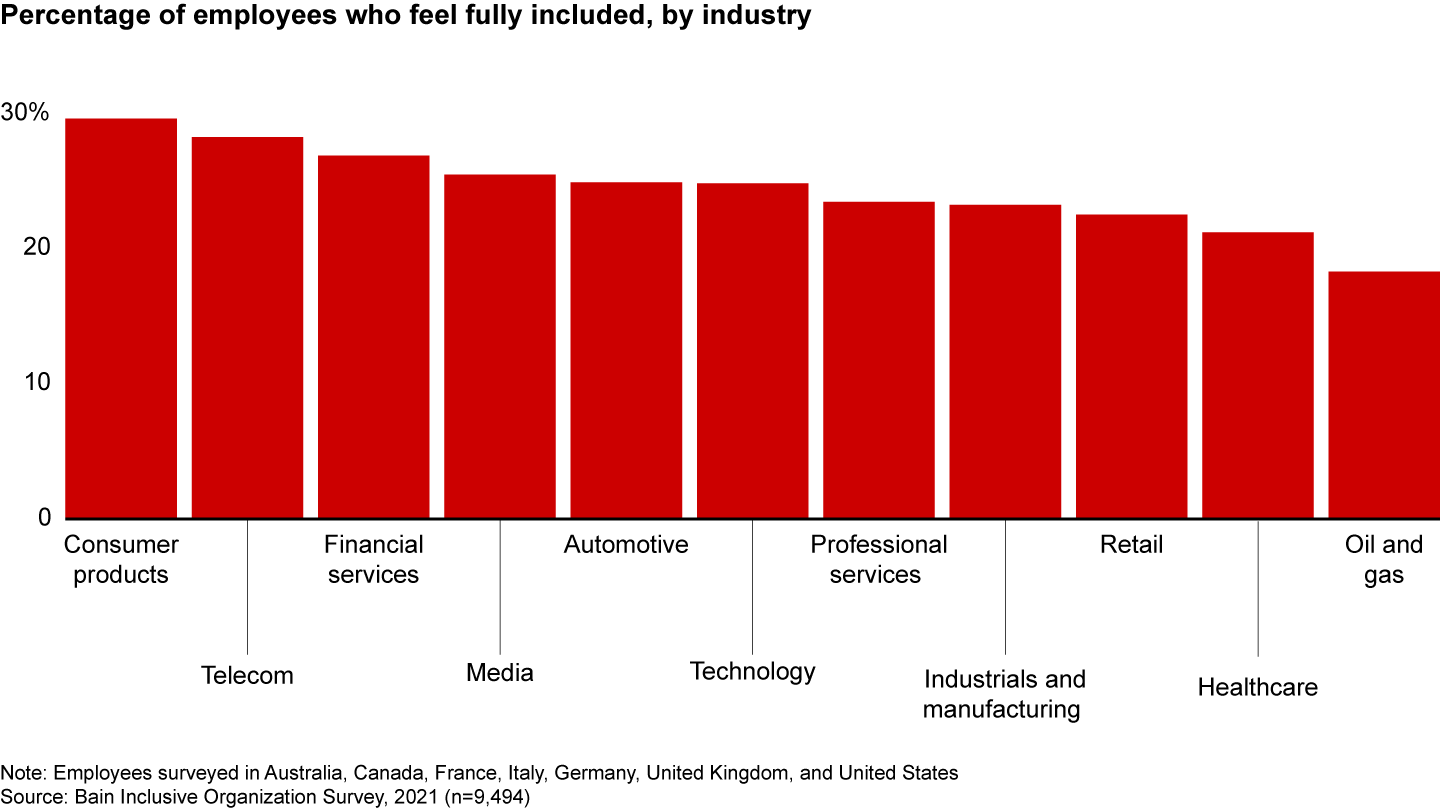
      Oil and gas trails other industries in measures of inclusivity

      While most energy executives are aware of the talent crunch in their sectors and the obstacles preventing them from drawing in more diverse talent, they may be overlooking some important keys to success. Inclusivity is an important factor for career success in every sector, but especially in some energy and natural resources (ENR) industries. Bain’s recent research found that nearly four out of five employees in the US oil and gas sector rate inclusivity as very important in an employer, the most of any sector we surveyed.

      “I want diversity in thinking, diversity in gender . . . more inclusion of people from different cultures and backgrounds is necessary for getting different ideas on the table.”

      Undergraduate student, mechanical engineering, 22

      However, Bain’s research also found that many senior leaders may have a rosier picture of inclusivity in their companies than the new hires they’re hoping will build their careers there (see Figure 2). Across factors, senior executives rated their organizations as more inclusive than did more junior team members.

      Figure 2
      Unconscious blind spots among senior leaders can limit their ability to design the right solutions for inclusivity

      These blind spots make it harder for energy and natural resources companies to know how to make their organizations more inclusive to a more diverse pool of talent. They can make it hard to stem the “leaky bucket” effect, in which well-intentioned recruiting efforts bring in racially or gender-diverse employees—who then leave soon after because they don’t feel like they belong or are included.

      “My perception is that traditional energy companies right now are misaligned with what I believe.”

      Associate engineer, renewable energy, 22

      Bain’s recent research on inclusivity identified the factors that make ENR employees feel included. Top factors included growth opportunities, transparent feedback, a mindset for growth among leadership, and strong coaching and professional development rituals—things that would be important to anyone navigating a career path. People in underrepresented groups (including women, Black, Asian, Hispanic, and LGBTQ+) reported greater inclusion if they saw inclusion in the company’s diversity mission and goals and experienced it in team meetings, performance reviews, and team building. They also felt more included if they worked with leaders who had a growth mindset and a commitment to transparent feedback and were open to unique points of view. 

      Supporting current talent

       While energy companies scrutinize and adapt talent strategies to include new sources and types of skills, it would be a mistake to assume that “legacy” talent profiles and preferences will remain unchanged. Most of the current energy workforce is highly motivated to support the energy transition and eager to apply their current capabilities and new skills to new missions. They’re also keen to remain relevant and valuable in an uncertain future.

      “You wouldn't want to be stuck in an industry that is potentially going to be gone in 20 years; you're looking at building a 30- to 40-year career.”

      Subsea engineer, oil and gas, 29

      The energy sector needs a skilled workforce doing many of the same things that have kept the industry running for decades—and will remain important for years to come. Yet even established roles are changing. Leaders need to continually inspire and motivate the workforce, making sure skills don’t erode, and showing these workers they remain important, valued, and included, even as their companies are transformed.

      “How will the company help me transition my knowledge and experiences into something that could help the energy transition?”

      Telecom engineer, oil and gas, 30

      The inclusion imperative

      There’s no simple solution for the complex talent challenges facing the energy sector. Success will require companies to deeply engage with and draw out the full potential of new and current talent populations, and to inspire them to innovate and solve problems together, not just in parallel. We believe that improving the sense of inclusion for all employees, old and new, will be a critical enabler of the evolving talent engine required to power the energy transition.

      A sincere commitment to inclusion makes organizations both higher performing and more welcoming for all workers, across lines of capability, demographics, and tenure.

      Bain’s recent report on inclusion shows that employees who feel fully included are up to six times more likely to remain with their current employer, and are much more likely to promote their place of employment to others (+71 vs. ‒83, using Bain’s employee Net Promoter Score℠ methodology of calculating the percentage of promoters minus the percentage of detractors) than those who feel “not at all included.”

      New employees want to have a seat at the table—to be invited to help solve the challenge of how to serve their communities in more environmentally sustainable ways. Existing employees also want to contribute to new priorities and want to know their unique skills and experiences remain valuable in an uncertain future. Inclusion won’t solve all of the complex talent challenges, but it will play a foundational role in any strategy.

      Getting this right as an organization is complex in any scenario, even more so in an industry undergoing major disruption. The tactics that support and improve inclusion are nuanced. But we’ve found a few common themes across industries that feel especially relevant to today’s energy landscape.

      • Signal commitment. People working in energy, both new and existing employees, are looking to know that they’re a part of the solution; that their organization is committed to thoughtfully navigating the transition; and that their perspectives are valued. Leaders should listen deeply, then talk openly and frequently about a sincere commitment to both the transition and fully including a diverse talent base.

      “I want to see a clear roadmap to decarbonization and actual metrics to measure that . . . words without measurable metrics are not as convincing.”

      Development engineer, renewable energy, 25
      • Promote growth. Everyone wants to build skills to navigate to the other side. Everyone wants to look ahead to a rewarding career path, characterized by deeper skills and expanding autonomy and authority. Invest in building clear, transparent career paths for new talent and helping existing talent understand lateral opportunities. Cultivate a growth mindset in leaders and give decision-making authority and leadership opportunities to the next generation to help build skills and confidence. Recognize that making this successful will require a complex set of changes to both ingrained behaviors and standard talent operations.

      “I do think the scale-up of energy technologies is going to require new skills that have to be learned and developed.”

      Analytical scientist, renewable energy, 30
      • Facilitate connection. Scrutinize the organizational silos that exist today, and guard against reinforcing them or creating new ones. New and existing employees need to be truly integrated, with an appreciation for the roles everyone plays in serving the organization’s long-term purpose and near-term strategy. Identify and experiment with tactics to strengthen connection across potential siloes, for example, through Agile teaming, cross-training, mentoring programs, and diversity affinity groups.

      Navigating the energy transition will require the deliberate marriage of new and existing talent communities over many years, joining together to adopt new ways of working in support of new products and services as well as legacy business models. These are the building blocks of inclusion for a diverse population, which we see as essential to attracting, retaining, and benefiting from the full potential of the diverse talent base needed to thrive in the energy transition.

      Read the Next Chapter

      Creating a Coordinated Approach to Decarbonization

      Data-rich perspectives

      • Execs on energy transition

      • Investing in Engine 2

      • Energy investors and ESG

      • Responding to Ukraine crisis

      Transition trends

      • Talent and inclusivity

      • Building coalitions for decarbonization

      • Circularity in plastics

      Strategic capabilities

      • How to do Engine 2

      • Operations through disruptions

      • Pricing and inflation

      • M&A opportunities

      • Delivering decarbonization

      Read our Energy and Natural Resources Report 2022

      Explore the full report Download PDF
      Autoren
      • Brenen Blair
        Alumni, Houston
      • Headshot of Anders Bruhn
        Anders Bruhn
        Partner, Copenhagen
      • Headshot of Emily Emmett
        Emily Emmett
        Partner, Houston
      Kontaktieren Sie uns
      Verwandte Branchen
      • Agrarwirtschaft
      • Bergbau und Metall
      • Chemieindustrie
      • Energieversorgung
      • Energiewirtschaft
      • Öl und Gas
      Ähnliche Beratungsangebote
      • Strategie
      Energy and Natural Resources Report
      Creating a Coordinated Approach to Decarbonization

      Energy and natural resources companies are building broad coalitions to develop policies that accelerate decarbonization.

      Mehr erfahren
      Energy and Natural Resources Report
      The Energy Transition’s Other Big Puzzle: Making the Math Work

      Strong investment returns are within reach for companies that focus on the fundamentals and aren’t afraid to get creative.

      Mehr erfahren
      Energiewirtschaft
      Sustaining Capital: From Chaos to Discipline

      Fragmented budgets, poor visibility, and missed forecasts are fixable with the right approach.

      Mehr erfahren
      Strategie
      What Business Leaders Need to Know About AI Sovereignty

      Aligning business strategy with national AI priorities is necessary to compete and scale.

      Mehr erfahren
      Energy and Natural Resources Report
      State of the Transition 2023: Global Energy and Natural Resource Executive Perspectives

      Bain’s third annual survey on the energy transition finds executives increasing investments in low-carbon businesses, but skeptical of consumers’ willingness to pay more.

      Mehr erfahren
      First published in Juni 2022
      Markierungen
      • Agrarwirtschaft
      • Bergbau und Metall
      • Chemieindustrie
      • Energieversorgung
      • Energiewirtschaft
      • Energy and Natural Resources Report
      • Öl und Gas
      • Strategie

      Wie wir unsere Kunden unterstützt haben

      Strategie New products propel profitability for metals manufacturer

      Kundenbeispiel lesen

      Mergers & Acquisitions An OFS captures post-merger growth synergies

      Kundenbeispiel lesen

      Mergers & Acquisitions Broader market plus tighter sales strategy equals big success for a portfolio company

      Kundenbeispiel lesen

      Möchten Sie mit uns in Kontakt bleiben?

      Wir unterstützen Führungskräfte weltweit, die kritischen Themen in ihrem Unternehmen zu adressieren. Gemeinsam schaffen wir nachhaltige Veränderungen und Ergebnisse.

      Net Promoter®, NPS®, NPS Prism®, and the NPS-related emoticons are registered trademarks and Net Promoter Score℠ and Net Promoter System℠ are service marks of Bain & Company, Inc., Satmetrix Systems, Inc., and Fred Reichheld.

      Bain Insights. Unsere Perspektive auf die kritischen Themen, mit denen sich international agierende Unternehmen konfrontiert sehen, finden Sie monatlich in Ihrem Postfach.

      *Ich habe die Datenschutzerklärung gelesen und akzeptiere sie.
      Bitte lesen Sie die Datenschutzerklärung und akzeptieren Sie diese.
      Bain & Company
      Contact us Sustainability Accessibility Rechtliche Hinweise Impressum Datenschutz Cookie-Richtlinie Sitemap Log In

      © 1996-2026 Bain & Company, Inc.

      Kontaktieren Sie Bain

      Wie können wir Ihnen helfen?

      • Business inquiry
      • Career information
      • Press relations
      • Partnership request
      • Speaker request
      Alle weltweiten Büros