

Brief

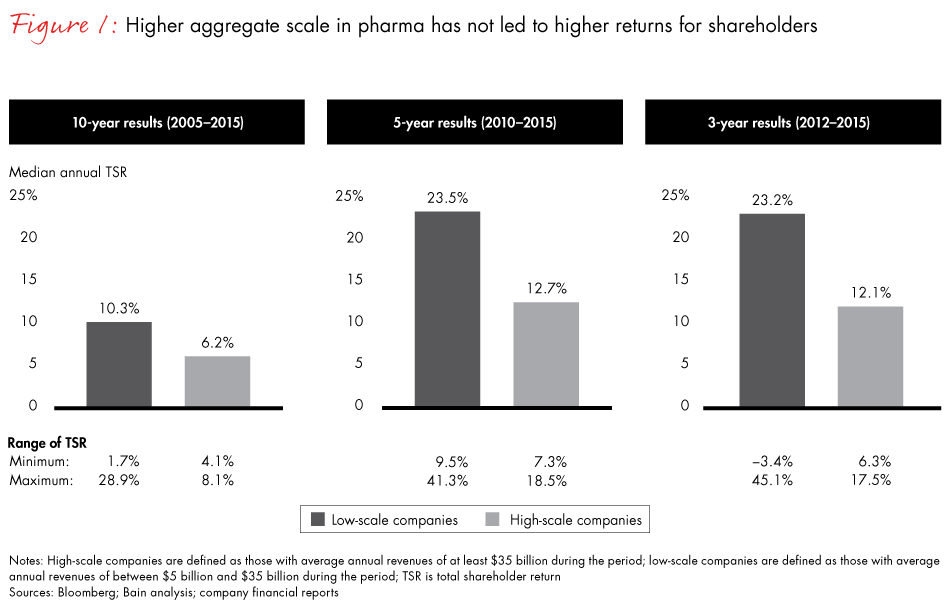
For years, biopharma industry leaders have wrestled with the limits of scale. Despite the benefits that come with size, companies with revenues of $35 billion or more have significantly underperformed smaller companies with annual revenues of between $5 billion and $35 billion in total shareholder returns (TSR) (see Figure 1). Why do the largest companies struggle to deliver above-average shareholder returns? And more important, what can they do to lift a stubbornly low TSR?
The short answer: Avoid complex, wide-ranging portfolios that undermine focus. Large biopharma companies compete in many categories and tend to accumulate an array of follower positions. The combined challenge of managing a diversified portfolio and multiple follower positions drags down shareholder returns.
Jeff Haxer, a partner in Bain's Healthcare practice, shares two ways that biopharma companies can spur shareholder returns by strategically managing their portfolios.
The biggest value creators in biopharma are category leaders, according to Bain research. Industry trends play to their strengths because category leaders concentrate on markets defined through the eyes of the customer, including patients, prescribing physicians and payers (see the In Vivo report To Outperform in Pharma, Go Deep—Not Broad). The category-leadership lens offers biopharma companies a deeper understanding of category dynamics and evolution, better insights into market needs, superior execution of clinical development programs and privileged access to key opinion leaders. Category leaders also identify the best external assets faster and are the partners of choice for innovative new players.
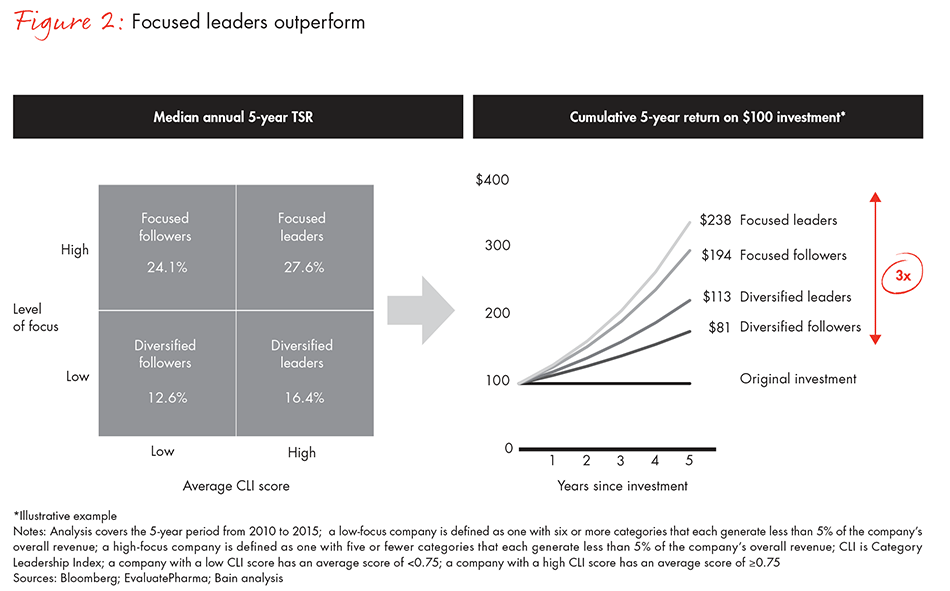
But even category leaders can spread their resources too thin, betting on multiple categories, which increases portfolio complexity and distracts management from the core business. That strategy undercuts returns. By contrast, companies managing to combine category leadership with portfolio focus create a powerful multiplier effect. These focused leaders deliver annual total shareholder returns more than twice those of companies that are diversified followers, Bain analysis shows. Compound the difference over three to five years, and the increase in investor returns is substantial (see Figure 2).
These two elements may not explain every company’s stellar performance—a serendipitous discovery in the lab of a highly valuable molecule can change a company’s fortunes, as can an unexpected failure. But apart from such chance events, category leadership and portfolio focus are powerful predictors of biopharma performance.
The benefits of that combination have major implications for portfolio strategy, including M&A and divestitures. Large companies can improve their TSR significantly, overcoming some scale disadvantages, by building category leadership in a few segments while divesting nonstrategic assets that add to portfolio complexity.
Category leaders with focus outperform
Total shareholder return, calculated over time, is the single best indicator of a company’s performance. To better understand TSR variation in biopharma, we studied the impact of category leadership and portfolio breadth or diversity on value creation.
The distinction between category leadership and portfolio focus is important. Category leaders in biopharma have average relative market shares of at least 0.75 across their portfolios. We define companies with focused portfolios as those with five or fewer “tail” categories, each generating less than 5% of total revenues over a five-year period. This five-year view takes into account the portfolio flux that all pharma companies face so as not to penalize a company for its standing at a single point in time.
Companies may be category leaders in their largest businesses yet still lack portfolio focus because they carry a number of tail businesses. We call these companies diversified leaders. Conversely, companies can have highly focused portfolios, but lack the relative market share to be category leaders—these are focused followers. Category leaders with focused portfolios—the focused leaders—outperform, because they avoid the distraction and complexity of managing multiple noncore businesses that contribute little to overall performance (see Figure 2).
Biopharma leadership teams continually place new bets on emerging categories that are subscale in the beginning—that’s normal. The risk is making too many bets and retaining lagging positions that consume resources but rarely receive sufficient investment to reach full potential. That drags down performance. Companies that stay focused over time achieve dramatic gains in shareholder returns. Five-year compounded returns are nearly three times higher for focused leaders than for diversified followers. And improving on even one dimension raises total shareholder returns: Focused followers and diversified leaders both outperform diversified followers by more than 30%.
Not only is there a significant difference in the magnitude of TSR of the largest biopharma companies and more focused peers, but the composition of shareholder returns in each group also is different, which is instructive. Between 2010 and 2015, the average focused leader produced two-thirds of its TSR growth from growth in profits, whereas the average diversified follower delivered nearly all of its shareholder returns by expanding its valuation multiple—share prices went up, even though operating results were tepid.
Importantly, attractive future growth expectations do not seem to account for the increase in share-price multiples for diversified followers. Instead, high dividend yields of biopharma companies in a historically low global interest-rate environment may have temporarily spared these dividend-paying companies a punishing result. Multiple expansion is unlikely to fuel similar growth in the coming five years.
Scale is helpful, to a point
Scale creates advantages in the biopharma industry; for example, a certain minimum scale is needed to fund big R&D bets and execute global product launches. However, when companies grow beyond that minimum scale, the challenges multiply. Our analysis shows that companies with revenues of more than $35 billion benefit from selling, general and administrative (SG&A) cost efficiencies that are lower, by 1% to 3% of revenue, than those of their next largest peers. While this is clearly an advantage, it comes at a cost.
As biopharma companies reach a certain size, countervailing forces begin to undercut the advantages of scale. The magnitude and complexity of operating in multiple biopharma sectors deplete management’s focus and slow decision making. Large companies also tend to focus power and resources on the center, and as a result, the voices of frontline employees may grow distant and powerless. Companies’ sense of mission and urgency may also fade. (For more about this, see the book The Founder’s Mentality.)
Why do leadership teams maintain diversified portfolios even as organizational complexity becomes a drag on value creation? There are a number of powerful motivations. For larger diversified biopharma companies, lagging positions absorb overhead, and some may offer future growth options. Yet for many diversified followers, even successful drug launches may barely move the needle on TSR because of company size and diverse portfolios. Stepping back and reexamining strategic options in the context of focus and category leadership can help leadership teams chart a course that balances growth with focus.

Focus for Higher Returns in Biopharma
The best performing companies combine category leadership with portfolio focus.
Strategic implications
In our experience, the composition of a biopharma company’s portfolio matters far more than its overall scale. Using that principle to guide strategy, biopharmas have several options for delivering higher TSR, depending on their starting positions.
-
Grow from a leadership position. Companies with category-leadership positions have built significant credibility with patients, innovators, key opinion leaders, prescribers and regulators. Category leaders have more insights based on data, greater ability to offer solutions beyond the pill and increased opportunity to pursue innovative payer contracts within and across drugs in the category. Investing in extending leadership is the best path to creating strong shareholder returns over time.
That said, categories eventually reach a growth threshold, as innovation hits scientific limits and the standard of care and patient experience become broadly acceptable to patient groups, payers and treating physicians. At that point, leadership teams feel compelled to place new bets. To avoid a move that would weaken TSR, concentrate investments on one or two new categories, stay focused and chart a path to leadership.
-
Navigate diversified portfolios and follower positions. Nearly all companies have some follower positions. For each position, it is important to evaluate whether the company has a legitimate path to category leadership. If the answer is yes, consider amplifying your investment. As an example, AbbVie is taking this approach in targeted segments in hematology. First, the company expanded its development program for the leukemia drug Venclexta (which it is developing in partnership with Roche) and then made a large, reinforcing acquisition of Pharmacyclics, adding the drug Imbruvica to its portfolio.
For follower positions with no path to leadership, divesting, swapping out or spinning off assets may improve portfolio focus and shareholder returns. The key is to evaluate the portfolio, category by category, and to put more options on the table than you may have historically. While many leadership teams may not have much experience with divestitures, spin-offs and swaps, a growing number of companies are pursuing such transactions. Examples of this trend include Novartis’ sale of its influenza-vaccine business to CSL, Bristol-Myers Squibb’s sale of its diabetes division to AstraZeneca and Biogen’s spin-off of its hemophilia business.
Is it better to break up?
In some cases, the smart approach may be a more radical portfolio makeover, such as splitting the diversified company into two or more focused companies.
Of course, breaking a company into independent units is not simple. Among other challenges, it can reduce the cost efficiencies mentioned earlier. Creating new teams, establishing legal entities, updating product labels and transferring licenses globally are time-consuming and costly endeavors.
Yet with the right strategic intent, spin-offs and divestitures can improve a portfolio’s odds of developing both category leadership and focus. Newly independent entities are more nimble and have a sense of urgency to establish leadership in their chosen fields. As long as these independent companies have sufficient scale, they may be better positioned to reinvigorate the business, attract category-specific talent and build leadership through category-specific M&A (see the Bain Brief “Mastering the Good Breakup”).
Consider Abbott Laboratories’ spin-off of AbbVie, and Baxter and Baxalta’s split. The rationale for both spin-offs was similar: The companies wanted to separate the risk profile of biopharma and medtech, and allow for the development of specific category leadership strategies aligned with that risk profile. Following the Abbott-AbbVie split, AbbVie’s annual TSR increased by 50% vs. the previous year. AbbVie pursued a much deeper pipeline in immunology and added a major leg in hematology. Baxter and Baxalta’s combined market cap-weighted TSR was 34% in the year following their split, compared with an 8.8% average annual shareholder return for the five years prior to announcement of their separation.
We recognize that both of these examples are cases of separating pharma assets from medtech assets. However, they highlight the flexibility and focus that the newly formed companies can harness as they seek leadership positions with a simplified portfolio.
Conclusion
For decades, biopharma companies have relentlessly pursued growth, counting on pure scale and M&A cost synergies to create value. We believe this strategy is reaching its limits and becoming counterproductive. Megamergers that don’t produce category leaders also don’t create portfolios that are likely to deliver attractive shareholder returns over time. By contrast, companies that build category leadership and eliminate excess complexity from their portfolios will outperform and, over time, reshape the competitive landscape.
Methodology
To determine the impact of category leadership, Bain constructed a proprietary metric called the Bain Category Leadership Index® (CLI) score, which measures the relative leadership of a company’s portfolio, and analyzed how different strategic moves can change a company’s CLI score. The methodology segments the pharma industry into 33 distinct categories. These are not markets, per se, but rather diseases that, through advanced analytics into prescribing patterns, have relevance at the prescriber, key opinion leader and payer levels. Within a category, the relative market share of the largest player is 1 or higher. We also consider companies with relative market shares of between 0.75 and 1 (meaning they are 75% to 100% the size of the largest player) to be category leaders, since they typically enjoy many of the same benefits as the largest player. The CLI score is revenue weighted across categories, so a score of 0.75 typically means that the company is a category leader in its largest categories. A CLI score of greater than 0.75 signals larger leads over peers. A CLI score that is lower than 0.75 signals that, on average, the company is a follower in its categories.
The research cited in this brief includes most global, branded biopharma companies with revenues of more than $5 billion. Excluded are companies whose nonpharma categories represent 40% or more of their revenues; companies that are privately held; companies that went public within the last five years or were acquired during that period; companies with unrepresentative shocks (e.g., Valeant); and companies with a majority focus on generics.
Dave Fleisch, Jeff Haxer and Andy Pasternak are partners in Bain & Company’s Chicago office. Todd Sangster is a principal in Bain’s San Francisco office. They are members of the firm’s Healthcare practice.
Category Leadership Index® is a registered trademark of Bain & Company, Inc.
First published in November 2016