
Skip to Content
  • Standorte

    Standorte

    North & Latin America
    • Atlanta
    • Austin
    • Bogota
    • Boston
    • Buenos Aires
    • Chicago
    • Dallas
    • Denver
    • Houston
    • Lisbon
    • Los Angeles
    • Mexico City
    • Minneapolis
    • Monterrey
    • Montreal
    • New York
    • Rio de Janeiro
    • San Francisco
    • Santiago
    • São Paulo
    • Seattle
    • Silicon Valley
    • Toronto
    • Washington, DC
    Europe & Africa
    • Amsterdam
    • Athens
    • Berlin
    • Brussels
    • Copenhagen
    • Düsseldorf
    • Frankfurt
    • Helsinki
    • Istanbul
    • Johannesburg
    • Kyiv
    • Lisbon
    • London
    • Madrid
    • Milan
    • München
    • Oslo
    • Paris
    • Rome
    • Stockholm
    • Warsaw
    • Wien
    • Zürich
    Middle East
    • Doha
    • Dubai
    • Riyadh
    Asia & Australia
    • Bangkok
    • Beijing
    • Bengaluru
    • Brisbane
    • Ho Chi Minh City
    • Hong Kong
    • Jakarta
    • Kuala Lumpur
    • Manila
    • Melbourne
    • Mumbai
    • New Delhi
    • Perth
    • Seoul
    • Shanghai
    • Singapore
    • Sydney
    • Tokyo
    Alle Standorte Anzeigen
  • Alumni
  • Presse
  • Newsletter
  • Kontakt
  • DACH-Region | Deutsch

    Wählen Sie Ihre Region und Sprache

    Global
    • Global (English)
    North & Latin America
    • Brazil (Português)
    • Argentina (Español)
    • Canada (Français)
    • Chile (Español)
    • Colombia (Español)
    Europe, Middle East, & Africa
    • France (Français)
    • DACH-Region (Deutsch)
    • Italy (Italiano)
    • Spain (Español)
    • Greece (Elliniká)
    Asia & Australia
    • China (中文版)
    • Korea (한국어)
    • Japan (日本語)
  • Saved items (0)
    Saved items (0)

    You have no saved items.

    Inhalte, für die Sie sich interessieren, werden hier gespeichert und können später gelesen oder weitergeleitet werden.

    Explore Bain Insights
  • Branchenkompetenzen
    Hauptmenü

    Branchenkompetenzen

    • Luft- und Raumfahrt, Verteidigung
    • Agrarwirtschaft
    • Chemieindustrie
    • Infrastruktur und Bauwirtschaft
    • Konsumgüter
    • Finanzdienstleistungen
    • Gesundheitswesen
    • Maschinen- und Anlagenbau
    • Medienwirtschaft
    • Metallindustrie
    • Bergbau
    • Öl und Gas
    • Papier- und Verpackungsindustrie
    • Private Equity
      Branchenkompetenzen
      Private Equity
      • Due Diligence
      • Exit Planning
      • Firm Strategy & Operations
      • Portfolio Value Creation
    • Öffentlicher Sektor und Sozialwesen
    • Einzelhandel
    • Technologie
    • Telekommunikation
    • Transportwesen
    • Reise- und Freizeitbranche
    • Versorgung und erneuerbare Energien
  • Managementkompetenzen
    Hauptmenü

    Managementkompetenzen

    • Customer Experience
    • ESG
    • Innovation
    • M&A
    • Operations
    • People & Organization
    • Private Equity
    • Sales & Marketing
    • Strategie
    • KI, Einblicke und Lösungen
    • Technologie
    • Transformation
  • Digital
  • Publikationen
    Hauptmenü

    Publikationen

    • Branchenthemen
    • Managementthemen
    • Bain-Bücher
    Alle Publikationen
    Ausgewählte Themen
    • Resilienz in der globalen Krise
    • M&A Report
    • Private Equity Podcast
    • Midyear Private Equity Report
    • Agile
    • Engineering Report
    • Digital Transformation
    • Elements of Value®
    • Firm of the Future
    • Nachhaltigkeitsstudie
    • Macro Trends
    • Future of Consumption
    • Weltwirtschaftsforum (WEF)
  • Über uns
    Hauptmenü

    Über uns

    • Was wir bieten
    • Unser Ansatz
    • Unser Team
    • Game Changer Award
    • Female Allstar Board
    • Messbare Ergebnisse (EN)
    • Auszeichnungen
    • Globale Partnerschaften
    • The Mission
    Further: Our global responsibility
    • Vielfalt & Chancengleichheit
    • Soziale Verantwortung
    • Sustainability
    Erfahren Sie mehr zu "Further"
  • Karriere
    Hauptmenü

    Karriere

    • Dein Einstieg
      Karriere
      Dein Einstieg
      • Find Your Place
      • Unsere Arbeitsbereiche
      • Unsere Teams
      • Angebote für Studierende
      • Praktika & Programme
      • Recruiting-Events
    • Arbeiten bei Bain
      Karriere
      Arbeiten bei Bain
      • Blog: Inside Bain
      • Karriere Stories
      • Unsere Bainies
      • Office-Standorte
      • Weiterentwicklung
      • Affinity Groups
      • Deine Benefits
    • Impact Stories
    • Deine Bewerbung
      Karriere
      Deine Bewerbung
      • Das erwartet dich
      • Der Interviewprozess
    FIND JOBS
  • Standorte
    Hauptmenü

    Standorte

    • North & Latin America
      Standorte
      North & Latin America
      • Atlanta
      • Austin
      • Bogota
      • Boston
      • Buenos Aires
      • Chicago
      • Dallas
      • Denver
      • Houston
      • Lisbon
      • Los Angeles
      • Mexico City
      • Minneapolis
      • Monterrey
      • Montreal
      • New York
      • Rio de Janeiro
      • San Francisco
      • Santiago
      • São Paulo
      • Seattle
      • Silicon Valley
      • Toronto
      • Washington, DC
    • Europe & Africa
      Standorte
      Europe & Africa
      • Amsterdam
      • Athens
      • Berlin
      • Brussels
      • Copenhagen
      • Düsseldorf
      • Frankfurt
      • Helsinki
      • Istanbul
      • Johannesburg
      • Kyiv
      • Lisbon
      • London
      • Madrid
      • Milan
      • München
      • Oslo
      • Paris
      • Rome
      • Stockholm
      • Warsaw
      • Wien
      • Zürich
    • Middle East
      Standorte
      Middle East
      • Doha
      • Dubai
      • Riyadh
    • Asia & Australia
      Standorte
      Asia & Australia
      • Bangkok
      • Beijing
      • Bengaluru
      • Brisbane
      • Ho Chi Minh City
      • Hong Kong
      • Jakarta
      • Kuala Lumpur
      • Manila
      • Melbourne
      • Mumbai
      • New Delhi
      • Perth
      • Seoul
      • Shanghai
      • Singapore
      • Sydney
      • Tokyo
    Alle Standorte Anzeigen
  • Alumni
  • Presse
  • Newsletter
  • Kontakt
  • DACH-Region | Deutsch
    Hauptmenü

    Wählen Sie Ihre Region und Sprache

    • Global
      Wählen Sie Ihre Region und Sprache
      Global
      • Global (English)
    • North & Latin America
      Wählen Sie Ihre Region und Sprache
      North & Latin America
      • Brazil (Português)
      • Argentina (Español)
      • Canada (Français)
      • Chile (Español)
      • Colombia (Español)
    • Europe, Middle East, & Africa
      Wählen Sie Ihre Region und Sprache
      Europe, Middle East, & Africa
      • France (Français)
      • DACH-Region (Deutsch)
      • Italy (Italiano)
      • Spain (Español)
      • Greece (Elliniká)
    • Asia & Australia
      Wählen Sie Ihre Region und Sprache
      Asia & Australia
      • China (中文版)
      • Korea (한국어)
      • Japan (日本語)
  • Saved items  (0)
    Hauptmenü
    Saved items (0)

    You have no saved items.

    Inhalte, für die Sie sich interessieren, werden hier gespeichert und können später gelesen oder weitergeleitet werden.

    Explore Bain Insights
  • Branchenkompetenzen
    • Branchenkompetenzen

      • Luft- und Raumfahrt, Verteidigung
      • Agrarwirtschaft
      • Chemieindustrie
      • Infrastruktur und Bauwirtschaft
      • Konsumgüter
      • Finanzdienstleistungen
      • Gesundheitswesen
      • Maschinen- und Anlagenbau
      • Medienwirtschaft
      • Metallindustrie
      • Bergbau
      • Öl und Gas
      • Papier- und Verpackungsindustrie
      • Private Equity
      • Öffentlicher Sektor und Sozialwesen
      • Einzelhandel
      • Technologie
      • Telekommunikation
      • Transportwesen
      • Reise- und Freizeitbranche
      • Versorgung und erneuerbare Energien
  • Managementkompetenzen
    • Managementkompetenzen

      • Customer Experience
      • ESG
      • Innovation
      • M&A
      • Operations
      • People & Organization
      • Private Equity
      • Sales & Marketing
      • Strategie
      • KI, Einblicke und Lösungen
      • Technologie
      • Transformation
  • Digital
  • Publikationen
    • Publikationen

      • Branchenthemen
      • Managementthemen
      • Bain-Bücher
      Alle Publikationen
      Ausgewählte Themen
      • Resilienz in der globalen Krise
      • M&A Report
      • Private Equity Podcast
      • Midyear Private Equity Report
      • Agile
      • Engineering Report
      • Digital Transformation
      • Elements of Value®
      • Firm of the Future
      • Nachhaltigkeitsstudie
      • Macro Trends
      • Future of Consumption
      • Weltwirtschaftsforum (WEF)
  • Über uns
    • Über uns

      • Was wir bieten
      • Unser Ansatz
      • Unser Team
      • Game Changer Award
      • Female Allstar Board
      • Messbare Ergebnisse (EN)
      • Auszeichnungen
      • Globale Partnerschaften
      • The Mission
      Further: Our global responsibility
      • Vielfalt & Chancengleichheit
      • Soziale Verantwortung
      • Sustainability
      Erfahren Sie mehr zu "Further"
  • Karriere
    Häufige Suchanfragen
    • Agil
    • Digital
    • Strategie
    Vorherige Suchanfragen
      Zuletzt besuchte Seiten

      Content added to saved items

      Saved items (0)

      Removed from saved items

      Saved items (0)

      Technology Report

      Don’t Count Out Growth Equity Investors

      Don’t Count Out Growth Equity Investors

      This class of tech investors has been battered by the market downturn, but their approach has permanently changed the financing of fast-growth innovation.

      Von Christian Buecker, Greg Fiore, Dunigan O'Keeffe, und Sean Tanaka

      • Min. Lesezeit
      }

      Report

      Don’t Count Out Growth Equity Investors
      en
      Auf einen Blick
      • In recent years, tech innovators backed by growth equity investors have grown rapidly to valuations of $1 billion or more.
      • The underlying technological and business model innovation that made this possible remain sound.
      • But the market shock of 2022 has clear ramifications—and offers new opportunities—to stars, fallen angels, and savvy tech incumbents.

      This article is part of Bain's 2022 Technology Report.

      Explore the report

      A version of this article appeared on Fortune.com.

      In the last decade, technology companies like Airbnb, Snowflake, Stripe, and Crowdstrike led a wave of disruption that reordered established industries and invented whole new ones. Along the way, they created astonishing value. In June, the number of private billion-dollar start-ups exceeded 1,100, according to data from CB Insights, a more than tripling in five years of these once-rare unicorns. As a group, they reached a value of roughly $4 trillion to $5 trillion before the recent market correction, according to CB Insights and Crunchbase. 

      This explosion has been backed by a new wave of growth equity investors. While many traditional venture capitalists narrowed their focus to early-stage companies that have not yet achieved product market fit, the funding of a new class of investors pioneering a different model of investment grew significantly (see Figure 1). These growth equity investors deploy large amounts of capital—often exceeding $100 million in a single funding round—to help relatively mature companies pursue breakthrough innovation and scale at an unprecedented pace. They often double down in later fund-raising rounds, positioning themselves as long-term investors by holding their stakes through the initial public offering (IPO) and beyond. As a result, newly minted growth specialist funds, hedge funds, refocused VC firms, and other growth equity investors have become the financial partner of choice for many fast-growth companies. 

      Figure 1
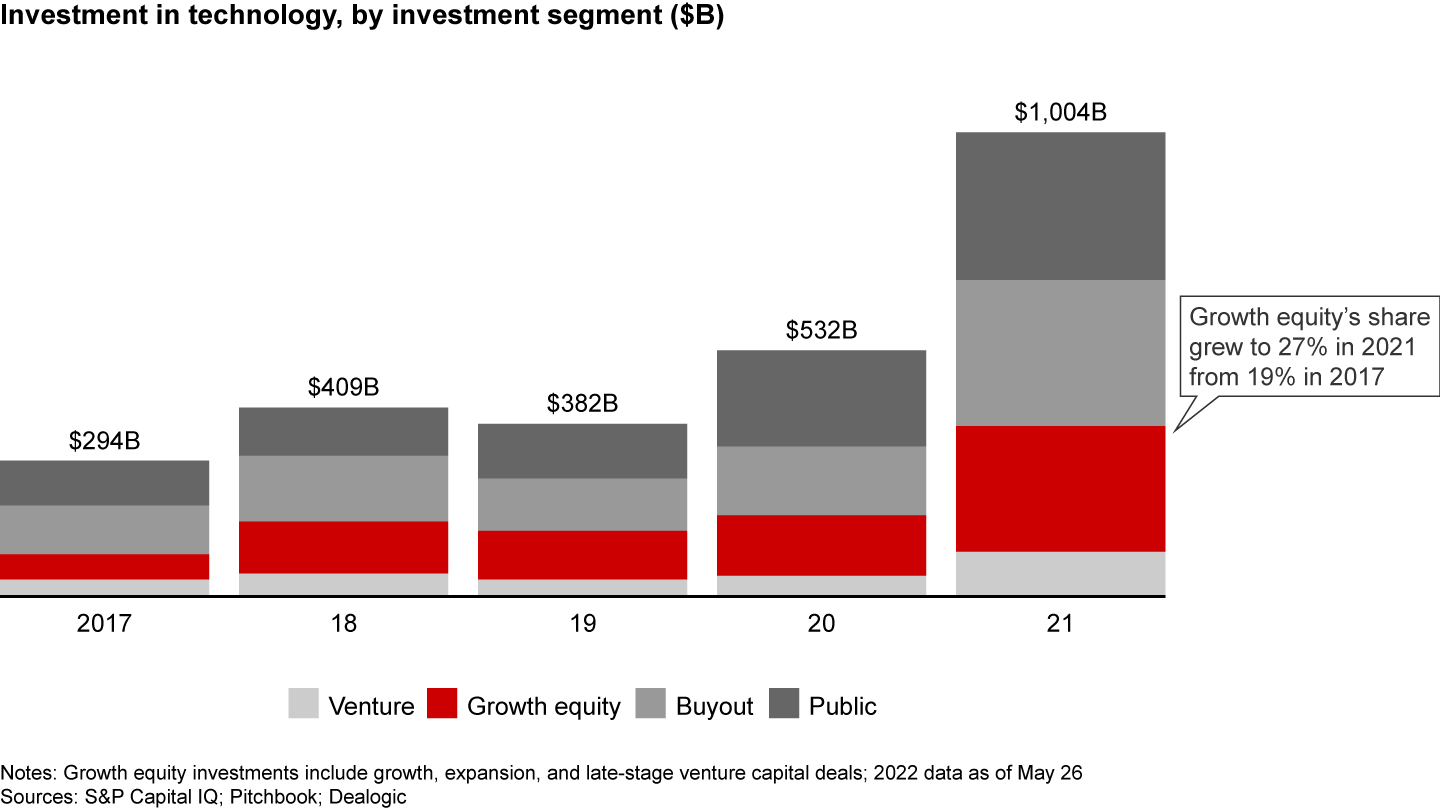
      In technology, growth equity has increased faster than all other investment segments

      Thanks to this new model, in recent years capital ceased to be a limiting factor for a private company’s quick scaling. Some 30% of companies that went public in 2020 had raised more than $100 million before their IPO, compared with 7% in 2015. This made it possible for Space X (valued at approximately $125 billion) and Shein (at approximately $100 billion) to grow to huge valuations while still private and helped Uber’s IPO reach $70 billion-plus and Kuaishou Technology’s debut in the range of $150 billion to $160 billion. Once public, growth-backed software companies continued to perform. Among software companies, growth equity-backed tech companies account for only 8% of revenue, but 19% of growth, 14% of sales and marketing spending, and 13% of research and development spending.

      Growth equity’s first big test came in 2022. By May, as interest rates hit high-growth stocks and the IPO markets, the cumulative market capitalization of the fastest-growing software-as-a-service (SaaS) stocks had fallen almost 70%, according to Meritech. Tech IPO volume in the first half of 2022 fell 80% from the same period a year earlier. The number of late-stage financing rounds collapsed. High-profile investors began to speak of black swans and tough times ahead. Companies that once couldn’t hire fast enough started letting people go. Today, both Kuaishou and Uber trade well below their offering price.

      Was this the growth equity bubble bursting?

      That’s an understandable question given the 2022 crash in valuations for high-growth assets, but growth equity has fundamentally altered tech investing over the last decade, and there is a strong argument that the underlying changes that led to the creation of the asset class remain sound—as technical innovation will continue to create opportunities for fast-scaling companies.

      Technological innovation 

      Innovative technology will continue to help build and scale disruptive businesses. Cloud computing puts highly scalable data centers and advanced capabilities at the fingertips of fledgling companies. Cloud-native companies like Snowflake, Databricks, and GitLab catapulted to success with tools for cloud data analytics, artificial intelligence, and DevOps. Their technology’s modularity, the way applications communicate via API-based architectures, has built an ecosystem of complementary solutions that collectively compete against the monoliths. And the next generation is waiting in the wings—nascent technologies like the Internet of Things, quantum computing, artificial intelligence, virtual reality, autonomy, new space, and web3. Not all will succeed, but the ones that do will become the next generation of growth equity-backed leaders.

      Business model innovation

      Business model innovation has changed how technology is bought and sold. SaaS customers no longer have to install and operate technology purchases themselves. Thanks to open-source, freemium, and product-led growth models, today’s frontline users can both try and buy technology. Other business model innovations have lowered the barriers to entry in industries previously considered immune to tech disruption, including financial services, healthcare, and even space, in the process creating a well-understood playbook and an ecosystem of executives and investors experienced in running and investing based on it.

      This flywheel of disruption is accelerating as innovations combine to create more innovation, a concept called recombinatory innovation. Think of how GPS, cell phones, and digital maps together created real-time navigation. Even in a world where geopolitical tensions increasingly affect the technology industry, innovation today remains a global market, nurturing a rich worldwide competition of ideas.

      Steps to take now

      While the new model of innovation has already spread strong roots, the market shock of 2022 will have ramifications. Once-rising stars will have to focus sooner on unit economics and a path to profitability. Fallen angels that haven’t lived up to expectations would benefit from thinking like a private equity investor: What costs, products, or customer segments would they cut? What assets would they sell in order to concentrate on the core?

      Incumbent tech leaders have a unique opportunity to fundamentally rethink corporate innovation patterns, and, after doing their homework, aggressively pursue mergers and acquisitions (M&A), partnerships with innovators, and talent acquisition. Three steps are paramount.

      1. Develop the skills to sense disruption. No industry or company is safe from disruption. Invest in customer relationships and deeply understand their needs. Ensure your customer and competitive intelligence is up to the task of monitoring the landscape and informing your strategy. Assess where you can partner and integrate with the next generation of companies, including the use of corporate venture capital as a means to better understand, partner with, and cultivate the ecosystem.
      2. Commit to major investments. Most companies will need to become tech-native. That may require new organizational structures, talent, culture, and budgeting. Rationalize your innovation bets by focusing resources where you can win and cutting subscale, half-hearted efforts. Reevaluate your M&A strategy for an environment in which buying the winners will remain difficult due to growth equity-backed valuations and founders who see selling to a big corporation as less attractive.
      3. Get good at scaling. An incumbent may never be as innovative as a founder able to raise $100 million, but it does have valuable assets a disrupter may lack: business ecosystems, customers, and often a strong core business. Established companies that figure out how to unlock untapped potential in those assets and scale them can borrow a page from the unicorns and set themselves on a whole new growth trajectory. 

      Savvy incumbents can compete with growth equity-backed success stories. Google Cloud’s sustained investment and innovation in analytics has enabled BigQuery to go toe-to-toe with Snowflake, for example. And Dynatrace incubated Ruxit, a cloud-native observability tool under the Compuware banner that is now its core product, helping it compete with growth equity-backed Datadog.

      Whether as direct competitors, complementary partners, or acquirers, companies are smart to operate on the principle that growth equity-backed business innovation is here to stay.

      Read the Next Chapter

      How to Compete and Win in the Multicloud World

      Value Evolution

      • The Rise of Growth Equity Investors

      • A Multicloud World

      • Welcome to Web3

      • The US-China Decoupling

      Competitive Battlegrounds

      • Defending against Disruption

      • The Engine 2 Imperative

      • AI’s Next Frontier

      • The Industrial IoT

      Operational Advantage

      • Beyond the Rule of 40

      • Sales Productivity

      • Consumption-Based Pricing

      • Software R&D Efficiencies

      • The Chip Shortage

      • The Circular Economy

      Read our 2022 Technology Report

      Explore the report Download PDF
      Autoren
      • Headshot of Christian Buecker
        Christian Buecker
        Partner, San Francisco
      • Headshot of Greg Fiore
        Greg Fiore
        Partner, San Francisco
      • Headshot of Dunigan O'Keeffe
        Dunigan O'Keeffe
        Partner, San Francisco
      • Sean Tanaka
        Alumni, San Francisco
      Kontaktieren Sie uns
      Verwandte Branchen
      • Cloud Computing
      • Internet of Things
      • IT Services
      • Semiconductors
      • Software
      • Technologie
      Technology Report
      To Scale the Industrial Internet of Things, Don’t Forget Hardware

      Just like software companies, OEMs and hardware makers are critical to getting the industrial IoT to the next level.

      Mehr erfahren
      Technology Report
      Will Agentic AI Disrupt SaaS?

      Disruption is mandatory. Obsolescence is optional.

      Mehr erfahren
      CIO Insights
      Despite Tech Layoffs, Competition for Talent Remains Fierce

      Tech workers increasingly value career development opportunities and remote or hybrid work options, while compensation has soared.

      Mehr erfahren
      Technology Report
      State of the Art of Agentic AI Transformation

      Tech-forward enterprises have cracked the code on ROI for AI. Falling behind is riskier than ever as the next wave of agentic AI raises the stakes.

      Mehr erfahren
      Technologie
      Using Hardware to Scale the Industrial Internet of Things

      Bain partners discuss the opportunity for hardware vendors to help companies develop their IoT pilots.

      Mehr erfahren
      First published in September 2022
      Markierungen
      • CIO Insights
      • Cloud Computing
      • Internet of Things
      • IT Services
      • Semiconductors
      • Software
      • Technologie
      • Technology Report

      Wie wir unsere Kunden unterstützt haben

      Nachhaltigkeit Can Microchips Turbocharge Sustainability Improvement?

      Kundenbeispiel lesen

      Change & Implementation A Go-to-Market Redesign Helps a Tech Company Thrive

      Kundenbeispiel lesen

      Helping a Midsize ERP Player Compete against the Giants

      Kundenbeispiel lesen

      Möchten Sie mit uns in Kontakt bleiben?

      Wir unterstützen Führungskräfte weltweit, die kritischen Themen in ihrem Unternehmen zu adressieren. Gemeinsam schaffen wir nachhaltige Veränderungen und Ergebnisse.

      Bain Insights. Unsere Perspektive auf die kritischen Themen, mit denen sich international agierende Unternehmen konfrontiert sehen, finden Sie monatlich in Ihrem Postfach.

      *Ich habe die Datenschutzerklärung gelesen und akzeptiere sie.
      Bitte lesen Sie die Datenschutzerklärung und akzeptieren Sie diese.
      Bain & Company
      Contact us Sustainability Accessibility Rechtliche Hinweise Impressum Datenschutz Cookie-Richtlinie Sitemap Log In

      © 1996-2026 Bain & Company, Inc.

      Kontaktieren Sie Bain

      Wie können wir Ihnen helfen?

      • Business inquiry
      • Career information
      • Press relations
      • Partnership request
      • Speaker request
      Alle weltweiten Büros