

Brief

Auf einen Blick
- Operational excellence management systems are an effective way to share best practices, ensure compliance and instill a culture of continuous improvement throughout an organization. Digitalizing these systems makes them more valuable and responsive to the needs of managers and frontline workers.
- Mobile and tablet apps connect frontline workers with the entire management system and can ensure work gets done in accordance with company standards, through a series of checklists and screens. The apps help unlock the full potential of the organization and facilitate instant feedback and sharing of best practices.
- Effective digitalization of management systems provides a seamless way to transform the organization with technology and process upgrades that are clearly tied to the company’s strategic goals.
Consider the maintenance superintendent at an oil refinery, preparing to give a toolbox talk—the informal safety meeting that usually takes place at the beginning of a shift or specific task. This superintendent is a conscientious leader, having worked in the industry for nearly two decades, and strongly motivated to ensure the safety of his crew. In preparing his talk, he consults the company’s operational excellence management system (OEMS) for specific details on the safe execution of the task at hand. But he finds the documentation hasn’t been updated since 2014. The relevant section contains nothing about protocols for drones or robotics, even though he knows they have been used on this type of job for more than a year, and will be used again today. He wastes a good deal of time scanning through text in binders and on the company intranet, but in the end, he cannot find exactly what he is looking for. At the toolbox talk, his crew listens attentively, but they can see he is piecing together requirements from a range of similar tasks. After the meeting, he gets a call from his manager, who asks him to confirm that his team is 100% compliant with the management system. In truth, he’s not certain.
This is just one of several ways that oil and gas companies still wrestle with their management systems. Over the past two decades, these systems have proven the most promising approach for achieving operational excellence and instilling a culture of continuous improvement in oil and gas companies. Management systems set global expectations for operations, defining common protocols and terminology—shared concepts that unify the organization and allow everyone to communicate clearly about tasks and objectives. By standardizing expectations for operational, commercial and back-office workers, they make it possible to measure and compare performance. Effective management systems also ensure compliance and map accountabilities from the top of the organization to the front line.
Just as important, they help companies share successful practices, promoting continuous improvement. An OEMS collects input from frontline workers, task forces and management teams, allowing executives to integrate valuable insights into operations. In this way, management systems provide the organization with a tool for change, a rudder for the ship.
The opportunity is large—but so is the gap between aspirations and reality. Simply putting a management system in place does not differentiate a company; senior executives want to understand how it will improve business performance. Breakthrough performance depends on how well the organization embeds the system into its operations, from the executive team to the front line and back office, and how employees act on it, day after day. It needs to be accessible and relevant, spurring everyone in the company to adopt a mindset of continuous improvement in pursuit of the ambitions detailed in the system.
And it’s here that digital technologies are beginning to have a significant impact on management systems. Simple digital tools, such as a mobile app that tracks and helps enforce compliance, are showing promise as a way to ensure that management systems remain vital and dynamic. Many oil and gas environments need to restrict the use of handheld devices for safety reasons, although improvements in technology and risk evaluation are expanding their potential use. Where devices are allowed, they can encourage frontline workers to refer to the app and underlying information. Low-power and voice-activated systems will help enable real-time solutions.

The Digital Edge in Oil & Gas Management Systems
How mobile apps can connect frontline workers and managers to transform an organization.
Of course, these apps are merely one part of a larger ecosystem of data informing the broader facility operations. Data collected by these devices, as well as from thousands of other sensors and systems, is aggregated into dashboard views that help managers make decisions about operations, often in near-real time. At a broader level, the aggregated data informs strategic decisions about operations and contributes to a culture of continuous improvement.
For a digital OEMS to add real value, however, organizations must consider the challenges of implementation, which go far beyond the technology itself. Most energy companies already have in place the critical IT systems that newer digital technologies can interface with and enhance. In most cases, their IT functions demonstrate the information management discipline necessary to ensure solid governance, as well as standard processes for developing and maintaining technology infrastructure. The most advanced already have well and reservoir facility management solutions that enable remote operations with real-time production information.
Most companies are now extending these capabilities and systems to support operational excellence management systems (see Figure 1). Building digital assets through detailed design and construction processes, and maintaining them through operations, requires clear standards and sustained focus. Integrating new digital technologies into daily operations, drawing meaningful insights and tapping those insights to continuously improve operations will require a significant ongoing transformation. But if the cost is significant, the rewards are even greater: Imagine if that maintenance superintendent could quickly pull up the relevant data on a handheld device, demonstrate proper procedure showing an instructional video on a tablet, and send feedback instantly based on his crew’s experience.
Figure 1
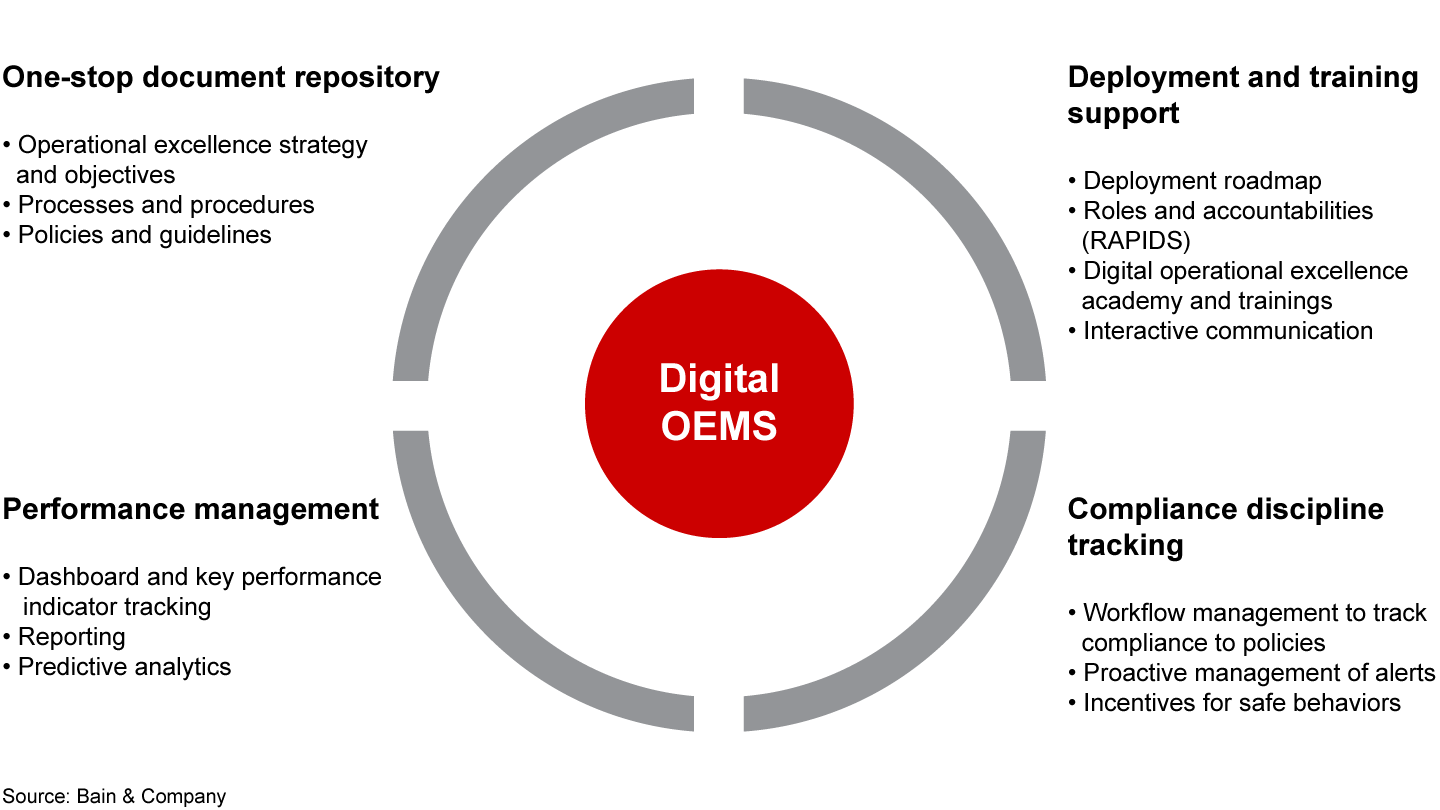

This brief outlines several of the most promising applications of digital technology to management systems and describes essential characteristics of successful digital transformations.
Digital technology in an operational context
Before embarking on a digital transformation of the management system, executives should have a clear view of how they will use technology to differentiate themselves and gain competitive advantage. Two use cases for digital in oil and gas can help start the thinking: mobile apps and aggregated data that delivers insights.
Mobile apps. Mobile apps are the front line of digitalization, the interface where many workers will interact directly with management systems. Apps make the contents of the management system more accessible, putting customized content at the fingertips of every employee with a phone or tablet.
But apps do much more: They change the way that employees interact with the management system. What was once a static document can now capture data, help ensure compliance and speed up the distribution of best practices across the entire organization.
Effective apps share some common traits:
- Personalized. Interfaces should be oriented around the needs of the employee using them. While the core elements of the management system remain consistent throughout the organization, individual employees can interact with them in a channel most relevant to their role, their location and the tasks they are performing.
- Streamlined. Contextualizing an app is challenging, but it can allow for more efficient navigation to the right information at the right time. Pathways should be easy and intuitive for employees to follow, bypassing less relevant information and focusing attention where it matters.
- Crowdsourced. Apps are a highly efficient way to gather feedback and input to improve the management system itself. And, of course, they can be a powerful tool for sharing best practices, sourced directly from users and enabling ongoing discussions in the interest of continuous improvement. Users can directly contact the owners of particular tasks or parts of the system.
- Integrated with data. Mobile devices become like sensors, acquiring information about which tasks are performed when and by whom, how long they take, what issues arise and how they are resolved, and where employees run into obstacles. This information allows managers to work proactively to resolve problems. Aggregating this data across a unit or the entire organization can deliver insights that may help improve operational efficiency, reveal the most promising or troublesome assets, or alter business models.
The prototype for one mobile app allows frontline personnel to see current jobs and confirm that each requirement has been addressed (see video below). At the tap of a button, the app provides supporting information and best practices from other practitioners on jobs and requirements, and it encourages employees to share their best practices or other comments, including photos and videos. The system ensures compliance and allows workers to enter explanations for any incomplete requirements.
Video: A Mobile App for Oil & Gas Management Systems
The prototype for the mobile app in the video above allows frontline personnel to see current jobs and confirm that each requirement has been addressed. At the tap of a button, the app provides supporting information and best practices from other practitioners on jobs and requirements.
Insights from aggregated data. Analytics are nothing new in oil and gas, of course: Reservoir modeling uses massive amounts of data, and refineries have used dynamic process modeling to increase uptime since the 1980s. The current wave of digitalization goes further with technological and process innovations that increase yields and improve operational performance. Data from systems, sensors and mobile apps can be aggregated and analyzed to deliver insights that improve operations, sometimes in near-real time. Over longer periods, these insights help drive innovation and aid in continuous experimentation and improvement that can transform industries.
Asset health is one application where adding more data to the equation and using more sophisticated analysis algorithms can improve accuracy and avoid unplanned stoppages or unnecessary replacement costs. One integrated energy company used Big Data tools to produce new insights in its downstream business, helping it reduce maintenance costs for key equipment by 20%–40% while simultaneously improving uptime. Advanced analytic techniques and new data tools improved performance and allowed it to zero in on the biggest opportunities for creating value—and on the equipment most vulnerable to failure. Dashboards allowed for deep dives into the data, revealing levels of detail ranging from overall plant performance to specific pieces of equipment. Detailed analysis helped the company create a more comprehensive picture of the equipment priorities for each unit.
Keys to a successful digital transformation
Digitalizing a management system requires a significant transformation in a company’s approach to work. Changing processes and behaviors is never easy, but three important principles can set the right context for the necessary transformation.
It’s not a digital transformation, it’s a business transformation. Across industries, traditional business models are being disrupted at an increasing rate, creating opportunities for nimble incumbents and new competitors. For oil and gas companies, the challenge is how to improve operations with new digital technologies while maintaining a focus on the core business. In an industry with a long history of how things are done—and many employees and contractors who have been working in similar ways for decades—companies can sometimes lose sight of the need to reinvent processes. The bar keeps rising for what great looks like: faster time to market, low-cost operations and new economic models. But adding new elements to a process can create complexity.
Successful reinventions use evolving technologies to go beyond incremental steps and leap forward. Applying digital technology in ways that deliver real value and address fundamental operational needs is more effective than investing in technology for its own sake. Introducing new digital technologies should help oil and gas companies simplify processes rather than add complexity.
Technology and data are critical, but not the hardest part. Enabling capabilities were once back-office considerations, but they have become strategic elements of differentiation for oil and gas companies, essential to gaining competitive advantage. This shift requires new modes of thinking: Changes to the operating model and culture are the hardest parts of a digital transformation. For example, getting teams to embed analytics into their decision making—the demand side of data—is often as difficult as building the data assets and systems to supply that data. To support all this activity, IT departments spend most of their time managing legacy systems while also investing in future technology.
Senior executives should form systematic plans to adapt ways of working, acquire new capabilities, enhance skills and change company culture. Success will also depend on tapping talent outside of the organization, including partnerships with specialist firms. Orchestrating a well-managed transition will require a new digital operating model, one that ties investments in new technologies and data to operational excellence and significant returns.
Experimentation is easy, transformation is not. Many companies in energy and other industries have difficulty scaling successful digital experiments. Contained initiatives with dedicated funding, top talent and strong leadership support can help pilot projects succeed. But across the broader organization, limited cross-functional coordination and skepticism at the front line can hinder success. Some critical initiatives struggle to navigate the gauntlet of traditional funding processes.
To improve the odds of success, executive teams should develop “scaling” as a new muscle. After clearly defining units of transformation—that is, the focus areas for tests and pilots—teams should roll through pilots methodically, extending scope and scale in parallel. Internal investment models can emulate the venture capital model to reward funding to worthy projects. Leaders will want to role-model new ways of working and tap the energy of the organization. This means prioritizing momentum and new value more than sticking to plan: Roadmaps offer direction, but course correction is a must.
It’s important to remember that within every company there are dreamers and doers. Doers focus on initiatives that will yield value in the next year or two, while dreamers imagine what the industry might look like a decade from now. Dreamers are intrigued by the realm of the possible, and less concerned with linking directly to immediate value. Both perspectives are important and need to be balanced. While it’s impossible to predict the future with complete certainty, most companies can see the general direction that their industry is heading. Enlisting the perspectives of doers and dreamers can help companies capture near-term opportunities while investing in the future.
Finally, as with any well-functioning management system, a digital OEMS requires clear sponsorship from the top. Bottom-up efforts often struggle to gain wide acceptance across the organization. To garner the best chances of success, sustained support from senior executives is critical, especially at the launch and in the early stages of developing a management system.
Joachim Breidenthal is a partner with Bain & Company in Johannesburg, and Francesco Cigala is a Bain partner in Kuala Lumpur. John McCreery is a partner in Houston. All three work with Bain’s Global Oil & Gas practice.
First published in August 2018